WGN-TV Morning Sports Anchor Pat Tomasulo has a lot of pet peeves. This one is dudes who run with their shirts off. As always, it's funny. And true. And sad. So very, very sad. This week's Pat-Down...
I couldn't find a Jack Beers in the census on the LES that matched his age. But I found a Samuel Beers who might be him living at 170 East 7th Street
Could Jack (Samuel) be related to a Bueller family of Knickerbocker whose mother's family was named Beer. Both the Beer and Beers hailed from Galicia, Austria. Hmmmmm. A link to the Beer historical comics post from last May
As a kid growing up on the Lower East Side, Jack Beers became known on vaudeville as "New York City's Strongest Boy." Later, he worked as a dog trainer and had small roles in Tootsie and Ghost Busters. In this clip from the documentary on his life airing tonight on PBS, a 94-year-old Beers navigates GPS, takes a shower, and rips a phone book into thirds with his bare hands. "We did it in one take," director David Wachs says.
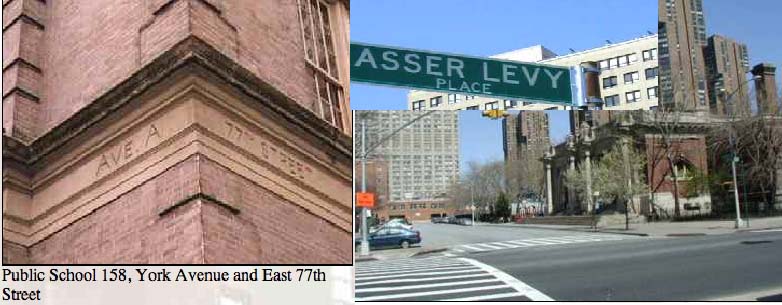
from 12/25/05 post on pseudo-intellectualism In the picture above we see remnants of an Avenue A on the side of PS158 on York Avenue, between 77th and 78th Street (BTW, PS158 has an extremely attractive assistant principal). From the wonderful forgotten-ny site: "One block east of 1st Avenue is a north-south thoroughfare that goes by different names depending on what part of town you are in. Between East Houston and 14th Street, it's called Avenue A, but further uptown it's York Avenue and other names. As originally laid out on the Randall plan of 1811, it was Avenue A all the way uptown. Obviously, though, things have changed. A stretch of Avenue A, between East 23rd and East 25th Street, was cut off from the rest when Stuyvesant Town and Cooper Village were constructed in 1947. It was renamed Asser Levy Place, for one of NYC's first Jewish settlers. Governor Peter Stuyvesant tried to bar him from the city militia, but Dutch West India Company directors in Amsterdam upheld Levy. The city renamed Avenue A for him in 1954. Between about East 26th Street and East 53rd Street the Manhattan riverside bends inward and there is no room for Avenue A, but it once again appeared at East 53rd and runs north to another inward turn of the East River at East 92nd Street. It is known as Sutton Place, for dry goods merchant Effingham Sutton, north to East 59th Street. Avenue A kept its name from East 59th to East 92nd Streets, until 1928, when it was named for World War I hero Sergeant Alvin C. York, who refused to capitalize on his winning the Medal of Honor, saying "this uniform ain't for sale." He used profits from the 1941 biographical movie starring Gary Cooper to open a school for children of his native Tennessee. One more brief stretch of Avenue A remained to be renamed, east of Avenue A in East Harlem. It was renamed Pleasant Avenue in 1879." Here's another Avenue A slide show from Mrs. Santa Claus.
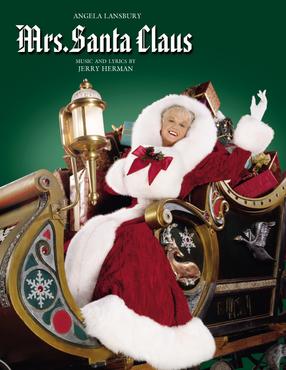
from 12/25/05 post on pseudo-intellectualism This 1996 made for TV Hallmark film is terrific. Great music and dance routines combined with Angela Lansbury and Lower East Side History. It just came out in DVD. I was showing it to Ms. Rabbe's 4th graders in anticipation of their spring 2006 study of immigration. The song, "Welcome To The World Of Avenue A" has you humming the tune for days. There's talk that a revival of it might come to Broadway in the future (Oh Oh, I'm sounding pretty gay, aren't I?-not that there's anything wrong with that) Here's part of the synopsis of the film: "If ever a movie had Christmas written all over it, it is Mrs. Santa Claus. After a long dry spell for musical fans, Hallmark debuted a truly old-fashioned confection complete with hum able songs by Jerry Herman, sparkling choreography by Rob Marshall, stylish costumes by Bob Mackie and sprightly performances by a cast of talented newcomers as well as movie veterans. The film is filled with snow-covered streets, evergreen-draped mantels and enough Christmas spirit to choke Scrooge. Even the names during the opening title sequence have sprigs of holly underneath. Angela Lansbury stars as the title character, a feisty Mrs. Claus who's a little down in the dumps because Santa (Charles Durning) is so preoccupied with the fast approaching Christmas Eve. She wants to help read the mail, but Santa refuses saying it is addressed to him. She lovingly wraps a scarf around his neck and says, "Well, if you don't need me..." Since Santa barely hears her when she tells him she has worked out a faster route, she decides to try it herself. Mrs. Claus has head elf Arvo (Michael Jeter) hitch up the reindeer and with eager anticipation takes off. Unfortunately bad weather grounds them in 1910 New York and Cupid hurts his leg on the landing. She finds a stable and with the help of Marcello (David Norona) boards the deer so Cupid can rest. Like Dorothy opening the door of her house into the colorful land of Oz, Marcello throws open the large stable doors and allows Mrs. Claus (or Mrs. North as she introduces herself) to enter the bustling world of Avenue A." Here's the entire article and here's a slide show I made with part of the Avenue song combined with selected clips from the movie.
Welcome to the world of Avenue A Where you hear Como Esta, and Bless My Soul and Oy Vey Rosie Finkelstein and Michael Monaghan are still going steady Mrs. Brandenheim is yelling out there window, “Breakfast is ready.” And that’s the way it goes on Avenue A Where Father Callahan bids Rabbi Hershey, “Good Day.” People caring their Lasagna and Chow Mein all share the same tray Part of the great big bouillabaisse called Avenue A Welcome to the world of Avenue A Where there’s a family drama playing day after day There’s a second hand emporium on every corner that I’d walk Ringelevio and little girls with jacks all share the same sidewalk That’s the way it goes on Avenue A Look there’s a pushcart full of bagels coming your way There’s a rag man with a saxophone There’s not a tune he can’t play Part of the great kaleidoscope of Avenue A That’s the way it goes on Avenue Where’s there’s a new adventure awaiting day after day There’s a rag man with a saxophone There’s not a tune he can’t play Part of the great kaleidoscope called Avenue A Angela reprise: I’ve landed in the world of Avenue A Where you hear Como Esta, and Bless My Soul and Oy Vey So a lady from a cold and distance place A lifetime away Still can become a part of the world of Avenue A
Lung Block 1903 This is interesting as the proposed Hamilton Park was to be the site of Knickerbocker Village. Was Father Curry anticipating that those displaced from the demolition would never find replacement housing or were there other considerations? Did he fear losing his flock? Shades of what happened when Knickerbocker and the Smith Houses were built. Certainly he might have a point that crime and illness were not the sole domain of Cherry Hill and certainly he may have whiffed at the anticipated profits made by Fred French type developers and bankers.
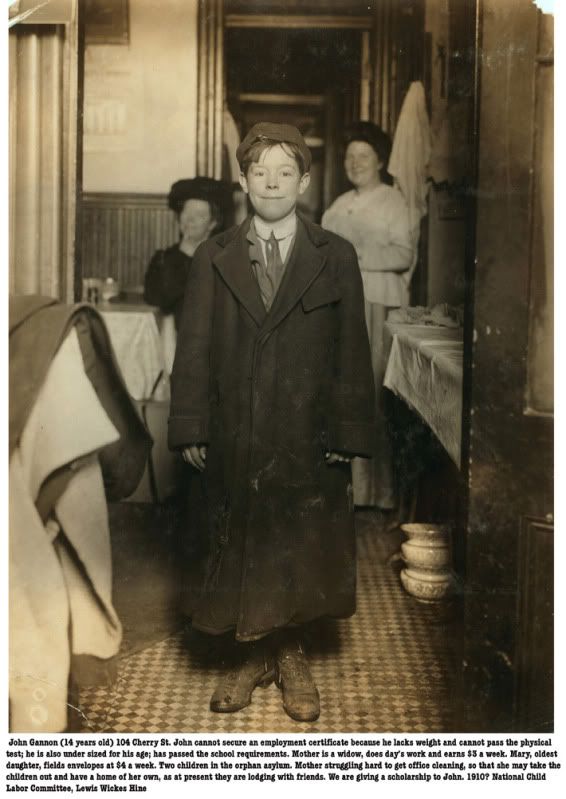
Click on the image above to get a clearer view of text that accompanies the photo. I'm not sure if John was a newsboy or just one of the subjects of the Hine's series on working children at the turn of the last century. Living at 104 Cherry Street puts him just about on the KV "lung block" and near another subject of a 1913 Lewis Wickes Hine's photo, Jimmy Chinquanana I'm not sure what was meant (from photo text) that a scholarship was recommended for John. For an orphan asylum?
bernstein I got a KV blog Hanukkah present in an email from Paula Sanders
Last night I was reading a book called The Golden Willow. It's story of a lifetime of love, by a man named Harry Bernstein. He is 99 yeas old and this is his third published book. I had loved his first book, The Invisible Wall, about his childhood in England before WW1. This book is about his life with his wife, who died in 2001. They were married 67 years. Chapter 5 includes those years when they lived in Knickerbocker Village starting in 1939. Wouldn't it be interesting to speak to him.? He lives in Brick NJ.
I found Harry's phone number and left a message. I hope to get to talk to him
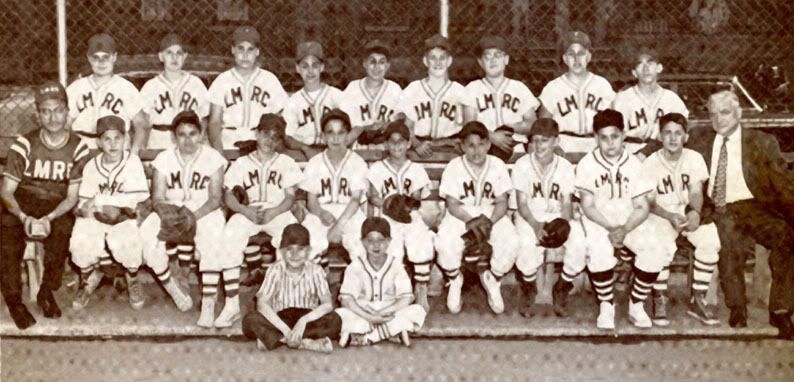
Episcopal Church of Our Savior - History Trinity Church decided to close St. Christopher's Chapel. ... missionaries and Episcopal religious to spearhead a new Chinatown Mission at 48 Henry Street. ... Rev. Dr. William Andrew Wendt Memories As remembered by Nydia Bellido, April 2007 Fr. Wendt was the Pastor of St. Christopher's Parish on Henry Street on the Lower East Side of Manhattan in the 1950s. How loved he was by the entire congregation for his humanity and his great sense of humour. He worked soooo hard to keep the boys off the street and out of gangs. He started a baseball team, made personal home visits and was practically a father to my brother Hector. I'll always remember the sadness when he left for a church in Washington D.C. I think he was my first childhood crush. He became so well known that the television program The Christophers did a program on his work at St. Christopher's. May he rest in peace and receive the heavenly reward he so richly deserves. God Bless You Father Wendt. In my heart, You were my first father. Love, Nydia Bellido As remembered by Brenda Kincaid Beatty, May 2002 I was privileged to work with Fr. Wendt the summer of 1963 at St Stephens and the Incarnation Episcopal Church.That was the summer of the March on Washington. I was a small part of an international summer service program. Fr. Wendt was a great man . He changed my life. I wish I had told him so. Brenda Kincaid Beatty, Winamte Volunteer 1964 As remembered by Tori Snell, June 2001 You may wish to know that one of your great Freedom Riders died two days ago. Rev. Dr. William Andrew Wendt, 81, died in after a brief battle with cancer and his exit was the stuff of legend and the sort of thing one might expect from such a larger than life figure. Bill died in the church where he started his ministry many decades ago. He was there for the late morning service; gave a healing (remarkable in itself); settled back with his granddaughter at his side and as he listened to a reading of Psalm 30 he drew his last breath. He was wheeled out as the congregation sang 'Now the Strife is O'er'.
The None But The Brave comic reminded me of this article I saved from long ago and I don't remember where it's from Tar Aw A My mother's best friend was Florence Crames. She was always Aunt Florence to me. Her uncle Charles Crames was a WW1 soldier for whom a square is named for in the Bronx. The bare-chested soldier on the last page I always thought could be her brother Charles who was named for her uncle. He saw plenty of action in the Pacific and I was always fascinated by the riveting stories Florence told of his experiences. One story was how her mother woke up from a nightmare with a wide gray streak in her hair. It was after she had a dream of an intense battle Charles was in. Sure enough on that very night he was in such a battle.
None but Brave He would have been 94 on December 12th. My cousin Melissa's birthday was on the 13th along with nice guy actor and Brooklyn's own Steve Buscemi. Patsy's had a Sinatra celebration.
Foodies and die-hard New Yorkers love to get into verbal scuffles over which of the city’s old-school Italian restaurants came first, stay faithful to the cuisine, are truly authentic, and so on. But one point is not in dispute: Patsy’s on 56th, the family-owned and -operated Italian restaurant open since it was founded in 1944 by Pasquale “Patsy” Scognamillo, was a favorite late-night drop-in of one of New York’s most beloved sons, Frank Sinatra (the man had to eat -- even if, as alleged by Kitty Kelley's very unauthorized biography, it involved scrambled eggs served on a call girl's chest). And this weekend, Chef Sal Scognamillo and crew will be serving their annual Sinatra tribute menu, in honor of the late great’s birthday; he would have been 94 on December 12. On Friday and Saturday at Patsy’s, diners can order Frank’s favorite dishes: Frank’s Clams Posillipo – involving littlenecks with garlic, tomatoes, basil, and more garlic -- Frank’s Veal Milanese, Frank’s Fusilli with Fileto di Pomodoro, and favorite desserts including a ricotta torte. $75 plus tax and tip gets you the above, a glass of wine, and the feeling of being connected – across time and tomato sauce – to one of the greatest entertainers New York’s ever birthed. Even if he was actually from New Jersey (potato, potahto). For reservations, call the restaurant at 212-247-3491.
Joe Bruno with some Frank Sinatra memories:
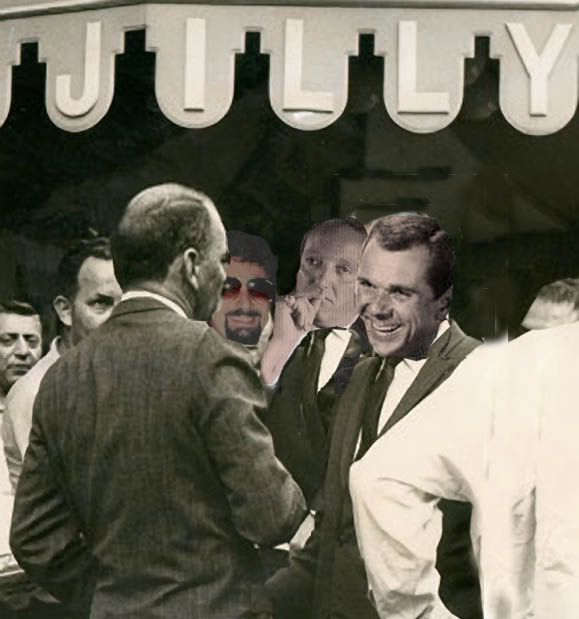
I owned a car service/limousine business in the late 1970's, that I ran from my lot (Bruno's Parking Lot). But I also got a lot of work from the DAC (Downtown Athletic Club). One time I got Jackie Cooper for a few weeks. He was one of the original Young Rascals in the 1930's movies. Had a TV program in the 50's called The People Choice, with the talking basset hound. Around 1978, Cooper (Real name was Italian) was directing a TV movie in NY city. He was staying the DAC, which had 15 floors of hotel rooms. I was a member there. Rudy Riska got me in. You had to be recommended by 2 members, and Rudy supplied them for me. I think Cooper liked me because I was Italian. He knew I was writing part time at the time, and that I came from Little Italy. I'd pick him up every night around 5pm, then take him to different restaurants around town. This went on for a few weeks. Wherever he went, he sent food out to me in the limo where I was waiting for him. One night I took him to PJ Clarke's, on 3rd Ave and 55 St. There was a side entrance on 55th Street, which led right to the dinning room area. The front entrance led to the bar. I parked on 55th street, and sat, waiting. A few minutes later, the waiter came out and told me Mr. Cooper wanted to see me inside. I said I could not leave my limo unattended. The waiter said he'd take care of it, and asked for my key's. There was a lot close by, and me parked my limo there. I go inside and Cooper is sitting at a table, with Frank Sinatra and Jilly Rizzo. I knew Jilly from his bar Jilly's on 50th Street and 8th Avenue. Just to say hello and goodbye. I went to Jilly's all the time. A older woman from the neighborhood tended bar there. I forget her name. But she was beautiful. She was one of my car service customers too. Copper told me to sit down and introduced me to Sinatra. The waiter handed me a menu and I ate and drank soda. Sinatra said he heard I was from Little Italy and did I know the Lime House, on the corner northeast of Mott and Bayard. Two entrances. The main on Bayard, and the other on Mott. It was like Vincents. Only shell fish, with a full bar. I said I went there all the time. In fact, 10 years earlier I was engaged to a girl whose father Bobby was the bartender there. Sinatra said he knew Bobby. Sinatra said used to go there late at night with Jilly. Near closing time. Jilly called in advance, and the place was always empty by the time he got there. Then they'd lock the doors and he's stay there until the wee hours of the morning, like his song. I was there maybe 45 minutes and talked only when spoken too, which is real hard for me. I just listened to what they had to say. When we were ready to leave, I shook hands with Sinatra and Jilly. The waiter got my limo, and I drove Cooper back to the DAC. The Lime House closed down in the 80's. It's now a Chinese something-or-another. Like everything else in Little Italy.
Hi David, That was so SWEET!! My whole family was so excited to see your post. My dad was loving the picture. He has some old pictures I would love to send you. Just let me know. Again thank you that was a nice memory. Best Lisa
A comment left on the previous Savoia post:
Ken said... In the late 1960s, I went to P.S. 1, across the street from Savoia. In the early 1970s, I went to J.H.S. 65 Annex, just two blocks further away. The neighborhood was already very Chinese, and so the bakery had many Chinese customers, of whom I was one who occasionally ventured in for sweet pastries and birthday cakes. I can still imagine biting into a Savoia cream puff, my favorite! Lisa, it is possible I ran into you a few times in the store at the time but never talked to you, but I am glad to hear that you stayed in the business and opened up your own cake shop as an adult! And thanks to Sol for this website for evoking the nostalgia of growing up in and around Knickerbocker Village!
from Paul Kefer
Savoia's was the ultimate family bakery. All of their cakes and pastries were delicious; especially their whipped cream cakes, which were a staple in my house. Let's not forget the jelly doughnuts! I still haven't found a better one yet. The Italian ices (homemade, I think) were a treat in the summertime.
from Son of Seth, in one of his free-form remembrances
By the way, Howie, thank for that maple walnut. It was delaycious. Still miles ahead of Junior's and any other similar establishment. Savoia oh boya. You know what I'm saying here. We would load up on candy by the quarter pound from that obscure bakery that was just around the corner on Madison Street, quarter block from Catherine - around the corner from the Brokowsky's fruit store, Gogol's and the pharmacy on the corner. Next to the newstand. Remember? By the bus stop. See what I'm saying? (In your mind, can you see it?) Bakery had golden and tan tile design but couldn't hold a candle to Savoia. No marble floors either. Excellent. Savoia's is fine with me. Maple walnut cake? Or maybe I'll go with the strawberry short cake. Or if the season is right the peach short cake. Whatever. Ices in every flavor? Can't go wrong with their ices. All rightee then.
If memory serve's me correctly Shawn is, or was, a Grand Street resident and the sister of former PS 177er Elaine Katz. from ny1.com
The latest New Yorker of the Week is making a big splash with more than 400 kids and 47 volunteers. NY1's Rebecca Spitz filed the following report. When Shawn Slevin says when she was five years old, she almost drowned. After being afraid of the water for four years, she was finally able to get back in the pool. "There was a swimming program that started in my local community and my parents coaxed me back into the water, and I was competing within the first year," says Slevin. After Slevin stopped competing when she was in college, she became a swim coach for teams around the city. Three years ago, she decided to start her own not-for-profit swim team called The Swim Strong Foundation. "I really wanted an opportunity to bring the principles that I learned and developed over the years out to a broader community," says Slevin. She instructs more than 400 students of all skill levels, and the older kids mentor the younger ones. "I really like the way she uses the older students to help the younger students, because she really does that right from the very beginning," says parent Ellen Fee. "Since she helped me a lot in swimming, I wanted to pay back the favor, and I love teaching," says Abby Nicolas, a former student and volunteer. The program is run entirely by volunteers at two pools in Queens and one in Brooklyn. Twenty-seven students have full scholarships, while the other swimmers pay between $9 and $15 for an hour-long lesson. The money is used to pay for the pool time. "We want it to be more accessible for our families who can’t afford that," says Slevin. Last month, Slevin started a swim program in Far Rockaway, Queens. She says it's especially needed in that community after several drownings occurred over the summer. "Drowning is the second-largest cause of death for kids, and African-American kids drown three times as more as any other demographic, and we really want to make a change to that," says Slevin. Slevin says she wants to help others avoid the experience she had as a child. "I would love this to be not only a national program but a global program, because drowning is an issue all over the world," she says. So, for giving kids an opportunity to dive into the water with confidence, Shawn Slevin is the latest New Yorker of the Week. For more information about the Swim Strong Foundation, call 1-646-269-7897 or visit www.theswimstrongfoundation.org.
Tonight Jewish kids will light the menorah, spin their dreidels and get their presents, but Hanukkah is the most adult of holidays. It commemorates an event in which the good guys did horrible things, the bad guys did good things and in which everybody is flummoxed by insoluble conflicts that remain with us today. It’s a holiday that accurately reflects how politics is, how history is, how life is. It begins with the spread of Greek culture. Alexander’s Empire, and the smaller empires that succeeded it, brought modernizing ideas and institutions to the Middle East. At its best, Hellenistic culture emphasized the power of reason and the importance of individual conscience. It brought theaters, gymnasiums and debating societies to the cities. It raised living standards, especially in places like Jerusalem. Many Jewish reformers embraced these improvements. The Greeks had one central idea: their aspirations to create an advanced universal culture. And the Jews had their own central idea: the idea of one true God. The reformers wanted to merge these two ideas.
As we celebrate the 400th anniversary of Henry Hudson’s voyage to America, historian Barry Lewis takes us back in time to rediscover the first European settlers in New York — the Dutch.
I never knew this song had lyrics ("The Toy Parade" by Dave Kahn, Melvyn Leonard and Mort Greene) - Leave it to Beaver Lyrics
Hey! Here they come with a rum-tee tum they're having a toy parade. A tin giraffe with a fife and drum is leading the kewpie parade. A gingham cat in a soldier's hat is waving a Chinese fan, A plastic clown in a wedding gown is dancing with Raggedy Ann. Fee fie fiddle dee dee they're crossing the living room floor Fee fie fiddle dee dee they're up to the dining room door. They call a halt for a choc'late malt or cookies and lemonade Then off they go with a ho ho ho right back to their toy brigade.
Bob Booker was a master of the seemingly lost art of the sketch comedy album; he was one of the writers behind the smash hit Kennedy parody disc The First Family, and several years later he teamed up with George Foster to create You Don't Have To Be Jewish, a collection of blackout bits and extended one-liners which poked fun at the absurdities of American Jewish culture. Like The First Family, You Don't Have To Be Jewish was recorded in a studio with a live audience in attendance, as a cast of actors performed scripted material much in the manner of a radio play. While You Don't Have To Be Jewish wasn't going to win any awards for originality even in 1965 ? many of these jokes were already antiques by that point ? and some of this material sounds a bit less than P.C. in the 21st Century (especially the persistent presence of the Nagging Jewish Mother), for the most part the album is funny stuff and far too good-hearted to offend anyone. Booker and Foster had the good judgment to assemble a superb cast for this recording, and they transform what could have been ordinary Catskill shtick into something memorable; the performers include Lou Jacobi, Jack Gilford, Betty Walker and Joe Silver, and their expert timing and feel for their characters is impeccable. You Don't Have To Be Jewish is a fine sampling of classic Borscht Belt humor (blended with a bit of like-minded new material) performed by a top-notch cast, and like the title says, you don't have to be of the Semitic faith to enjoy it ? though it couldn't hurt.
The two tracks here are:
Reading of the Will - Jack Gilford, Arlene Golonka, Lou Jacobi, Jackie Kannon, Betty Walker and Housewarming - Jack Gilford, Arlene Golonka, Betty Walker
I'm spending Hanukkah, in Santa Monica, Wearing sandals lighting candles by the sea. I spent Shavuos, in East St. Louis, A charming spot but clearly not the spot for me. Those eastern winters, I can't endure 'em, So every year I pack my gear And come out here to Purim. Rosh Hashona, I spend in Arizona, And Yom Kippa, way down in Mississippa. But in Decemba, there's just one place for me. 'Mid the California flora, I'll be lighting my menorah. Every California maid'll Find me playing with a dreidl. Santa Monica, spending Hanukkah by the sea
Back when the west was very young, There lived a man named Masterson. He wore a cane and derby hat, They called him Bat, Bat Masterson. A man of steel the stories say And women's eyes all cast his way A gambler's game he always won His name was Bat, Bat Masterson The trail that he blazed is still there. No one has come since, to replace his name. And those with too ready a trigger, Forgot to figure on his lightening cane. Now in the legend of the west, One name stands out of all the rest. The man who had the fastest gun, His name was Bat, Bat Masterson.
Gene Barry, Actor of TV, Film and Stage, Dies at 90 By MICHAEL POLLAK Gene Barry, who portrayed debonair lawmen on television but whose career of more than 60 years ranged from song and dance on Broadway to science fiction, died Wednesday in Woodland Hills, Calif. He was 90 and lived in Beverly Hills until about a year ago. His death, at an assisted-living facility, was confirmed by his daughter, Elizabeth. As the dapper star of “Bat Masterson” from 1958 to 1961, Mr. Barry sported a derby hat, gilt-tipped cane and spangled vest in the days, as the theme song said, “when the West was very young.” (The real Bat, whose full name was William Barclay Masterson, was a gambler, gunslinger and marshal who spent his later years as a New York newspaperman and died in 1921.) In “Burke’s Law” (1963-66), Mr. Barry played the equally insouciant Los Angeles police captain, Amos Burke, an independently wealthy crime fighter with a mansion, a chauffeur-driven Rolls-Royce and a stream of beautiful women. In its third and final season, Burke changed professions and the show was renamed “Amos Burke, Secret Agent.” A generation later, in the 1994-95 season, Mr. Barry reprised the role, this time as chief of detectives. Mr. Barry starred as a magazine tycoon in “The Name of the Game” (1968-71), in which he rotated starring roles with Anthony Franciosa and Robert Stack. He also starred as a wealthy movie celebrity and secret government agent in “The Adventurer” in 1972-73. He won a Tony nomination in 1984 for his performance as Georges, the less flamboyant half of a gay couple, in “La Cage Aux Folles,” the first Broadway musical in which the principal lovers were gay men. Mr. Barry “proves a most sensitive foil — far more sensitive than you’d ever guess from his starring roles on such television series as ‘Bat Masterson’ and ‘The Name of the Game,’ ” Frank Rich wrote in The New York Times, adding that Mr. Barry sang his love songs “with tender directness.” Mr. Barry said at the time, “I’m not playing a homosexual — I’m playing a person who cares deeply about another person.” In 1999, the 78-year-old Mr. Barry combined musical comedy with show business reminiscences in the Oak Room at the Algonquin Hotel in Manhattan, in a show that included among other things a Maurice Chevalier impersonation. He had made his nightclub debut in the Latin Quarter in 1962. Gene Barry was born Eugene Klass on June 14, 1919, in New York to Martin Klass, a jeweler, and Eva Klass. He was attending New Utrecht High School in Brooklyn when he won a singing contest and a scholarship to the Chatham Square School of Music. While studying there, he began singing on the New York radio station WHN. He soon went from the Catskills to Manhattan bistros to Broadway productions, making his debut in the labor musical “Pins and Needles.” He also performed in a series of operettas at Carnegie Hall and in Broadway productions of “Rosalinda,” “The Merry Widow” and “The Would-Be Gentleman.” The impresario Mike Todd hired him to play opposite Mae West in “Catherine Was Great” (1944). Mr. Barry met his wife, Betty, who acted under the name Julie Carson, during rehearsals. He left “Catherine” for the musical “Glad to See You” and then moved on to straight acting roles, winning a Critic’s Circle Award for his leading role in an Equity Library production of “Idiot’s Delight.” Mr. Barry signed a Hollywood contract in 1951. Two years later he starred in perhaps his most famous movie role, the scientist Dr. Clayton Forrester, in the George Pal production of “War of the Worlds,” based on the H. G. Wells novel. He also had a role in 2005 as Tom Cruise’s ex-father-in-law in the Steven Spielberg remake. His more than 20 movies also included “Soldier of Fortune” (1955), with Clark Gable and Susan Hayward, and “Thunder Road” (1958), with Robert Mitchum. From the 1950s through the 1980s, Mr. Barry appeared in scores of television specials and series, including “Playhouse 90,” “General Electric Theater,” “The Twilight Zone,” “Fantasy Island,” “The Love Boat,” “Charlie’s Angels” and “Murder, She Wrote.” His wife of 58 years died in 2003. Besides his daughter, Elizabeth, of Los Angeles, he is survived by two sons, Michael L. and Frederick J., both of Topanga, Calif., three grandchildren and two great-grandchildren. In an interview with Nan Jarrett for an Internet fan site in 2000, Mr. Barry recalled that he was appearing in the final season of the television comedy “Our Miss Brooks” when a producer asked him to play Bat Masterson. “The idea of playing a saddle-type cowboy was repulsive to me,” he said. “Then he told me about the derby hat and cane, and I went by the costume department and saw the outfit that Masterson would wear, and I couldn’t resist.”
Hi David, My name is Lisa Zagami (Favazza) My dad had a bakery on Catherine street years ago. I was wondering if you remembered it and would you know him. His name is Anthony Favazza (sonny).
I did some googling and discovered Lisa has this business
Made in Heaven Cakes was developed from a childhood inspiration. Lisa's father, Anthony Favazza, owned the successful Savoia Bakery in New York City and it was there that Lisa learned the business and decided then that she would one day open her own specialty cake shop. In 1995 that dream came true. Along with her husband Victor and her design team, Made in Heaven Cakes was created and has flourished over 10 years creating beautiful wedding and specialty cakes for their customers. Their experiences from their culinary and art school education enabled them to incorporate current trends, designs and colors to create a variety of artistic cakes to make their customers events special and unforgettable. Lisa works closely with her clients to customize a cake that expresses who they are and of course, what works with the overall wedding design. Made in Heaven Cakes 530 Third Ave., nr. 13th St., Park Slope, Brooklyn; 718-788-2727
I must have seen this movie a thousand times as a kid. Who knew that a fourth warder was actually there. from janeresture
Gung Ho! The basis of Carlson's thinking was what he called Gung Ho, basically, "work together." But his concept of this was not merely a battle cry, a slogan or a motto, etc.; it is an ideal that goes to the very root and core of leadership and the social structure of the military unit. He held open " Gung Ho Talks" with his troops with all hands having a say in the matters at hand. Leaders were those who were recognized by their ability to lead, rather than being appointed to rank. Of course, this all came from his experience with the Chinese 8th Route Army, where he had first recognized that the true basis of leadership was ethics itself (something he had pondered upon all his life to that point). Thus he attempted to teach and guide his raiders in what he referred to as Ethical Indoctrination. Some thought that he carried this too far, but not his own men. He did not carry his ideals of leadership and organization beyond the confines of Marine Corps regulations, but others feared that he would. Carlson insisted on officers and enlisted alike eating the same food, being provided the same quarters, etc. They sang hymns and patriotic songs together, often with Carlson playing his harmonica. He not only allowed, he insisted each of his own men make decisions on their own. Carlson had a grasp of what it is that makes men fight. His long and varied service plus his constant study and reflection upon the subject left him with beliefs and theories that he had been developing for many years. These he used in establishing his 2d Raider Battalion. He knew it was necessary for men to know why and for what they were fighting. He taught his Marines the implications involved between the war in Europe and the war in the Pacific. And every man could ask questions and state his views. They also discussed matters such as what kind of society they wanted after the war, etc. Interviewed by Robert Sherrod aboard ship just prior to the Tarawa invasion Carlson said, "You spoke about espirit de corps...the Marine Corps has it to a high degree. But when the going gets toughest, when it takes a little more drive to stay sane and to keep going, and a man is hungry and tired, then he needs more than espirit de corps. It takes conviction....Our greatest weakness is the caliber of our officers, and that, of course, is a reflection of our system of education." Carlson went on to state that the best officers were enlisted men after they had proven themselves in battle. Within a few days after the battle for Tarawa, Carlson was flown home. He spoke before a meeting of one thousand officers at Camp Pendleton. "Tarawa was won," Carlson told them, "because a few enlisted men of great courage called out simply to their comrades, 'Come on, fellows. Follow me!' And then went on, followed by men who took heart at their example, to knock out, at great sacrifice, one Jap position after another, slowly, until there were no more. Tarawa is a victory because some enlisted men, unaffected by the loss of their officers, many of whom were casualties in the first hour, became great and heroic commanders in their own right. "But--" He paused for a long time. "But with all that courage and fortitude and willingness to die on the part of some of the men, too many others lacked initiative and resourcefulness. They were not trained to understand the need for sacrifice. Too many men waited for orders--and while they waited they died. What if they had been trained not to wait for orders?" He was deeply angry. Lives could have been saved. It was this very matter he had mentioned to Robert Sherrod of Time...."What if they had been trained not to wait for orders?" Carlson had asked. And how extraordinary was the resourcefulness of the few!...But if all had been trained to act by themselves...."Our leaders did not give them that chance," Carlson told the thousand Marine officers at Camp Pendleton."
I didn't realize that Call Of Duty had a game devoted to Makin Atoll. I cut out one of the more gruesome parts. Before the Army 165th Regiment of Charles Murphy landed a Marine Ranger force invaded in late 1942. The game tells a version of their story. The Makin Island Raid (pronounced, "Muggin") (occurred on August 17, 1942 – August 18, 1942) was an attack by the United States Marine Corps on Japanese military forces on Makin Island (now known as Butaritari Island) in the Pacific Ocean. The aim was to destroy Japanese installations, take prisoners, gain intelligence on the Gilbert Islands area, and divert Japanese attention and reinforcements from the Allied landings on Guadalcanal and Tulagi. The raid was among the first American offensive ground combat operations of World War II. The others were the 32nd Infantry Division and 41st Infantry Division on New Guinea, the 1st Marine Division and the Americal Division on Guadalcanal, and the 9th, 3rd Infantry and the 2nd Armored Divisions in North Africa. The USMC raiding force was drawn from the 2nd Raider Battalion and comprised a small battalion command group and two of the Battalion's six rifle companies. Because of space limitations aboard ship, each company embarked without one of its rifle sections. Battalion headquarters, Company A and 18 men from Company B (totaling 121 troops) were embarked aboard USS Argonaut and the remainder of B Company (totaling 90 men) was embarked aboard USS Nautilus. The raiding force was designated Task Group 7.15. The Marines launched in rubber boats powered by small, 6 hp outboard motors shortly after midnight of August 17. Surface conditions were windy and rainy, with a difficult chop, swamping many boats and drowning out outboard motors. The mission continued with operable boats towing to shore those without power. The Raiders landed at 05:30 and swiftly defeated the Japanese garrison, estimated to number as few as 83 or as many as 160 troops. During the fighting, Sergeant Clyde A. Thomason was killed while leading an assault on a Japanese position. Thomason was posthumously awarded the Medal of Honor for his actions and was the first Marine recipient of this honor during World War II. Evacuation of the Raiders The Raiders were evacuated from the island by the same two submarines. USMC casualties were given as 18 killed in action and 12 missing in action. Of the 12 Marines missing in action, one was later identified among the 18 Marine Corps graves found on Makin Island. Of the remaining eleven Marines missing in action, nine were inadvertently left behind or returned to the island during the night withdrawal. They were subsequently captured, moved to Kwajalein Atoll, and executed by Japanese forces. The remaining two Marines were never located. Carlson reported that he had personally counted 83 Japanese bodies and estimated that "160" Japanese were killed based on reports from the Makin Island natives with whom he spoke. Additional Japanese personnel may have been killed in the destruction of two boats and two aircraft. Morison states that 60 Japanese were killed in the sinking of one of the boats. Although the Marine Raiders succeeded in annihilating the Japanese garrison on the island, the raid failed to meet its other material objectives. No Japanese prisoners were taken, and no meaningful intelligence was collected. Also, no significant Japanese forces were diverted from the Solomon Islands area. In fact, because the vulnerabilities to their garrisons in the Gilbert Islands were highlighted by the raid, the Japanese strengthened their fortifications and defensive preparations on the islands in the central Pacific, which may have caused heavier losses for U.S. forces during the battles of the Gilbert and Marshall Islands campaigns. However, the raid did succeed in its objectives of boosting morale and testing Raider tactics.
On Veteran's Day I noticed on Gerry Murphy's facebook page that someone commented on her father's WW2 accomplishments so I emailed Gerry to ask about them. Her answer:
My Dad during WW II received the Silver Star, Bronze Star, Purple Heart and numerous other medals. He fought in all the major battles of the Pacific. He was with the famous Fighting 69th.
I did some detective work to figure out that he fought at Makin Atoll in the Gilbert Islands. That's where the above footage comes from. I was too late to recognize him here for Veteran's Day, but I thought December 7th would be an appropriate time. Our heartfelt thanks to Charles F, Murphy Jr. for his service to our country. For more information see the history net's page on the Gilbert Island campaign and for more information on the 165th Infantry, fighting 69th Regiment go here
Pardon me from one last nostalgic KV 1950-60 era musical break. I like to search archives for interesting historical stuff related to KV and the LES but a great musical find was made recently. I listened to many of the tracks on Jonathan Scwartz's show yesterday. The above isn't one of them, but it's among Ella's best recordings and one of the best songs ever written. an excerpt from the nytimes of 11/29/09
Intimate Ella Fitzgerald, Rediscovered, By FRED KAPLAN WITH all the multi-disc jazz boxes that have come out in recent years — the complete Miles Davis on Columbia, the complete Charlie Parker on Savoy, the complete Duke Ellington on RCA and so on — it’s hard to believe that any significant tapes by any major musician might still be languishing undiscovered in a record company’s archives. Yet Verve has just released “Twelve Nights in Hollywood,” a four-CD boxed set of Ella Fitzgerald singing 76 songs at the Crescendo, a small jazz club in Los Angeles, in 1961 and ’62 — and none of it has ever been released until now. These aren’t bootlegs; the CDs were mastered from the original tapes, which were produced by Norman Granz, Verve’s founder and Fitzgerald’s longtime manager. They capture the singer in her peak years, and at top form: more relaxed, swinging and adventurous, across a wider span of rhythms and moods, than on the dozens of other albums that hit the bins in her lifetime. Richard Seidel, the producer of the boxed set, first heard the tapes early this year. He was driving to Massachusetts from his home in New Jersey and brought along some rough CD transfers to play in the car. “I was feeling kind of down that day,” he recalled, “and the more I listened, I could not help but start to smile. I’ve worked on dozens of Ella projects over the years, but there was something different about this one — the sheer rhythmic joy she projects, the endlessly inventive improvising.” There’s nothing rare about a joyous Ella Fitzgerald recording; the woman exuded joy in nearly every note she sang. Yet the level on these sessions soared higher and plumbed deeper. Gary Giddins, the veteran critic and author of “Jazz,” agrees. “This ranks on the top shelf of her live recordings,” he said. “It’s about as good as it gets.” Why these tapes stayed locked in the vault for nearly half a century — and what it took to set them free — is a tale of a producer’s neglect, a jazz sleuth’s obsession and a string of happy coincidences. The 1961 Crescendo gig, which took place from May 11 to 21 (with one night off), was booked as an afterthought to begin with, a time filler between a European tour that Fitzgerald and her quartet had begun in February and a monthlong stay at the Basin Street East in New York that June. Granz took the unusual step of taping every set. But in the next year alone he and Fitzgerald recorded six studio albums, most of them with large orchestras, including two of her eight heavily promoted songbook albums, each devoted to standards by a prominent American composer. In this context it’s not so surprising that the Crescendo tapes received short shrift. “My guess,” Mr. Seidel said in a phone interview, “would be that Norman Granz was just recording Ella so much at the time, and was probably focused much more on her big studio projects.” Granz did pull 12 tracks from the roughly 14 hours of material recorded at the Crescendo and released them that year as an LP called “Ella in Hollywood.” But the album didn’t do well, perhaps because it sounded so strange. In between the songs, for reasons now unknown, someone spliced in loud applause that had been recorded in a large concert hall, making the whole album seem artificial. (The Crescendo was a nightclub of 200 seats.) Whatever the reasons for the flat reviews and scant sales, the executives of Verve — which Granz had sold to MGM in 1960 — put the Crescendo tapes in the vault, where they were forgotten for the next 27 years. Then, in 1988, Phil Schaap, a dogged jazz scholar well known for excavating long-lost treasures from studio archives, was contracted by PolyGram (which had recently bought Verve) to compile a discography of all the recordings — issued and unissued — that Fitzgerald ever made for the label. Early on in the task, riffling through PolyGram’s vast tape facility, then in Edison, N.J., Mr. Schaap unearthed the never-released tapes of a 40th-birthday concert that Fitzgerald recorded at the Teatro Sistina in Rome on April 25, 1958. He urged PolyGram’s executives to release them. When they did, as an album called “Ella in Rome,” on the concert’s 30th anniversary, it soared to No. 1 on Billboard’s jazz chart. Stephen Holden, in The New York Times, hailed it as “a treasure for the ages.” It was soon after this triumph that Mr. Schaap came across the tapes from the Crescendo Club — not just the tracks that Granz had picked for “Ella in Hollywood,” which was long out of print, but the other reels, which nobody had unspooled for nearly three decades. Mr. Schaap listened to all of them and thought that here was another trove of hidden jewels.
We wish you the merriest, the merriest, the merriest, the merriest to you We wish you the merriest, the merriest, the merriest, yes the merriest, We wish you the merriest, the merriest, the merriest Yule cheer, We wish you the happiest, the happiest, the happiest, yes the happiest, We wish you the happiest, the happiest, the happiest New Year. May your tree be filled with happiness, happiness and friendliness for all May your heart be filled with cheerfulness, With happiness and cheerfulness and friendliness for all. We wish you the happiest, the happiest, the happiest, yes the happiest, We wish you the merriest, the merriest, the merriest Yule cheer, And the happiest New Year. The happiest and the friendliest, and the merriest, the cheerfullest, And the happiest New Year.
It's been 65 years since the immortal Glenn Miller disappeared just before Christmas on December 15, 1944. His Orchestra, in the too-short run under his personal leadership, had recorded only one Christmas song, ("Jingle Bells," October 20, 1941). Dedicated fans around the world are certain that, had he lived through World War II, he would have recorded a complete album of the best-loved music of the holiday season. In the 1980s, Richard Wilhoyte, one of the horde of Glenn Miller buffs around the world, heard about the idea of members of the Miller Orchestra recording an album of Christmas songs, His instant reaction: "Let's do itnow!" So the combination of Wilhoyte, Richy Barz, Dale Thompson and John La Barbera came together and took hold. A list of desirable players was drawn up musicians had to be working currently, had to be alumni of the Glenn Miller band, had to have recognized and outstanding talent, had to be able to take a leave-of-absence fro their current "gig," and had to be available to come to New York to record. In The Christmas Mood was the resulting album from those sessions65 minutes of musical memories, of good cheer, of the most enduring "sound" of the Swing Era Big Bands arranged and performed by alumni of The Glenn Miller Orchestra. "Sleigh Ride" is a popular light orchestral piece, composed by Leroy Anderson, about a person who would like to ride in a sleigh on a winter's day with another person. The composer had the original idea for the piece during a heat wave in July 1946; he finished the work in February 1948. Lyrics were written by Mitchell Parish in 1950. It was first recorded in 1949 by Arthur Fiedler and The Boston Pops Orchestra. The song was a hit record on RCA Victor Red Seal 49-0515 (45 rpm) / 10-1484 (78 rpm), and has become the equivalent of a signature song for the orchestra. The 45 rpm version was originally issued on red vinyl. Although "Sleigh Ride" is often associated with Christmas, and often appears on Christmas compilation albums, the song's lyrics never specifically mention any holiday or religion except certain "Sleigh Ride" versions (the Carpenters and Air Supply being examples).
Lewis Street Newsboy Benjamin and his newsboy brother have been mentioned before, but above I've combined many of those prior post resources with new images I've unearthed of his early 1900 address (27 Lewis Street) along with a map. More than likely he attended PS 110 on Cannon Street
Albert Smith, fifteen years old, of No. 10 Cherry St. Cornelius Boyle, thirteen years old, of No. 352 Water St. Abraham Greenhouse, fourteen years old, of No. 31 Allen St. Isaac Miller, thirteen years old, of No. 163 Ludlow St Samuel Eisenberg, a fourteen year old boy, of No. 157 Orchard St.
Children's Aid 1915 Going back 100 years ago the city was populated with homes and schools for orphans and poor children who often worked as newsboys and newsgirls. There was one in the sixth ward on Elizabeth and Hester Street called The Italian School
A project I did with third graders using Newsies. They had visited an old Newsboy lodging house on 6th Street, between and Avenues B and C. Neighborhood history and architecture was the overriding theme of a school wide learning fair involving social studies and technology. They had watched Newsies and had done internet research and follow up writing and art projects, dress up and role playing. I did this with them as a little culminating event.
One of the best ways to study the 1900 era in NYC history with kids is through the movie Newsies. It's real-life setting was the newspaper publishing center in New York at the time, which was around Park Row. The closest newsboy lodging house was on Duane and Oak Streets in the Fourth Ward. I had posted a small clip from newsies before, now I notice that the entire film can be found, in parts, on youtube. Above is part 1
Newsies is a 1992 Disney live action film musical starring Christian Bale, David Moscow, and Bill Pullman. Robert Duvall and Ann-Margret also appeared in supporting roles. The movie gained a cult following after its initial failure at the box office. The film marked the directorial debut of Dirty Dancing choreographer Kenny Ortega (High School Musical) and featured the music of composer Alan Menken (Beauty and the Beast, The Little Mermaid, Aladdin). Although the film was not originally intended to be a musical, it contains twelve songs and multiple dance sequences (for which the young cast trained for approximately 10 weeks). Musical highlights include "Carrying the Banner," "Santa Fe," "Seize The Day," and "King of New York." Newsies was not a commercial success when first released; in fact, it ranked among the highest-costing and lowest-grossing Disney live-action films in the studio's history. Movie critic/historian Leonard Maltin even christened it "Howard the Paperboy" (in reference to another infamous box-office flop, Howard the Duck). However, the picture gained fans when it was released on VHS and was played on the Disney Channel. After much petitioning, Newsies was released on DVD in 2002. It has since gained a modest yet enthusiastic cult following. Newsies is based on the true story of the Newsboys Strike of 1899 in New York City. Thousands of homeless children are living in Newsboys Lodging Houses, including Manhattan newsboy Jack Kelly (Christian Bale), who is a regular newsboy selling newspapers for Joseph Pulitzer (Robert Duvall) and his paper, the New York World. Jack "Cowboy" Kelly has a dream of escaping NYC to go to Santa Fe, NM. David Jacobs (David Moscow) leaves school temporarily and joins the newsies along with his little brother Les (Luke Edwards) to help his family while his father is out of work because of a broken arm. Soon, Jack and David become good friends, David introduces Jack to his family, and Jack falls in love with Sarah, David's sister. Shortly afterward, the price of newspapers for purchase by the newsboys is raised 10 cents per 100 papers, decided by joint decision of Pulitzer and William Randolph Hearst. Feeling they will be unable to bear the added cost, Jack Kelly organizes a strike with the aid of David Jacobs. As the protagonist, Jack Kelly struggles with his past as he forms an important friendship with David and his family. Between his dream of one day going to Santa Fe, New Mexico, and currently wanting to help his friends, he faces lots of difficult decisions involving money and lodging. Along the way, the boys are aided by newspaper reporter Bryan Denton (Bill Pullman) and vaudeville performer Medda Larkin (Ann-Margret), as well as being hindered by Snyder, warden of "The Refuge" juvenile detention facility (Kevin Tighe). Jack and the newsies gain the cooperation of every newsie from New York and Brooklyn to team up and strike against the big-shot newspapermen.
Knickerbocker Village at the 2010 Conference on New York State History, June 4
click on picture above for conference schedule
All copyrights acknowledged. For research and educational purposes only.
June 1974
PS 177: June, 1959, Nancy with Mrs. Jonas
About Knickerbocker Village
I found that a recurring topic on my blog, Pseudo Intellectualism, would be my memories of the wonderful place I grew up in on the Lower East Side, Knickerbocker Village. I lived there from 1952-1964. There has also been an avalanche of new information coming in from my old friends through our group emails. All of this has refreshed our collective minds and I decided to shift my old posts (from the last two years) to this dedicated site as well as add new recollections. Hopefully other lost KVer's can arrive here and feel free to share as well. Note 1: Many posts are an outgrowth of history projects I did with kids while teaching on the LES. Note 2: As this blog has evolved it has also become a view of life in NYC during the 50's and 60's. You can contact me at davidbellel.mac.com.
Stewie Brokowsky R.I.P., photo by Murray Schefflin
Help In Understanding Various Blog Posts, The KV Mind Map: Click On Image Below
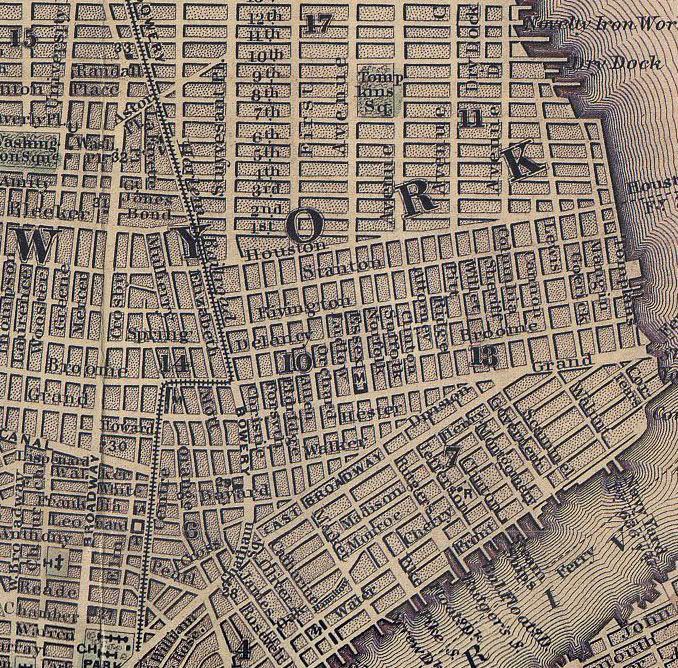
1847 LES Ward Map Section: A Geographic Tool For Locating Blog Posts
Click For A Better View
There was an error in this gadget
Deep Thoughts
#1. Annie Dillard talks about her fascination with science and minerals in particular. Then she goes on to details anecdotes concerning various Americans who became obsessed with the possibility of discovering valuable or interesting mineral deposits or rock formations within or close to their home environments. She speaks about men - almost all these scientific minded people are male - who discover veins of coal, copper, bauxite, and so on. She depicts the ordinariness of their fascination and the fact that it tapped into the extraordinary. Like nature had these incredible finds waiting to be unearthed all around. People who could see the worth of what was all around them or, in some cases, beneath them, excavated and found, just beneath the surface of their obsessive preoccupations, depths of riches and fascination. So in exploring the history of KV we go back into what had been the ordinary and find it layered in a criss-cross of historical significance. A transmutation of the lung block, redeemed as a bold social experiment tinged with ambitions as immodest as a revolution and as commonplace as sandwiches - ordinary though it may be but still - the most delicious sandwiches of the twentieth century. Buried beneath the surface of the KV heritage are connections to so may aspects of our culture and NYC's greatness as to be not only unfathomable but irrefutable. Do you know what I'm saying here?
Son Of Salvatore
FAQ's: Click On Image
KV Honorary Members (And Their Corresponding Sponsors)
Tim Russert-Mark
George Carlin-Allan
Paul Newman-David
Pete Seeger-Bob
John F. Kennedy Jr.-Joe
To be is to do - Plato To do is to be - Socrates Do be do be do - Frank Sinatra
Yes. I was thrown out of the Canal theater a number of Saturdays for rolling on the floor, in the aisles laughing. I think one of the movies that prompted my gaiety was "Psycho" - the shower scene. What can I tell you? I guess I wasn't tuned into the mood. At the time. Also saw many rock and roll movies at the Canal, Elvis films and the Murray the K fests. Saturday I often would go there with Joey Maldonado and his cousins. We would load up on candy by the quarter pound from that obscure bakery that was just around the corner on Madison Street, quarter block from Catherine - around the corner from the Brokowsky's fruit store, Gogol's and the pharmacy on the corner. Next to the newstand. Remember? By the bus stop. See what I'm saying? (In your mind, can you see it?) Bakery had golden and tan tile design but couldn't hold a candle to Savoia. No marble floors either.
guest memorist Howie: the first movie I ever went to was at the Tribune Theatre (near City Hall, now by the site of Pace University), a Disney cartoon 'Lady and the Tramp', also remember going there with Ronnie, David and maybe Paul, think it was '62 to see 'Safe at Home' starring Mickey Mantle and Roger Maris....I saw 'The Time Machine" with David at the Canal theatre in 1960 (academy award to George Pal - special effects), we were so taken by the notion of time travel that we proceeded to go home and build a time machine...somehow we got hold of some wood, nails, rope and wheels..after a couple of days the time machine started to take shape although it looked remarkably like a pretty decent scooter so we decided it needed a safe haven and hid it in a pit on Monroe St...one that we were able to climb...on the third day the time machine was stolen from the pit...we never saw it again...probably in the year 3000 by now..
guest memorist Neal Hellman on BLT's (the non Ref Luncheonette variety) A great B.L.T. is a complex eatable symphony. One in which all the parts maintain their individuality, yet at the same time, surrender their tasty nuances in the true spirit of gastronomic gestalt and dwell as one.This equinox I choose Sumano's Bakery Ciabatta bread. Though I was skeptical about it's naked, pale texture, I felt it would toast up well and its many crevices would add some fun places for the mayo to go.With the mayonnaise choice I have to stay with tradition and of course go with Hellmann's though for some reason it's known west of the Mississippi as “best foods”. Please do not waste my time with this hippie safflower oil concoction or some other type of healthy alternative. For when it comes to mayonnaise for my Ultimate B.L.T. there is no east or west, there is only Hellmann's…. case closed. My ingredients are now all together, but the intense work has just begun. For now without the correct timing and the correct application of all the ingredients, my ritual could easily plummet into a spiritual abyss. All ingredients must sit together (as one) at room temperature as I invoke the spirit of all the great B.L.T. makers in all the luncheonettes in the greater metropolitan area of New York. I heat my cast iron skillet (using a Teflon pan would be heresy) to a comfortable medium heat. I lay the bacon down 4 strips per sandwich and as I do the strips greet the metal with a friendly sizzle “hello”. As they are slowly cooking I cut the tomato's, neither too thin or too thick and lay them down ever so gently on a plate to await their glorious marriage. The lettuce has been carefully washed and spun with all traces of ribs removed. The mayonnaise jar is open and waiting to join this eatable canvass. Once the bacon is turned the toast swings into action. It has to be brown all the way but with no traces of crusty darkness.As the toast is finishing I remove the bacon and pat it down with a paper towel. Now it's time to assemble my edible equinox creation. Mayo on both pieces of toast, then the tomato's and I prefer the lettuce between the tomato and the bacon, for I feel it's texturally more secure that way. I don't want an immediate confluence of tomato and bacon; I like the lettuce to work as a buffer. Here's where many folks really go askew: they push the bread down so hard that the bacon is crushed. No, no a thousand times no. One must gently, ever so gently caress the concoction together. After which one will take a sharp knife and make a diagonal cut. A straight cut is what people from small towns in Nebraska and Ohio do. Those of use who are members of the B.L.T. illuminati always make a diagonal cut. The masterpiece will then be placed on a plate and then consumed in a way as to enjoy the warm and crunchy (yet still pliable) bacon, the exploding sensation of a dry farm Molino tomato, the juicy lettuce, the condiment-ing mayonnaise and ever so supportive bread. My first Ultimate B.L.T. goes to my neighbor for her birthday. With that offering I realize now that I am truly invoking the Japanese Equinox celebration of Hign-e. Yes with my ultimate B.L.T. offering I am illustrating the six perfections: perseverance, effort, meditation, wisdom, observance of precepts, and giving.
KV Journeyman
11/13/07: Even standing in the cold rain, the Baroque facades on these buildings are fantastic. Brussels has some of the best architecture in the world, all types, all styles. Standing in the middle of the main town square one is overwhelmed with the magnitude of detail and size.
11/14/07: I am currently in Brugge in NW Belgium. It appears to be a quiet town with all old and small buildings, perhaps pre-Victorian, with a network of canals similar, but without the gondolas and singing rip-off-the-tourist gondoleers. I'll learn more tomorrow as we get a tour prior to dinner.
12/5/07: Just finished a fresh grilled tilapia sandwich while sitting outside looking at the expansive white sands of Clearwater Beach and the far reaches of the Gulf of Mexico, realizing I am flying back to DC tomorrow morning into the remnants of the latest Alberta Clipper to wreak havoc on the Nation's Capitol. Enough to upset the strongest and staunchest among us.
Time Magazine: 10/15/1934
Smack in the middle of the slum-mulligan of Manhattan's lower East Side two barefaced, rectangular apartments rear their bricks twelve stories into the air. Jointly christened Knickerbocker Village, they cover four whole city blocks. Between the two units is a concrete playground, and within each will be a garden. Each of the 1,593 apartments has wooden parquet floors, electric refrigeration, tiled bathrooms, outside windows. The elevators are self-operating. Rentals range from $22.50 for 2½ rooms on the ground floor to $87.50 for a 5½-room penthouse. Average is $12.50 a room. Knickerbocker Village will cost about $9,000,000, and with the exception of Rockefeller Center is the only large structure which Manhattanites have noticed abuilding these last two years. Last week it was ready for occupancy.
Because Knickerbocker Village is also Manhattan's first experiment in government-financed, low-cost housing, RFC's Chairman Jesse H. Jones, East-Sider Alfred E. Smith, many a minor wig gathered in its banner-decked playground to mark the day. Said Al Smith: "I was tempted to swap the Empire State Building." Chairman Jones thumped the tub of slum clearance. Informed that the first of the two units was already 95% rented, while the second unit (to be opened Dec. 1) was 50% rented, he waved an expansive hand at the holiday bunting, declared: "I know of no ... safer investment for public funds than to clear about 500 acres of your slums."*
Whether or not Knickerbocker Village was a fitting inspiration for such official rejoicing was last week a red hot sociological question.
In 1929 Realtor Fred Fillmore French began buying land on the lower East Side. By swearing his 42 brokers to secrecy and using dummy corporations, he managed to get some 15 acres for $5,000,000. Then in 1931 he announced a grandiose scheme for the erection of a $50,000,000 development for junior Wall Street executives. At this point he found that he could not get credit. At the same time Fred F. French Operators, Inc. began passing its dividends on $14,000,000 of preferred stock. The project remained only a scheme with a staggering upkeep in land taxes.
When Congress authorized the RFC to make loans on slum clearance projects, Realtor French picked out the worst block in his holdings and ecstatically presented it to Mr. Jones as a worthy subject for clearance. His choice was "Lung Block," so called because of its high tuberculosis mortality rate. On it lived 650 families. In its backyards were seven jakes. On this fester Mr. French proposed to build a low-cost housing project. Mr. Jones agreed to do business, and RFC lent 85% of the required $9,000.000.
Average cost of "Lung Block" to Knickerbocker Village was high: $3,116,000, or $14 per square foot. The tax assessment was therefore reduced by two-thirds to bring the monthly room rental down to the $12.50 stipulated by the RFC. Because the average rental on "Lung Block" had been about $5 a room, Knickerbocker Village remained a low-cost housing project only in the minds of the white collar workers, who proceeded to fill it.