Tuesday, November 25, 2008

The Munster's Escort Santa In The Macy's Thanksgiving Day Parade:1960


Al Lewis was quite a character. When he died over two years ago the obituaries stated he was 95. That was the age Al claimed to be, except he was really 82!
From a memorial broadcast given on Democracy Now on 2/6/08. Al talks about his role at the Rosenberg's funeral. You can also listen to it here
Part 1
Actor and activist Al Lewis died at the age of 82. In the acting world, he was best known for playing Grandpa on the Munsters. He was also a lifelong activist. He ran for New York Governor on the Green Party ticket and was a longtime radio host on Pacifica station WBAI.
Today we remember actor, radio host, and political activist “Grandpa” Al Lewis. He died Friday after years of failing health. There are conflicting reports over his age at the time of his death. He was thought to be 95 years old, but according to the Associated Press, his family now says he was in fact 82. Lewis was best known for his roles on two 1960s comedy series–as “Grandpa” on the “The Munsters” and Officer Leo Schnauzer on “Car 54, Where Are You.” He was also a life-long political activist, and an outspoken critic of US policy at home and abroad. In 1998, he ran for Governor of New York, as the Green Party candidate against Governor George Pataki. He also took turns as a basketball scout; a restaurant owner in Greenwich Village; and a radio host on WBAI here in New York.
Grandpa Al’s death was announced Saturday by WBAI program director Bernard White, during the same time-slot he used to host his weekly program. We’re going to play an excerpt now from an interview Bernard White and I conducted with Grandpa Pal on Democracy Now!, on April 10, 1997. We pick up the interview where Grandpa Al about his early involvement in political activities. Here, he talks about the case of Ethel and Julius Rosenberg–the married couple convicted and executed for spying for the Soviet Union at the height of the McCarthy era in the 1950s.
* “Grandpa” Al Lewis, interviewed April 10, 1997.
AMY GOODMAN: I’ll play an excerpt of that interview that Bernard White and I conducted with “Grandpa” Al Lewis on April 10, 1997. We pick up the interview where “Grandpa” Al Lewis talked about his early involvement in political activities. Here he talks about the case Ethel and Julius Rosenberg, the married couple convicted and executed for conspiring to spy for the Soviet Union at the height of the McCarthy era in the 1950s.
“GRANDPA” AL LEWIS: Most people don’t remember. When the Rosenbergs were executed, the funeral was in Brooklyn—well, they didn’t live in Brooklyn—at IJ Morris. And most people are not aware the two bodies were on view. And a group of us were there to make sure that no maniac came in and threw acid, and there was all kinds of crazies around during the height of the McCarthy period. And the lines started to form at 6:00 in the morning. The viewing didn’t open until about 10:00. It was a group of us from the NMU. And most people are not aware that the majority of people who came to view the Rosenbergs, as they laid in the coffins, were black people.
I was there from the get-go before they opened the mortuary. Had a couple of incidents, one with a Daily News reporter. I still remember her name. Ruth Montgomery was trying to sneak a camera in. We did not allow pictures to be taken, you know, of this and that. I grabbed the bag and the camera and, you know, she said, “You can’t do that.” And I said, “I know you ain’t gonna stop me. I know that. And you can attempt to call the police. You want to do that? There’s about 8,000 people waiting in line. You want to start a riot? Now, get out of here. Take your camera and get out.”
Anyway, he had made a decision. The good doctor had made a decision to go to the cemetery and you can read the front page of the New York Times. At least a thousand cars who followed the Hearst, children, grandmother. And I had to make sure that nobody messed with William Edward Burghardt DuBois. So, as we say in them old westerns, you know, we goin’ round up a posse, somebody’s gotta ride shotgun. Well, Al Lewis rode shotgun. And I always said, man, any mother’s son put his foot on that running board knows he’s the running board. I want to know if he could swallow the 45 that go right in his mouth. That’s it.
AMY GOODMAN: So there was no trouble?
“GRANDPA” AL LEWIS: Even Steven. You make your play; I’ll make mine. Take it from there.
BERNARD WHITE: Why do you figure—did you ever think about this? Why so many black folks went to visit—to view the bodies of the Rosenbergs?
“GRANDPA” AL LEWIS: They were not black radicals. Most of them were women. And I think they understood—I don’t even know if they felt that they were innocent or guilty or—I think they just felt that they shouldn’t have been executed. It’s like down in the South, Mississippi, when they used to march down from the penitentiary at Parchment. Parchment Farm. Women working in the cotton fields didn’t know these men, and they used to sing, and the song came out of that. [singing] Another man done gone / Another man done gone to the Parchment Farm.
And it was that kind of an affinity that they had with people who—you have to understand. See, people don’t understand. Whether they did or didn’t, certainly the trial didn’t prove that, that they were communist sympathizers, whatever you want to call. You have to understand the period that—you know, things grow out of soil. You know what I’m saying? You know, it’s hard to grow broccoli out of a rock. You need the proper soil.
And in those communities, because that was my community, Brownsville, East New York, you know how people knew what communists were? Didn’t read a book, didn’t read a pamphlet. During the Depression, the marshal came and evicted 20 people a day, and here come the communists, then the YCL, the Young Communist League. As soon as the marshal leaves, go up, break the lock, carry the furniture back in. Now, who do you think them people are going to—that’s how they knew communists.
I mean, read John L. Lewis’s book. Toughest places to organize was in the South. Harlan County. Good lord! I mean, you get off the train, they shoot you; bus, don’t matter. And he used to bring in communists. And that’s what people knew them as. They didn’t know nothing about no ideologies, the Soviet Union, Karl Marx. They didn’t know what the heck that was. And so it was that kind of an affinity. These people are putting their lives out on the line and getting hit on. If I don’t remember a thousand battles. They used to call it home relief; now they call it welfare—in the ‘30s. And battles, they wouldn’t give the lady home relief or they’d cut her off, or they took away this and stuff. And then, battles with the police. Well, I mean, people say, ‘Jeez, wow! So, if they were communists, they were probably moving back furniture the same way.’ It’s that kind of an affinity that underdogs have.
AMY GOODMAN: We are talking to Al Lewis, longtime actor and political activist. And Al, we just couldn’t resist. Remember Vera Hall?
VERA HALL: [singing] Another man done gone / Another man done gone from the county farm / Another man done gone / I didn’t know his name / I didn’t know his name / I didn’t know his name / I didn’t know his name / He had a long chain on / He had a long chain on / He had a long chain on / He had a long chain on / He killed another man / He killed another man / He killed another man / He killed another man / I don’t know where he’s gone / I don’t know where he’s gone / I don’t know where he’s gone / I don’t know where he’s gone / I’m going to walk your log / I’m going to walk your log / I’m going to walk your log / I’m going to walk your log.
BERNARD WHITE: So what is it in your past that made you pick the side that you’re on? I mean, there were many people—excuse me, that you worked with—
“GRANDPA” AL LEWIS: I think somebody hexed me at birth. I don’t know.
BERNARD WHITE: Because you could have just made money and been very comfortable and not—
“GRANDPA” AL LEWIS: Yeah.
BERNARD WHITE:—have anything to do with any of these issues.
“GRANDPA” AL LEWIS: That’s the way it’s supposed to be. That’s the way it is supposed to be. You fight for what you believe in. As I said many a time, I’m my mother’s son. I remember my mother taking me to demonstrations. I was a boy. My mother was—I guess, what’s that? The Bell Curve would say she was an ignorant peasant woman from Europe. Came here, girl of 15, worked in the sweatshops. Brought over five daughters and her mother and father from Europe. Worked on her back. Worked all her life. Sweatshops. Garment center.
AMY GOODMAN: Polish?
“GRANDPA” AL LEWIS: Never had a vacation, my mother. Never went to a movie. Didn’t have the time, bringing up a family, taking care of her five sisters and her mother and father, brought them here from Europe. Had to earn money for passage and everything. And my mother was the kind of woman who understood the class struggle. While my mother worked as a poor lady in the garment center, and the boss said, ‘You know, it’s kinda hot; let’s open the window,’ my mother’s thinking was, ‘If the boss says open the window, no, we keep it closed! That’s it! That’s it!’
My mother used to go on demonstrations. My mother used to—see, you people don’t remember. You all are youngsters. But during the Depression, people selling on the street corner, and along came the police officer of that day and used to attempt not all, but many, to get a dollar or two bribe. Otherwise, you can’t stay here. My mother was the kind of woman who would say in broken English—I’ll do my mother now—‘Why you doing there? Why you bothering that man? He’s trying to make a living. Get away from there!’ to the policeman. When I was a little kid, I was embarrassed. I’d pull my mother. ’Don’t pull me! Why you doing that?’ Well, my mother had a voice bigger than mine. Suddenly there’s 50 people there, and the cop is getting scared. You know, for a dollar he’s trying to get from the guy selling garbanzo beans—arbus, we called them—or sweet potatoes or something. And here’s a mob. He don’t know if they’re going to tear his head off. And he walked away. But that was—I’m my mother’s son. That’s it. I mean, I don’t know how else to explain it. Then, of course—
BERNARD WHITE: Oh, that explains it very well.

Monday, November 24, 2008

The Death Of Fanucci


Can you spot Reverend Joseph Moffo of St. Joseph's?
from movie-locations
The scenes of younger Vito’s Little Italy neighborhood of 1917 were shot on Sixth Street in the East Village between Avenues A and B, tricked out in period dressing. A block north is the bar where the Rosato brothers try to garrotte Pentangeli, PH Vazac’s, 108 Avenue B at Seventh Street (known as Seven and B), at the southeast corner of Tompkins Square Park in the East Village.

KV Hockey At Tanahey Park


Featuring a line change. The rink is named after Reverend Joseph Moffo
Godfather II Trivia:
The statue carried during the Festa is of St. Rocco and is currently located at St. Joseph Church in New York City. The priest in the Festa is Rev. Joseph Moffo, who was the pastor of St. Joseph at the time of the filming. In addition, the altarboys and men carrying the canopy were also from St. Joseph.

about Tanahey Park
Located between the Manhattan and Brooklyn Bridges, this playground was named for local civic and political leader Martin F. Tanahey (1874-1930). Born and raised in this Lower East Side neighborhood, Tanahey held various public offices over 22 years. He served as chief clerk in the Labor Department of the State of New York and later became assistant appraiser of the Port of New York, the busiest port in the world for the first half of the 20th century. He also was an assistant government appraiser in President Woodrow Wilson's administration. In 1922, Tanahey was elected to the Board of Alderman from District 1, which includes the Lower East Side, and remained an alderman the rest of his life. Tanahey was a chief lieutenant of Democratic Party leader Thomas F. Foley (1852-1925), a saloonkeeper and politician associated with Tammany Hall for whom nearby Foley Square is named. Martin F. Tanahey died of pneumonia at his home at 177 Cherry Street in 1930.
The land occupied by this playground was acquired by condemnation for park purposes on October 17, 1949. The park opened on October 11, 1952, and was named Martin F. Tanahey Playground by local law. When built, the playground was divided into separate sections. The sides facing Market and Catherine Slips were originally constructed as sitting areas with chess and checker tables, while the center section was reserved for active recreation, with spaces for basketball, volleyball, paddle tennis, shuffle board, and horseshoe pitching.
Since its original construction this playground has gone through several changes and renovations. A 1972 local law transferred a 10-foot wide strip of parkland on the south side of Tanahey Playground from Parks to the Manhattan Borough President’s office to provide for the widening and improvement of Water Street. A 1975 renovation added a roller hockey rink, bocci courts, benches, and a basketball court to the park, and removed an old comfort station. The park maintains three distinct sections. The side near Market Slip is still a sitting area with benches, game tables, and picnic tables. The other end of the park features play equipment for children and black iron art work of swordfish, lobsters, eels, and fish along the gate. Three basketball courts and Rev. Joseph Moffo Rink occupy the middle of the park. New play equipment was added throughout the 1980s and 1990s, and a $433,000 reconstruction of a portion of the playground along Catherine Slip was completed in March 1998

The Sign Of The Times' Line Dance

Petula's Sign Of The Times

It's A KV/LES Sign Of The Times


from a different part of the 60's then Bob Dylan's
"A Sign of the Times" was a 1966 single by Petula Clark. Written by Tony Hatch, the uptempo pop number juxtaposed Clark's driving vocals with a powerful brass section. She introduced the tune on the Ed Sullivan Show on February 27, 1966.
The song indicated a burgeoning trend toward tempo in medlodic music, reaching #2 on Billboard's easy listening chart, as opposed to its #11 position on the Hot 100. In the late 1990s "A Sign of the Times" reached an entirely new audience in the United States when Clark's recording was featured in a series of popular Target Department Store commercials.

It's a sign of the times
That your love for me is getting so much stronger
It's a sign of the times
And I know that I won't have to wait much longer
You've changed a lot somehow from the one I used to know-oh-oh
For when you hold me now it feels like you never want to let me go
It's a sign of the times
That you call me up whenever you feel lonely
It's a sign of the times
That you tell your friends that I'm your one and only
I'll never understand the way you treated me-ee-ee
But when I hold your hand I know you couldn't be the way you used to be
refrain
Maybe my lucky star at last decided to shine
Maybe somebody knows how long I've waited to make you mine, mm, mm, mm
I'll never understand the way you treated me-ee-ee
But when I hold your hand I know you couldn't be the way you used to be
refrain
Maybe my lucky star at last decided to shine
Maybe somebody knows how long I've waited to make you mine, mm, mm, mm
It's a sign of the times
That you kiss me now as if you really mean it
It's a sign of the times
And a year ago I never could have seen it
Don't ever change your mind and take your love away-ay-ay
Just leave the past behind and, baby, only think of how it is today
It's a sign of the ti-imes
It's a sign of the ti-i-i-i-imes
It's a sign of the times
It's a sign of the ti-i-i-i-imes

Bob Dylan Live At Newport


from the bob dylan user at youtube

Sunday, November 23, 2008

Positively Dylan: The Lackow-Levinsons


from the youtube description:
from 1964 at the Newport Folk Festival: The Original Singers: Cordell Reagon, Bernice Johnson-Reagon, Charles Neblett and Rutha Mae Harris were organized during the Albany, Georgia Movement. They traveled over 100,000 miles spreading the message of freedom and raised funds for SNCC. Miss Harris and Miss Johnson are natives of Albany,Georgia and sang with the best. Here they are with Joan Baez, Peter, Paul and Mary, Bob Dylan and Pete Seeger. This group traveled with Dr. King and were instrumental in helping people of color earn their right to vote
.
How many roads must a man walk down
Before you call him a man?
Yes, n how many seas must a white dove sail
Before she sleeps in the sand?
Yes, n how many times must the cannon balls fly
Before they're forever banned?
The answer, my friend, is blowin in the wind,
The answer is blowin in the wind.
How many times must a man look up
Before he can see the sky?
Yes, n how many ears must one man have
Before he can hear people cry?
Yes, n how many deaths will it take till he knows
That too many people have died?
The answer, my friend, is blowin in the wind,
The answer is blowin in the wind.
How many years can a mountain exist
Before its washed to the sea?
Yes, n how many years can some people exist
Before they're allowed to be free?
Yes, n how many times can a man turn his head,
Pretending he just doesn't see?
The answer, my friend, is blowin in the wind,
The answer is blowin in the wind.

I recently learned that Arlene Levinson, nee Lackow, is a big Bob Dylan fan and with her husband Bob, acknowledged Dylan experts. They host a radio program called Positively Dylan. From the WHPC FM (Long Island) program guide
(Monday & Friday 6pm) Hosts Bob and Arlene Levinson play the compelling music of Bob Dylan. Both new and long time fans will enjoy hearing their interesting analysis and commentary in addition to all of Dylan’s familiar groundbreaking songs.

An excerpt from a piece that a fan of theirs, Mary Ellen Walsh wrote at workingmother
Some women are football widows. You know the hubby is holed up, eyes glued to the TV no matter where—family Sundays or facing TV screens out to dinner in restaurants. Jeez! How many times my friends have heard in a minute, after this play! They are widows, alone until the season is over. Me, I’m a Bob Dylan widow. I can’t wait out the season because it never ends. My husband Tom is passionate about Bob Dylan. Let me explain conversations that go like this…“How far are we going daddy?” My son Robert moans while driving in upstate New York to visit family. “We’re going all the way, till the wheels fall off and burn,” Tom answers from the song Brownsville Girl. Or our friend’s daughter’s birthday is Cinco de Mayo, the 5th of May. Tom croons, “I married Isis on the 5th of May,” from Isis. Wow, it’s dark at night, earlier each day. “It’s not dark yet, but it’s getting theeere,” says Tom from Not Dark Yet which has many spin offs into “Are they here, yet…NO they aren’t here, YET, but they’re getting there,” and so on. I’ll spare you the rest. I hear the incarnations of all that is holy in Tom’s voice. Hon, he was the first person to put two versions of the same song on one album—Forever Young. I’m taking a shower—come out soaking wet—Tom’s there, Need I tell you, he broke the 3-minute song formula for 45s with Like A Rolling Stone, paving the way for Hey Jude and Stairway to Heaven. In the middle of watching "American Idol" Tom whispers…Without Dylan, none of this music would exist. And the older Tom gets (42) the worse it is. He cannot tolerate new music, which to him means anything recorded after 1984. Except, of course, for Dylan who Tom says just keeps morphing and ages well like fine wine. It all started when we re-met (we grew up together--a long story) in October 1994, Tom invited me to the third night Dylan performed at Roseland. I declined and you’d think I struck him by saying… “I don’t really like Dylan.” The blow more shocking than Dylan going electric. But we began dating anyway despite my bad taste in music: Lou Reed, the Talking Heads, Janis Joplin, Led Zeppelin and Pearl Jam. Somehow, I had to pass initiation by going to Dylan concerts with Tom like Ellen Barkin in the movie Diner where she had to take the football test. I had to be converted to exorcise years of bad music out of my soul. We saw Dylan every which way, with a ten-gallon hat on, with an “electric” band, with Van Morrison or standing on his head...smoking, not smoking…cries of but he’s different every night. Tom even serenaded me while strapping on a harmonica in a metal neck rest and sang Dylan tunes, while driving, as we headed from New York down to D.C. for a friend’s wedding. Six hours of touch and go traffic crooning Girl of the North Country and Desolation Row. Okay. Okay. ENOUGH. “Yes, I’ll marry you.” Years went by. There were many Dylan moments like the time Tom was ghost white and deathly ill and I had to check him for a pulse during the Twyla Tharp does Dylan thing his mom got tickets for us to see. He was gripping the armrest so tightly breathing deep La Maze-class breaths and I thought he passed out from loathing. “It’s a desecration. How could he agree to this?” But over this past year, Tom would come home joyfully on Friday nights. Not because a grueling week was over, not because he was happy to see me—which he was—but because of BOB. A DJ from 90.3 FM Nassau Community College’s radio station here on Long Island who plays—you guessed it—nothing but Dylan and takes requests. Requests! Tom was in heaven. This guy was like a giant encyclopedia brain of nothing but Dylan facts, songs, snippets of lyrics with obscure live versions. Every Friday night between 6 and 8, we eat dinner listening to BOB spinning Bob. DJ Bob Levinson is quite a guy. Other than knowing all things Dylan, and broadcasting two Dylan shows a week (Mondays taped and Fridays—live), He writes for Isis a Dylan only magazine and put together a cool DVD “Walking Tour of Bob’s history.” This walking tour includes places still in existence and some that aren’t: Lion’s Head, Cedar Tavern, Gaslight Café in Manhattan. BOB even taught an NYU class on Dylan. It was Valentine’s Day. Tom requested Tomorrow Is A Long Time for me. The next week, our son Robert called in requesting Mr. Tambourine Man. The week after that was our daughter Kelly with Like A Rolling Stone. Then our friends, who love Dylan (Betsey's another Dylan widow) came to visit. They called in Most of the Time. Not only did BOB oblige our every whim, he actually sent us a bootleg of an October 1994 Boston show Tom and Gary saw. Should I be jealous of DJ BOB and Dylan? Never. It’s that little place Tom needs to go to, as he puts it… “Dylan’s music scratches that itch on your soul.” I respect that and don’t feel like a widow at all. Dylan is so much a part of our lives. I've grown to love Nashville Skyline, my favorite album...and of course Just Like A Woman, especially by Richie Havens, makes me cry every time I hear it! Then, I finally called in and requested Bruce Springsteen doing Dylan to which BOB selected Chimes of Freedom. Beautiful….Thanks Bob Levinson. We set a place for you at our table every Friday night. Thanks 90.3 FM! To call the show...516-572-7440.

a link to the syllabus of a course that Bob and Arlene taught on Dylan

Tim Robbins And Susan Sarandon: Who's Almost?

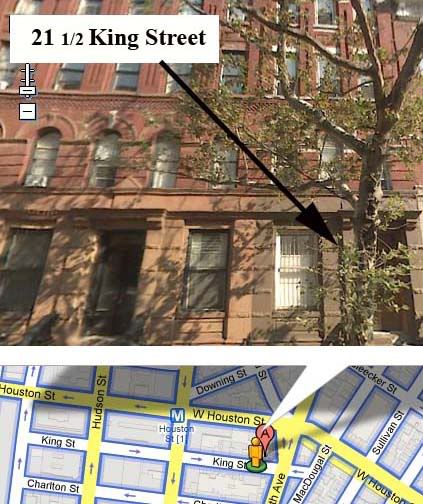
Above, Tim's address in the 1970's when he went to Stuyvesant High School
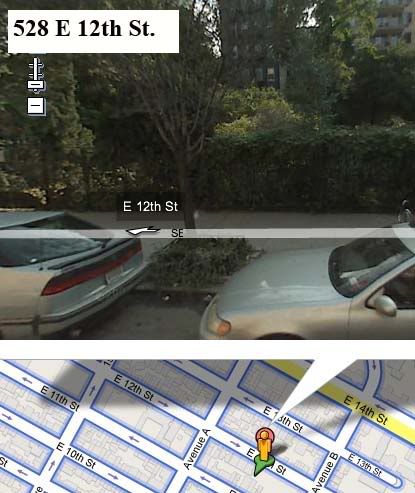
Possibly the address of Susan Sarandon's mother Lenora Marie Criscione in 1930. As much as I'd like to include them I don't think I have a strong enough case.
An excerpt from a 1992 story about Tim:
Gil and Mary, who met as music majors at UCLA, married in 1952. When Tim, their youngest child, was barely 2, his father was signed to cut a record in New York City. Gil flew ahead from Los Angeles, while Mary packed up the car and drove the kids - Adele, 7; David, 5; Gabrielle, 4; and Tim - to Manhattan. "I have the feeling," says Robbins, "the first two years of my life were very quiet. Serene. Birds chirping. And then into our station wagon and driving cross-country. New York City! Raarrgh! This explosion! Tim was not a happy-go-lucky toddler. "He was very sober and pontifical," recalls his father. "We used to call him Timothy Cardinal Robbins. My ex-manager once came in and saw Tim and called him 'the oldest person in the world.'" Adding to Tim's mystique was the fact that he didn't speak "until a relatively late age," Gil says. "But he didn't have to. He had a form of language, but it was not intelligible. His three siblings translated for him." Tim also, according to his father, had "a wonderful fantasy life." All sorts of characters inhabited "his extra-extra-world. It was Tim's joke." Short on money, the Robbinses - crammed into a top-floor railroad flat on King Street - were long on talent and ambition. The children shared a love of music and drama, and Gil gave them guitar lessons. But he "didn't encourage any of the kids," he says. "It's a very difficult life. I made sure they saw the backside of it as well as the glitzy side." With Ian and Sylvia coming to Thanksgiving dinner and Tom Paxton regularly at the kitchen table, the Robbinses entertained an eclectic group of friends who were smart, outspoken, and involved. The theater of the streets provided a colorful backdrop, with a neighbor who flounced down the block in velvet Shakespearean suits and Norman Vincent Peale leading protests in Washington Square Park. A women's house of detention once stood in the neighborhood. "You'd walk down the street and hear these women: 'Help me. I need to get ... so baaaddd. I need somebody to ...meeee!!' I was, like, 11 years old," says Robbins. "That's probably why they closed it down." The neighborhood did not make him tough, just disciplined. "I have a different meter as far as who I trust and who I don't," he says, measuring his words. "What is real and what isn't. If it's sometimes too defensive, that's called 'street law.'" The Robbins children attended parochial school and were taught by nuns. Tim now says the role of altar boy was his first "stage experience," and when it came time to choose a confirmation name, he wanted Illya, for Illya Kuryakin, of The Man From UNCLE. "My parents said I wasn't allowed to. Illya's not a saint." Gil Robbins continued his career as an actor, appearing in Off-Broadway shows like How to Steal an Election and joining the road company of 1997. The 10-year-old Tim performed with his older sisters in plays for the Theatre for the New City. He directed his first play at the age of 14 and performed satiric political sketches lampooning Watergate figures. The Robbinses voiced outrage at crimes against democracy. "I suppose it was skepticism as far as politics is concerned," recalls Mary. "I think mistrust of the government was probably a theme." When his older sister Adele was attending Ohio's Antioch University, says Robbins, "one time my mother came into my room, woke me up and said 'I want you to be very proud of your sister. She was just arrested for protesting the Vietnam War.'" Acting wasn't Robbins's only obsession. He'd wake up at 4 am for hocked practice, and he also became a decent baseball player. He attended the elite, science-oriented Stuyvesant High School, where he got good grades. [Don't let the word "elite" fool you: it's a public school. - Pol] His brother, David, meanwhile, has veered off into heavy-metal music and left for California. Tim was awarded a Regents Scholarship to the State University of New York at Plattsburgh, twenty miles from the Canadian border. Isolated and remote, the college nevertheless had a small theater department, which Tim participated in. Says Gil, "He was a large frog in a small pond. He wasn't learning anything about himself." But he was learning how to party. He says Plattsburgh had a thriving bacchanalian scene. "I've done hallucinogens, but I don't think it's responsible to talk about this kind of stuff because people read that and think that validates whatever they're doing. I know there are definitely personalities that should not take hallucinogenic drugs.

The World Of Jewish Vinyl


audio from All Things Considered from 11/20/08
transcript:
A new book documents American Jewish history in an unusual way — through vinyl album covers. Authors Roger Bennett and Josh Kun wrote And You Shall Know Us By The Trail Of Our Vinyl, which details Jewish vinyl album covers they have collected over the years. Jewish, in these terms, includes everything from the prolific cantor Sol Zim to the Temptations' Fiddler on the Roof medley. The kindred spirits found each other in 2003 as they searched for their own Jewish identities and dug through stacks of albums. They pooled their collections — word got around — and soon their garages were overflowing with vinyl. "Boxes and boxes started to head our way — they were gratefully received," Bennett tells NPR's Melissa Block. "Each one was a crackingly good album. But it was more than that — it was like a footprint through history."
Bennett says that he and Kun started to become obsessed with collecting the albums. "Whereas normal men go to Vegas or go golfing or perhaps hunting, at the weekend," he says, "the two of us would head to the place where Jewish vinyl goes to die — which is of course Boca Raton — and spend hours cruising around thrift stores there and returning back laden down by vinyl." But how did the two of them get into collecting Jewish kitsch albums in the first place? Bennett, who grew up in Liverpool, England, says he stumbled into it when he was 8 or 9 years old. He inherited his mother's record player and her records. And among the Mamas and the Papas' greatest hits and the Beatles albums, he says, he stumbled across two — one by Connie Francis and the other, Irving Fields' Bagels and Bongos — that "struck [him] as being fairly remarkable." "The second has come to loom large in my life, because it connected me to Josh originally, which is Irving Fields' Bagels and Bongos, a Jewish guy who grew up in New York, trying to make music that would please the Latin community." That album likewise drew Kun to Bennett. "As you can probably tell, Roger is an incredible mambo dancer, so that record was a direct beeline to his heart and legs," Kun says. "For me it was the record that was key that opened up this whole world that I never knew existed, which was the Jewish Latin craze of the 1940s and '50s." "Bagels and Bongos was really just the tip of the iceberg," he adds. "Its cover is probably the most striking thing that first caught my eye 'cause of its total elegance. But the music on the record is just beautiful, beautiful Latin versions of various Yiddish songs and Hebrew songs. As Bennett and Kun traveled their journey through Jewish LPs, they also found Ruth Wallis, who Kun says was "part of the crew of bawdy, trash-talking, hard-drinking, hard-smoking women comics in the 1960s, who have really for the most part dropped out of history." While Wallace has been remembered, the women around her, like Patsy Abbott, he says, "have been forgotten." This is what Kun and Bennett have found particularly disconcerting — Bennett says they want to "change the legacy of many of the performers that we found, to send out a beacon to other performers who are out there, who are still alive, so that we can record their stories." As they continue to collect records, Bennett and Kun are searching for answers to particularly difficult questions. "Which is, really, who are we, what are we inheriting, what does it mean to us, and what are we going to do about it?" Bennett says. "So that this book really is the beginning of a journey, the journey is not over, and we're framing questions. We've got thousand of albums left to collect before we can even think of answering them."

Saturday, November 22, 2008

Our Strong Band And The White House


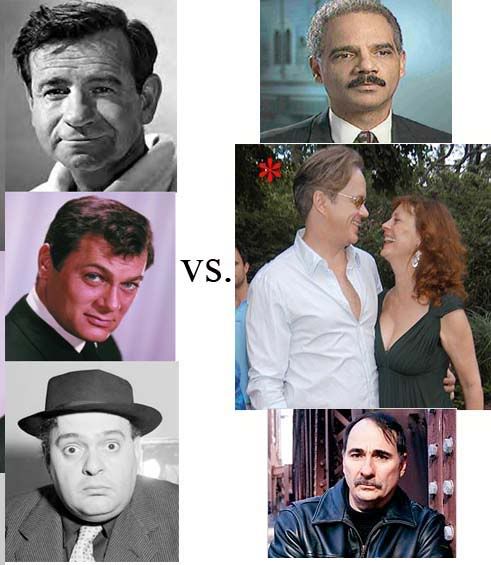
A friendly online debate took place recently between KV Stuyvesant grads and KV Seward Park grads. Each group proffered examples of the greatness of their alumni. I think I settled the dispute with my nominee for the champion of all SHS graduates, Tim Robbins. Here he is displaying his prize accomplishment.
On the left: Walter Matthau, Tony Curtis, Zero Mostel
On the right: Eric Holder (new Attorney General and SHS class of 1969), Robbins, David Axelrod (Obama's Campaign Director and SHS class of 1972)

A Friend Of KV?: Secretary Of Commerce, Bill Richardson


An imagined conversation between Rich and his former boss at the Department of Energy and the future Secretary of Commerce.