Showing posts with label tenement museum. Show all posts

Thursday, May 13, 2010

Rebecca Lepkoff: Life On The Lower East Side, Part 4


An excerpt of Rebecca's portion of a book talk at the Tenement Museum on May 13, 2010
The Lower East Side became by the 1930s a vibrant multiethnic community full of families and friends. The residents congregated on stoops, street corners, sidewalks, fire escapes, and rooftops of the neighborhood tenements and shared the unique languages, food, and festivals of their various cultures.
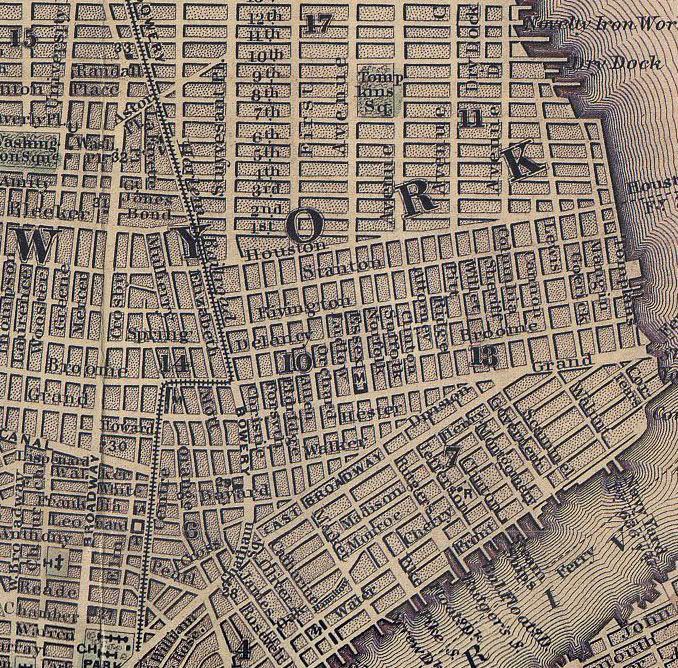
Rebecca Lepkoff, herself a child of immigrant parents, grew up in this community. The faces of the Lower East Side became her muse and through the lens of her camera she captured the lives of a spirited neighborhood - women hanging laundry out their windows, children playing stickball in the street, men chatting at the barbershop. This book, the first monograph of Lepkoff's work, highlights the area between the Brooklyn and Manhattan bridges from the Bowery to the East River.
Over 170 reproduced photographs and essays by Peter E. Dans and Suzanne Wasserman uncover a forgotten time and place and reveal how the Lower East Side remains both unaltered and forever changed.

Wednesday, February 24, 2010

Waiting For Lefty


No, that's not Waiting For Lefty above. And I'm not talking about waiting for such great KV lefties such as Rambo Murray and Mark, The Cutter. I wish, however, there was a quality video of Odets' Waiting For Lefty. Especially one that equaled the quality of the performance that the Theater 808 group gave last night at the tenement museum. Odets wrote much of the snappy dialogue for Sweet Smell of Success. It was one of Seward Park's Tony Curtis' best performance.
Clifford Odets (July 18, 1906 – August 18, 1963) was an American playwright, screenwriter, socialist, and social protester.
Odets was born in Philadelphia of immigrant parents, Lou Odets (born Gorodetsky) and Esther Geisinger, and raised in the Bronx, New York. He dropped out of high school to pursue acting. He helped found the Group Theatre, a highly influential theatre company in the U.S. that utilized a new acting technique, closely associated with the thinking of the Russian master Constantin Stanislavski.
After briefly trying acting, Odets decided to become the Group Theatre's first original playwright. At the urging of Group co-founder Harold Clurman, he wrote Awake and Sing! in 1935. Although his first play, it is often considered his masterpiece. It follows the story of a large Jewish family in New York.
Mainly due to the misgivings of Group leader Lee Strasberg, Awake and Sing! was not produced right away. Odets's first play to be produced was the one-act Waiting for Lefty. This is a series of interconnected scenes depicting workers for a fictional taxi company. The focus alternates between the drivers' union meeting and vignettes from their difficult, oppressed lives. The climax is a defiant call for the union to strike. The play can be performed in any acting space, including union meeting halls and on the street. The play's wild success brought Odets unexpected fame and fortune. Odets would soon move to Hollywood to begin writing for the screen as well as the stage. His play The Flowering Peach was the preferred choice of the Pulitzer Prize jury in 1955, but under pressure from Joseph Pulitzer Jr., the prize went instead to Cat on a Hot Tin Roof, which the jury considered the weakest of the five shortlisted nominees.
These plays, along with Odets's other major Group Theatre plays of the 1930s, are harsh criticisms of profiteers and exploitative economic systems during the Great Depression. They have been dismissed by some critics as mere propaganda, but Odets asserted that all of his plays deal with the human spirit persevering in the face of all opponents, whether they be the capitalist class or not. In later years, Odets's plays became more reflective and autobiographical, although class consciousness was ever in the background. The playwright George S. Kaufman gently tweaked him about his innocuous turn: "Odets, where is thy sting?"
In 1952, Odets was called before the House Un-American Activities Committee (HUAC). He disavowed his communist affiliations and cooperated by "naming names"; as a result, he did not share the fate of many of his colleagues who were blacklisted. Odets didn’t provide the names of anyone who hadn’t already been mentioned to the committee, but he later expressed guilt and “revulsion” over his testimony. Odets was reportedly tormented by his testimony until his death in 1963, and he wrote relatively little for stage or screen after his 1952 subcommittee appearance.[3]
Odets's dramatic style is distinguished by a kind of poetic, metaphor-laden street talk, by his socialist politics, and by his way of dropping the audience right into the conflict with little or no introduction. Often character is more important than plot, which Odets attributed to the influence of Anton Chekhov. In general, Odets's political statements reflect the Marxism that was common in the 1930s; he often points to the Soviet Union as an example of a perfect socialist state.
His first wife was Academy-Award winning actress Luise Rainer; his second wife was actress Bette Grayson, and he also had a relationship with actress Frances Farmer. Grayson's death at 32 left Odets to care for their two children, Nora, born in 1945, and Walt Whitman[1], now a clinical psychologist, author and painter, born in 1947. He was a close friend of Jean Renoir, who was also working in Hollywood during the 1940s. Renoir dedicated an entire chapter of his autobiography to his friendship with Odets including a moving visit to the playwright on his deathbed.
Clifford Odets died of colon cancer at the age of 57 in 1963 and was interred in the Forest Lawn Memorial Park Cemetery in Glendale, California.

Friday, February 19, 2010

Tenement Talk, February 18: The Bagel


above, a vintage Lender's Bagel commercial. Lender's, feh!
Below, since I didn't bring my camera, a photoshopped facsimile of Maria Balinska and Ed Levine at the Tenement Museum last night. It was excellent and well-attended.

Ed Levine spoke with Maria Balinska about her book, The Bagel: The Surprising History of a Modest Bread
Some highlights:
Of special interest to KVers and old 4th Warders is the link of the Italian ciambella to the Jewish bagel. Something I never knew.
The might of the bagel union. An excerpt from wikipedia
The Bagel Bakers Local 338 was a trade union local that was established in the early 1900s in New York City and whose craftsmen were the primary makers of New York's bagels, prepared by hand, until the advent of machine-made bagels in the 1960s led to its end as an independent organization in the 1970s.
Jewish immigrants brought the bagel to the United States at the turn of the 20th century, with hundreds of small bagel bakeries sprouting up in Manhattan's Lower East Side, in which workers worked under difficult conditions for minimal wages. To represent these workers, The International Beigel Bakers Union was established. Local 338 was established by 300 bagel craftsmen who joined together in Manhattan, establishing standards for bagel production by hand and mandating that new spots in the union be handed to sons of existing local members. All of the local's members were Jewish and meetings were conducted in Yiddish. By 1915, the local had contracts with 36 bakeries in the New York City area.

Who knew of a Montreal bagel
In addition:
Ed Levine's excellent site called Serious Eats
A 2008 nytimes' article about Maria Balinska and the publishing of the hard cover version of her book
An interesting article about the final resting place of the old bagel makers in Staten Island by Benjamin Feldman

Monday, February 1, 2010

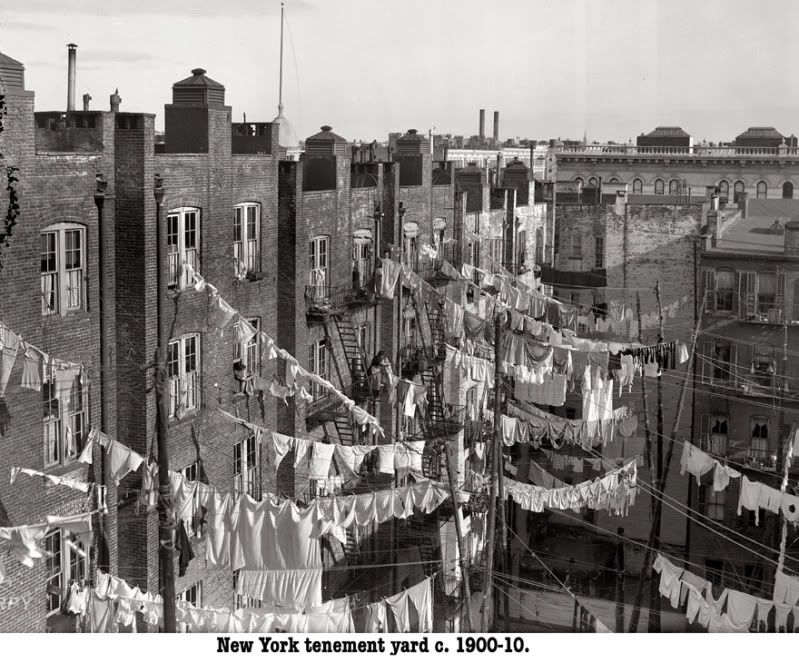
Wash Day: 1900


from the tenement museum
Housekeeping in the Tenements
Housekeeping in a tenement was no easy task for the women and children who generally did it. There were no automatic machines to wash and dry clothes and dishes or get the dirt off the floors and carpets. And for much of the nineteenth century, few tenements even had running water. Perhaps most importantly, tenement dwellers didn't have the household help which middle and upper class new Yorkers could afford.
One of the most basic household chores was taking out the trash to the garbage boxes on the street. Although there had been some street cleaning since the days of the Dutch, primarily done by "cartmen," the City did not organize a department of street cleaning until 1881. Effective street-cleaning, however, did not arrive until the appointment of George Waring to direct the department in 1895. Trash also tended to accumulate in the rear yards and airshafts of tenements. Another basic chore was keeping dust and dirt off the floors, rugs, and upholstery. During most of the nineteenth century, wood and coal burning stoves made the task difficult since they produced soot, which tended to get into just about everything. Gas burning stoves, standard by the 1930s, significantly alleviated this problem.
Women used the same tool to battle dirt and dust that had been used for centuries throughout the world - the broom. Until the twentieth century, brooms were made from twigs or tufts from a corn plant. Since brooms did little to remove dust from rugs and upholstery, these items had to be periodically taken outside and beaten. This was an important part of the annual spring cleaning. Mechanical carpet sweepers were invented in the late 1870s, but electric vacuum cleaners weren't common until the 1930s, and then still mostly among the middle class.
Since most tenements didn't have indoor plumbing until the turn of the century, water had to be brought in for baths, washing clothes and dishes, or cleaning the apartment itself. If hot water was needed it had to be heated on the stove. During the 19th century, laundry was usually washed outside by the water pumps - weather permitting - in order to save the labor of hauling it up or down dark tenement stairways. Of course if the tenement had indoor plumbing, as most did by the 1910, washing was done in the kitchen and the clothes were usually boiled in the water.
Under the best of conditions, the wet laundry was hung to dry on the roof or on clothes lines strung between buildings. But poor weather, water dripping from clothes on higher lines, pollution, falling refuse, and thieves frequently made it necessary to dry laundry in the kitchen. Ironing was done by heating several irons on the stove and then using them alternately as they cooled. Needless to say, it was hot and exhausting work. After the turn of the century, even the working poor began sending some of their clothes out to commercial laundries, frequently owned and run by Chinese immigrants. While many middle class Americans had their own automatic washing machines by the 1930s, tenement dwellers didn't often have the money or the space and continued to use commercial laundries.
The kitchen was generally the central work-place of a tenement apartment, especially if it had running water, which most did after the tenement act of 1901. Families hooked up their stoves (which they usually brought with them in the 1870s) to the kitchen chimney, and it was here that food preparation, cooking, and eating took place. Because tenements had no reliable food storage facilities (the refrigerator was common in middle class households in the 1930s, but not in working class tenements), children were sent to purchase food as many as three times a day. During the 1870s, children also helped their mothers by scavenging for wood and coal to use as fuel in their stoves. Since few tenements had central steam heat as late as the 1930s, stoves were usually used for heating as well as cooking.
Women could earn money for their housekeeping labor if they took in boarders. Part of the boarder's rent was often meant to pay for the woman (or women) of the tenement apartment to do the boarder's laundry, cooking, cleaning, etc. However, this was the only time a monetary value was placed on this exhausting work.

Wednesday, November 11, 2009

Tenement Museum Talk From 11/10/09


photo above a composite of a previous Tenement Museum talk with Kevin Baker and my insert of a pic of Edward Rutherfurd

KV Goomba and loyal Yankee fan Kevin Baker introduced author Edward Rutherfurd who gave the Tenement Museum audience a glimpse of his new novel, New York
New York's magnificent gift to the storyteller is a four-century history as exciting as that of any place on earth.It is a place echoing with stories, from old Manhattan's Indian trails and Dutch settlements to the dramatic construction of the Empire State Building and the tale of John Lennon's Dakota. During the American Revolutionary War, New York was the British Headquarters; New Yorkers organized the canals and the railroads that opened up the American West. In the Civil War, astoundingly, the city almost seceded from the Union. From the terrible Draft Riots, the Blizzard of '88, the Great Crash of ’29, to the tragedy of 9/11, New York has so often been centre stage.Larger-than-life historical characters abound in this story: Stuyvesant, the Dutchman who defended New Amsterdam, Lord Cornbury the transvestite English Governor, Washington whose presidency began in New York, Ben Franklin who tried to keep America British, Lincoln, who made one of his greatest speeches in the city, the titanic JP Morgan, Tammany Hall's Fernando Wood and Boss Tweed, legendary socialites like Mrs Astor and Mrs Vanderbilt, memorable city figures like La Guardia, Robert Moses, and Mayor Koch.But above all, for me, this novel is a tale of ordinary people - local Indians, Dutch settlers, English merchants, African slaves, German shopkeepers, Irish labourers, Jews and Italians arriving through Ellis Island, Puerto Ricans, Guatemalans, and Chinese, inkeepers and gangsters, society ladies and sweatshop workers. These scores of fictional characters were frequently suggested to me by the lives, or fragments of lives, of real people, sometimes nameless people, that I discovered in my research and who moved me. And those people were just a tiny sampling of the millions who came through New York to America, in search of freedom - and usually found it.

A second bonus of the event was meeting a current KVer, fellow Kevin Baker fan and nice guy, Jeff Spielman. Jeff is a photographer who did the cover shot of Homicide pictured above.

Thursday, October 15, 2009

Tenement Talk From September 29th


From the September 29, 2009 book signing at the Lower East Side Tenement Museum. LESHP director, Eric Ferrara presented a lecture on the history of the Sicilian Mafia to a standing-room only crowd at the museum's Tenement Talk series, and signed copies of his new book, "A Guide to Gangsters, Murderers and Weirdos of New York City's Lower East Side."

The Lower East Side: An Endangered Place


I saw this in it's full version at the Tenement Museum last night. I'll give it a 4th Ward review: Supposedly MA Shumin is famous, it's hard to believe he's famous for directing film. Warren Shaw as historian? He was oppressively dominating and self-aggrandizing at the presentation. They needed the 6th Ward bowery originating hook. The best part was the portrayal, whether intended or unintended, of Sion Misrahi as an a-hole and the appearance of two personable KVers, Antoinette Massero and Angela Pungi.

Saturday, March 21, 2009

At The Tenement Museum March 12, 2009


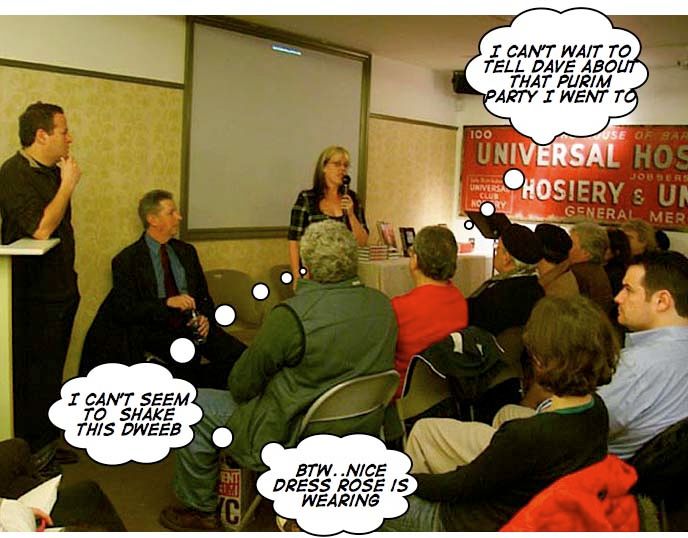
I was looking at one of my favorite sights, the six for five blog of Pat Hamou and lo and behold I spotted myself. The picture there however didn't have the thought bubbles.
From that six for five post
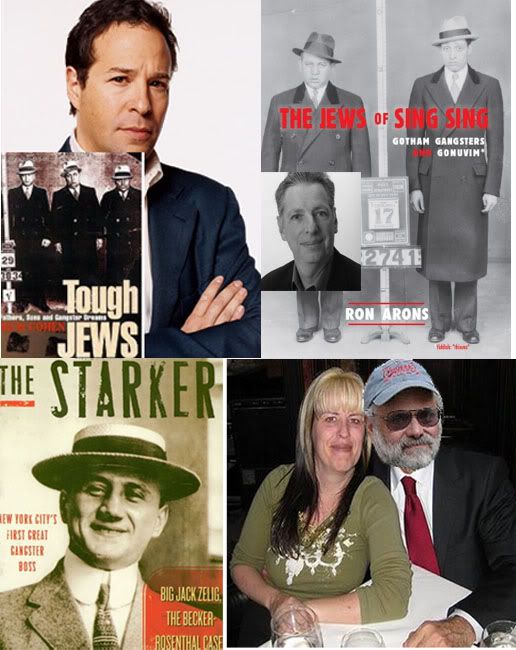
Last Wednesday, March 11, authors Rich Cohen, Rose Keefe and Ron Arons held a talk called 'Jews Behaving Badly' at the Lower East Tenement Museum on Orchard Street in New York City.
The event was ironically held just around the corner from 286 Broome Street (left), the former home of Big Jack Zelig, and the subject of Rose Keefe's book.
Drawing a large crowd, the three authors offered their own views on the history of Jewish Gangsters, read from their books, and fielded many questions in a clear and articulate manner. It seems the entire era still held a fascination with the many in attendance, as their inquisitivness was nice to behold - kudos to the Lower East Tenement Museum for organizing this event.
A stranger irony to the evening however was that it was coincidentally held on the eve of the guilty plea and sentencing of Bernie Madoff the next morning just a few blocks away. While the interest in gangsters past is partly embedded in the lure of colorful characters, larger than life personalities, and the safe, comfortable distance of history; the likes of Madoff and his inexcusable white color crimes are nothing to be glorified or revered. Madoff deserved every year of the one-hundred and fifty that were handed to him and may they pry every dollar out of every corner of his dirty little world in hopes of restitution to those affected by his actions.

Sunday, March 15, 2009

Tenement Museum Event: Jews Behaving Badly, March 11


I was at this event this past week. It was excellent. I got my copy of "Starker" signed by Rose Keefe. Rich Cohen has a future as a stand up comedian. In the discussion one comment was made that would have caused KV group emails to heat up. To paraphrase, "one big difference between Jewish gangsters and gangsters from "other" ethnic groups was that for them it was a one generation deal, they did it to survive, they insisted on the next generation go on to college." Maybe so in many cases, but maybe the next generation had enough of a bankroll from the gangster generation that they didn't need to follow... or those ill-gained profits were moved into legitimate businesses. Or if Joe Columbo Jr. or Jr. Gotti followed their fathers, perhaps the third generation didn't. So what we're talking about is a difference, if any, in "crime" time duration, not natural inclination.
Some links
Rich Cohen's Tough Jews
Ron Roth's, The Jews Of Sing-Sing
Rose Keefe's, "The Starker, Big Jack Zelig, The Becker Rosenthal Case, and the Advent of the Jewish Gangster"
We had a previous post on Jack Zelig last October