Showing posts with label essex street. Show all posts

Wednesday, April 25, 2012

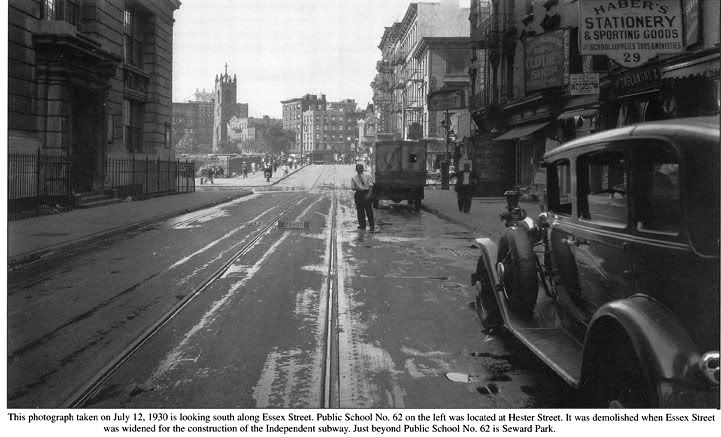
29 Essex Street: Haber's Stationery and Sporting Goods


Viewable on the right side. It was a favorite destination of KVers. Supposedly, Joe Kuperstein once considered becoming an owner. about two years ago from Marsha Algranati Levine:
I lived on Essex St, over Haber's. My mom actually worked in Habers, a pretty short commute. My parents moved into the Seward coop my last year in high school, my mom's still living there. If anyone hasn't been in the old neighborhood for a while, you're in for a big shock, it's changed a lot
.

Sunday, November 27, 2011

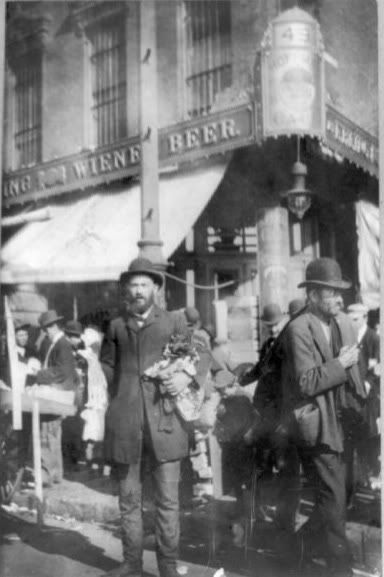
49 Hester Street 1910

This picture was taken just around the corner from 27 Essex Street where garbage was to accumulate a year later. The gentlemen in the foreground is selling socks just in front of the obligatory corner German bar of that era. In time, as the neighborhood would be more densely populated with different Eastern European immigrants, those bars would be less popular and merchant stores would predominate. In 1968, the artist Grace Hartigan would write that Henry's fruit stand which was then located at this address would inspire the painting of her "East Side Sunday." Note: Henry's, at that time, was next to Hollander's Pickles

Saturday, November 26, 2011

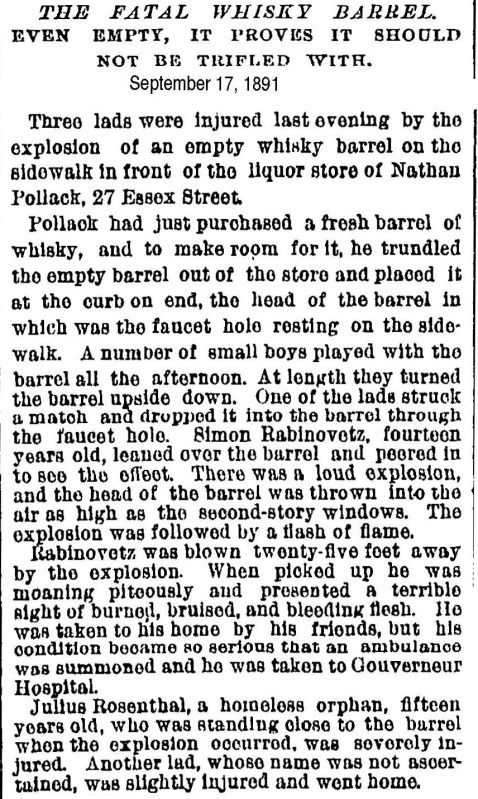
27 Essex Street 1891

Caution, no smoking near whiskey barrels.

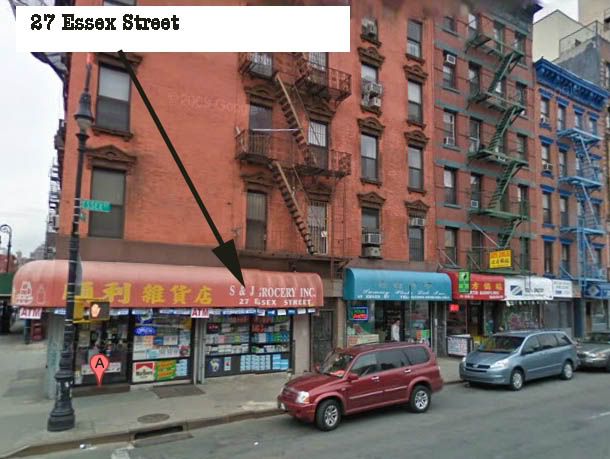
27 Essex Street: Then And Now

The then has a reference to the 1911 garbage strike. The notation in the picture incorrectly refers to PS 26. What is meant is PS 62 which was across the street on the eastern side of Essex at that time. About the 1911 strike from secondat
An article in the New York Times gives some background. The men demanded that they be able to work during daylight hours, mainly for reasons of safety, and the Sanitation Department, which employed them, refused to grant this demand. A snide letter to the editor gives one person's reaction: The reason for the cleaners' strike Is plain to one who's smart; Like most of us they want to choose Their hours a la carte. The city hired strikebreakers and the work stoppage was soon brought to an end. Times letter writers saw the conflict as a test of power between the Teamsters Union and city government. Some supported the union and some supported government, but most simply wanted their ashes collected and the streets cleared of accumulating trash. LC's photos are from its Bain News Service collection. The garbage trucks of the day consisted of one man, one horse, one cart. The city operated more than 20,000 of them. I appreciate the dignity of the horses shown in the photos: alert, patient, and strong. The images seem to show a police force intent on preserving order without taking sides. In them the faces of strikebreakers show a lack of confidence, maybe just nervousness, maybe fear. The faces of the crowds in the street show everything from anger, to interest in the spectacle unfolding before them, to the well-known New Yorker's seen-it-all aloofness.
What I gleamed from David Ziskind's One Thousand Strikes The workers were striking for a 48 hour week and relief from annoying regulations and arbitrary discipline. When any driver was found with garbage containing ashes, even though they may have been mixed by householders, the driver was fined several days pay.

Saturday, November 12, 2011

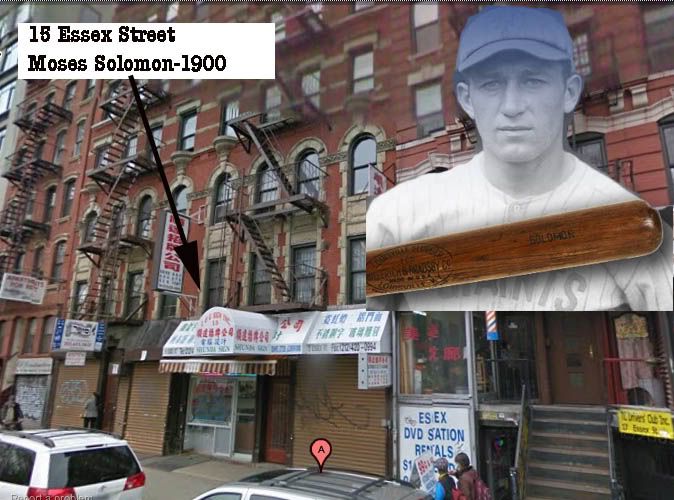
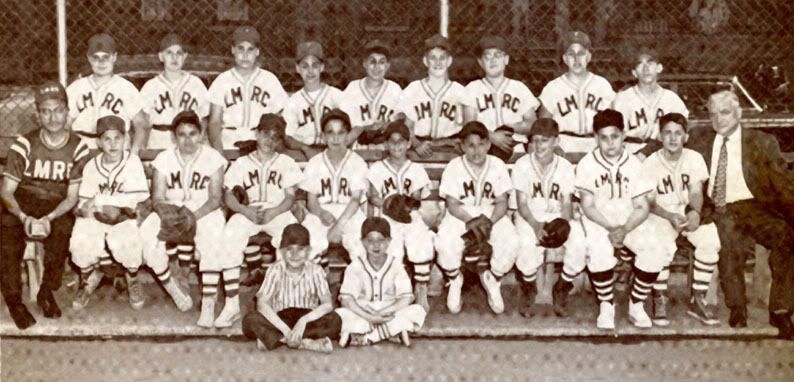
Who's Almost Who In Knickerbocker Village History: Moses Solomon

About Moses from passion4baseball:
Moses Solomon was born on December 8, 1900 in New York City. He was the son of Russian immigrants, Benjamin and Anna Solomon. The elder Solomons were married in Russia in 1884 and came to the United States in 1891. They had eight children in all and Moses was the fifth of the eight. In 1906, the family moved to Franklin, Ohio and Benjamin worked for a junk dealer. Moses also worked for the dealer and is listed in the 1920 census as a time keeper for the dealer. A year later, Moses played baseball for the Vancouver Beavers in the Pacific Coast International League. He played in 115 games and batted .313 with 13 homers. Not bad for a first year in professional ball. He only played in a few games in 1922 but still batted .303. But it was 1923 that would make him a legend. By 1923, he had signed to play for the Hutchinson Wheat Shockers in the Southwestern League, a Class C league. He played mostly first base for the Wheat Shockers and had one of the most memorable seasons in minor league history. In 134 games, he batted 527 times, piling up 222 hits for a .421 average. He hit 40 doubles, 13 triples and 49 homers. The 49 homers set a minor league record and only the great Babe Ruth had more in professional baseball. McCarthy heard of Solomon's exploits and amidst much hoopla, purchased his contract and brought him to the Giants in September of 1923. He made his major league debut on September 30 and played two games. In eight at bats, he had three hits including a double and drove in a run. It would be the only two games he would ever play in the major leagues. The Giants found out about an aspect of Solomon's game that would prove to be his undoing. He couldn't field. The same minor league season where he set the record for home runs, he made 25 errors. He made an error in the two games he played in the outfield for the Giants. He was the Ron Bloomberg of his time. All hit, no field. Moses Solomon continued after the 1923 season to bang around the minor leagues. He played through 1929 and batted over .300 three times, but his total home run output of all those seasons did not come close to totaling as much as his 49 in 1923 alone. One source indicates he also played football, but no record can be found as such. By 1930, he is listed in the census as being back in Franklin, Ohio with his wife, Gertrude and two young children. His occupation is listed as, "Agent." His Wiki page states that he went into real estate and did quite well. The Rabbi of Swat died in Miami, Florida in 1966. Moses Solomon (or Mose) only played two games in the major leagues, but not many people could state that his career ended with a .375 average. Imagine if the guy with the .313 minor league career batting average could have caught the ball. His minor league record of 49 homers was broken in 1924 by Clarence Kraft who hit 55. Kraft didn't hold the record long himself as a guy named Tony Lazzeri (you may have heard of him) hit 60 in 1925.

Sunday, October 30, 2011

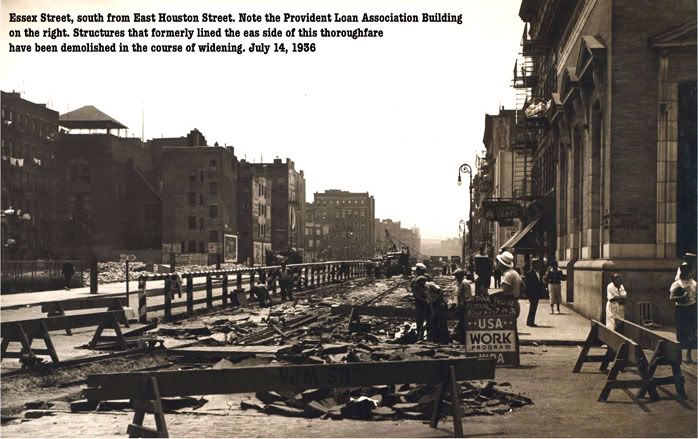
Essex and Houston Street: 1936

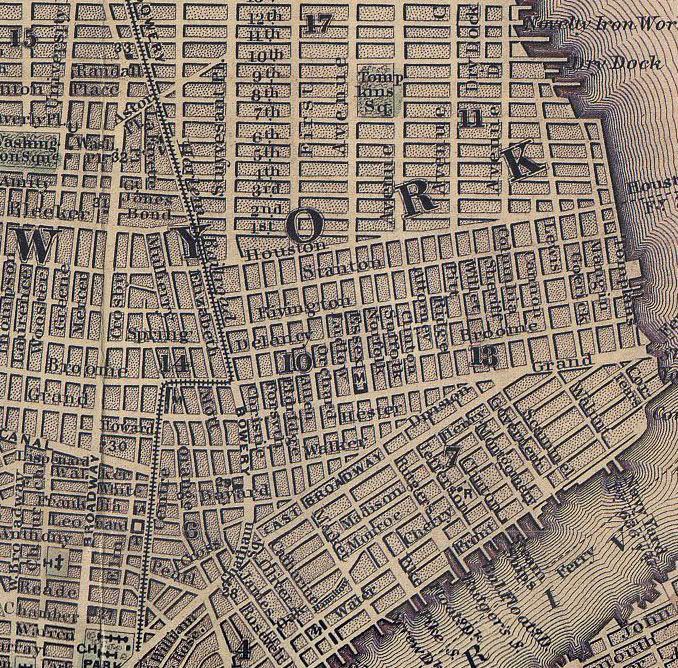
Essex Street had to be widened for the construction of the 6th Avenue subway. The route would turn eastward from 6th avenue after the West 4th Street stop, eventually passing below Houston until Essex. From there it would turn south towards East Broadway.