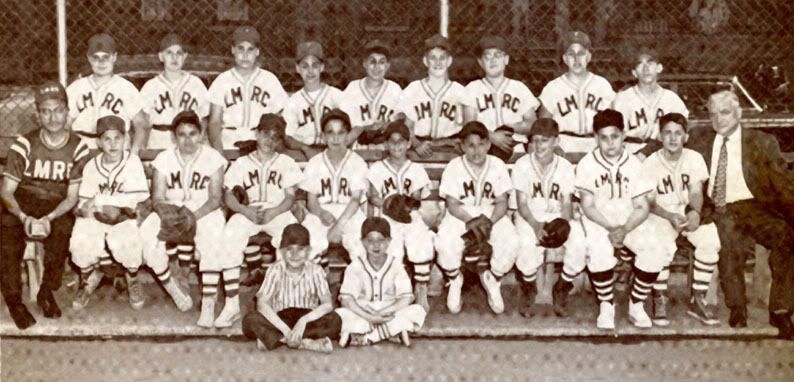
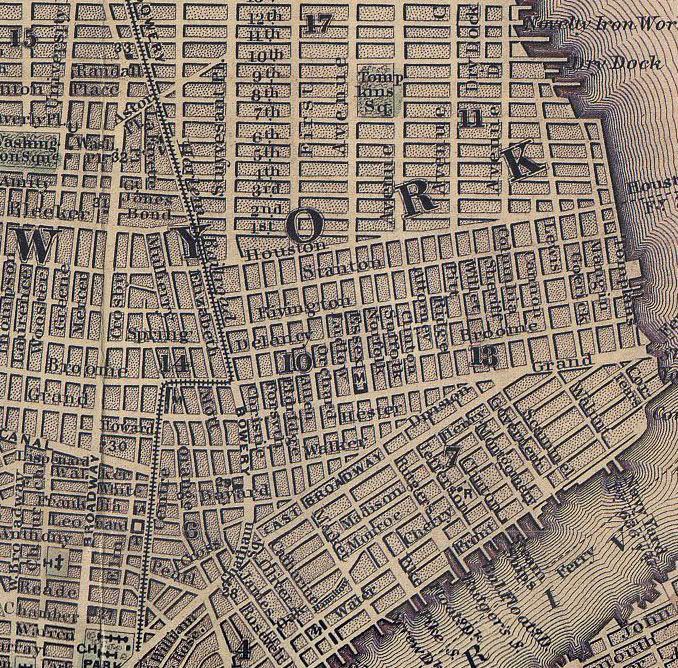
I had to pinch hit for Rob Hollander's and les projects' five points tour a few weeks ago. Along with Rob's "course of study" this site by Gregory Christiano was one of the best resources
Gangs Five Points
Showing posts with label five points. Show all posts
Showing posts with label five points. Show all posts
Friday, October 16, 2009


Sunday, July 12, 2009
Monday, September 29, 2008
Dedication of the Five Points’ Mission House,” New-York Daily Times, June 18, 1853
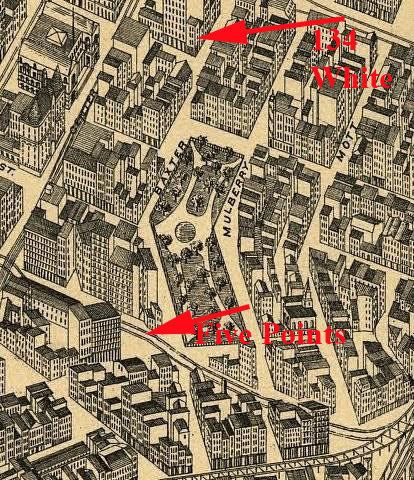
The map is from 1903. The web source of the article is the lost museum
This newspaper article describes the 1853 opening of the Five Points Mission House, a Methodist mission located in one of New York City’s most impoverished neighborhoods. The article illustrates the attitudes that motivated urban missionary work in an “infected district of the City” that was predominantly Catholic, and reflects how Protestant evangelism, poor relief, and reform went hand in hand during the antebellum era. The Five Points’ Mission House, erected on the site of the Old Brewery, was opened yesterday afternoon with religious services, as the centre of missionary and humanitarian enterprize in that infected district of the City. Notwithstanding the excessive inclemency of the weather, a very numerous and highly respectable audience, the majority of whom were ladies, assembled in the Chapel of the Mission House. The children of the schools attached to the Mission were also in the room, and sang some simple hymns during and after the services. Amongst the several clergymen who participated in the proceedings we noticed: Rev. Dr. Bangs, Dr. Floy, Rev. J. B. Wakeley, and S. Martin-Dale. Messrs. Heath and Devois, Missionaries on their way to California, were also among those present. After the usual religious exercises, the Rev. Dr. Floy (of the Madison street M. E. Church,) delivered an appropriate discourse . . .It should be borne in mind that the house they stood in was erected solely for the relief of the poor. Nor was all that toil and trouble expended merely that the wretched sons of want might there find a home; nor was it in order that the little children, once running wild through this most wicked quarter of this wicked city, might be taken in there and taught to read and write. Its object was not to supply merely temporal wants. It had a holier end in view—one that, in the present day, was too much forgotten—for at this very period there was a widely diffused kind of infidelity that would place the temporal benefits of the poor above their spiritual wants, and inculcated as the paramount duty, that to clothe the naked and feed the hungry were the first labors of Charity. It would be far from his intention to say anything against that kind of charity either. But he would go much further—he would have the Charity exhibited by the Redeemer, who, during this mission, labored more to supply the necessities of the immortal soul, than those of the frail mortal body. Charity such as that was simply the teaching of pure Christianity, and for such an object, primarily, that building had been erected. He yielded to no man in his firm devotion to that phase or form of Christianity which he, in his ministration, was called upon to preach, and at whose altars he was a listener. But he never would unite himself to such an undertaking if its objects were merely sectarian—the elevation of one sect over another, or the promotion of any form of religious bigotry. The object of the enterprise was not that men might be made Methodists, but that they might be made members of Christ’s Church, and walk in the way of His law. Then as of secondary importance their temporal wants might be supplied, and, subsequently, if they should seem it good to them to seek Heaven in the same path in which the Methodists do, so much the more certainly would harmony be insured. Dr. F. then went on to speak in regard to the civilizing influences of Christianity. The knowledge of Christian truth removed ignorance much more efficaciously than mere secular instruction. . . .Rev. J. B. Wakely briefly addressed the meeting, stating that the Society was at present in debt some $15,000, and urged its friends to be liberal and open-hearted in their contributions for its aid. . . .
Five Points Mission 2
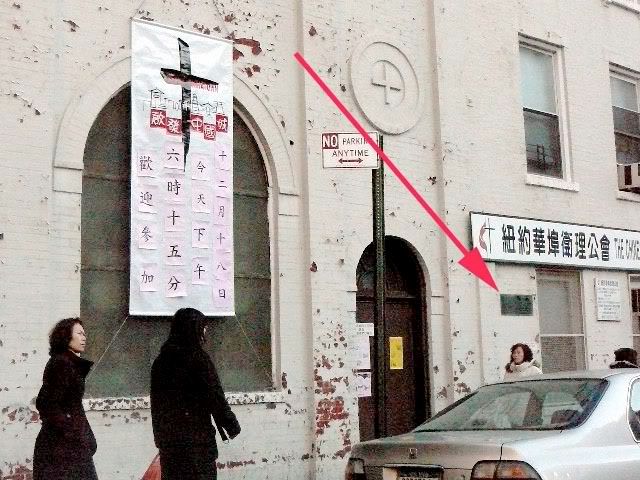
A follow up to a previous post that showed the highlighted plaque
below information about the mission from the Five Points Mission site
Located at 69 Madison Street. The church was established in 1966 at Five Points Mission on Madison Street to serve the growing population of new Americans from Hong Kong and China; and the church's first community programs included an after school center, English language class for adults, boy scouts, Chinese folk dance class and the summer children's center. In 1970 the church was renovated and additional spaced added. In 1972 the Chinese Methodist Center was formed. As the church grew, new programs were continually added; and today the center has 8 full time and 33 part time staff members. Programs include the Mei Wah Day Care Center, The Mei Wah School-After School Center, Chinese Methodist English Institute, A Your Recreational Center, A Community Service Group, A Summer Day Camp, Tai Chi Chuan, Piano Lessons and a wide variety of programs for high school and college students. Chinese language and English languages church services are held, and the Flushing Mission in Queens has many programs for new Americans. The church acts as an advocate and participates in community affairs.
Wednesday, September 24, 2008
Five Points: Gangs Of New York, Part 1
From a documentary done by the History Channel a few years ago called the real Gangs Of New York
Five Points-Part 2
from bowery boys once again. Part 1 of part 2 of their August 2008 series on the Five Points. This time I experimented with pairing the audio with video from a masters of photography series that's been youtubed by user cybelephotography
The photographers highlighted here are Jacob Riis, Eugene Atget, Helen Levitt and Alfred Stieglitz. Some of it works, some of it doesn't. If it's distracting, just close your eyes and listen to the history of the 6th ward. KV is in the old 4th ward.
Tuesday, September 23, 2008
Five Points History
Audio from an excellent 2 part podcast from the bowery boys'from august 2008
There should be over 50 images in this slide show but very few are showing. Some of the main sources are Patrick Reynold's comic history of New York City, Big Apple Almanac and
stills from the Gangs Of New York via Evan Richards cinematography blog and the map blog from the nypl digital collection
Five Points was a neighborhood area in Lower Manhattan, northeast of City Hall, at the intersection where Baxter [formerly Orange], Worth [formerly Anthony], Park Street [formerly Cross] came together to form a five point intersection. The area was made famous in the book, The Gangs of New York, by Herbert Asbury, 1928, and the screenplay to the 2002 movie. Matthew Dripps’ 1852 map, pl. 2, has the original street names, and notes the presence of the Pirnics Distillery, but not the Mission or House of Industry.
Matthew Dripps’ 1867 map of New York, pl. 5, still shows the House and Mission. G. W. Bromley’s 1879 Atlas, pl. 4 and the 1885 Robinson atlas, pl. 4, continues to show the Five Points House of Industry and the Five Points Mission, just south of The Tombs, notorious prison. The 1867, 1879 and 1885 maps all show a small underground stream in the area with a dashed line. This Five Points website has additional historical information about Five Points. The Sanborn Manhattan Landbook, pl. 8, shows the current situation with the N.Y. State Office Building and the New York County Courthouse on the old Five Points site.
Five Points Mission
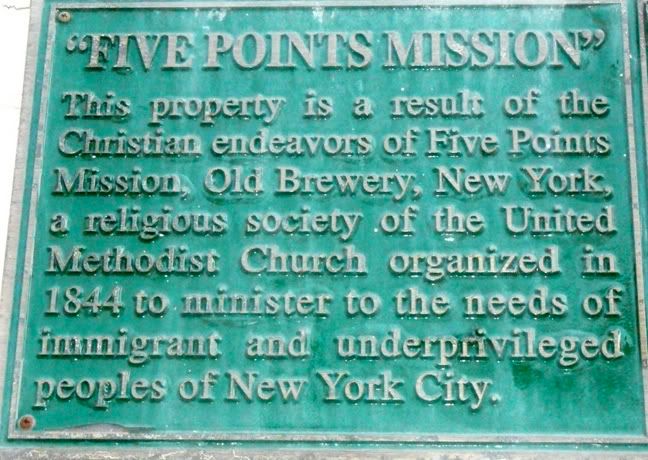
Interesting this plaque is not found in the Five Points, but just a block away from Knickerbocker Village
Subscribe to:
Posts (Atom)


 Posts
Posts