Showing posts with label speakeasies. Show all posts

Monday, April 5, 2010

Hirshfeld's Speakeasies: 1932

Hirshfeld Speakeasy
from amazon
Prohibition was in its last gasp; the Depression still gripped the nation, and New Yorkers found ever more creative ways to tipple, in hideaways from Harlem to Greenwich Village. “Many law-abiding people now thought it was their patriotic duty to drink,” Pete Hamill writes in his introduction to The Speakeasies of 1932. “The speakeasy was a forging ground, a place where issues of class and race could be submerged in the name of a larger goal: the simple good time.” Hirschfeld, who died in January, would go on to immortalize Broadway stars in the Times. Kahn, who died in 1962, was a prolific screenwriter until his refusal to name names landed him on the Hollywood blacklist. Before all that, however, these lifelong friends deftly captured the Manhattan demimonde with a gimlet eye and a Runyon ear.

Speakeasy Corruption: 1931

Speakeasy Corruption 1931
I tend to doubt that Anthony Lapi's bootlegging enterprises were part of the Liberty League.

Friday, March 12, 2010

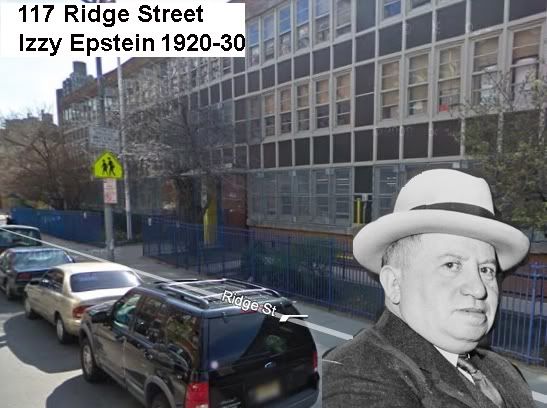
Izzy Epstein: 117 Ridge Street


Izzy (Isidor/Isadore) Einstein (ca. 1880 or 1883–17 Feb 1938) and Moe Smith (ca. 1887–1961) were American police officers, specifically agents of the US Prohibition Unit, during the first years of the alcohol prohibition era (1920–1925). They were well known for successfully shutting down illegal speakeasies and similar drinking establishments.
Izzy and Moe operated between 1920 and 1925 in New York. They were known for using disguises and made 4,932 arrests, of which 95% ended in convictions (around 4,680). When in 1927 Izzy was "offered" a transfer to Chicago, he quit. In the 1930 US census, his occupation is listed as "broker/insurance"
Isidor Einstein was born in Austria to Austrian parents ca. 1883[2] or 1888[1] and was a native speaker of Yiddish. He emigrated to the United States ca. 1901. He married Esther Einstein (b. ca. 1888, Austria/Galicia; imm. ca. 1891) ca. 1906, and they had at least seven children: two deceased by 1910, Joseph (ca. 1910), Charles (ca. 1912), Edward (ca. 1914), Albert (ca. 1916, not the famous theoretical physicist Albert Einstein), and Milton (ca. 1927). In April 1910, he was a retail merchant in a general store in Conyngham, Luzerne County, Pennsylvania. In January 1920, he was a mail sorter in a post office in Manhattan.
Einstein's obituary in the magazine Time: "Died. Isidore ('Izzy') Einstein, 57, most famous Prohibition agent; ten days after amputation of his right leg; in Manhattan. With his partner Moe Smith, Izzy operated so successfully on what he called the "Einstein Theory of Rum Snooping" that as direct result of his raids 4,932 bartenders, bootleggers, speakeasy owners tripped to jail. Izzy liked to "play" streetcar conductor, gravedigger, fisherman, iceman, opera singer. He walked into the Democratic National Convention of 1924 (Manhattan) with a goatee glued to his chin, announcing himself as a delegate from Kentucky, found only soda pop." He is buried at Mount Zion Cemetery, Queens County, New York.

Speakeasies, Moonshne and Whiskey Blues

Tuesday, March 9, 2010

Speakeasies Redux

Speakeasies
an excerpt from a 2009 nytimes article on speakeasies,
Bar? What Bar?, By WILLIAM GRIMESON, a nondescript block in Williamsburg, not far from the Brooklyn-Queens Expressway, a new bar and restaurant called Rye opened last week. Try to find it.
There’s no sign out front. The facade, an artfully casual assemblage of old wooden slats, gives the place a boarded-up, abandoned look. It does have a street number, painted discreetly on a glass panel above the front doors, but that’s it. Like a suspect in a lineup, it seems to shrink back when observed.
There are a lot of bars like this right now. They can be found all over the United States, skulking in the shadows. Obtrusively furtive, they represent one of the strangest exercises in nostalgia ever to grip the public, an infatuation with the good old days of Prohibition.
Their name is legion: the Varnish in Los Angeles; Bourbon & Branch in San Francisco; Speakeasy in Cleveland; the Violet Hour in Chicago; Manifesto in Kansas City, Mo.; Tavern Law in Seattle (scheduled to open later this month). Everywhere, it seems, fancy cocktails are being shaken in murky surroundings.
New York has fallen hard for this fad. Sasha Petraske, the cocktail artist behind Milk & Honey, has just opened Dutch Kills on a bleak commercial strip in Long Island City, Queens. A small sign that says “BAR” is the only tip-off to its existence.
At the Hideout, in Fort Greene, Brooklyn, aspiring customers ring the bell at a forbidding-looking garage door and then stand there as a pair of eyes scrutinize them through a 1920s-style peephole.
The ultimate in speakeasy mystification takes place at PDT (Please Don’t Tell) on St. Marks Place in the East Village. Patrons have to enter through Crif Dogs, the hip hot dog place, then step into a phone booth and identify themselves by speaking into the receiver. A buzzer opens a secret door, revealing a strange, twilight world where artisanal cocktails are consumed under the watchful eyes of a stuffed jackelope and raccoon, and a bear wearing a bowler hat.
Whoopee!
“Speakeasy is a funny term, since the business is legal,” said Eric Alperin, a partner and head bartender at the Varnish. “What people are referring to is the allure, almost like an opium den.”
Brian Sheehy, an owner of Bourbon & Branch, agreed. “People have an affection for this period of American history, and they want the mystery,” he said. To enhance the backroom ambience, Bourbon & Branch assigns customers a password, to be spoken into an intercom, when they make a reservation. Once inside the bar, customers are expected to abide by house rules. “Speak easy,” is one of them, enforced by bartenders when necessary.
Password or no password, deluxe or down-low, all these bars have something in common. None of them really resemble an actual speakeasy from the 1920s, although Bourbon & Branch, oddly enough, sits on top of one, reached through a trap door leading to the basement.
A little history, please.
Prohibition, which took effect in January 1920 and finally ended in December 1933, was the worst cocktail era in the history of the United States, for obvious reasons. Half the liquor was homemade or adulterated, forcing the great classic drinks of the early 20th century to exit the stage. In their places appeared cocktails designed to mask poor ingredients, like rye and ginger ale, or the Alexander, a repellent mixture of gin, crème de cacao and cream.
“The basic raw materials then available, and I use the term raw advisedly, made it imperative that they be polished or doctored or decorated,” Frank Shay wrote in a 1934 Esquire article bidding farewell to the Great Experiment. “Also it was essential that their rougher edges be smoothed down in order that they might pass to their true goal without too great distress to the drinker.”

Division Street Speakeasy: 1932

Alcohol Poison 1932
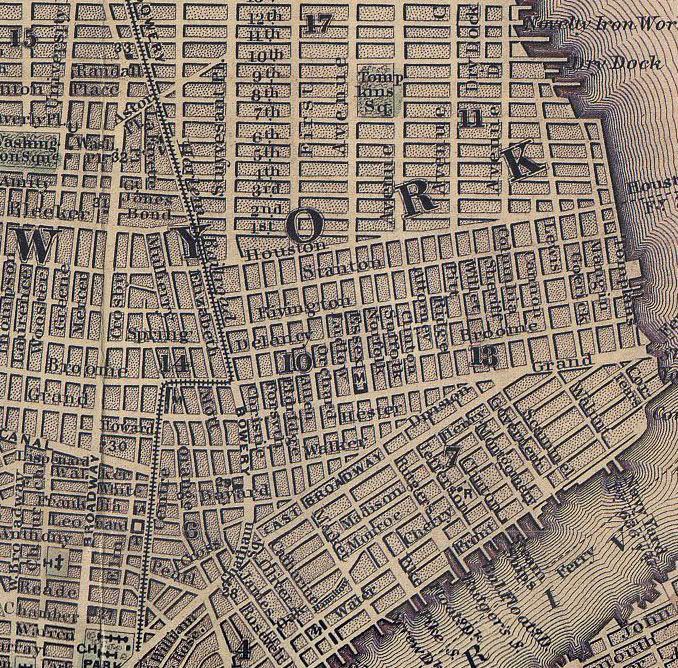
by 1932, the East Broadway, 10th Ward area is no longer fancy. Many local residents were dying of alcohol poisoning.