Showing posts with label market street. Show all posts
Showing posts with label market street. Show all posts
Friday, April 20, 2012
The Empty Lot On Henry And Market: 1932


Saturday, November 12, 2011
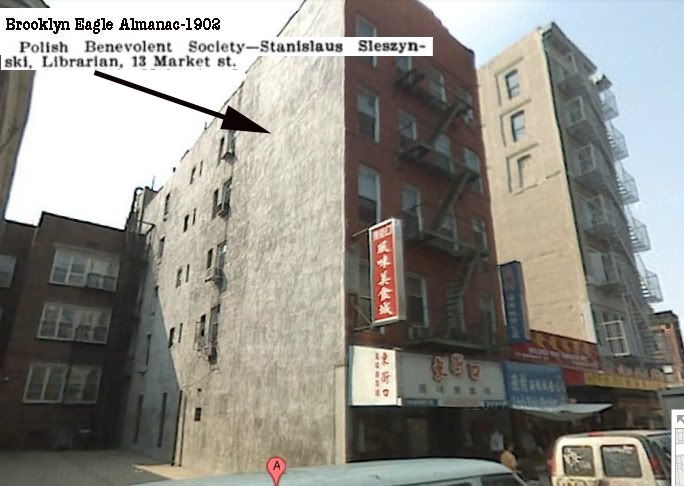
13 Market Street: Former Site of the Polish Benevolent Association/Library
A Hidden 4th Ward Reference In Mr. Skeffington
Saturday, October 1, 2011
Lamula Opposes Santangelo, 1951

Monday, April 25, 2011
38 Market Street History: 1888
38 Market
Note the wrong diagnosis and the subtle racism shown in portraying the Italian immigrant as the carrier of the Yellow Fever and the need to isolate him. 38 Market still looks like it once housed a doctor's office.
Note the wrong diagnosis and the subtle racism shown in portraying the Italian immigrant as the carrier of the Yellow Fever and the need to isolate him. 38 Market still looks like it once housed a doctor's office.
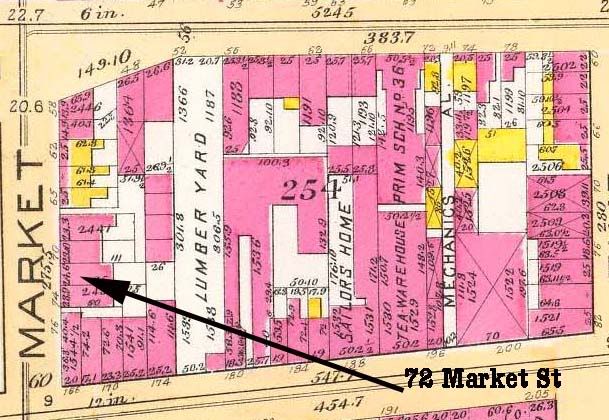
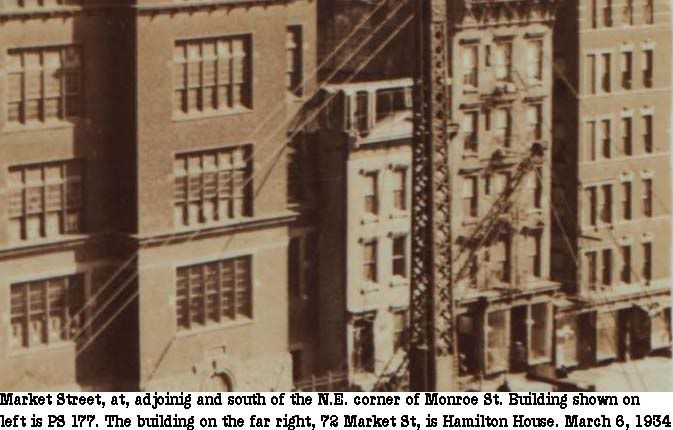
72 Market Street History
72 Market
I guess riding in a Tally Ho Coach was just asking for it.
PS 177 was in the second district.
I would guess William Homan of 72 Market Street, Mrs. John Kehoe of 37 Catherine Street, Miss Jenny Montgomery of 52 Market Street, Fred J. Seelig of 13 Allen Street
and Dr. William Henry of 97 Henry Street were all citizens of some stature to be on the school board.
I guess riding in a Tally Ho Coach was just asking for it.
PS 177 was in the second district.
I would guess William Homan of 72 Market Street, Mrs. John Kehoe of 37 Catherine Street, Miss Jenny Montgomery of 52 Market Street, Fred J. Seelig of 13 Allen Street
and Dr. William Henry of 97 Henry Street were all citizens of some stature to be on the school board.
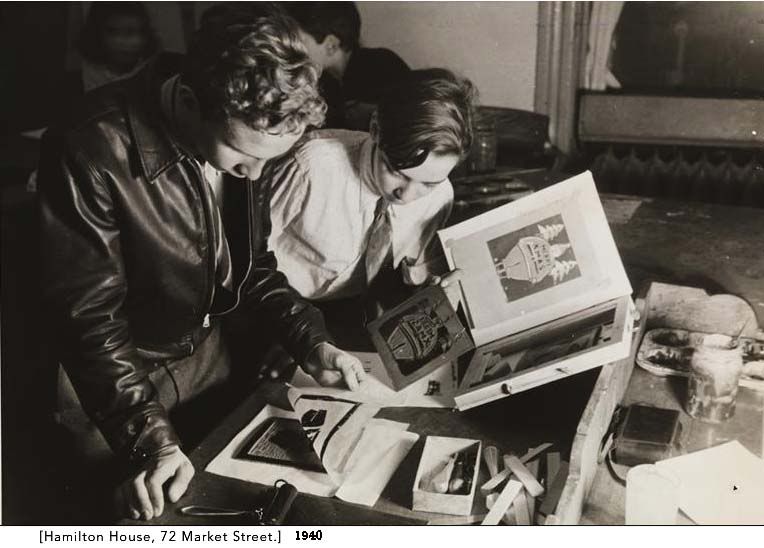
Hamilton House: 72 Market Street, 1891 site
Some Hamilton Madison House History
Timeline
1898 In Spring, Madison House of the Downtown Ethical Society is founded at 300 Madison Street.
1900 Under the leadership of Board Member, Bella Moses, mother of Robert Moses, Madison House embarks construction of a permanent summer camp.
1902 Hamilton House is founded on Hamilton Street. On June 17th Hamilton House is incorporated.
1910 Madison House acquires a building at 216 Madison Street.
1915 In November, Hamilton House moves from Hamilton Street to 72 Market Street.
1920 In September, the summer camps are replaced by Camp Rossbach for both boys and girls at Tompkins’ Corners near Peekskill. This camp later becomes Camp Madison and later is known as Camp Madison-Felicia.
1925 In the mid-twenties, Madison House is incorporated.
1926 Dr. Algernon Black becomes Headworker at Madison House until 1930.
1929 The building at 226 Madison Street is completed
1930 During the next ten years, Madison House provides facilities for WPA workers who serve the neighborhood’s cultural, health and social needs.
1941 World War II starts. Mrs. Josiah Willard, President of Hamilton House, from 1952-1954 and Helen Greenebaum, Headworker, share the task of managing the House during the war years.
1947 The neighborhood population becomes primarily by African-Americans and Latinos. Friction between the pre-war community and the newcomers escalates. Teenage gangs present an acute problem. Geoffrey Wiener is Headworker. Helen Hall, Headworker of Henry Street Settlement and a member of the Hamilton House Board, urges Mr. Wiener on. The budget is $12,000, with a deficit carried by Henry Street Settlement House.
1950 In the 1950s the first Hamilton-Madison House Thrift Store opens on Madison Street. The thrift store moves uptown to Third Avenue and moves again on Third Avenue before locating on Second Avenue.
1951 The Golden Age Group of Chinatown is established as a group of Chinese senior citizens at Hamilton House.
1952 In February, Hamilton House offers counseling and family care work as an experimental project through an arrangement with the Family Services Division of the Community Service Society of New York
1953 When the second half of Smith Houses is completed, a community space and a 55 child pre-school Day Care Center are allocated. Hamilton House is named the sponsor. In a dedication ceremony in March 1953, Mrs. Franklin Delano Roosevelt is the principal speaker.
1954 HAMILTON HOUSE and MADISON HOUSE MERGE
1954 Mrs. Shirley Chisholm is named the Director of the Child Care Center of Hamilton-Madison House.
Saturday, April 23, 2011
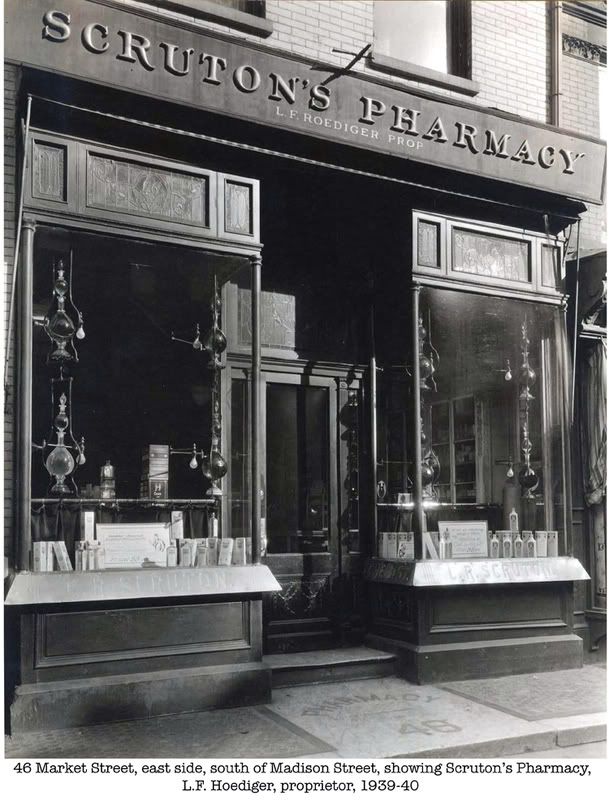
46 Market Street History
46 Market History
Evidently there was some hanky panky in the Scruton's acquiring of 46 Market Street.
Mr. James of 46 Market appears to be a man of some money with his Tally Ho coach.
Evidently there was some hanky panky in the Scruton's acquiring of 46 Market Street.
Mr. James of 46 Market appears to be a man of some money with his Tally Ho coach.
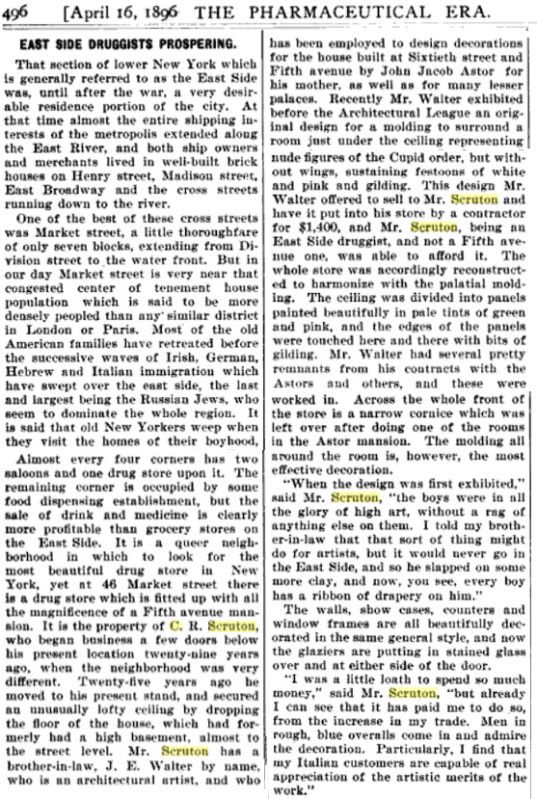
An Article About Scruton's Pharmacy In 1896
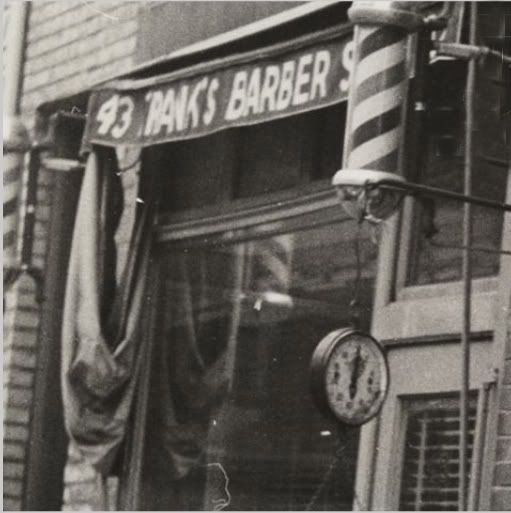
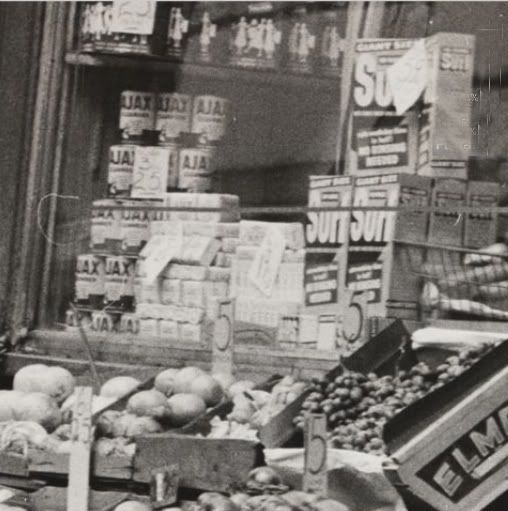
46 Market Street, 1939: C.R. Scruton's Pharmacy
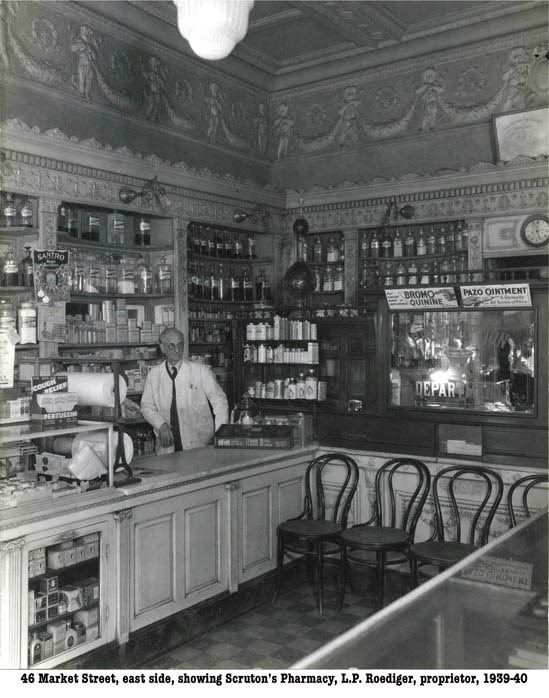
below a close-up of the display
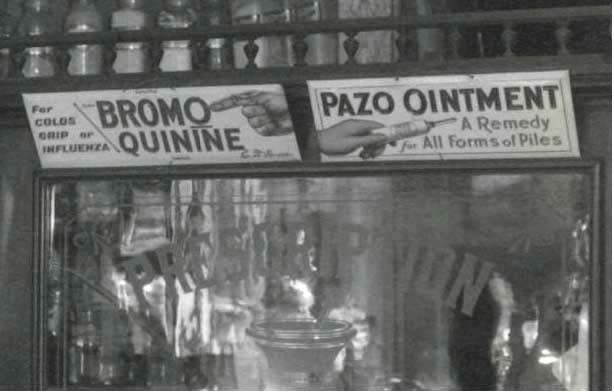
and also with a close up view
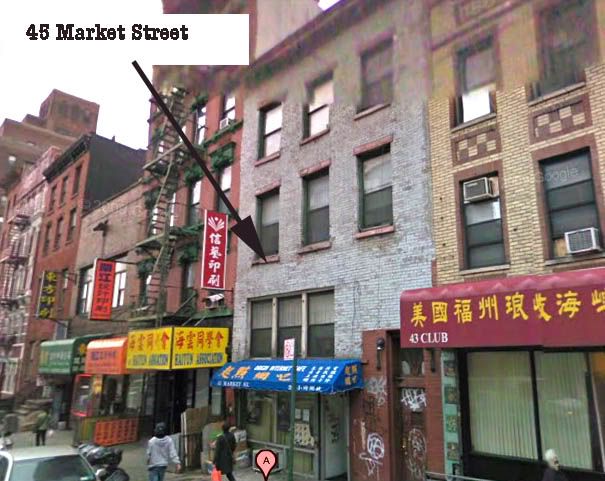
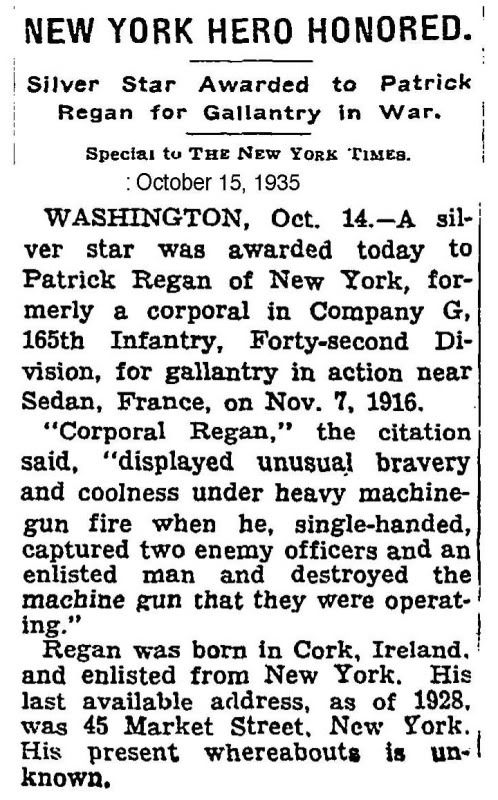
Friday, April 22, 2011
More 43 Market Street History
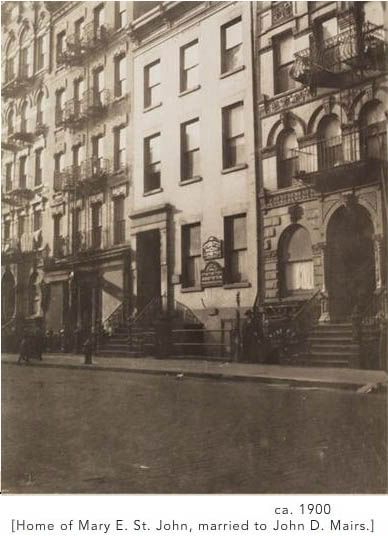
The above is not a building on Market Street. I'd guess somewhere on Madison or Henry. Mary instead lived at 43 Market in 1900. Below is part of the census report for that address. Looks like Mary may have had some money. She appears to have a servant. The money must have been "old", because from the census the block is populated with working class types.
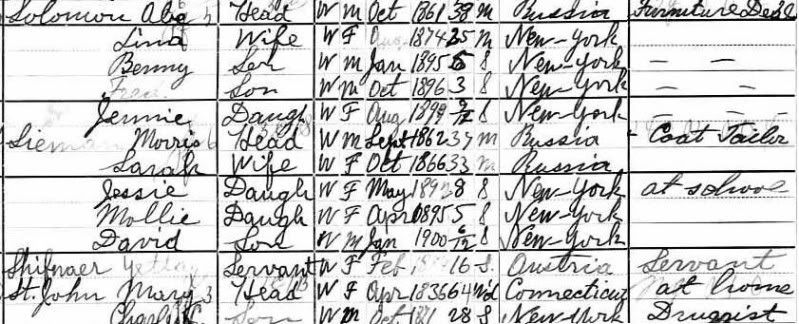
from an ancestry message board
Dear James,
I am actually a bit familiar with your family, but just a bit and only very recently. I am from the LaTourette family and I just finished up some basic research for a staff writer for the New Yorker Magazine. They are doing (or thinking of doing) an article on Golf Courses within the NY City limits. This is what I know, and again a bit limited:
From the NYC directory of 1869.
Mairs John Dows, mer. 20 South, h 114 E. 36th (he is a Merchant)
And I also found this today:
JOHN DOWS MAIRS, merchant, who died in Irvington-on-the-Hudson, Oct. 3, 1881, in his 54th year, was a native of Utica, N.Y., and a nephew of David Dows. He began life as a clerk for Mr. Dows, who entertained a sincere respect for his competent young nephew. He was drawn away to California for a time but returned to New York and by invitation of the senior partner entered the firm of David Dows & Co. in 1854. In the affairs of this house, he spent the rest of his life, gaining a fortune and the esteem of the whole mercantile community. He was a member of the Produce Exchange from its organization.
He married a woman by the name of Mary St. John and this is the obit I found on her:
The notice of her death was in the New York Times, 04/30/1906:
Mairs - On Sunday morning, April 29, Mary E. St. John, widow of the late John D. Mairs,
Funeral services at her late residence, 14 West 54th Street, on Tuesday morning, May 1, at 10 o'clock. Kindly omit flowers.
Their son was Edwin Hays Mairs and I believe they also had a daughter named Mary Dows Mairs who married Rev. John Betts Calveret.
Edwin Hays Maris married my distant cousin Catherine LaTourette Evans and they had four children that I know of (I could dig for more information): John Dow Mairs; Mary St. John Mairs; Joanna LaTourette Mairs and Walton H. Mairs.
As you probably know, John D. Mairs was born May 5, 1886, married Feb. 14, 1911 to Mary Dake Mattison, and died May 2, 1928. And I have them having at least three children: Edwin Hays Mairs; Unknown female Mairs and John Dows Mairs. You know the rest.

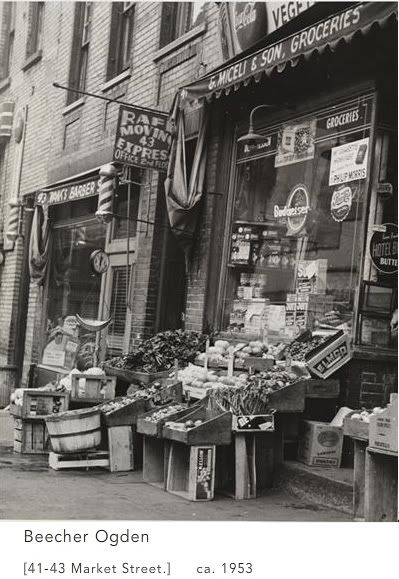
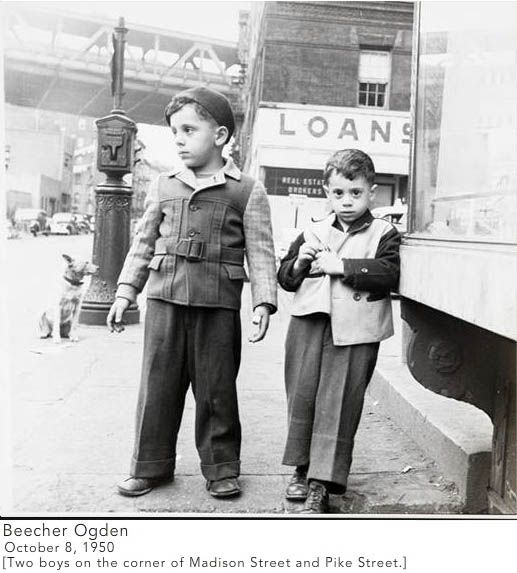
Madison and Market Street: 1950
below, a close up of the above

Sunday, March 7, 2010
51 Market Street: The William And Rosamond Clark House
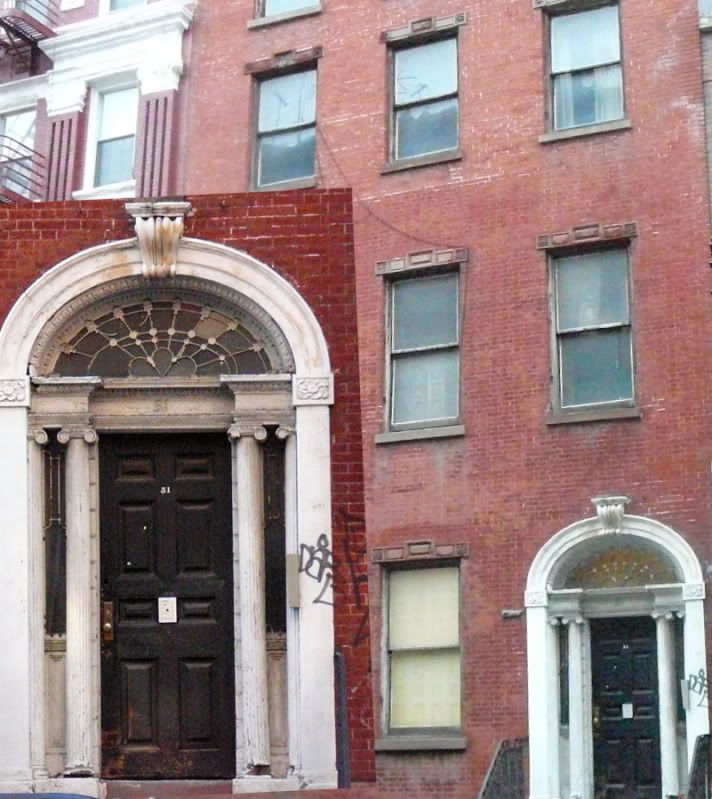
an excerpt from a 2003 nytimes article on downtown federal style landmarks including 51 Market Street
Downtown, Federal Era Blooms in Hiding, By DAVID W. DUNLAP.
To imagine a genteel park at the entrance to the Brooklyn-Battery Tunnel, as Mayor Michael R. Bloomberg does in his grand plan for Lower Manhattan, it may help to remember that this was once a genteel neighborhood indeed.
And if you pause long enough to take it in, the Robert Dickey mansion at 67 Greenwich Street can help conjure that era, two centuries ago. Ignore the fire escapes for a moment and the thick coat of battleship gray, the long-shuttered hardware store and the advertising banner on the Edgar Street facade. (Edgar Street? Yes, named for William Edgar, a 19th-century merchant whose own mansion was nearby.)
Concentrate instead on the complex keystones in the second- and third-floor lintels, which undulate almost like small bolts of linen. Note the lively dot-dash-dot pattern of Flemish bond masonry: short brick ends (headers) alternating with longer brick sides (stretchers). Above all, walk around to Trinity Place, where the house presents an elegant bow in the shape of a half-oval. Those windows once framed a view of Dickey's garden, where the MC Exchange Tavern now stands.
For size and sophistication, 67 Greenwich Street is a rare specimen. But as a type, it keeps good company. Throughout Lower Manhattan are dozens of houses built in the early decades of the federal republic, from the 1790's to the 1830's.
Intended for merchants and tradesmen and shopkeepers as New York burst from its provincial cocoon to become the young nation's commercial hub, Federal houses recall the lingering influence of English design. Their simplicity reflects the restraint imposed by the high cost of hand labor but also shows that "social customs in New York did not yet demand a pretentious dwelling," Charles Lockwood, a social and architectural historian, writes in "Bricks and Brownstone" ( McGraw-Hill , 1972).
Having survived, Federal houses continue to humanize some tough-edged high-rise precincts with their intimate domestic scale. They also offer a steadying historical anchor in an all-too-ephemeral period. Much of the joy of Federal houses comes from the pleasure of discovering these snug little dwellings that are nestled among the lofts, towers and skyscrapers. Their smallness actually helped protect them before there was a landmarks law, since 20- and 25-foot lots are not attractive individually as development sites.
Today, many of the estimated 300 Federal houses in Manhattan are official landmarks or in the Greenwich Village and Charlton-King-Vandam Historic Districts, subject to regulation by the Landmarks Preservation Commission. The best preserved, inside and out, is the 171-year-old Merchant's House Museum at 29 East Fourth Street (www.merchantshouse.com).
But once you adjust your vision to a two-and-a-half-story level, you can begin to find Federal houses all around. This highly selective field guide offers a few hints for spotting them.
Look first for the inverted-V silhouette of a pitched roof punctuated by dormers, exemplified by the Gideon Tucker House, 235 West Broadway, at White Street, built in 1809 and now the Liquor Store Bar; the James Brown House, 326 Spring Street, near Greenwich Street, built in 1817 and now the Ear Inn; and the Stephen Van Rensselaer House, 149 Mulberry Street, near Grand Street, built in 1817 and now Paolucci's Restaurant. All are landmarks.
Even when roof lines are hard to see, dormers stand out, as they do at 190 and 192 Grand Street, Federal houses near Mulberry Street that now house the Piemonte Home Made Ravioli Company and Florio's Pizzeria and Restaurant.
Don't be fooled by the absence of a pitched roof or dormers, however. The sloping attics of Federal houses were often expanded into full third or fourth floors. How do you tell? Look at the brickwork, typically Flemish bond in the original portion — header-stretcher-header — with all-stretcher courses above.
On the Rector Street side of 94 Greenwich Street, part of a remarkable surviving row of Federal houses in the Financial District, you can see the original peak and discern the angled roof line. This house is also notable for nine splayed window lintels with keystones.
Even when lintels are not so elaborate, they are almost always distinctive. Typically, the ornamentation is restrained but strongly geometric, often in the form of incised lines and recessed panels.
At the entranceways, otherwise simple houses bloom extravagantly. Paneled doors may be flanked by fluted Ionic columns, framed by narrow windows known as side lights and topped by delicate fan lights, elliptical windows with leaded panes in a fan-shaped array.
One of the more astonishing doorways — partly because of its condition and partly because of its location — is the landmark William and Rosamond Clark House, built at 51 Market Street, near Monroe Street, in 1825, when the Lower East Side was a wealthy part of town. Flemish-bond brickwork, incised lintels and a pitched roof can also be seen across the street, at Nos. 44 and 46.
Further testimony to the neighborhood's affluence is offered at the Henry Street Settlement, whose buildings include three adjoining landmark Federal houses at 263 to 267 Henry Street, near Montgomery Street. Notable for Ionic columns at its entrance, No. 265 also has a back porch, visible across the Martin Luther King Jr. Community Park. (When was the last time you saw a back porch in Manhattan?)
Though numerous Federal door surrounds have survived intact, it is less common to see the original wrought-iron balustrades and fences.
That was one reason Mr. Lockwood, the historian, marveled as he beheld two plump iron pineapples, the symbol of hospitality, flanking the stoop of La Lanterna di Vittorio Caffe at 129 Macdougal Street, near Third Street. The newel post and the balustrade also have Gothic arches, acorn finials and a flat plate to scrape mud off your boots
Saturday, April 11, 2009
46 Market Street: Scruton's Pharmacy, 1939, Close-Up
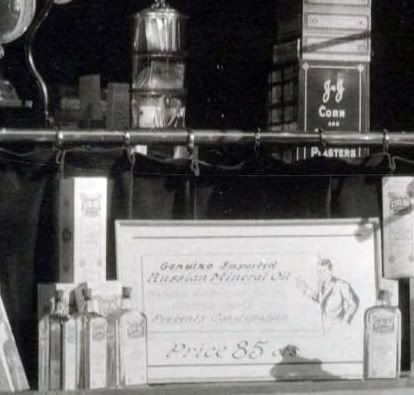
Just $.85 for genuine imported Russian Mineral Oil
Subscribe to:
Posts (Atom)


 Posts
Posts