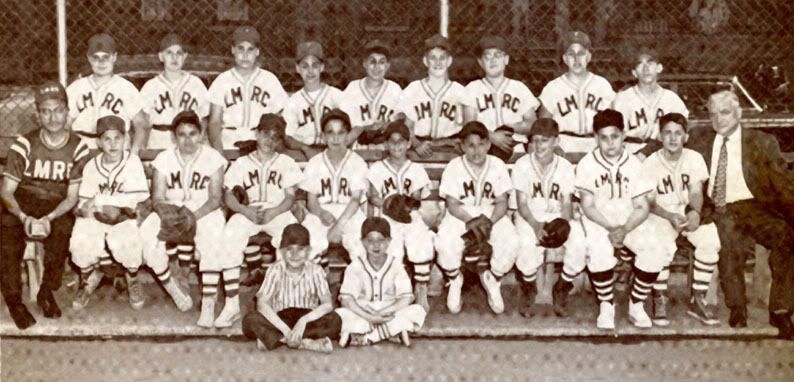
Hale Comics 1
Comic 1 in the series
Showing posts with label nathan hale. Show all posts
Showing posts with label nathan hale. Show all posts
Saturday, July 18, 2009


Nathan Hale Died Here 4
Nathan Hale Post
Pictures that include some of the various sites where there are statues of Nathan Hale and where various groups think his demise was met.
Pictures that include some of the various sites where there are statues of Nathan Hale and where various groups think his demise was met.
Friday, July 17, 2009
Nathan Hale Died Here 3
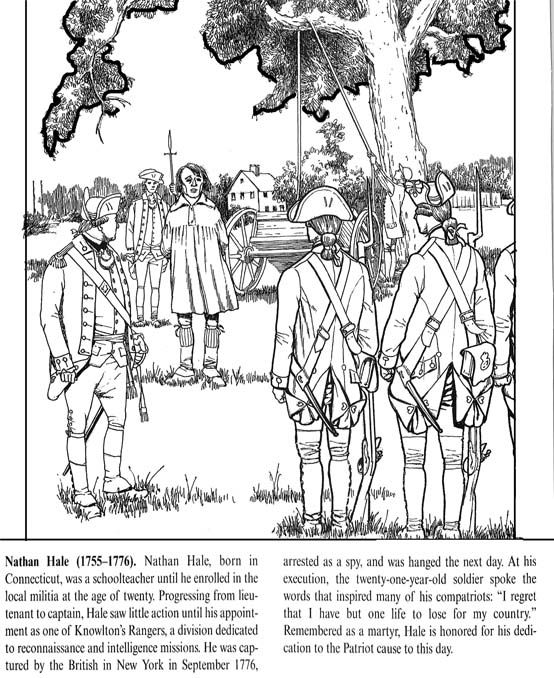
from the nytimes of 11/23/1997
MAKING IT WORK; Nathan Hale Was Here . . . and Here . . . and Here
By DAVID KIRBY
DID the American patriot Nathan Hale meet his fate where a Gap store now stands on Third Avenue at 66th Street? Did he lose his one life for his country at the site of the Yale Club in midtown? Or did the British string him up downtown, at what is now City Hall Park?
Even now, no one knows for sure.
For at least 150 years, historians and Revolutionary War buffs have debated where Hale was hanged as a spy in 1776. History books, biographies and encyclopedias are literally all over the place when it comes to the site of Hale's execution.
There are three places in New York where our hero was supposedly captured, four where he may have been detained and no less than six where he is said to have been hanged.
Many people assume Hale was executed by British troops in present-day City Hall Park. They have good reason: the park was so widely believed to be the site of the hanging that on Nov. 25, 1893, a monument to the ''Martyr Spy'' was erected there.
The next morning, there were glowing accounts in The New York Herald of the grandiose dedication of the monument. But the same day, the paper ran a letter from William Kelby, the librarian of the New-York Historical Society, who said he had proof that Hale went to the gallows near what is now East 66th Street.
The son of a wealthy Connecticut farmer, Hale was said to have been a dashing ladies' man. When Washington put out a call for spies to monitor enemy movements after British troops crushed American rebels in August 1776, Hale was the only volunteer.
Capt. Nathan Hale went to Long Island, passing himself off as a Dutch schoolteacher as he ambled undetected amid the redcoats, probably near the site of the Unisphere in Flushing Meadows Corona Park.
On Sept. 15, 1776, Gen. William Howe brought the British army across the East River, landing at Kips Bay and setting up headquarters at the mansion of the rebel Beekman family, near what is now First Avenue and 51st Street.
Six days later, Hale was arrested by the British, who found military notes in Latin in his shoes. The rest is history, or mystery.
Some say Hale was captured on Long Island. Others say he was caught after crossing the East River and landing smack in a nest of British soldiers, who may have been camped out a cocktail's throw from what is now Elaine's. The most popular theory is that Hale was taken prisoner in what today is downtown New York, during a fire set by the Yankees on Sept. 21, 1776, that destroyed much of the city.
Depending on who you ask, Hale might have spent his final night in the jail on the Commons, where today Mayor Giuliani issues edicts; at Bayard's Sugar Mill on Wall Street, near the site of the New York Stock Exchange; at the Beekman mansion greenhouse or at the Sign of the Dove Tavern, across Third Avenue from where the Gap now stands at 66th Street.
We do know that Hale was hanged on Sept. 22, 1776, after rejecting an offer to switch sides to save his rebel skin. He was just 21.
Speculation about the hanging site seems to have begun in 1825, when one Gabriel Furman of Brooklyn somehow divined that Hale was killed ''on the Brooklyn shore, to the southwest of the old ferry house.''
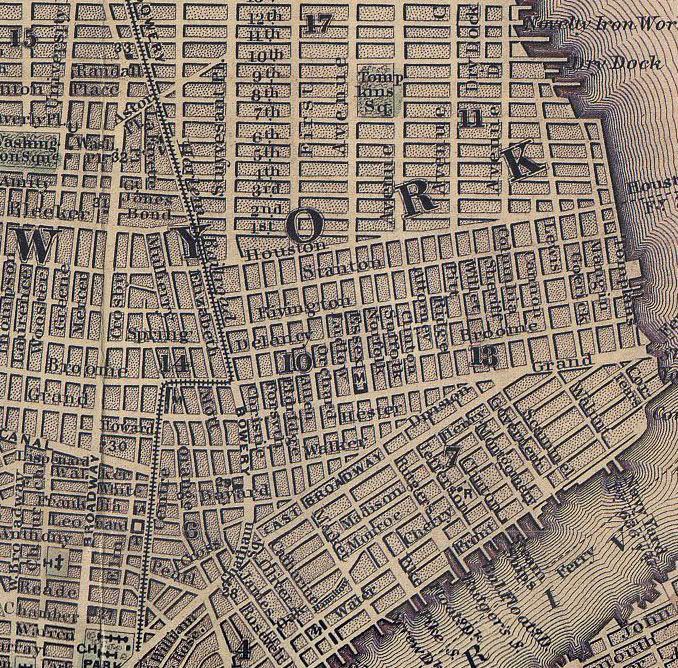
Not so, Henry Onderdonk Jr., a historian, said in his 1846 book ''Revolutionary Incidents of Queens County.'' According to Onderdonk, ''He was hanged upon an apple tree in the orchard of Colonel Rutgers, on the present East Broadway in this city.''
In 1850, Benjamin Thompson, known as the historian of Long Island, identified the spot as being ''in the neighborhood of Madison and Market Streets.''
Then, on Nov. 25, 1893 -- the 110th anniversary of the British evacuation of New York -- Kelby dropped his bombshell: an entry dated Sept. 22, 1776 that he found in the British headquarters ''orderly book.''
''A Spy fm the Enemy (by his own full confession) apprehended Last night, was this day Executed at 11 oClock in front of the Artilery Park,'' it said.
But where was the artillery park? Another entry, from Oct. 11, 1776, refers to one ''near the Dove,'' evidently the tavern. A third entry mentions artillery ''near the five-mile stone,'' the marker five miles north of New York and supposedly near the Dove, on the Boston Post Road, which is Third Avenue, at present-day 66th Street.
So did Kelby solve the mystery? Not really. ''There was a whole series of parks, camps, ammo dumps and bivouacs scattered all over,'' including lower Manhattan, said Ted Burrows, a professor of history at Brooklyn College and an authority on the British occupation. ''We can't know for sure where this particular artillery park was.''
As for the Sign of the Dove restaurant on Third Avenue and 65th Street, it was named after the original, though when Joseph Santo opened it in 1962, he did not know the Hale connection, said Henny Santo, Joseph's sister-in-law. ''Then this woman called us researching a book on Hale,'' Ms. Santo said. ''She claimed to have a British officer's journal saying he'd witnessed Hale's execution, across the Post Road from the Dove.''
But that 1979 book, ''Nathan Hale,'' is out of print, its publishing house has folded, and the author, Susan Poole, has an unlisted number in Cambridge, Mass. Becky Akers, a self-described Hale fanatic who has written about the Revolutionary War period for history journals, is hardly convinced. ''If that journal entry existed, every historian would know of it, and they don't,'' she said.
She added: ''My fantasy is to go in under the Gap with a bulldozer and try to find his bones. But I have a horrible feeling the British just tossed him in the East River.''
To complicate matters further, there is the plaque that has long been on the wall of the Yale Club at Vanderbilt Avenue and East 44th Street, saying that Hale, a Yale graduate, was executed nearby.
No one seems to know anymore why the plaque was put there. Maybe it was overreaching Eli pride, or confusion over a Colonial newspaper advertisement that said the Dove tavern was ''near the four mile stone,'' which would be about 44th Street today.
And in yet another Hale mystery, a bronze of Nathan Hale disappeared from a small alcove at the Yale Club a few years back. The talk at the bar was that it was stolen, and some say it has been replaced. ''I can't comment on bar buzz,'' said Frederick A. Leone, the club's president. ''All I can say is that there's a statue of Nathan Hale on the second floor.''
If it's not certain where Nathan Hale was executed, then how do we know that he uttered those famous last words about having only one life to lose?
There are different versions of what Hale said on the gallows. According to the journal of Frederick Mackenzie, a British officer who witnessed Hale's hanging, Hale said, ''It is the duty of every good officer to obey any orders given him by his commander in chief.''
The line most people remember -- ''I only regret that I have but one life to lose for my country'' -- actually comes from the memoirs of Hale's friend William Hull, who wrote 50 years after Hale was hanged that he ''was calm, and bore himself with gentle dignity.''
But an anonymous article in The Boston Chronicle six years after Hale's death quotes him as saying: ''I am so satisfied with the cause in which I have engaged, that my only regret is that I have not more lives than one to offer in its service.''
Maybe Hull figured his version would be more easily memorized by future American schoolchildren.
As to where the hanging took place, theories abound.
Nathan Hale Died Here 2
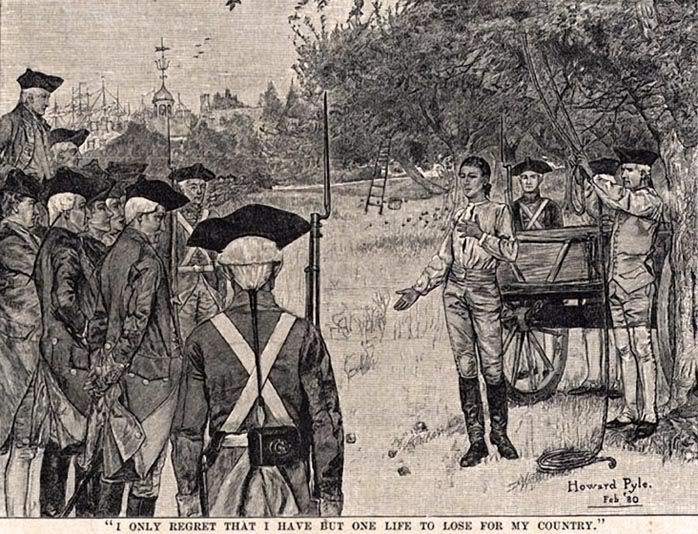
The Execution of Nathan Hale, 1776
In the early summer of 1776, the British evacuated Boston leaving the city and New England to the rebelling colonialists. Where would the British strike next? The mystery was solved when a British naval force appeared off the coast of Staten Island in late June - New York would be their target. The city had great strategic value. Its deep harbor could shelter the British fleet and its capture would pave the way for the Red Coats to battle northward up the Hudson and link with a force moving south from Canada. This would separate New England from the rest of the colonies.
In late June, the British occupied Staten Island in a landing unopposed by the Colonials. In late August a combined force of British and Hessian troops crossed Lower New York Bay and invaded Long Island. The British attacked the Americans from two sides forcing the Colonials to cross over to Manhattan Island. In early September, General Washington retreated again, this time across the Harlem River leaving New York City to the British.
Nathan Hale was a lieutenant in the Continental Army. In his early twenties, Hale had worked as a schoolteacher before the Revolution. In late September 1776 he volunteered to cross the British lines and travel to Long Island in order to gather intelligence. Unfortunately, his mission was soon discovered and he was captured by the British. Taken to General Howe's headquarters (commander of the British forces) in New York, the young spy was interrogated and executed on September 22. Word of the execution was brought to General Washington's headquarters shortly after by a British officer carrying a flag of truce. Captain William Hull of the Continental Army was present and recalled the event:
"In a few days an officer came to our camp, under a flag of truce, and informed Hamilton, then a captain of artillery, but afterwards the aid of General Washington, that Captain Hale had been arrested within the British lines condemned as a spy, and executed that morning.
I learned the melancholy particulars from this officer, who was present at his execution and seemed touched by the circumstances attending it.
He said that Captain Hale had passed through their army, both of Long Island and York Island. That he had procured sketches of the fortifications, and made memoranda of their number and different positions. When apprehended, he was taken before Sir William Howe, and these papers, found concealed about his person, betrayed his intentions. He at once declared his name, rank in the American army, and his object in coming within the British lines.
Sir William Howe, without the form of a trial, gave orders for his execution the following morning. He was placed in the custody of the Provost Marshal, who was a refugee and hardened to human suffering and every softening sentiment of the heart. Captain Hale, alone, without sympathy or support, save that from above, on the near approach of death asked for a clergyman to attend him. It was refused. He then requested a Bible; that too was refused by his inhuman jailer.
'On the morning of his execution,' continued the officer, 'my station was near the fatal spot, and I requested the Provost Marshal to permit the prisoner to sit in my marquee, while he was making the necessary preparations. Captain Hale entered: he was calm, and bore himself with gentle dignity, in the consciousness of rectitude and high intentions. He asked for writing materials, which I furnished him: he wrote two letters, one to his mother and one to a brother officer.' He was shortly after summoned to the gallows. But a few persons were around him, yet his, characteristic dying words were remembered. He said, 'I only regret that I have but one life to lose for my country.'"
Nathan Hale Died Here 1
Sea Land Church Hale
According to this 1919 nytimes' article Nathan Hale died somewhere near Market and East Broadway, but...
According to this 1919 nytimes' article Nathan Hale died somewhere near Market and East Broadway, but...
Subscribe to:
Posts (Atom)


 Posts
Posts