Showing posts with label east broadway. Show all posts
Showing posts with label east broadway. Show all posts
Monday, October 1, 2012
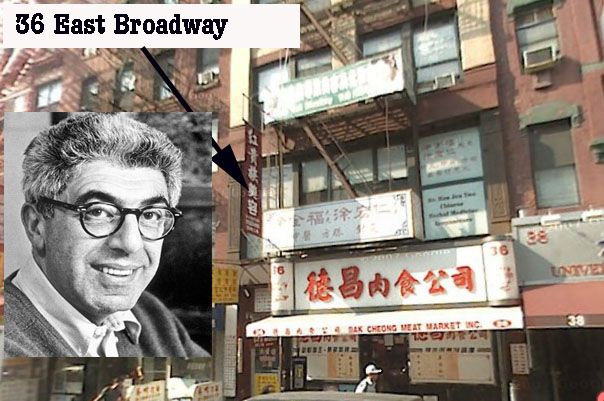
Who's Almost Who In Knickerbocker Village History: Barry Commoner


Tuesday, May 22, 2012
106 East Broadway: The Silbowitz Family
Thursday, October 13, 2011
Samuel Dickstein: Lower East Side Congressmen

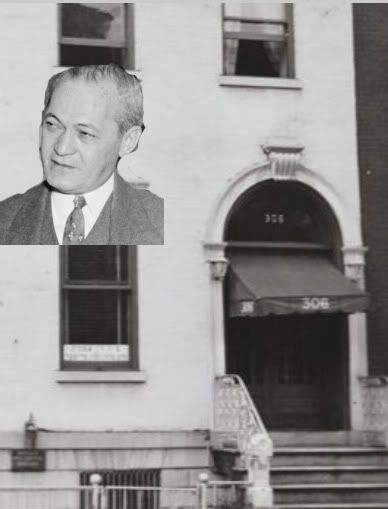
Samuel Dickstein (February 5, 1885 – April 22, 1954) was a Democratic Congressional Representative from New York and a New York State Supreme Court Justice. He played a key role in establishing the committee that would become the House Committee on Un-American Activities, which he used to attack fascists, including Nazi sympathizers, and suspected communists. Soviet files indicate he was paid by the NKVD. Dickstein was born into a Jewish family living near Vilnius in present-day Lithuania. He emigrated to the United States in 1887 with his parents, who settled in New York City. There he attended public and private schools in New York City, the College of the City of New York, and graduated from the New York City Law School in 1906. He was admitted to the bar in 1908 and commenced law practice in New York City. He served as special deputy attorney general of the State of New York from 1911–1914, member of the board of aldermen in 1917, member of the State Assembly 1919–1922. He served as a member of the Democratic County Committee and was elected as a Democrat to the Sixty-eighth Congress and was reelected eleven times. He resigned from Congress on December 30, 1945. He served as Chairman on the Committee on Immigration and Naturalization (Seventy-second through Seventy-ninth Congresses). During his tenure as Chairman of the Committee on Naturalization and Immigration, Dickstein became aware of the substantial number of foreigners legally and illegally entering and residing in the US, and the growing Anti-Semitism along with vast amounts of anti-Semitic literature being distributed in the country. This led him to investigate independently the activities of Nazi and other fascist groups in the U.S. This investigation proved to be of such significance that on January 3, 1934, the opening day of the second session of the 73rd Congress, Dickstein introduced a resolution calling for the formation of a special committee to probe un-American activities in the United States. The "Dickstein Resolution" (H.R. #198) was passed in March 1934, with John William McCormack named Chairman and Samuel Dickstein Vice-Chairman. Dickstein had refused the chairmanship of the Committee, feeling that his Jewish ancestry might have an adverse effect on the proceedings. Throughout the rest of 1934, the Special Committee on Un-American Activities conducted hearings, bringing before it most of the major figures in the U.S. fascist movement. Dickstein, who proclaimed as his aim the eradication of all traces of Nazism in the U.S.[2], personally questioned each witness. His flair for dramatics and sensationalism, along with his sometimes exaggerated claims, continually captured headlines across the nation and won him much public recognition. He was instrumental in establishing the temporary Select Committee on Un-American Activities (the 'Dies Committee') with Martin Dies, Jr. as chairman, in 1938 to investigate fascist and Communist groups in the United States. Later the same committee was renamed the House Committee on Un-American Activities when it shifted attention to Communist organizations and was made a standing committee in 1945. Following the 1938 Anschluss, Dickstein attempted to introduce legislation that would allow unused refugee quotas to be allocated to those fleeing Hitler. Dickstein later served as a Justice on the New York State Supreme Court until his death in New York City.
Protesting The Closing Of The Bialystoker Home
an excerpt from a recent nytimes' article
Closing a Nursing Home, and a Chapter of New York History By JOSEPH BERGER Her 98-year-old father lies under white sheets, frail and incoherent, attached to a feeding tube and a catheter. But Rose Lauria visits him nearly every day, taking a 10-minute bus ride to the historic block where the Bialystoker Center for Nursing and Rehabilitation has towered over the Lower East Side’s tenements for 80 years, then greeting her father with a “Hey, cutie pie!” “Every day is precious,” she said. “I love him and I want to see he’s cared for properly.” But she is worried about the future quality of that care because in recent months, she has watched the three other beds in his room lose their occupants, and her father, Thomas Lauria, may soon be required to surrender his bed. The Bialystoker home, plagued by deep debt and what it regards as inadequate Medicaid reimbursements, is closing. It was opened in 1929 as a nursing home and communal center by Jewish immigrants from Bialystok — the Polish city that lent its name to the bialy and the conniving impresario of Mel Brooks’s “The Producers.” In authorizing the closing, the state’s Department of Health has ordered the home, which is scheduled to shut in late October, to find new beds for all 95 residents. Meanwhile, its 10-story building at 228 East Broadway is on the market for an asking price of more than $10 million. Ms. Lauria is upset, and not only because she will have a far longer commute from her East Village home to visit her father at his probable next stop, a nursing home in Brooklyn that has space for him. Her bigger worry is that her father, who has been at Bialystoker for 12 years and suffers from dementia and an ulcerated esophagus, will not acclimate himself to unfamiliar rooms and faces. “These people live here,” Ms. Lauria said. “They get used to the workers, the atmosphere. It becomes like their family. There’s no place like home, but this place is pretty good.” Many people in the neighborhood are upset as well, because Bialystoker is one of the last major Jewish institutions still standing there. The 10-story building on the other side of East Broadway that long housed The Forward, a Yiddish newspaper, is now a condominium apartment building. Some neighborhood residents are seeking landmark status for the tan brick, Art Deco Bialystoker building, an application that the city’s Landmarks Preservation Commission has begun evaluating. The home also houses a synagogue on its second floor, where daily services are held, and it, too, will close, another loss in a revitalized neighborhood that once had 500 synagogues but is now down to about a dozen. The other day inside the synagogue, a solitary, white-bearded Hasid, Yesocher Wieder, 60, swayed over a page of the rabbinical commentary called Gemara, then rose and blew a shofar, a ram’s horn. The home’s board has been accused by some critics of mismanagement, for accumulating a debt of over $8.5 million and losses of $100,000 monthly. William Quintana, the Bialystoker home’s director of recreation, accused the board and its chairman, Ira M. Meister, of conduct that was “unethical and a conflict of interest” for the sale last year of an adjoining two-story medical building to the chairman. Mr. Meister said in an interview that the board had no choice because it needed the roughly $1.5 million netted from the sale to pay the nursing home’s mounting bills, and a sale to his real estate firm — he is president of a firm, Matthew Adam Properties, that manages 100 co-op and condo buildings — made for a speedy transfer. He has leased that adjoining building to the Educational Alliance, a venerable cross between a Y.M.C.A. and a social services institution that taught generations of immigrants how to become good Americans. But Mr. Meister plans within two years to move his management business, now on East 59th Street, to the East Broadway building.a previous 2008 post on the building of the bialystoker home another 2008 post on Bialystoker history
Tuesday, May 17, 2011
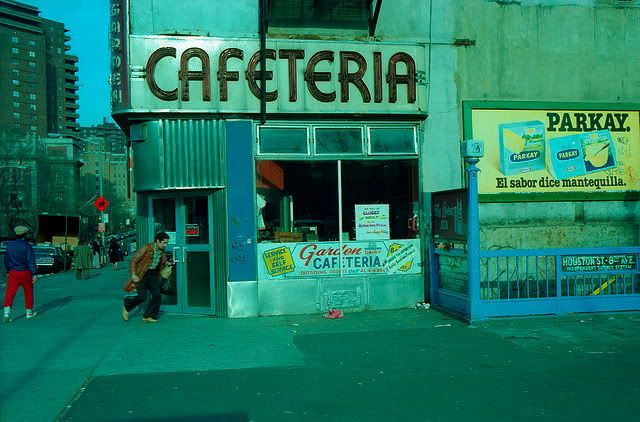
East Broadway And The Garden Cafeteria

a comment by Carol Foresta, a former KVer
I grew up on the lower east side. The Garden Cafeteria served as a meeting place both inside and out. My father used to wait outside of it for me each evening, when I was a student returning from college. He'd smoke his pipe and stand in front of one of its doors. There he would meet all of his friends and people from the neighborhood. They would be engrossed in conversation. Because my mother was an excellent cook, my father did not dare to eat at the Garden.The Garden always attracted a colorful assembly of people so very long ago. I believe the people who go there today are probably equally interesting. (Sept., 2007)a comment from Mark, aka "The Cutter," aka "Shoom"
Thanks for the Garden Cafeteria memory on the KV blog.
For our family it was a big deal. We virtually never went out, or in fact, ate with Dad. So, it filled two voids for the family.
I remember we always ate in the back room. It was on a rare Sunday, and there seemed to be many other families there as well. I don't ever remember taking our time, and casually eating. We were probably out of there in less than 30 minutes. Tables were turned over and even if there was a small staff, there seemed to be at least one at our table every five minutes.
Changes At 181 East Broadway
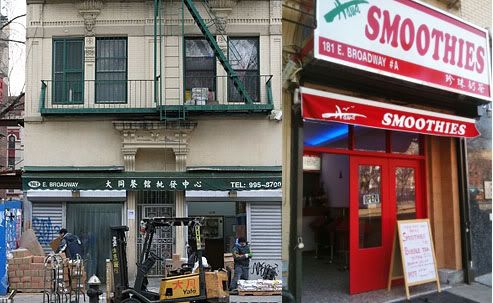
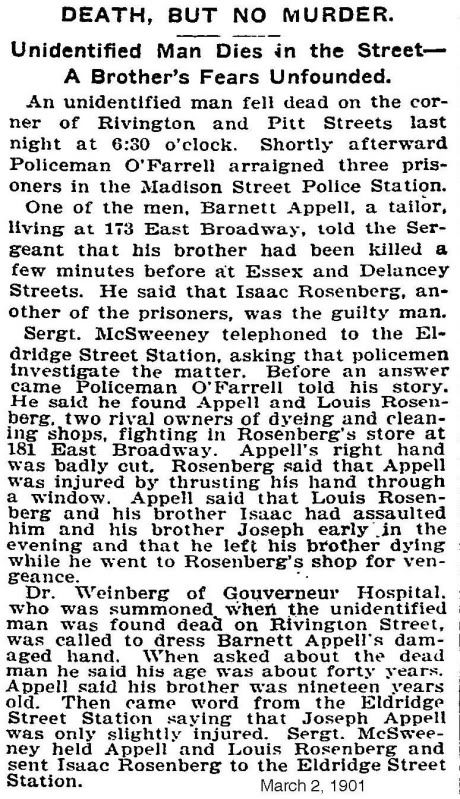
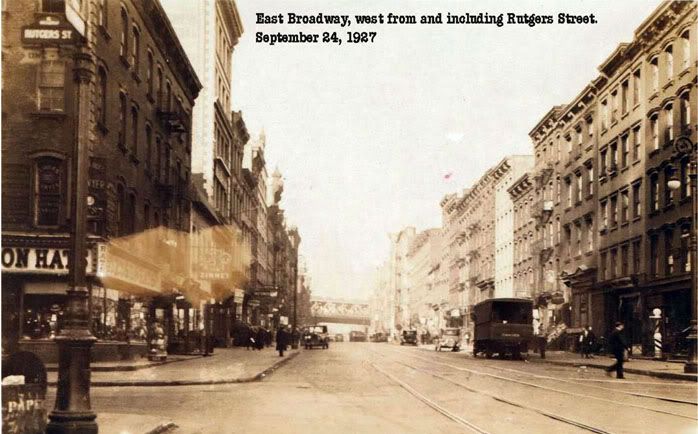
Michael Wang already has several locations of Hawa Smoothies (including a popular branch in Wall Street Center), and his latest storefront is now open at 181 East Broadway. The shop is named for Wang's native Hawaii and the interior is bright and inviting, with six cherry-red stools for perching.
Saturday, December 25, 2010
Meyer London: 279 East Broadway
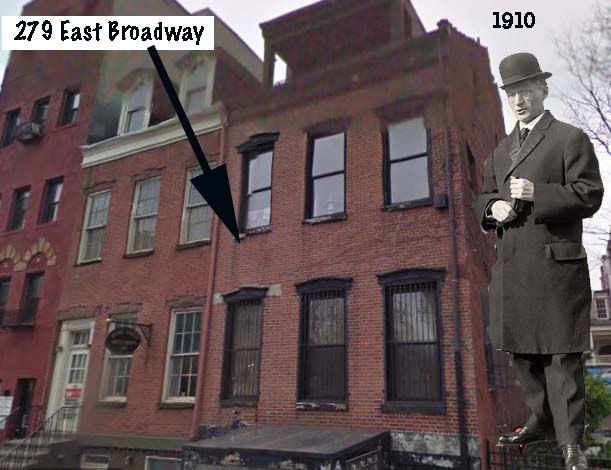
Meyer London (1871—1926) was an American politician from New York City. He is best remembered as one of only two members of the Socialist Party of America elected to the United States Congress.
Meyer London was born in Kalvarija, Lithuania (then part of the Russian Empire) on December 29, 1871. Meyer's father, Efraim London, was a former Talmudic scholar who had become politically revolutionary and philosophically agnostic, while his mother had remained a devotee of Judaism. His father had established himself as a grain merchant in Zenkov, a small town located in Poltava province of the Ukraine, but his financial situation was poor and in 1888 his father emigrated with Meyer's younger brother to the United States, leaving Meyer behind.
Meyer attended Cheder, a traditional Jewish primary school in which he learned Hebrew, before entering Russian-language schools to begin his secular education.[2] In 1891, when Meyer was 20, the family decided to follow his father to America so Meyer terminated his studies and departed for New York City, taking up residence in the city's largely Jewish Lower East Side.
In America, Meyer's father had become a commercial printer, doing jobs in the Yiddish, Russian, and English languages and publishing his own radical weekly called Morgenstern. Efraim London's shop was a hub of activity, bringing together Jewish radical intellectuals from throughout the city, many of whom met and influenced the printer's son with their ideas.
Meyer earned money as a tutor, taking on pupils at irregular hours and teaching literature and other topics. He later obtained a job as a librarian, a position which allowed him sufficient time to read about history and politics and to study law in his free time. Meyer also frequented radical meetings, gradually developing proficiency as a public speaker and participant in public debates.
In 1896, London was accepted to the law school of New York University, attending most of his classes at night. He completed the program and was admitted to the New York state bar in 1898, becoming a labor lawyer, taking on cases which fought injunctions or defending the rights of tenants against the transgressions of landlords. London did not handle criminal cases, but rather limited himself to matter of civil law.
In 1898, London ran for New York Assembly in the old 4th Assembly District, as the candidate of the Social Democratic Party of America, successor organization of Debs' Social Democracy.
London was active in the 1910 New York Cloakmakers Strike, during which the International Ladies' Garment Workers' Union (ILGWU) brought out 50,000 in a successful struggle for higher wages and better work conditions against their employers. In his capacity as counsel for the ILGWU, London drew up and published a communique in the name of the strike committee.[10] In this manifesto, London declared:
"We charge the employers with ruining the great trade built up by the industrious immigrants. We charge them with having corrupted the morale of thousands employed in the cloak trade.... Treachery, slavishness and espionage are encouraged by the employers as great virtues of the cloakmakers. This general strike is greater than any union. It is an irresistible movement of the people. It is a protest against conditions that can no longer be tolerated. This is the first great attempt to regulate conditions in the trade, to do away with that anarchy and chaos which keeps some of the men working sixteen hours a day during the hottest months of the year while thousands of others have no employment whatever.... We appeal to the people of America to assist us in our struggle."
London argued against an injunction issued against the strikers before the New York Supreme Court en route to a victory of the strikers after a labor action lasting the better part of two months.
In January 1916, London was joined by Socialist Party leaders James Maurer and Morris Hillquit in a meeting with President Woodrow Wilson trying to forestall American entry into World War I.
London's place in the cloakmakers' strike made him one of the best-known public faces of the Socialist Party in New York City and over the course of three runs for Congress he gradually constructed a winning coalition, emerging victorious despite the violence and fraud practiced by the campaign of his Tammany Hall-supported Democratic opponent in the election of 1914. London thus became the second Socialist elected to Congress, following Wisconsin's Victor Berger.
As a Congressman, Meyer London was one of 50 representatives and six senators to vote against entry into World War I. Once America was at war, however, London felt obliged to support the nation's efforts in the conflict. He strongly opposed the Espionage Act of 1917 and the Sedition Act of 1918, which made criticism of the president or the war a crime. These actions angered his constituency, London said, "I wonder whether I am to be punished for having had the courage to vote against the war or for standing by my country’s decision when it chose war."
Saturday, March 20, 2010
The Watch House Mapped
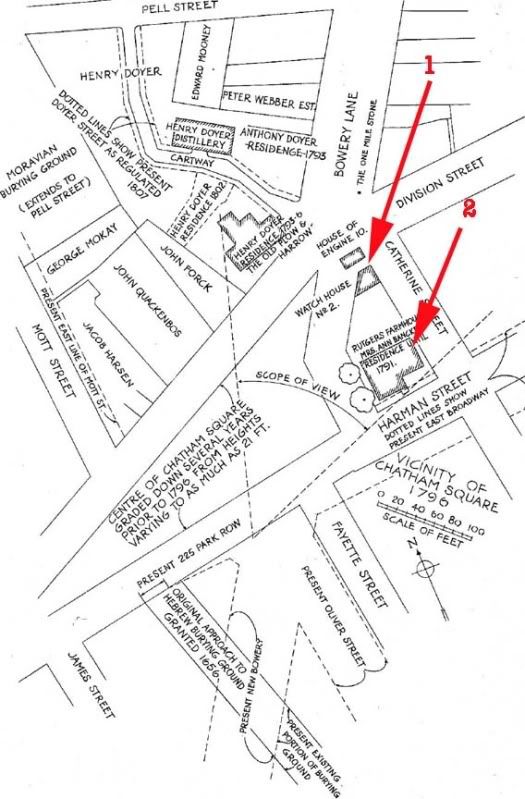
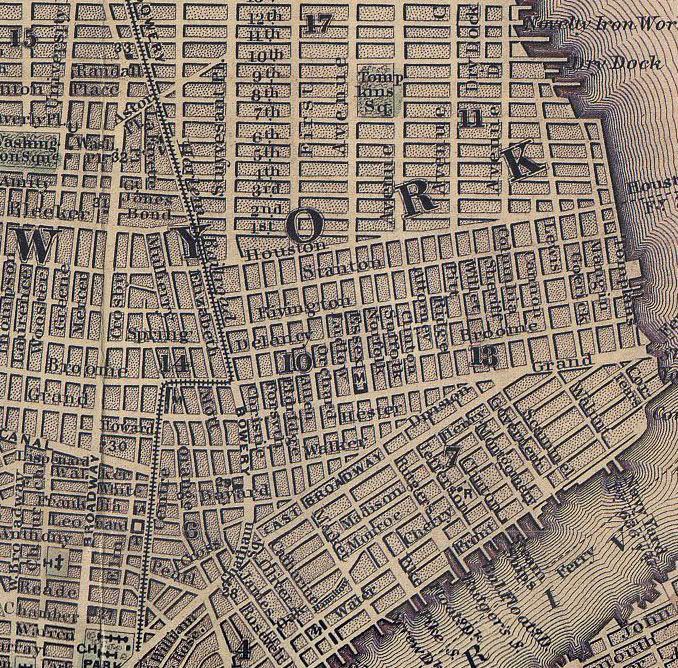
Arrow number 1 points to the Watch House mentioned in the previous post. Arrow 2 points the house belonging to Anna Bancker, who was a Rutger's family member. Bancker Street was the original name of Madison Street. Ann Bancker was Hendrick's Rutger's wife and the mother of Henry Rutgers. Harmon Street was the original name of East Broadway.
Tuesday, March 9, 2010
East Broadway: 1895
East Broadway Linens 1895
by 1895, East Broadway was a fancy shopping destination
by 1895, East Broadway was a fancy shopping destination
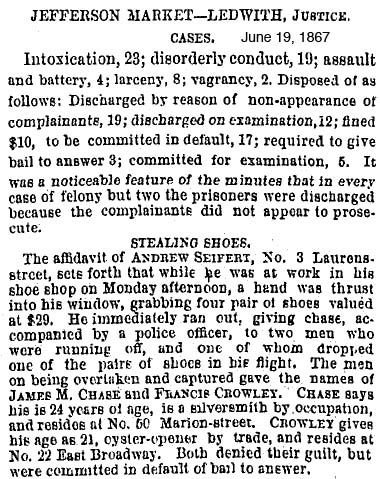
Monday, March 8, 2010
22 East Broadway
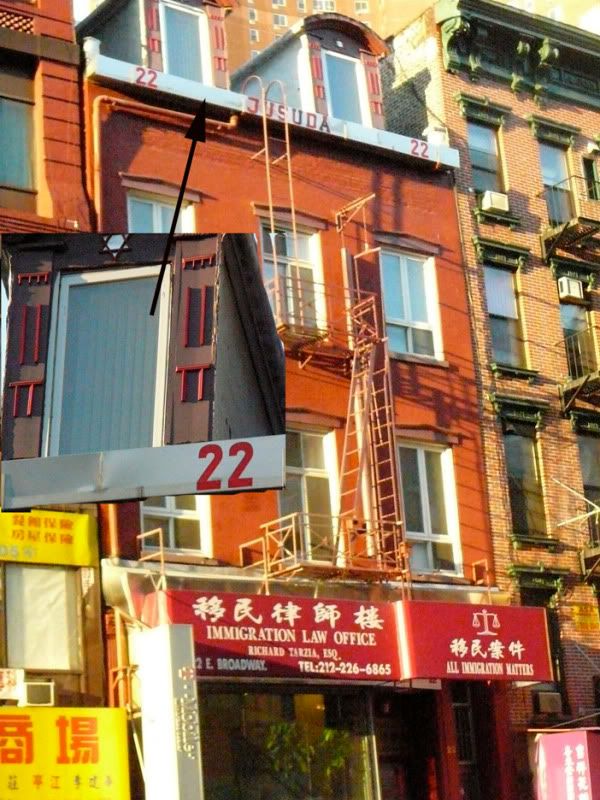
an excerpt from a 2003 nytimes article on downtown federal style landmarks including 22 East Broadway
Most Federal houses have not received such loving care in their old age. All that remains of the palmy days at 510 Greenwich Street, near Spring Street, is what Mr. Lockwood takes to be the ghostly remnant of an arched fanlight. "It's almost as if it's telling you: `I'm here. Love me. Notice me.' "
Of course, interior remnants are out of the public eye. But when Mike Siegel, the owner of 22 East Broadway, near Catharine Street, noticed Mr. Lockwood staring at his 172-year-old building, he invited him in. Even after countless decades of commercial use, the house still has a parlor doorway surrounded by carved anthemion leaves, a chaste marble fireplace and a statuary niche.
Friday, February 19, 2010
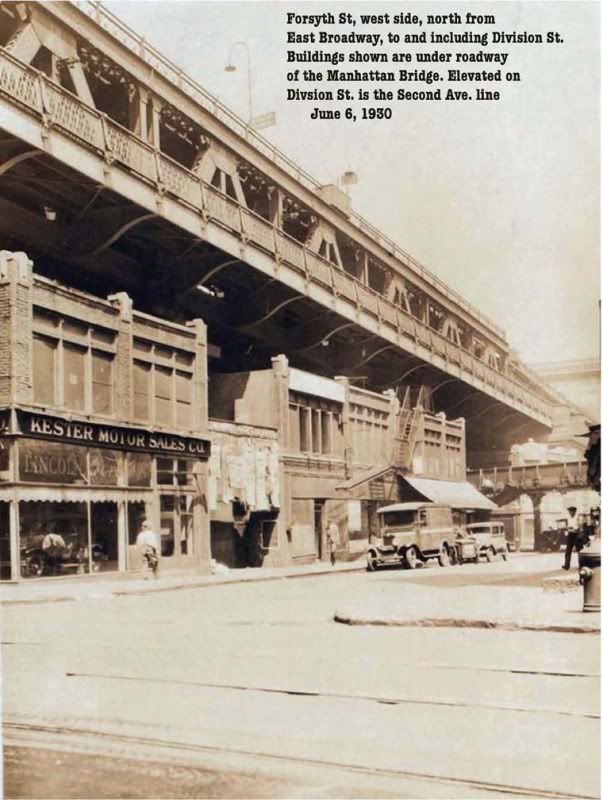
Kester Motors On East Broadway
Kester Motors 86 Broadway
Who would have known there was a car dealership on East Broadway?
Who would have known there was a car dealership on East Broadway?
Monday, March 16, 2009
Children's Aid Society: East Broadway, 1875-?
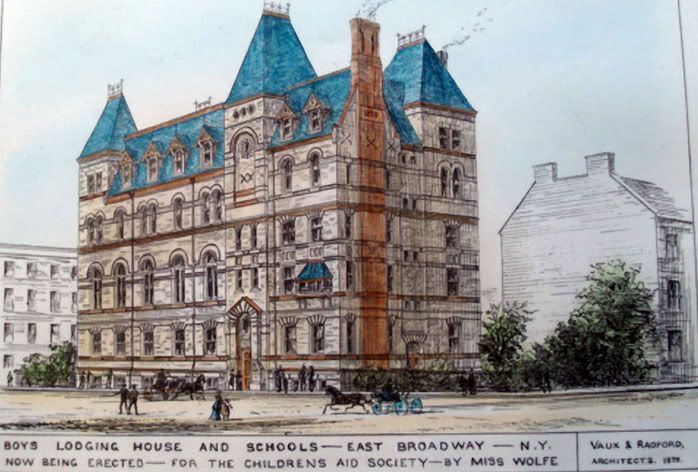
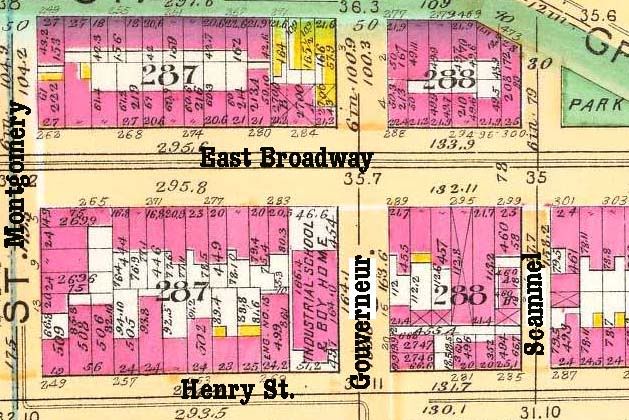
Evidently there was a branch of the Children Aid's Society on East Broadway and Gouverneur in the late 1800's. The architectural drawing has a 1875 date. On the 1891 map its called an Industrial School and Home locaed at 283 East Broadway. It probably also served as a newsboy lodging house
Sunday, March 15, 2009
East Broadway Run Down
various East Broadway photographs; some mine, some from nyc-chinatown and many from the bridge and tunnel club. Some also, misplaced. I'm still trying to remember where that fire house on East Broadway was that Cliff's class visited. about the music clip, which I edited just before it went "free"
East Broadway Run Down is a 1966 album by legendary jazz saxophonist Sonny Rollins, his last album before industry pressures led him to take a six year hiatus. The album represents one of his more notable experiments with free jazz, according to The New Grove Dictionary of Jazz illustrating "the furthest extent to which he incorporated noise elements into his playing". It has been critically described as among his 60s "jewels". Music journalist Piero Scaruffi praised the album for the dissonant titular song, "a bold thematic improvisation on the riff of Lionel Hampton's 'Hey Baba Rebop'." Personnel Elvin Jones - drums, Freddie Hubbard - trumpet, Jimmy Garrison - bass
Tuesday, January 27, 2009
Subscribe to:
Posts (Atom)


 Posts
Posts