Showing posts with label st. joseph's. Show all posts

Saturday, March 20, 2010

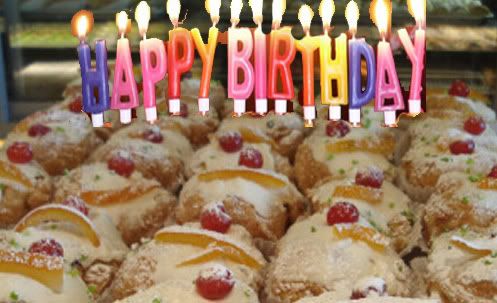
Happy Birthday, Happy St. Joseph's Day


I'm a day late. March 19th was my father's birthday along with the date of St.Joseph celebration. My mouth is watering for those sfingis
from wnyc's last chance foods
WNYC's Amy Eddings headed to Villabate-Alba Bakery in Bensonhurst to chat with owner Manny Alaimo about Saint Joseph's Day for a special edition of Last Chance Foods. Alaimo, who is a third-generation baker, explains that the sfingi is filled with ricotta, while the zeppole di San Giuseppe (of Saint Joseph) sports a creamy custard middle. He says that zeppole is the less traditional of the two and mainly created for those who didn't like the sfinigi's cannoli-type ricotta filling.
The zeppole at traditional Sicilian bakeries like Villabate-Alba are nothing like the greasy sponges of fried bread found at street fairs. These are made from a firm dough piped into swirls. The zeppole and sfinigi are both garnished with powdered sugar and maraschino cherries. The sfingi stands out, though, because it's also topped with a slice of candied orange. According to Alaimo — or at least the priests who taught his Sunday school classes — the story about the orange goes like this: As a child, Jesus liked to tease the camels that carried baskets of the fruit on their backs. The animals would get flustered, and the oranges would roll onto the ground. Joseph would come by pick then up, and Mary would bake small loafs of bread to give to the camel keepers as an apology. Alaimo notes that the sfingi at Villabate-Alba are filled with sheep's milk ricotta imported from Sicily. He insists that ricotta found in the states is often from cows, heavier and more coarse. Bensonhurst native Diane Mingoia prefers sfingi, and she stopped in to pick some up for her cousin Joseph. She explained that the holiday is particularly special for those named after the saint. So for all the Joes and Josephines out there — or dessert-lovers in general — today is a good day to stop by the local Italian bakery and wish everyone a happy Saint Joseph's Day.

Tuesday, July 28, 2009

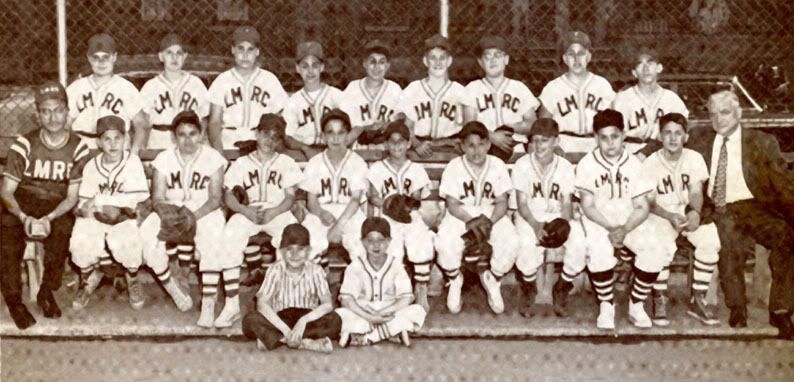
Boy Scout Troop 111 Of St. Joseph's And Ten Mile River Camp

Ten Mile Camp
From Joseph Barone:
Reading the story about summer camp, and having just attended my first summer one in over 20 years, reminded me that the Boy Scouts of Troop 111 (sponsored by St. Joseph), would each year go to Ten Mile River Scout Camp. TMR as it was commonly called, was located near Monticello and Max Yesgur's Farm.
I know of at least two KVer's (Troop 111) who served on staff over the years at TMR.
First, Richard Galasso (parents still live in KV) served on staff at Camp Davis Lake in 1969. He reminded me a number of times of how they all gathered around a couple of transistors to listen to the Landing on the moon. (Richard is # 10 in slide 1).
And yes, the second one was yours truly at Camp Keowa in 1978 at a Counselor in Training. (Joseph is #32 in slide 2)
Although, the next person was not a KVer, he did live on the LES and was very well known in Scouting during the 1950s thru the 1970s: Julius "Julie Y" Yavarkovsky. "Julie Y" owned a paper good business on Ludlow St.

The pdf file above has pictures of Richie Galasso, Joseph Barone and Julie Yavarkovsky.
Julie passed away over 30 years ago. Ten Mile River Camp was an excellent site/museum that the pictures above come from

Tuesday, May 5, 2009

Sanctuary


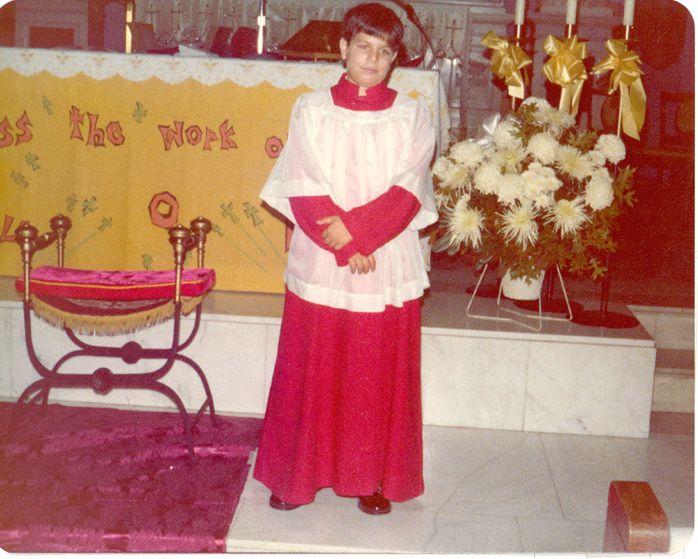
Above: Joseh Barone, Oct. 13, 1974

Recently, my son became an Altar Server and it brought back memories of when I was an Altar Boy.
When I was in the 5th Grade, you could become an Altar Boy. Many, if not all, of the Catholic boys in St. Joseph became Altar Boys. It was a big thing for us.
Training to learn how to serve was conducted by the moderator of the Altar Boys. Each week, for four or five weeks, we would meet after school to practice and learn about the various items used during Mass.
We would go into the Sanctuary, where the priests would dress for Mass. It was a large room behind the left side altar - behind the "back staircase" (if you were facing the front of the Church), which held a couple of large closets, and cabinets w/ drawers. (There was also a toilet back there too.) These cabinets and closets held various vestments, chalices, books, and other items used during the various Masses throughout the year. Behind the main altar, in the rectory, was a large cabinet which would hold the altarboy albs (white robes), which the altar boys wore for everyday Masses. Every boy was assigned one and responsible for keeping them clean.
Since it was not even 10 years after Vatican Council II, we wore red cassocks and white surplices for the 11am Mass - which was a considered a sort of High Mass, in which incense was used, Latin sung, etc. They were also used during other special days, such as Christmas Midnight Mass, Easter, etc. There were held in small alcove (between the elevator and Sanctuary). Yes, there is an elevator in the Rectory, which would take you to the Church basement, all of the floors of the rectory and up to school. It was one of those with a sliding gate, which you had to close by hand.
Once or twice a week, we would go down to the Sacristy to be trained after school. Our training consisted of practicing the our role -- when and where to sit, stand and/or kneel, when to hold up the Lectionary (or book of prayers), how to help with Communion, etc. We also learned how to set-up for and clean up after Mass. In addition, we had to learn about, including the names, of the various items used: Chalice, Ciborium, paten, purificator, etc. Although these items were usually ready for us before Mass, every once in a while, something our be missing and we had to go and get it for the priest. So, we also had to learn where it was.
Altar Boys were first introduced to the everyone during the Easter Masses. We would usually be part of the procession in and out of the various Masses. We did not do anything, since there were many other older boys.
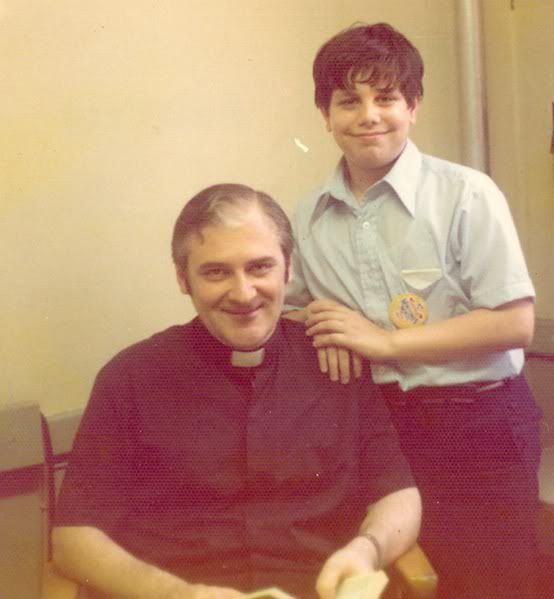
Above: Fr. Hector Satori (Asst. Pastor of St. Joseph) in May of 1975. He was also the Altarboy Moderator for a couple of years.

Once you had learned what to do, you were assigned for a week of Masses and a Sunday Mass. On the Monday after Easter, I was required to serve the 8am Mass (which means I had to get up early on my vacation). I was scheduled with one of the Maldonado boys (they lived in the Smith Projects -- I think at 54 Catherine). You were always assigned the first time with an older server. As soon as Mass ended, the older boys usually "cut out" and left the younger guys to clean up.
So, you would arrive at least 10 minutes before Mass. You would dress, bring out anything that needed to be set up, light the candles and hang around waiting for the priest to begin. Since it was the weekday, Mass would last about 25 minutes, and there there was usually about 10 to 15 minutes of clean up --depending on how fast you worked together on it.
Now, depending upon the person who cleaned up, one of the things some of the boys would do is to drink the leftover wine. The wine used by the priests is usually sweet with a low alcohol content -- not strong like the Italian red wine. If there was one priest, the wine would be put into a small a small cruet (like a small pitcher), similar to ones you might find holding vinegar or red wine used for salads. They only hold three or four ounces of wine, not a huge amount. And after the priest had used some, you were lucky if there was one or two ounces left. So, some of the altar boys would fill the rest of the cruet with cold water and drink it. You couldn't get drunk on that but it was a big thing. Funny, how when you are younger, these are big things.
As I got a bit older, I and my buddy Jude, would many times be asked to serve the 8am Mass. Most mornings we usually had Fr. Chan. Now, Fr. Chan fled Mainland China in 1949, when Mao and the Communists took control. Each morning he would race in about five minutes before Mass was to begin, with a big "HELLO BOYS". (He lived on the Riverside Drive in the upper 80's/lower 90's, with some other priests who I believed also had fled the Mainland at that time.) We would then help him to vest up and out we would go.
Now, Fr. Chan was well known for speeding through the Mass, except during the Consecration (or when we believe that the bread and wine are turned into the Body and Blood of Christ) which he would slow down. Typically, he would be done under 20 minutes. This was great if you had to serve and then head up to school. If you were lucky, you would be up in your classroom by the first bell. (Once done, Fr. Chan would head up to the kitchen for some coffee, cookies and to read the paper for a bit, before heading back uptown or making the rounds in Chinatown.)
In addition, we would also be called upon to serve a Funeral Mass. Funeral Masses usually started at 9:15am and ended about 10:15am. If the altar boys were given tips, we never got them with one exception. At the funeral of the father of one of the neighborhood boys, who was an altar boy himself, he handed each of us, at the end of Mass a couple of dollars. We were all too embarrassed and attempted to give back the money but he refused. (It was rumored that the sacristan would get be given money to distribute to us, but we never saw any of it.)
If you were a faithful server, meaning you rarely missed serving, you might be called upon to serve a wedding. Now, serving a wedding usually meant a tip -- that was your way of being thanked for faithfully serving. The tips were usually two or three dollars but sometimes it went up to $5.
I remember very well one wedding in particular. The bride was from KV. The wedding was in the early afternoon. The Church was packed. Fr. Moffo was the priest. It was a ceremony only, which meant that it should last about 20 to 30 minutes. The time for the ceremony came, no bride. Okay, some brides are a few minutes late. No problem. We waited. And waited and waited. About an hour later, she showed up. Fr. Moffo was furious. (My mom was wondering where the heck I was all this time.) After the ceremony, one of the groomsmen came in and gave my buddy and I $15 to split. Each of us got $7.50 -- a huge haul. We were talking about it for weeks.
by Joseph Barone

Thursday, April 16, 2009

San Giuseppe: 1927


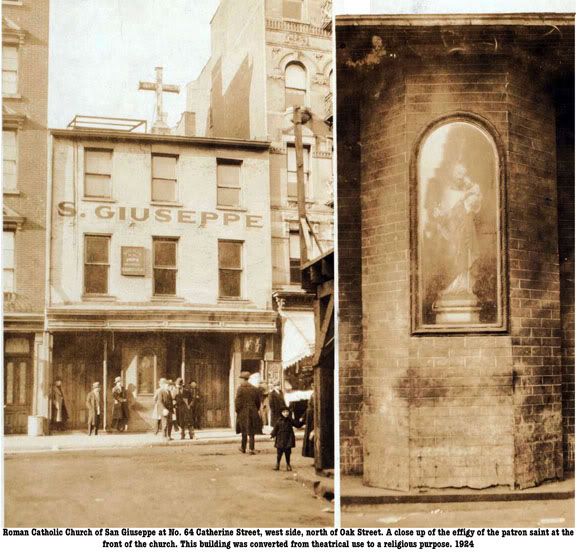
This was on Catherine directly across from St. Joseph's Church. There looks like there may be some scaffolding in front of where the church might be. This and the next four posts have images that are relevant to the time period that Sam Solerwitz had his furniture stores on Oak and Catherine.

Friday, April 10, 2009

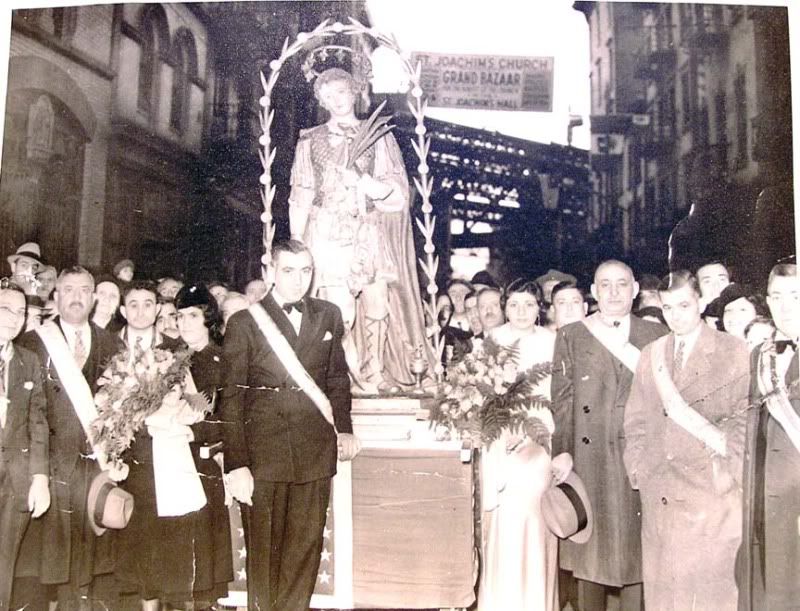
1937: The Procession Of San Vinenzo, St. Joachim's Church On Roosevelt Street

A great photo of the procession of San Vinenzo taken in 1937, outside of St. Joachim's Church on Roosevelt St.(courtesy of the Gallo family), from the Craco Society There's much more interesting history to explore there.

The St. Rocco Society Of Potenza

I was curious about the picture of the group kneeling in front of St. Joseph's that I included in the previous post so I researched the St. Rocco Society. An excerptFrom the St. Rocco Society site from an article written last August

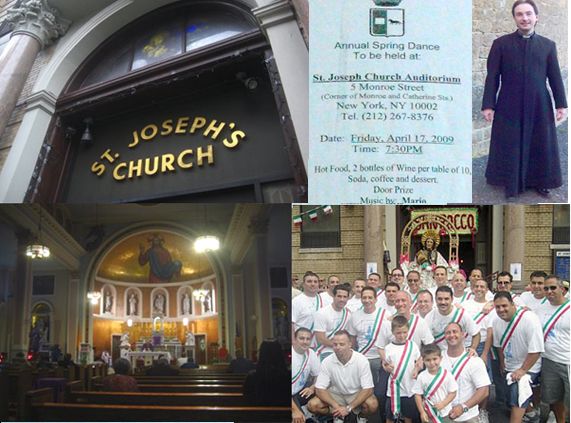
Once again, with tremendous pride, Stephen S. La Rocca, Esq., President of the St. Rocco Society of Potenza announces the 119th Annual feast of St. Rocco to be held on Sunday, August 17, 2008 at St. Joseph’s Church, 5 Monroe Street, New York, New York. The Solemn high Mass will be held at 12:00 noon followed by the procession, the highlight of the event, at 1:30 p.m. The procession will begin at the Church and wind it’s way through the streets of Little Italy as it has done since August 1889.
History:
The St. Rocco Society was founded in 1889 by immigrants from the Southern Italian City of Potenza in the Basilicata region, on Roosevelt Street in Manhattan’s Lower East Side. Every year since it’s founding, without interruption, the society has celebrated St. Rocco’s feast with procession. It is one of the oldest Italian American Societies in New York State.
After the demolition of Saint Joachim’s Church on Roosevelt Street, the original home of the St. Rocco feast due to urban renewal, the feast was and is still celebrated at St. Joseph’s Church on Monroe and Catherine Streets a few blocks from the original site.
Although the Society was founded by men from the Italian city of Potenza (some of whose descendants are still members of the society), from it’s earliest days immigrants from many towns in the provinces of Potenza and Matera participated in the procession. Eventually, those who participated came from every area of Southern Italy and Sicily.
The focus of the feast is the procession of the Statue of St. Rocco. Even before St. Rocco begins “his walk” through the neighborhood he is nearly covered with the money offerings of his faithful. The statue carried on the shoulders of the members is accompanied by an Italian street band for the entire length of the approximately three hour long walk. Following the statue, march the devotees as a means of thanking the saint for his powerful help and looking forward to future graces and blessings through his intercession.
Well into the 1940’s thousands of people traveled to St. Rocco’s feast to honor their beloved Saint by walking in his procession in the scorching August heat. However, with the passing of the years and a diminishing Italian population in the neighborhood, attendance, through remaining strong, lost some of its original strength. Through it all, Angela and Anna Carnevale, two dynamic sisters and daughters of one of the founding members of the society, kept the procession going without interruption. For too many years to count, their dedication kept the feast alive. It was at Angela Carnevale’s urging that Mr. La Rocca was asked to become President of the Society and assume it’s leadership eight years ago.

Tales From St. Joseph's


With Easter approaching a very timely story from Joseph Barone:
Recently, my father-in-law passed away. During what the Roman Catholic Church now calls the Mass of the Resurrection, or Funeral Mass, I thought about Rev. Peter Vesta.
Fr. Vesta was the pastor of St. Joseph in the late 1960's and I believe into 1970 or 1971. I remember him usually wearing cassock outside of the Church walking up and down Monroe St. saying his rosary or daily prayers.
By 1970 or 1971, Fr. Peter became very ill and left us as Pastor. I don't know what it was. I can only surmise it was cancer.
By 1972, I was an Altar Boy (now they call them Altar Servers, since both boys and girls now serve on the altar). Since we were also students at St. Joseph, we would be called out of class to serve Funeral Masses, which usually began by 9:15am and ended by 10:15am. Then, back up to class.
By that time (maybe it was 1973), Fr. Peter was living at St. Joseph (in residence, as they called it) and wheelchair bound.
When Fr. Peter died, I (as well as a couple of other boys) were asked to be Altar Boys for the Mass.
The Church was packed. There were a large number of priests in attendance, and we (the Altar Boys) usually sat on the left hand side (if you were facing the altar) on a set of small wooden stools, with red leather seats.
The morning of the funeral Mass, it was dark and raining. As the Mass progressed, the weather got worse and worse. It was pouring, there was lightening and thunder. And during what we would call the most sacred parts of the Mass, the weather got only worse. I remember looking up at the stained glass windows, and there was no light coming into the Church, since it was so dark and rainy.
At the end of the Mass, all of us headed back up to class.
I remember looking out the window, about 11:30am or so, and it had stopped raining and the sun was shining.
I thought about Fr. Peter, since basically the same thing happened during my father-in-law's funeral.

Thursday, March 5, 2009

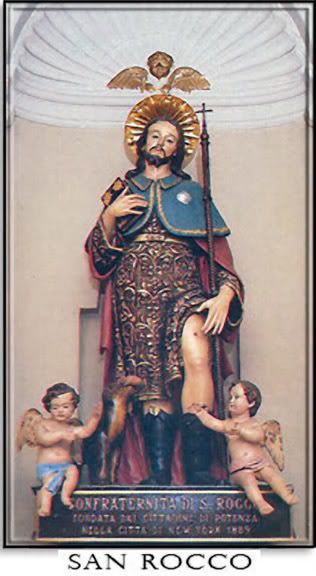
The Original Statue Of San Rocco


a h/t to Joseph Barone for this info
from the saint rocco society
The statue was kept in a special chapel in St. Joachim's Church on Roosevelt Street. When St. Joachim's was demolished, the statue was taken to St. Joseph's Church, 5 Monroe Street, where it remains enshrined to this day.
The original statue is of magnificent artistic quality, made of Italian papier mache'. It weighs with it's base over 100 lbs.
As the statue aged, Angela Carnevale the Treasurer of the St. Rocco Society and then it's acting President and sole organizer decided to purchase the new statue, fearing the original priceless statue might be damaged while carrying it in the procession.
For the last 25 years or so a duplicate statue has been used for the Feast and Procession.
The original statue was "rented" by Francis Ford Coppola and used in the filming of "The Godfather II" during it's Festa di San Rocco scene. Only members of the Society were allowed to carry the statue in the film. The statue is the oldest Italian American religious society statue in New York.
The original statue can be seen at the rear left of the Church of St. Joseph, 5 Monroe Street, New York, New York. The "Feast" statue is stored during the year and brought out and placed on the main alter under a special canopy for the week prior to the Feast.

from Joseph Barone
A number of people from the parish were used in the filming, among them were the men carrying the canopy. One of them was Mikey Tramatola (sic) who lived on the ground floor in the K Building. There were two boys (one named Paul -- about a year or so younger than I was), a girl (I think the middle child) and the dad. The mom had died a number of years back. They later moved to the apartment complex across from the South St. Seaport., Southbridge Towers
The altar boys were also from the parish. They got the part because they walked into the St. Joseph rectory at the right time and had a short haircut. (If I had walked in about 10 minutes earlier, I would have gotten a part in it. I could have been a contender...I could have been somebody.)
The guys were out of school for two weeks and got paid well for the work.
In addition, there is a small platform with candles on it (looks like a cake covered w/ candles). This was also traditionally carried in the St. Rocco procession each year in August by the women of the St. Rocco Society.

Monday, November 24, 2008

The Death Of Fanucci


Can you spot Reverend Joseph Moffo of St. Joseph's?
from movie-locations
The scenes of younger Vito’s Little Italy neighborhood of 1917 were shot on Sixth Street in the East Village between Avenues A and B, tricked out in period dressing. A block north is the bar where the Rosato brothers try to garrotte Pentangeli, PH Vazac’s, 108 Avenue B at Seventh Street (known as Seven and B), at the southeast corner of Tompkins Square Park in the East Village.