Showing posts with label world of our mothers and fathers. Show all posts
Showing posts with label world of our mothers and fathers. Show all posts
Friday, August 24, 2012


Thursday, August 23, 2012
End Of A 14 Monroe Era

Wednesday, August 24, 2011
Monday, June 14, 2010
Groucho Marx On Father's Day
The closest Groucho got to the lower east side was the address of his maternal grandparents, Louis and Fanny Schoenberg (or Schonberg). They were living st 376 E. 10th Street from 1880-1885. This information came from a Marx brothers' site Harry Ruby who wrote the song was a Bronx boy. In 1920 he was living at 347 E. 173rd Street
Today, Father, is Father's Day
And we're giving you a tie
It's not much we know
It is just our way of showing you
We think you're a regular guy...
You say that it was nice of us to bother
But it really was a pleasure to fuss
For according to our mother
You're our father
And that's good enough for us
Yes, that's good enough for us.
Tuesday, April 27, 2010
As Mother's Day Approaches
The unofficial KV Matriarch....Marion Fox
Personalize funny videos and birthday eCards at JibJab!
Monday, March 22, 2010
Staff Sergeant Matthew Alberti Of 11th Street

I wonder if my mother knew him. She lived just down the block from him at 516 E. 11th in 1942. They were just about the same age. See a previous post about Sergeant Alberti
Tuesday, February 2, 2010
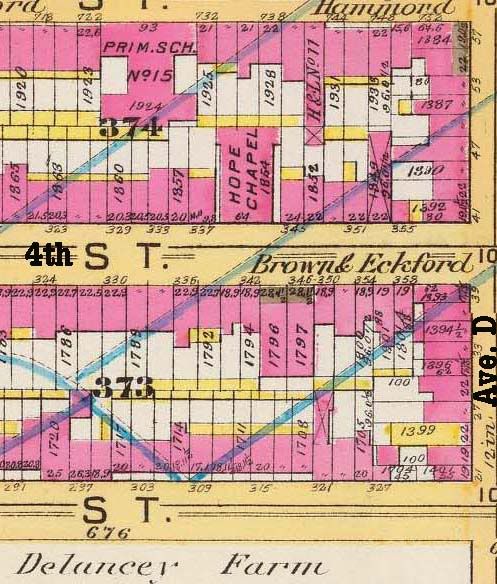
East 4th Street, 1935: PS 15 And The Carpathian Russian Orthodox Church

below, a map view of the block in 1891
This is something new to me About the Carpo Rusyns
Have you ever been asked the question: "What is your ethnic background?" Most of us have been asked this question many times, especially by fellow genealogists. We all have the ready answers: "I'm German; I'm English; I'm Irish; and on and on.
Yet, there are about one million descendants of an ethnically distinct people who came from the Carpathian Mountain region of the former Austro-Hungarian Empire who have a confused or non-existent sense of ethnic identity. These descendants of late 19th and early 20th century immigrants know that they are of Slavic ancestry, but are unsure to which specific ethnic group they belong to. This is understandable when you examine the origins and history of the Carpatho-Rusyns.
These people came from a specific geographic area with defined ethno-linguistic boundaries in the north east region of the former Austro-Hungarian empire. This area encompassed part of the then district of Galicia , the former old Hungarian counties of; Saros, Zemplen, Szepes, Abauj, Ung, Ugosca, Bereg and Maramos. These areas are now contained within the modern day boundaries of Poland, Slovakia, Ukraine and a few villages in Romania and Hungary . These immigrants originated in a small area of a very large empire. They did not come from a specific country. Furthermore, they were members of the Greek (Byzantine) Catholic Church (also called Uniate) and the Russian Orthodox Church, both of which were totally unfamiliar to native born Americans.
Their clergy were not required to be celibate. It was indeed a difficult thing for Americans to comprehend. Even the Roman Catholic bishops in the United States, in some cases, refused to believe that Catholic priests could be married! As you might imagine, this caused many an unpleasant incident when Eastern rite Catholic priests came to America and presented themselves to the local Roman Catholic bishop as per the custom. In some cases, communications between the two sides were strained to the point that Roman Catholic bishops refused to grant faculties to the Uniate priests. These priests were often insulted and angry because they were refused permission to exercise their religious rituals which were allowed by the Holy See and defected to Orthodoxy in many cases along with their congregation. This "conversion" required no change in their religious rituals.
Confusion extended to secular life as well and it was no small wonder then that the Rusyns did not know how to respond to their American friends and neighbors to the question: "What is your ethnic identity?" Some of the immigrants responded that they were Austrian or Hungarian because they were subjects of the Austro-Hungarian Empire. Some said they were Slovaks because they came from a village that was later incorporated into Czechoslovakia. Some said they were Ukrainian. These persons of Ukrainian national orientation came primarily from the eastern reaches of Galicia, the area east of the San River, where ethnic Ukrainians were numerous and very nationalistic. This Ukrainian identity was reinforced by the clergy and was instituted by Metropolitan Josyf Sembratovych. Some countered that they were Russians because they were members of the Russian Orthodox Church. The Orthodox priests reinforced this identity. This was a very confusing situation to say the least!
The immigrants within their own ethnic communities called themselves: Rusyn, Rusnak, Ruthene, Ruthenian, Carpatho-Russian, Carpatho-Ruthenian, Carpatho-Ukrainian, and Lemko. These terms have a religious connotation signifying membership in either the Greek Catholic or Russian Orthodox Church. Some of the immigrants and their offspring called themselves "Slavish" which is a slang term that they used meaning like "Slovak" - but not really! The Rusyns have a phrase in their language in which they refer to themselves as the "Po Nashomu" People. This in effect meant to them: people like us who speak our language. This was often a response to the question "Who are you?" Such an answer leads one to the conclusion that a nationalistic identity problem did exist, and still does, for this East Slavic group of people.
Monday, February 1, 2010
Pre-Detergents Wash Days: Fels Naptha
At PS 177 we had a substitute teacher named Mrs. Fels who told us she was part of the Fels family made famous by this soap. Joseph Fels seemed like a pretty interesting character. He supported the single tax made popular by Henry George
Fels Naptha Soap
Fels Naptha Soap
Saturday, October 31, 2009
67 East 4th Street
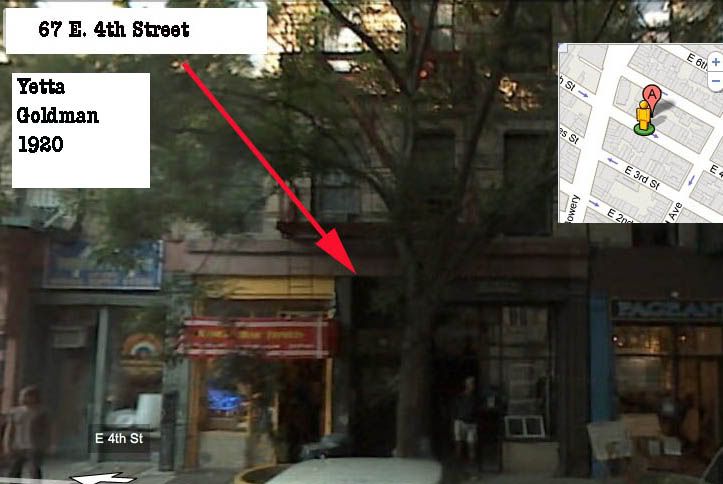 Allan and Howie's mom, Yetta Goldman, was living at this address in 1920. It's between the Bowery and First Avenue. East 4th Street is one of the most historic blocks in the city.
 The Lower East Side History Project has a lot by lot history of the block.
The Village Voice chose it as one of the best in the city
The West Side has its Lincoln Center. Nice, but a little garish for our taste. The East Village, on the other hand, has East 4th Street, a block-long cultural retreat boasting no fewer than 12 theaters, eight dance and rehearsal studios, and a screening room for avant-garde films. East 4th Street between the Bowery and Second Avenue is where La MaMa, the New York Theater Workshop, the Rod Rodgers Dance Company, and Millennium Theater all present their works. Sandwiched in between are an array of fine shops and artisans, including Barbara Shaum (the expert leather maker), a pair of marvelous musical instrument shops, the 4th Street Food Co-op, and the great KGB Bar. This little Bohemia was long ago targeted by Robert Moses's wrecking ball, and much of the housing—mostly six-story tenements—passed into municipal hands. But it was rescued by the efforts of the Cooper Square Committee, a local citizens' group that has never given up trying to create and save affordable housing and commercial space even in the torrid real estate market of the East Village. The result is a veritable People's Republic of East 4th Street—right here in Bloomberg Town!
Friday, October 23, 2009
Schmatta And The Union Label
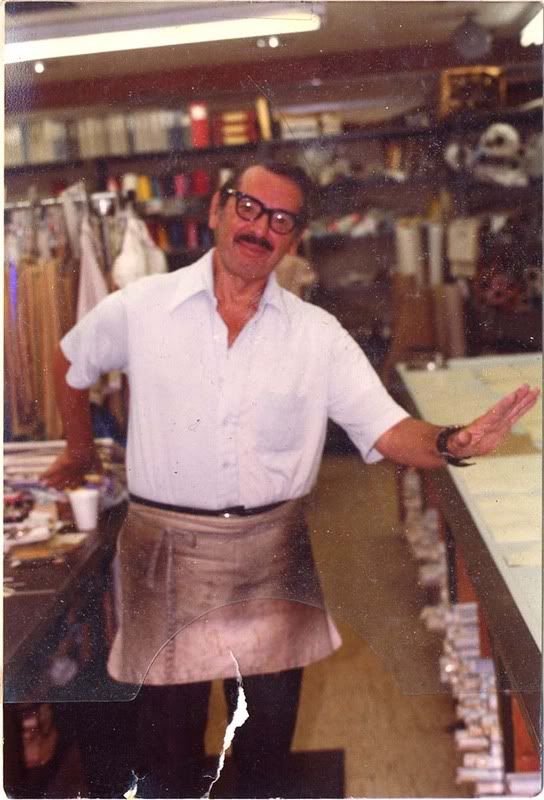 Two older posts that are noteworthy in regard to the recent Schmatta movie on HBO. One was on 12/27/07 And the other followed it the next day on 12/28/07
Garment Gangsters
The Schmatta documentary doesn't touch on the gangster influence in the industry. Originally "good" mobsters were employed to counter the boss' use of mobsters to intimidate workers and break strikes. However, their influence soon transferred into control and ownership of several garment concerns, especially trucking. Little Augie and Benny Fein (mentioned in the article below) were part of that group. Benny Fein was mentioned before in April
SCHMATTA: RAGS TO RICHES TO RAGS
Currently on HBO.
from the hbo site of the movie
Youtube has a few more clips of this excellent movie. Clip two is here. A third clip is here. The Boston Globe has a review, strangely nothing in the nypress. I'm sure my father knew many of the oldtimers in the movie. I believe he worked for a while as a cutter and a marker/grader at Russ Togs. Amongst my KV friends, the Schumer and the Hyman dads were employed in the Schmatta trade on 7th Avenue. I'm sure there were many more KV Schmatta families, past and present, but today it's a dying breed. That's part of the problem with the U.S. economy.
from the hbo site of the movie
SCHMATTA: RAGS TO RICHES TO RAGS
A cautionary story of labor and greed, Schmatta: Rags to Riches to Rags follows the decline of the once-robust apparel manufacturing industry in the U.S., while chronicling the industry's relationship with unions and government. From the "Garmento" to the seamstress, from the designer to the marketing maven, from the small businessman to the financier, Schmatta offers a firsthand account of how the industry helped generations of Americans march out of poverty and right into the golden age of the American middle class. But while Schmatta reminds us of the early days of the garment industry and its heyday, it also probes its troubling decline, which has occurred largely within the last 30 years. In 1965, 95% of American clothing was made in the U.S.A.; by 2009, only 5% is manufactured here.
Director Marc Levin focuses his lens on Manhattan's Garment District, an eight-block area on Manhattan's West Side which gave birth to the domestic industrial labor movement, and played a key role in major American political activities. From its immigrant origins in the 19th Century, the labor movement rose quickly against deplorable sweatshop conditions. In recent years, however, the realities of automation, deregulation, globalization and outsourcing - all part of the race to the bottom line - eventually eroded the industry's unprecedented momentum.
This film tells some of the stories of the workers, labor organizers, designers, fashion execs and manufacturers who built their careers in the Fashion District, including: Joe Raico, a fabric cutter who took great pride in his workmanship, and laments that America doesn't produce anything anymore; Charles Kernaghan of the National Labor Committee, whose open letter to Kathy Lee Gifford caused a media circus in 1996; Irving Ruosso, owner of Russ Togs, one of the U.S.'s largest sportswear companies; Stan Herman, a designer who has worked in the District for five decades, and others.
Youtube has a few more clips of this excellent movie. Clip two is here. A third clip is here. The Boston Globe has a review, strangely nothing in the nypress. I'm sure my father knew many of the oldtimers in the movie. I believe he worked for a while as a cutter and a marker/grader at Russ Togs. Amongst my KV friends, the Schumer and the Hyman dads were employed in the Schmatta trade on 7th Avenue. I'm sure there were many more KV Schmatta families, past and present, but today it's a dying breed. That's part of the problem with the U.S. economy.
Monday, September 21, 2009
When Harlem Was Jewish
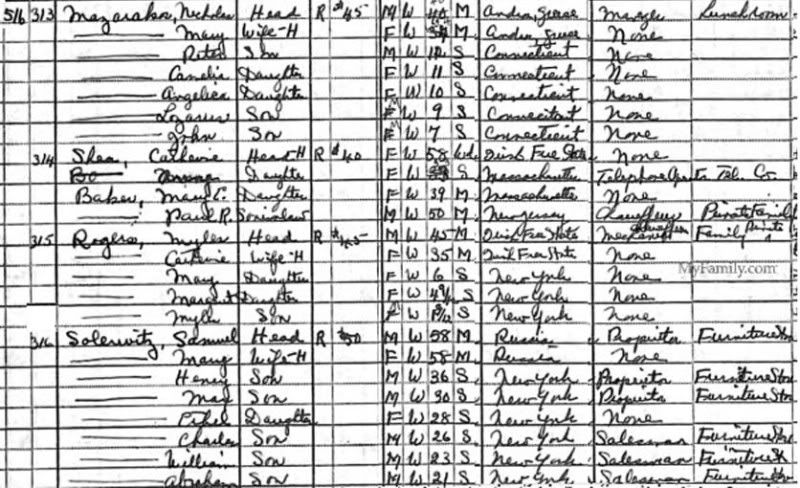
Above a portion of the 1930 census of 516 W. 134th Street. It shows the "famous" Solerwitz family that would later move to Knickerbocker Village. The family had several furniture stores near KV. The Solerwitzs lived in the same building with people of Greek, Irish, and German ancestry. Below on the left is the bakery on 283 W. 118th Street where transplanted Harlem KVer Son of Seth gets his rugelach. The picture comes from a recent nytimes feature on Harlem. The original Seth also lived in Harlem before moving to Knickerbocker Village. Union Settlement in the right portion of the photo was in East Harlem. It is now located on 104th Street
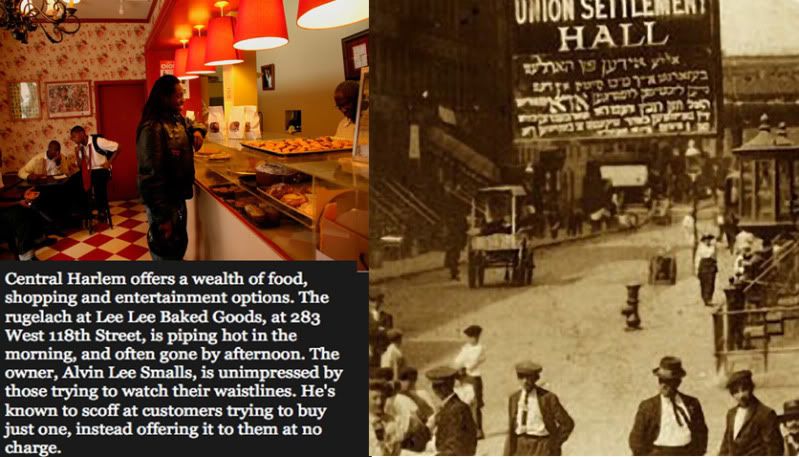 About When Harlem was Jewish from Harlem Be Spoke
A little known history of Harlem is that it was one of the the Jewish capitals of the world by 1920. Greater Harlem was 90 percent white at the time, and a one third of this population consisted of Jews who started moving into the area in the late 1880's after the construction of the trains going uptown. The Harlem Jewish population was the third largest in the world, with Krakow in Poland in the lead and downtown New York's lower east side in second place. The estimate census was around 178,000 total Jews in greater Harlem, which is slightly more than the number of African Americans living in Harlem today.
Harlem was divided into sections in the turn of the century, and this held especially true for the Jewish population. The lower photo of East Harlem exemplifies the class difference in Jewish society. Working class Jews lived meagerly east of 5th avenue while more wealthy Jews inhabited the new brownstones and French flats of West Harlem. In the 20's a small portion of African Americans began to move into Central Harlem but were also a separate community. By 1930, the white flight of the cities began and only 5,000 Jews remained. Today, Jewish communities can be found further north of Harlem in Hudson Heights and also south, on the Upper West Side of Manhattan.
Friday, September 18, 2009
Tuesday, September 15, 2009
Monday, June 22, 2009
Sunday, June 21, 2009
Claude Thornhill: Snowfall
One of my father's favorite songs. It may not fit for the first of summer, but we've been getting nothing but rainfall. It also fits the nuclear fallout thread of duck and cover.
About Claude Thornhill from a previous post
SNOWFALL, the band's gorgeous theme, written and arranged by Claude, is in many ways its most memorable piece of music. This is an especially subdued rendition, with the usual brilliant brass release played an octave lower and into mutes; As Bill Borden points out, "This is the version we used to close our programs."
Saturday, May 23, 2009
Benny Goodman
If you're not listening to the big 100th year celebration of Benny's birth on wkcr, you're missing something
There's a kv connection but not strong one
Saturday, March 7, 2009
Wednesday, March 4, 2009
Henry Street, Between Market And Catherine: 1932, Close-Up
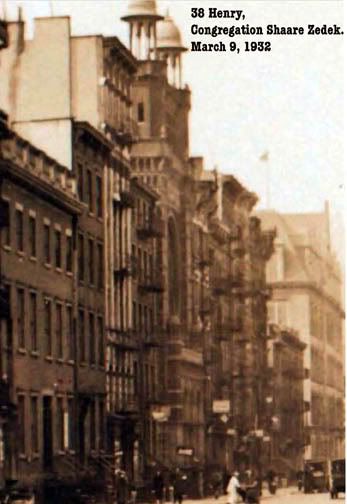
This structure at 38 Henry really caught my eye. I investigated further
from wikipedia
Congregation Shaare Zedek (Gates of righteousness) is a Conservative synagogue located on West 93rd Street in Manhattan. Founded in 1837, by Polish Jews, Shaare Zedek is the third oldest synagogue in New York City. The congregation originally met at 38 Henry Street on Manhattan's Lower East Side. In 1850, it purchased a building at 38 Henry Street that was originally built by a Quaker congregation in 1828 that had been converted for use as a synagogue by congregation Ansche Chesed in 1840. The congregation replaced this building with a new building on the same property in 1891 and in 1900 opened a branch synagogue at 25 West 118th Street in the newly-fashionable neighborhood of Harlem. The building is now a church. The Henry Street building was sold to Congregation Mishkan Israel Anshei Suwalk in 1911.Shaare Zedek's present, elaborate, Neoclassical building was designed by the architecture firm of Sommerfeld and Steckler and buit in 1922/3.
Since July 2006 the congregation has been led by Rabbi Julia Andelman and President Richard Friedman. Although Shaare Zedek was the last Conservative synagogue in the area to allow fully egalitarian worship, women now participate in every aspect of the service and the congregation has hired its first female rabbi. While preserving the traditional liturgy quite closely and committing to a fairly strict observance of Jewish law, the community is generally politically and socially progressive. Jews of all sexual orientations and races are fully welcomed.
more to come on this and the structure to the left at 48 Henry Street
Subscribe to:
Posts (Atom)


 Posts
Posts