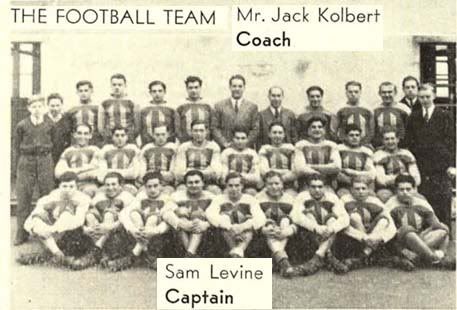
seward-fb-35

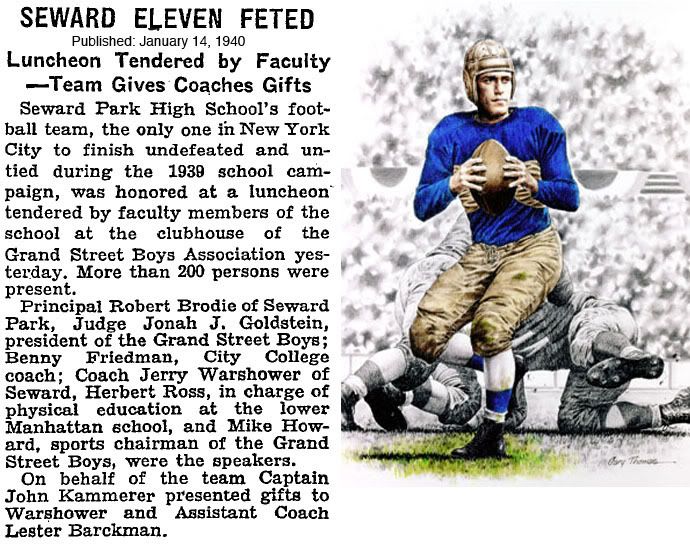
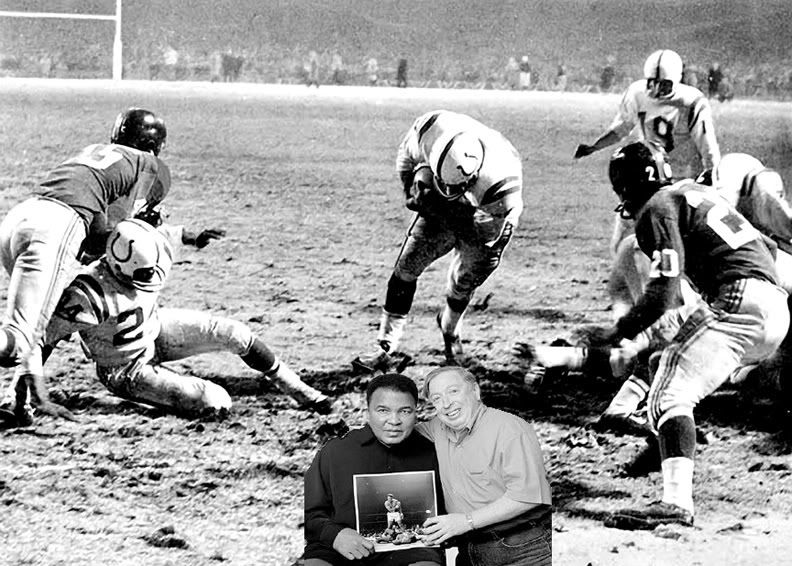
Neil Leifer (born December 28, 1942 in New York, New York) is a noted photographer for the Time family of magazines. As a boy in New York City, Leifer would gain free admission to New York Giants games by pushing the wheelchairs of handicapped patrons into the stadium. Using his free ticket and a camera, he would then position himself on the field with the photographers.
Leifer gained free admission to the 1958 NFL title game between the Giants and Baltimore Colts. This game became famous as the first overtime game in league history. Leifer, on his sixteenth birthday, caught several images of the game winning touchdown which he sold to Sports Illustrated.
Sports Illustrated's editors liked Leifer's work and he quickly became a boy wonder at the magazine. He had his first cover shot in 1962 at age 19.
Leifer was also known for taking risks. For the 1966 heavyweight title fight between Cleveland Williams and Muhammad Ali, Leifer placed a camera in the rafters of the Houston Astrodome in order to get a shot of the canvas when the victor knocked out his competition. His shot of Ali standing over a defeated Williams has been seen by millions. A year earlier, Leifer was one of the only two photographers with color film in his camera when Ali knocked out Sonny Liston in Lewiston, Maine, and his image of the moment has become not just one of his most famous photos, but one of the most memorable sports photos of all time.
Neil is also known for the help offered to photographers at new venues. His knowledge of all the major sites of events saved many a young shooter, and made his place among the not-only greats, but tops among the "good guys."
After over 150 covers for Sports Illustrated, Leifer left sports for a wider range of assignments with Time Magazine. This included a notable spread on the "Big Five" shot on safari in Africa.
In later years, Leifer gradually reduced his workload. He likes to brag that the only pictures he takes anymore are of his grandchildren, although he has been known to come out of retirement for a special cover shoot for Sports Illustrated on rare occasions.
In recent years, Leifer has focused his creativity to the moving image. He is the director, and often writer, of noteworthy films. Most recently, Leifer was shortlisted for the documentary film short Oscar for 2007, titled "Portraits of a Lady".
Professional football was on the rise in the 1950s and reached a crescendo during the latter part of the decade. Much of the popularity can be traced to a single game the 1958 NFL Championship Game between the Baltimore Colts and New York Giants.
The game played at Yankee Stadium in New York attracted a national television audience and became known in football lore as "The Greatest Game Ever Played" More importantly, the game captured the collective attention of the nation and as a result, pro football exploded across the country in the following years. By the mid-1960s, professional football became the nation's favorite sport to watch and has remained on top ever since.
The drama was high on December 28, 1958 as the NFL's title game moved into its final minutes of regulation. While an enamored crowd watched, the television audience lost contact when someone inadvertently nudged a cable and knocked NBC off the air for several minutes.
Hall of Famer Gino Marchetti watched from the sideline as he nursed a broken leg suffered earlier in the game. Historians note that the game actually contained its fair share of sloppiness six lost fumbles, missed field goals, interceptions, and conservative play-calling - which would detract from its moniker claiming to be the greatest game ever.
But, there's no denying that the excitement of the back-and-forth battle reached epic proportions as quarterback Johnny Unitas led the Colts' offense onto the field late in the game. With the clock ticking, the Colts began from their own 14-yard line. After two incomplete passes, Unitas connected with halfback Lenny Moore on an 11-yard play to start moving the offense up the field.
Steve_Myhra_kicks_game_tying_FG
Steve Myrhra kicked a 20-yard field goal with seven seconds to play in regulation to force the first overtime in NFL playoff history.
Johnny U. missed on a long pass to L.G. "Long Gone Dupre," before turning to his favorite target. On second-and-ten, he found Raymond Berry for a 25-yard gain to midfield. Then, Unitas looked down the left sideline and connected with Berry for another 15 yards. One more Unitas-to-Berry hook-up, which was good for 22 yards, put the Colts at the Giants' 13-yard line. With seven seconds to play in regulation, kicker Steve Myhra trotted onto the field and booted the 20-yard field goal to send the game into overtime. It marked the first time in league history that a championship game would be decided in sudden death.
The Giants won the coin toss but were forced to punt after they went three-and-out. Seizing the opportunity, Baltimore's offense methodically controlled the ball and moved 80 yards on 13 plays. History was made when fullback Alan Ameche punched through the line on a one-yard, game-winning touchdown after 8 minutes and 15 seconds of overtime to give the Colts a 23-17 win and the NFL title!
We were playing by 110, not KV. And I don't remember how Teddy spelled his name, but we always thought it was presidential. Obama wanted to make peace with Lieberman.
Teddy Roosevelt lived in KV/ WOW. Maybe it was Teddy Graf. I recall talking about the events in Tanahey Park with Dave, Stevie, and probably Bobby and Marty. We all agreed at that time that, at that particular time, we very very sensitive and unprepared for an enemy (Russia?) attack. Even then we were concerned about national security. On another note. Can somebody please explain to me why Joe Leiberman still chairs the Home Land security committee? Hasn't he done enough damage?
To answer Howie's question: It did happen on a Friday. We were scheduled to play a basketball game that night on the court by the East River Drive but didn't play. We did play on Sunday at PS 110, not sure if we were just playing or it was a scheduled game. I remember Teddy Roosevelt (sp) coming down to the court telling us that Oswald got shot.
Giants lost that day to the Cardinals.
45 years ago I ran into Stewie going to my 8th grade French class, Ms. Phifer, who just about everybody detested was my French teacher. I think Booby was in my class along with Stewie's older brother, Lenny. I didn't believe Stewie when he told me the president had been shot, thought him to be kidding; as he was prone to do. Turns out he wasn't
kidding; word came over the loudspeaker a few moments later about what had happened and Ms. Phifer broke down. I didn't hate her as much after that.
The episode reached a new level when Ruby shot Oswald on national TV. I didn't see it live. My mom did, and she went crazy. I heard her screams in the living room, came running in from the bedroom to discover that the whole world had been turned upside down.
I recall Mr. Kessler. He was a cold fish. I can just picture him going on with his quadratic equations.
I was in an algebra class at Seward Park and it was announced over the loudspeaker. The teacher(I'll never forget his name-Mr. Kessler, barely paused to acknowledge anything and then kept on teaching. I ran into Jerry and David on the way home and we stood stunned for a while.
Elinor: C'mon it was only 45 years ago, of course we were in the same class, probably since 1st grade ...I was relaying what occurred the last period of the day which was Social Studies, period 8 on Friday, Mr.Klein our Social teacher was giving us a test, it was about 2:30 when someone came into the room and whispered something to him and I heard him respond, "don't tell them now..they're taking a test..." .... after that we went back to our official class (Schwartzbarth) and there was an attempt to broadcast the news over the PA system ... as for who actually broke the news to us for the first time .. could have been either teacher .... by the way ..do you remember how I signed your graduation book? ... "To the first bird that could not fly..." .. remember the nickname Birdie? ...finally, one of the all-time greatest pieces of useless information, but one we can be proud of is the we graduated from 65 in '65 ...
Howie,.... I thought we were in the same classes at 65? I was in Ms. Schwartzbarth's english class when she TOLD us what happened. We all went straight home to watch the events on TV. I was supposed to be going to my dancing school class uptown on 47th that day but of course my mother wouldn't let me go and insisted it would be closed!.....If I recall correctly, we were in 7th grade at the time.
Francis Newton "Frank" Gifford (born August 16, 1930) is a former American football player and one of the better-known American sports commentators in the latter part of the 20th century who made the transition from an athlete to broadcasting.
Gifford was born in Santa Monica, California, the son of Lola Mae (née Hawkins) and Weldon Gifford, an oil driller. After graduating from Bakersfield High School, Gifford was unable to gain an athletic scholarship to the University of Southern California (USC) due to his low grade point average. Undeterred, he played a season for Bakersfield College, making the Junior College All-American team while making the grades needed to enroll at USC. At USC, Gifford was named an All-America.
He began his NFL career with the New York Giants by playing both offense and defense, a rarity when platoon football became popular after World War II. He made eight Pro Bowl appearances and had five trips to the NFL Championship Game, the forerunner of the Super Bowl. Gifford's biggest season may have been 1956, when he won the Most Valuable Player award of the NFL, and led the Giants to the NFL title over the Chicago Bears.
He lost 18 months in the prime of his career when he was the victim of one of the most brutal, though completely legal, hits in NFL history. During a 1960 game against the Philadelphia Eagles, he was cleanly blindsided by Chuck Bednarik on a passing play, suffering a severe head injury that led him to retire from football. However, Gifford returned to the Giants in 1962, changing positions from running back to wide receiver (then known as flanker). Despite his long layoff and having to learn a new position, he became a star once again.
His Pro Bowl selections came at three different positions—defensive back, running back, and wide receiver. He retired again, this time for good, in 1964, after making the Pro Bowl as a receiver.
During his 12 seasons with the New York Giants (136 regular season games) Frank Gifford had 3,609 rushing yards and 34 touchdowns in 840 carries, he also had 367 receptions for 5,434 yards and 43 touchdowns. Gifford completed 29 of the 63 passes he threw for 823 yards and 14 touchdowns.
Gifford was officially inducted into the Pro Football Hall of Fame on July 30, 1977.
After his playing days ended, Gifford became a commentator mainly for NFL games on CBS. His big break came in 1971 when he replaced Keith Jackson as play-by-play announcer on ABC's Monday Night Football, joining Howard Cosell and Don Meredith, and would continue on as a commentator until 1997, amid controversy regarding an affair he had with airline stewardess Suzen Johnson. In 1998, he was given a reduced role on the pregame show. After that, Gifford left Monday Night Football.
Gifford also served as a reporter and commentator on other ABC programs, such as their coverage of the Olympic Games and skiing, and has guest hosted Good Morning America on occasion. In 1995, he was given the Pete Rozelle Award by the Pro Football Hall of Fame for his NFL television work.
He also announced Evel Knievel's jumps for ABC's Wide World of Sports in the 1970s, including when Knievel failed to clear 17 buses at Wembley Stadium in 1975.
Gifford has a younger brother, Waine, and an older sister, Winona. He has a daughter Heidi from a woman he did not marry. Gifford has another daughter, Victoria Denise Gifford (b. February 20, 1957) with Maxine Avis Ewart. Victoria married a member of the Kennedy family, Michael LeMoyne Kennedy.
Gifford has been married (since 18 October 1986) to current Today Show talk show host and singer Kathie Lee Gifford (who coincidentally shares his August 16 birthday). They have two children: son Cody Newton Gifford (b. March 22, 1990) and daughter Cassidy Erin Gifford (b. August 2, 1993).
In 1997, the tabloid The Globe hired Trans World Airlines flight attendant Suzen Johnson to seduce Frank Gifford in a hotel room equipped with cameras installed by the newspaper. ESPN later reported that Johnson was paid $75,000. The Atlantic put the figure at $125,000. Johnson succeeded and The Globe published photographs showing Frank Gifford with Johnson. The New York District Attorney considered filing criminal charges against The Globe for, among other things, prostitution, but the Giffords asked that he drop the case.
Gifford, the 78-year-old former star for the New York Giants and later an icon on Monday Night Football, tells the story of this much-chronicled game between his Giants and Johnny Unitas's Baltimore Colts from both his perspective and through interviews with teammates and opponents. Gifford decided to write this book after David Halberstam, a friend of Gifford's who had planned to write a book about the game, was killed in a 2007 car accident. Gifford's is a candid, insightful and entertaining look at the camaraderie and culture of the first great stirrings of the NFL, when professional football was a second-class sport in comparison to baseball. He describes vividly an era where the Giants players worked second jobs in the off-season, spent many fall nights barhopping their way across midtown Manhattan and often partook of cigarettes and beer in their Yankee Stadium locker room. Despite the title, this is less a book about how that 1958 game changed the NFL (which was covered in Mark Bowden's summer release of The Best Game Ever) than it is an enjoyable telling of the men who played it.
In 1958 Frank Gifford was the golden boy on the glamour team in the most celebrated city in the NFL. When his New York Giants played the Baltimore Colts for the league championship that year, it became the single most memorable contest in the history of professional football. Broadcast to an audience of millions, it was the first title game ever to go into sudden-death overtime. Its drama, excitement, and controversy riveted the nation and helped propel football to the forefront of the American sports landscape.
Now, to mark the fiftieth anniversary of "The Greatest Game Ever Played," New York Giants Hall of Famer and longtime television analyst Frank Gifford provides an inside-the-helmet account that will take its place in the annals of sports literature. Drawing on the poignant and humorous memories of every living player from the game—including fellow Hall of Famers Sam Huff, Andy Robustelli, Art Donovan, Lenny Moore, and Raymond Berry—as well as the author's own experiences and reflections, The Glory Game captures a magnificent moment in American sports history. It is the story of two very different cities and teams, filled with the joy, the disappointment, and the eternal pride of a day that will forever symbolize all that is great about sports.


 Posts
All Comments
Posts
All Comments