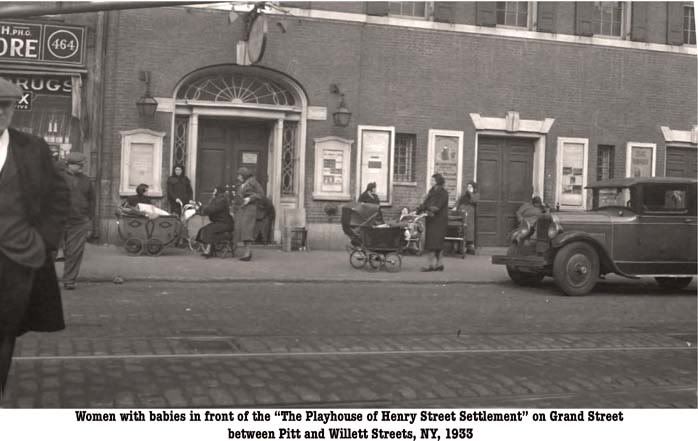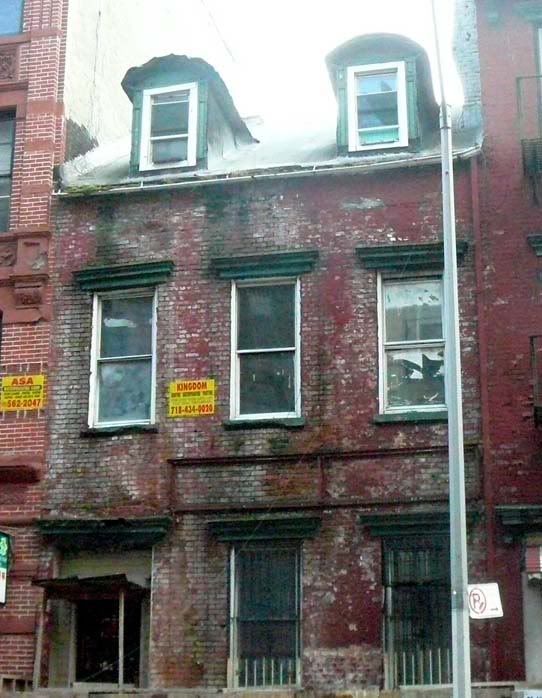

It really should be "then and Then" since 16 Henry Street looks like it hasn't changed.
Correction: The pic of the house is of 24 Henry Street, which, as of May, 2012, is slated to be demolished.

Lillian Wald Remembered- Sunday, March 22, 11 AM
Pay tribute to Lillian Wald (1867-1940), founder of the Henry Street Settlement and the Visiting Nurse Service of New York. Wald's public health campaigns on the Lower East Side opened the door to national and international crusades for social justice, and immigrant, women's, and civil rights. Professor Marjorie Feld (Babson College) will discuss her recent biography of Lillian Wald, highlighting the challenges Wald faced in building these legacies. Co-Sponsored by the Tenement Museum
Free
Lillian D. Wald (1867–1940) was a nurse, social worker, public health official, teacher, author, editor, publisher, women's' rights activist, and the founder of American community nursing. Her unselfish devotion to humanity is recognized around the world and her visionary programs have been widely copied everywhere.
Wald was born into a comfortable, German-Jewish middle-class family in Cincinnati, Ohio (Her father was an optical dealer.) In 1878, she moved with her family to Rochester, New York. She attended Miss Cruttenden's English-French Boarding and Day School for Young Ladies, and upon graduation, tried to enter Vassar but was denied, as the school thought her too young, at 16. Several years later, however, she went on to attend New York Hospital's School of Nursing.
In 1893, after a trying time at an orphanage where children were maltreated, she started to teach a home class on nursing for Lower East Side (New York) women. Not long thereafter, she began to care for sick residents of the Lower East Side, and soon decided to devote her life to this cause. Along with another nurse, Mary Brewster, she moved into a spartan room near her patients, in order to care for them better. She was the founder of the Henry Street Settlement which later attracted the attention of Jacob Schiff, a prominent Jewish philanthropist who secretly provided her the means to help more effectively the "poor Russian Jews" whose care she made her life's mission. She was able to expand her work later, having 27 nurses helping her by 1906. She never married, preferring to devote herself fully to her career. She authored two books relating to this work, the first being The House on Henry Street, first published in 1911, followed by Windows on Henry Street in 1934. Both books went through numerous printings and today modern reprints are available in both hard and paperback editions. Today, Lillian Wald is widely regarded as the founder of visiting nursing in the United States and Canada.
Another of her concerns was the horrendous treatment of Black Americans (especially the rash of hundreds of lynchings), and as a consequence, she was one of the seminal founders, in 1909, of the NAACP (National Association for the Advancement of Colored People). As she was already renown for her social work, her involvement in this newly-founded organization was instrumental in raising support for the cause of racial equality. In fact, the first major public conference to create the organization opened with a meeting at her Henry Street settlement.
She died in 1940 of a cerebral hemorrhage. Many people mourned the loss of the dedicated nurse and immigrant reformer. The Lillian Wald Houses on Avenue D (Manhattan) were named for her. She was interred at Mount Hope Cemetery in Rochester.
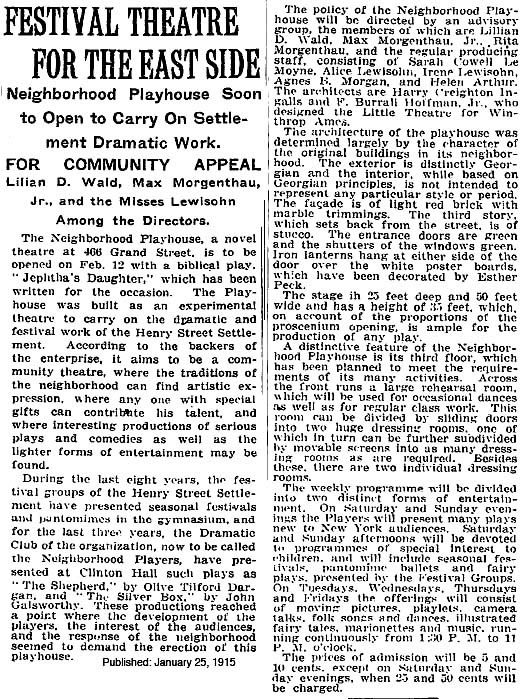
Then in 1935, she was named to what she came to consider her most important post-Director of the Music School of the Henry Street Settlement School in New York, an appointment that she would hold for nineteen years.
Spofford's decision to enter settlement work was typical of college educated women of her generation, who, in searching out ways to put their education and gifts at the service of society, found in settlement work a perfect outlet for their aspirations. At the Henry Street Settlement, Grace Spofford accessed yet another female network group which would energize her as she continued to work for social reform.
From the outset, Grace Spofford continued to use the collaborative processes that had become her modus operandi, surrounding herself with an excellent Music Committee which served as an Advisory Board. Its members included Lillian Wald, Helen Hall, Aaron Copland, George Gershwin, Jascha Heifetz, Felix Salmond, and Harold Taylor. Under Spofford's guidance, the Music School began to move in ways that made it more meaningful to the lower East Side community and enabled it to continue excellent musical standards and make important contributions to the field of music education.24 With the enthusiastic support of Henry Street Settlement House Director Helen Hall, the Henry Street Music School strengthened its already excellent programs.
A highlight of Spofford's early years at the Henry Street Settlement House occurred during the 1936-37 academic year-one year after Spofford's arrival. She convinced Aaron Copland, whom she had appointed to the Composition Faculty, to write a new work for the children at the school, one that would be suitable for performance by students, while simultaneously not sacrificing musical standards. Copland welcomed the challenge to write a piece that would be simple enough for youngsters to perform and that would allow him contact with the youth of America. The resulting work was a young people's "play opera" entitled "Second Hurricane," performed by children and young people ages 8-19 from the Music School, the Professional Children's School, the Seward Park High School, and the Adult Chorus of the Henry Street Music School. Many who were involved in the production went on to become prominent in their various spheres of the arts: conductor Lehman Engel, director Orson Welles, and actors Joseph Cotton and Charles Pettinger being the principals among them
Under Spofford's leadership, enrollment at the Henry Street Settlement Music School grew and faculty was expanded. In the 1940-41 season, the school could boast among its faculty pianist Isabelle Vengerova, violinist Ivan Galamian, harpist Lucile Lawrence, and composer Roy Harris, to mention but a few. By 1952 the school had 70 teachers and an enrollment of 900, ranging in age from 5-65 and representing 32 different national backgrounds. Although many of the students had made names for themselves in the world of music, Spofford's philosophy in educating the underprivileged was that "we are just as proud of the ones who marry and raise families or follow careers which have nothing to do with music."
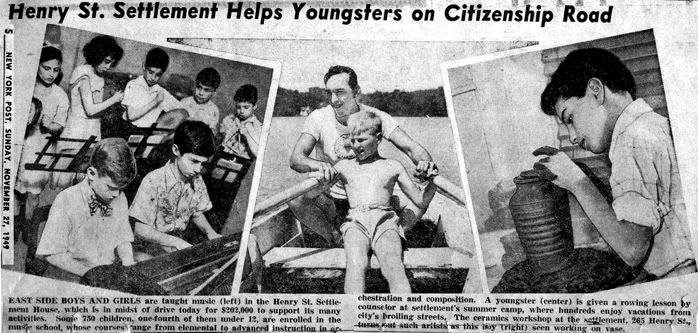
New York Post—November 27, 1949:Henry St. Settlement provided the promo photo (left) of Cliff (wearing his signature bowtie) and an unidentified accompanist performing Brahms Piano Concerto No. 1 with orchestral backup.


 Posts
All Comments
Posts
All Comments