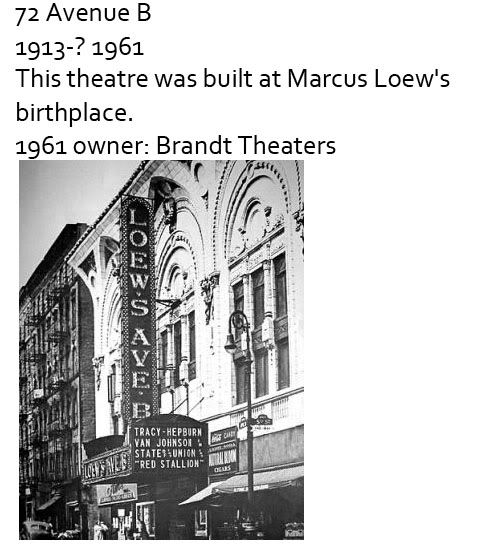
Loew’s Avenue B Theatre is part of one of the great rags-to-riches stories of showbiz history. Movie mogul Marcus Loew erected it on the very site of the tenement building where he was born. Needless to say, his birthplace was demolished to make way for the luxurious 1,750-seat theatre, which was designed by Thomas W. Lamb and first opened on January 8, 1913, with vaudeville as its main attraction and movies thrown in just as fillers. The Avenue B Theatre was the top Loew’s house on the Lower East Side until the mid-1920’s, when the circuit took over the Commodore Theatre on Second Avenue, which was a much busier area for entertainment and shopping. The Avenue B Theatre was reduced to playing movies at the end of their Loew’s circuit run, and remained so until its closure around 1957-58. I don’t know if anyone operated the theatre after that. It was eventually demolished and replaced by a nursing facility.
Showing posts with label movie theaters. Show all posts
Thursday, September 8, 2011
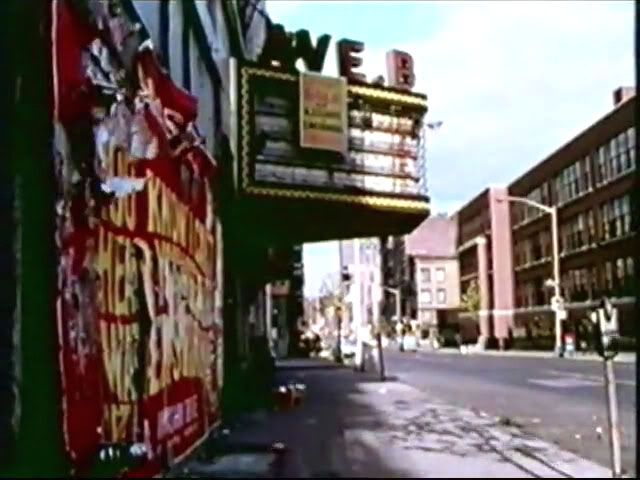
Avenue B Theater In 1967
I isolated a clip from the 1967 film showing the Avenue B theater, which was located between East 5th and East 4th Streets on the west side.
for more on the theater from cinema treasures
Thursday, July 28, 2011
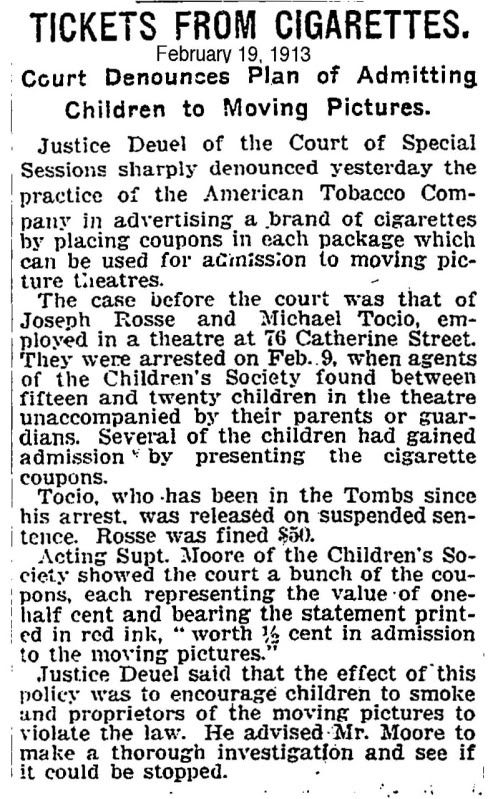
76 Catherine Street: Site Of The New Catherine Theater
Catherine Movie Fire
Seeing the mention of a movie theater on the 1921 map lead me to seek info on a theater at 76 Catherine.
Monday, February 1, 2010
The Charles Theater
Charles 1
The last three images from the pdf above are from evgrieve
next, below from
the nytimes from Victor Washkevich
separate entries from cinema treasures
The last three images from the pdf above are from evgrieve
next, below from
the nytimes from Victor Washkevich
Dear Diary:
Growing up on 16th Street between Avenues B and C before Stuyvesant Town was built meant that respite from summer’s heat was available only if you went to the upscale movie theaters like the RKO Jefferson or the Academy of Music, both farther west on 14th Street. No such luxury could be found at the local movie house, the Bijou Theater, on Avenue B between 11th and 12th Streets.
This two-story theater was strictly a no-frills neighborhood flick house. But when the summer temperature inside became unbearable or cigarette smoke blurred the screen, the ceiling of the Bijou began to ever so slowly slide open from the center toward the edges to provide egress for both heat and Lucky Strike’s blue vapors.
For a 10-year-old like me it was magic — until a sudden thunderstorm came up and the rain began pelting the seats. The roof’s closing speed was also ever so slow, and people scrambled in all directions like it was a fire drill. When it finally closed, we all went back to our seats, gave them a swipe with a handkerchief and never took our eyes off the screen.
The Marx Brothers had their “Night at the Opera.” We had our nights at the Bijou.
Victor Washkevich
separate entries from cinema treasures
I suspect that this was originally the 595-seat Bijou Theatre, which was situated at 193 Avenue B, according to many editions of the Film Daily Year Book. The owners may never have bothered to report a name change because there is no listing for the Charles in any FDYB. But the name was being used at least by 1949, as evidenced by a photo of the Charles marquee at the New York City Housing Authority website. The theatre was a late-run "nabe" and may have even closed before it became an avant-garde showcase in the 1960s. About five years ago, I found the building still standing, but converted to non-theatrical use (partially as an Hispanic church, if I recall correctly).
In research yesterday at the Library of the Performing Arts at Lincoln Center, NYC, I discovered that this was definitely the Bijou Theatre before being re-named the Charles. In 1961, Daniel Talbot, who ran The New Yorker Theatre, took over the Charles, which was then showing Spanish movies, and converted it to a policy similar to that at The New Yorker, but with more emphasis on "new" filmmakers, who were given one night a week to show their latest works to the public at a reduced admision price. In 1969, the Charles was taken over by Radley Metzger, who also owned Audubon Films. He might have been the last person to operate the theatre before it closed.
During the 60's when the neighborhood was hispanic/puerto-rican and hippies, my loving, now deceased aunt and her frisky handed boyfriend took me to the Charles theatre to see " the Killing of Sister George". I guess I was about 6 or 7, strange movie, I do remember breasts and murder, but mostly what I remembered was that my aunt and boyfriend only watched a quarter of the movie (lol). It was a small theatre, sat about 500, and a big " CHARLES" on the marquee. Thanks Aunt Dolores.
I also believe the Charles Theatre opened as the Bijou Theatre with the name change occuring around 1945.
In June of 1968 the Charles had a double bill of "Guess Whos Coming to Dinner" & "Luv".
I believe Radley Metzger's steamy "Camille 2000" got audiences hot and bothered there for a while in 1969.
I re-call seeing "Claire's Knee", "2001", and perhaps "Satyricon" there circa 1970. I can't rememberwhen it actually closed but must have been shortly afterwards, perhaps 1972-73
Sunday, January 31, 2010
The Loew's Commodore
Fillmore Commodore
The Loew's Commodore became the Loew's Fillmore
from Cinema Treasures
The Loew's Commodore became the Loew's Fillmore
from Cinema Treasures
Loew's Commodore Theater in 1968
New York, NY
105 Second Avenue
When it opened in 1926, the Commodore was the largest of the 10 movie theatres in operation on Second Avenue between Houston and 9th Street.
Screens: Single Screen
Style: Adam
Seats: 2830
Architect: Harrison G. Wiseman
Originally opened in 1926 as the independently operated Commodore Theater, this movie house/Yiddish theater was taken over by Loew's Inc. and later became known as the Village Theater. It can credit Lenny Bruce as appearing on its stage.
In March 1968 it became the Fillmore East concert venue. Over the years, innumerable bands played here including Santana and Chicago. After decades of success, the Fillmore finally closed.
In the fall of 1980, it was converted into what was to become New York City's best and most celebrated gay disco 'The Saint', which became famous world-wide. This continued until May 2, 1988 when the doors closed following a non-stop 48 hours party. The building was used spasmodically for a couple of years for live events, then stood empty for a few years until the auditorium was demolished in around 1996.
Today the narrow facade remains and the lobby is now remodeled as an Emigrant Savings Bank. Apartments/condos called Hudson East were constructed on the site of the auditorium. In the lobby of the bank are pictures of the Fillmore, Village Theater and Loews Commodore Theatre as well as some posters from the Fillmore days.
Saturday, January 30, 2010
The Jefferson Theater
Jefferson Theater
the first photo is a segment of a larger one from shorpy
from cinema treasures
the first photo is a segment of a larger one from shorpy
from cinema treasures
RKO Jefferson Theatre
214 E. 14th Street
Status: Closed/Demolished
Screens: Single Screen
Seats: 1916
Architect: George Keister, Thomas W. Lamb
The old Jefferson Theatre opened in 1913 as a B.F. Keith's vaudeville theater in what is now known as the edge of the East Village. Later the RKO Jefferson, this theater was located at 214 E. 14th Street near Third Avenue. The entrance was a narrow space between two tenement houses with the bulk of the theatre (auditorium) located in 13th Street. The Jefferson operated at least into the 1970's and was demolished in 2000. Today, the site is filled with bricks and debris from the demolition and the old Jefferson as passed on.
Also known as B.F. Keith's Jefferson Theatre
Last owner was a relative of the owner of the Wetson hamburger chain. He was almost singlehandedly trying to restore it with only one helper. A visit to the upstairs proved he was wasting his time as vandals had removed all the plumbing by that time & the inside of the theater was in shambles. He quickly found this out and gave up on this vanity project
posted by WilliamMcQuade on Mar 20, 2002 at 8:39am
The East 13th Street portion (or rear of this theatre's building) can be seen in Taxi Driver. The action with Robert De Niro, Jodie Foster and Harvey Kietel all take place around the corner from The Jefferson.
posted by Greenpoint on Feb 8, 2004 at 3:38pm
The Jefferson was another Adam design by Thomas W. Lamb, and was built by B.S. Moss and Sol Brill. It first opened on January 25, 1913 with Keith's vaudeville. During the heyday of vaudeville, the Jefferson was one of the top NYC houses. New acts that registered well with the audience were assured of getting a booking at the Palace on Broadway, which was the ultimate reward for an entertainer in those days. Through its Keith's affiliation, the Jefferson became an RKO movie theatre, but retained vaudeville on the programs until well into the 1930s.
posted by Warren G. Harris on Mar 22, 2004 at 1:32pm
George Keister was the Jefferson's architect. Thomas Lamb did only some minor alterations in the 1930s. The Jefferson was built by the Irvington Construction Company, and took nine months to complete. The original seating plan showed 1,885 seats-- 1,124 in the orchestra, 689 in the balcony, and 72 in boxes...George Keister's other NYC theatres included the Astor, Belasco, George M. Cohan's, Selwyn, Chaloner (later Town), and both versions of the Earl Carroll.
posted by Warren G. Harris on Mar 27, 2004 at 7:47am
The narration above says it was closed by the early 60's but I seem to recall when going to Luchows in the seventies triple kung fu bills playing? Maybe an independant took over when RKO gave it up?
Yes, it was operated by "indies" after RKO left. It would be very difficult to track the exact closing as a movie house because the operators never advertised in the newspapers or sought listings in magazines like New York. When I last had a chance to visit the dingy interior in 1981, the Jefferson was closed and awaiting re-development as a disco/rock palace, but that never happened.
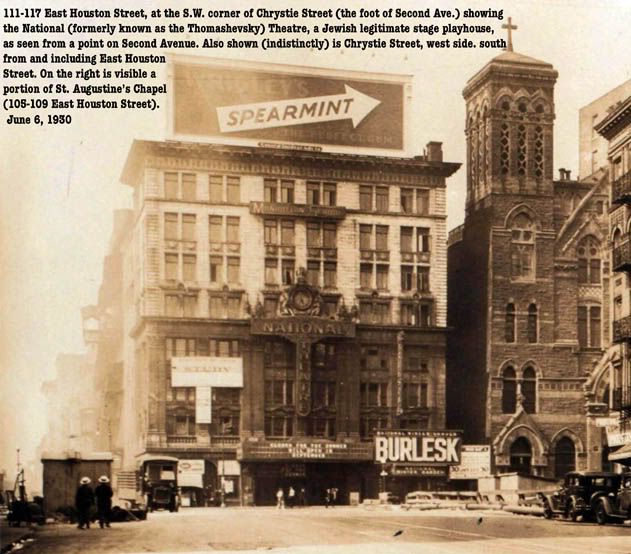
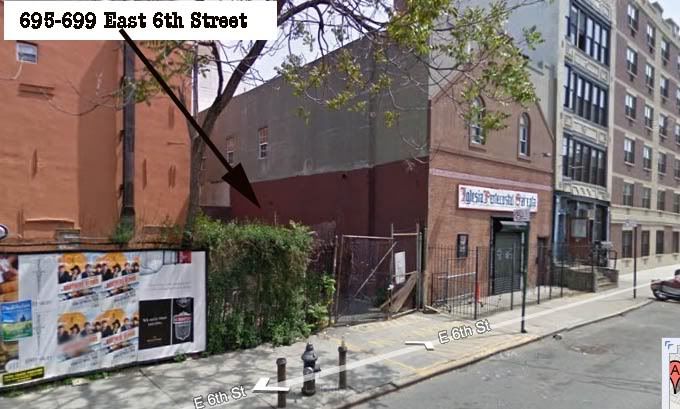
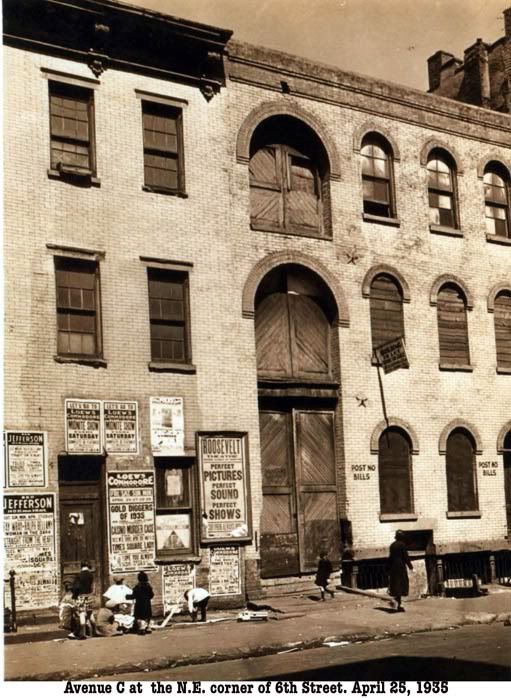
The Roosevelt Theater On Houston Street

Above the Roosevelt/National Theaterfrom NYPL Digital Gallery, The New York Public Library
history from cinema treasures
National Theatre & Roosevelt Theatre
111 - 117 E. Houston Street
Seats: 2863
Architect: Thomas W. Lamb
Built as a twin 'piggy-back' theatre , it was planned by Louis Minsky to be called the Unique Theatre and be used for burlesque. However when built (to the designs of noted theatre architect Thomas W. Lamb) it opened on 6th May 1913 as the National Theatre (on the lower level seating 1,900) which was leased to Thomasefsky & Adler for use as a Yiddish theatre. The upper theatre had a seating capacity of 963 and was named the Crown Theatre.
Programming varied from Yiddish stage shows to burlesque and it ran Russian films from 1936 to 1939 when the Crown Theatre was re-named Roosevelt Theatre.
The building was closed in 1941 and was later reopened as two movie theatres known as the National Theatre (seating 1,800) and Roosevelt Theatre (seating 963). These closed in 1951 and lay empty until they were demolished in 1959 for a parking lot.
The 1941 edition of Film Daily Yearbook lists this theatre as the Roosevelt Theatre, Houston Street. The seating capacity given is for 400 and it is listed as 'Closed'
A 1934 NY Times article mentions the Roosevelt Little as another name for the National Theatre (legit). The National was on the SW corner of Houston and Christie which maps now as 273 Bowery, 10002,
The site had been home to a household supply manufacturer from 1871-1911. I believe the theatre was built by Louis Minsky and Max Steuer, open by May 1913, and was known originally as the National (along with the National Winter Garden). In March 1935, it became the combination house known at the New Roosevelt Theatre. Simply the Roosevelt by September 1936, it exhibited Ukrainian, Soviet, Yiddish, and Chinese movies in the late 1930s and early 1940s. The National Winter Garden, located on the sixth floor, seated 299 and was known as the Rooftop Theatre from at least the mid-1940s through the building's closing. The theatre proper was known as the Downtown National from at least 1941-1951.
The theatre was closed when it was purchased by the Transit Authority in 1958.
I believe the lot on which it existed sat empty until the recent construction of the first building in the large Avalon Chrystie Place mixed-use development currently underway on both sides of East Houston. The particular building on the site, the foundation of which had to be built around 4 subway lines underground, will include a new community center and gym jointly operated by the Chinatown YMCA and University Settlement, a 60,000-sq.-ft. Whole Foods supermarket — the chain’s largest in Manhattan — and 361 rental apartments, 80 percent of which will be market rate and 20 percent for low-income tenants.
Subscribe to:
Posts (Atom)