290-294-grand-st
A previous post with a then and now view of Grand and Eldridge
Showing posts with label eldridge street. Show all posts
Showing posts with label eldridge street. Show all posts
Saturday, April 17, 2010


Wednesday, April 14, 2010
Grand And Eldridge Street: 1928

This is diagonally across the street from where the April 11th fire took place in 2010.
Sunday, June 7, 2009
I Like New York On June 7th
Pictures from June 7th on the lower east side, many from Eldridge Street Synagogue's Egg Rolls and Egg Creams Event.
Come to the best block party in downtown right where Chinatown and the Lower East Side meet. Celebrate the rich cultural traditions of the Jewish and Chinese communities. Klezmer music and Chinese opera, scribal art and calligraphy, Yiddish and Chinese lessons, folk arts and hands-on activities, tours of the Eldridge Street Synagogue and, of course, kosher egg rolls and egg creams! Plus: This year the Center for Traditional Music and Dance will be recording your favorite folksongs. Come prepared with your tune and belt it out, karaoke-style!
Friday, April 24, 2009
LES Fires In 1854
Eldridge Fire
As for 206 Eldridge Street, where a fire occurred in 1854, it once housed the offices of John Sniffen
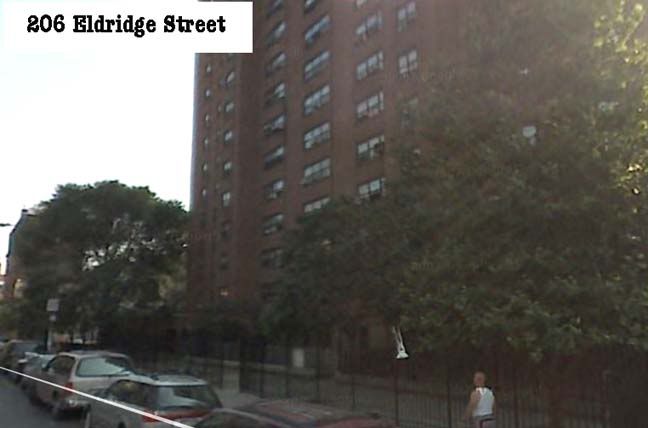
As for 206 Eldridge Street, where a fire occurred in 1854, it once housed the offices of John Sniffen
According to "The Street Book," by Henry Moscow:
John Sniffen, builder, listed in the 1859/60 NYC Directory as having offices at 206 Eldridge Street and living at 152 Henry Street, built carriage houses on East 36th Street. "Sniffen Court," on the south side of East 36th Street, near 3rd Avenue is named for him.
Eldridge Street In The Book Lush Life
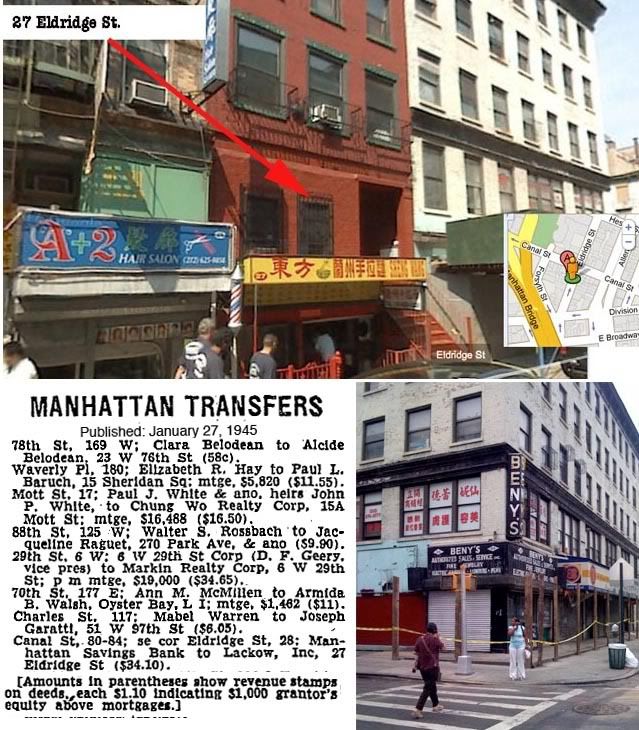
Above we follow in the footsteps of the main characters on a fateful night in a key scene of Lush Life. It takes place on the LES with key scenes at the Smith Projects (called the Lemlichs). Here the journey starts at Norfolk and Rivington at Schiller’s Liquor Bar, the model for Café Berkmann in the book. We proceed west on Rivington to Eldridge and then turn south. We end up at 27 Eldridge, a building once owned by the Lackow's Below is the transcript of the audio
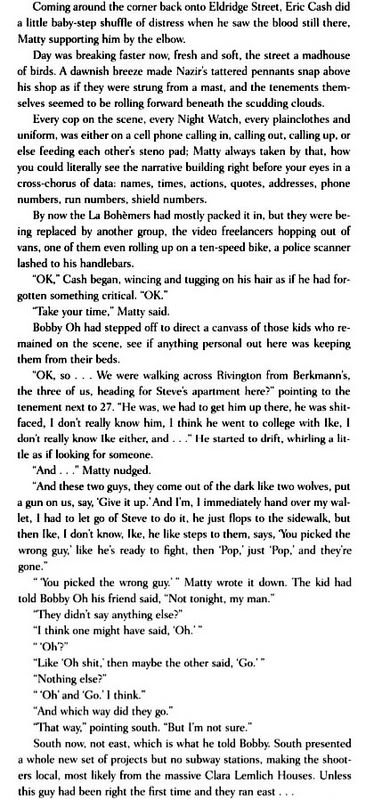
Lush Life was mentioned before in two posts last April. Here's one
Here's the second when Richard Price spoke at the Tenement Museum
22 Eldridge Street: Then And Now
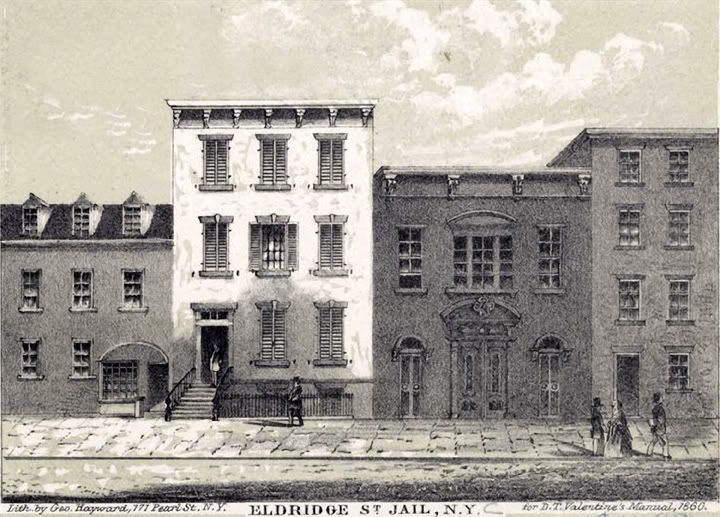
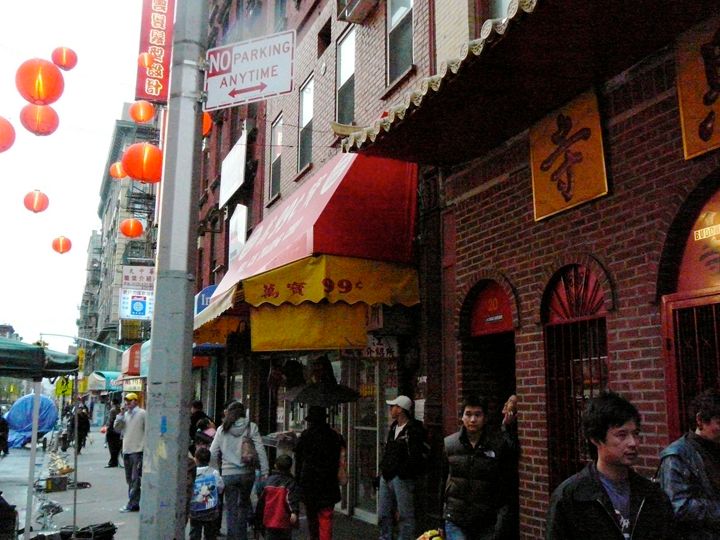
I also learned that 22 Eldridge (with the red awning and the $.99 sign) was once the site of a jail
The Fire House At 20 Eldridge Street
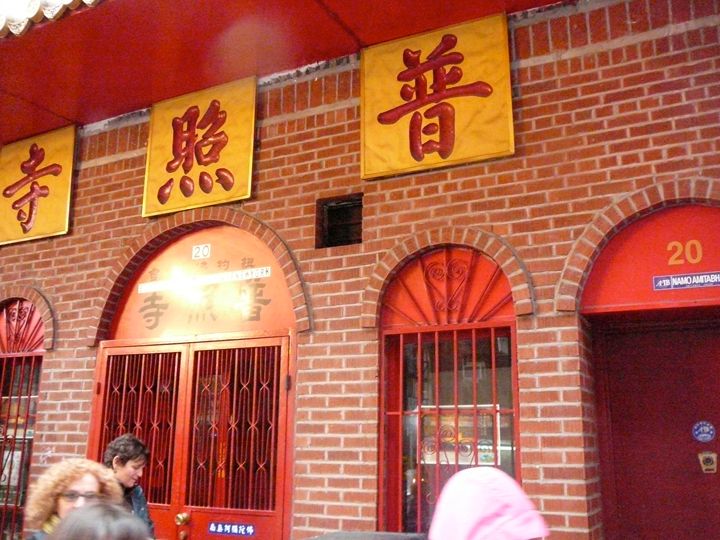 Here's something I learned on the walking tour that I went on. This building was the site of an old fire house going back to the 1800's. Evidently some the grill work is original in some form.
I'm not sure whether it once housed Engine Company 9 or a different Engine Company or just a Ladder Company
from the Engine Company 9 site
Engine Company 9 is the oldest Company in the New York City Fire Department. Engine 9's roots can be traced all the way back to the Colonial days of 1731. At that time two hand pumpers were imported to New York from London, England. Before these pumpers arrived, the people had only leather buckets to transport water onto a fire.
These new pumpers were side stroke, 2 cylinder machines. They were mounted on solid block wheels and were dragged to the fire by the volunteer firemen. The new pumpers were housed in sheds built for them at Wall and Nassau Streets, then the site of City Hall. Engine 1 was named "Hudson Engine", and would stay in existence after the paid Department came into being, as Metropolitan Engine 2. They were disbanded in the 1970's. (Their original Engine is still in existence at the New York State Volunteer Fireman's Home Museum in Hudson N.Y.). Engine 2, named "Chatham Engine", would eventually become the present Engine Company 9. Chatham Engine was moved to the Boston Post Road (now called The Bowery) in 1784, and then to Eldridge and Division Streets in 1832. There was always a great rivalry between the old "Vollies"; Each Company wanted to be the first to get water on the fire. Any trick would be used to slow down the other companies including FIST FIGHTS ON THE WAY TO THE FIRE! Chatham Engine was a bitter rival with Engine 26 and in 1845 both companies were disbanded for fighting. Chatham Engine was reorganized as "Excelsior Engine 2". They moved into a house on Henry Street near Catherine Street in 1846. They remained there until early in 1865 when they moved into a new house built at 55 East Broadway. By this time the City of New York had grown to more than a million people and it was decided that a paid Fire Department was needed to replace the volunteers. On September 29, 1865 Excelsior Engine 2 became Metropolitan Engine Company 9. Engine 9 remained at their East Broadway quarters for over 100 years. In 1969 they moved into their present quarters at 77 Canal Street. Engine 9 shares their quarters with Ladder Company 6 and Satellite-1, a special apparatus that carries large diameter hose and foam equipment.
Ladder Company 6
-In the days before the paid Department in New York City, Ladder 6 was known as "Phoenix Hose Company."
- Ladder 6 was formed in the Metropolitan Fire Department (which became the FDNY under the Tweed Charter) on September 27th, 1865.
- Ladder 6's quarters at 77 Canal St. was previously an American Civil War Hospital and an armory.
- In 1965 the City of New York purchased the adjoining building and began
combining the two.
- In May of 1969, with the new facilities finished, Engine 9 and with Ladder 6 were quartered together.
The Tragic Aerial Ladder Test of 1875
Before Aerial Ladders were introduced to the FDNY, the Firefighters had to make due with the limited reach of portable ladders or attempt dangerous entry and exit through the interior of buildings consumed by fire in order to rescue trapped victims. Seeing many tactical advantages to the increased reach of an Aerial type ladder the FDNY Chiefs and Commissioners purchased several of them and began a series of field tests. Ladder 6 was selected to receive the first of these new Aerials and so Members of Ladder 6, Engine 9, and Battalion 4 all participated in these field tests.
Unfortunately the final test ended in tragedy on September 14, 1875. This was the day when the first Aerial Ladders were to go "in service" and a great public display of these new Ladders was planned at Tweed Plaza, a triangle formed by the intersection of East Broadway and Canal Street. Keep in mind that during this phase of American History, the public would turn out in droves for such a spectacle (an attitude that continued well into the first half of the 20th century.) And so many hundreds of people lined the Plaza that day to see the christening of Ladder Company 6's new Aerial.
September 14, 1875
At The Tweed Plaza, Canal St. and East Broadway
An Aerial Ladder was to be tested. Several public trials of the Invention had been given and the dangerous character of the Invention had been commented on. On one occasion when one of the Ladders appeared to be ready to topple over, Chief Bates prevented it by slashing a line, which carried to the top of the Ladder. (editor's note: Chief Eli Bates was Chief of Department in 1875.)
The final experiment was made on the Plaza, in the presence of a vast crowd and many Firemen and others interested in such matters. The Ladder was raised in eight sections to a height of 97 feet and Chief William H. Nash of the 4th Battalion ascended followed by Firefighter Philip J. Maus of Hook and Ladder 6, Firefighter William Hughes of Engine 9, four other Firemen and a Lieutenant.
Chief Nash had reached the summit of the Ladder when it snapped far below him and dashed Nash, Maus and Hughes, who were above the fracture, to the cobble stones of the square. Nash and Maus were instantly killed and Hughes died within an hour. No one else was injured.
The accident revived gossip which charged there was a corrupt understanding with the inventor and the payment from the City of $25,000 (editor's note: that's a huge sum of money in 1875!) for his Patented Rights. Public indignation ran to an intense pitch. The Fire Commissioners promptly shut down the Aerial Business.
September 15th Commissioner King offered a Resolution which was adopted prohibiting the further use of Aerial Ladders as it had been demonstrated they were useless and there was good reason to believe that the Invention was foisted on the Department at an enormous expense and by corrupt means.
Chief Nash was buried form 149 Clinton Street and his Funeral was attended by six Companies formed of details from the various Battalions. Maus was buried from 159-1/2 Essex Street and Hughes from No.10 Monroe Street.
The Sorcerer's Apprentice On Eldridge Street
A few clips that I pieced together on 4/22 as they were preparing for a shoot supposedly in the evening. In the beginning you hear the Eldridge Synagogue tour leader
About the film:from the bad and the ugly
The Sorcerer’s Apprentice has moved out of Brooklyn and into Chinatown on the island of Manhattan this week to shoot some exteriors for what I can only guess is the Chinese New Year scene in the adaptation of the Disney animated story, though this is going to be a live-action adaptation.
Toby Kebbell has boarded the cast of Disney’s The Sorcerer’s Apprentice, signing on to portray Drake Stone, a celebrity illusionist who joins forces with Alfred Molina’s evil sorcerer, Horvath, to gain ultimate powers, according to Variety. The Jerry Bruckheimer production is based on the popular “Sorcerer’s Apprentice” segment in Disney’s animated classic
Fantasia. The story revolves around a college student who is recruited to work reluctantly for a sorcerer and given a crash course in magic to help him battle dark forces in Manhattan. Nicolas Cage, Jay Baruchel and Teresa Palmer star in the film, directed by Jon Turteltaub.
from the movie blog
The movie is already underway in New york and has a summer 2010 release schedule.
I have two minds on this. First off is the feeling this is just a disaster waiting to happen on biblical proportions. The potential cheese factor is enormous. Why does Nic Cage seem to be attached to all of these?
HOWEVER… I’ve got to admit that the premise also holds a lot of potential to be bloody cool if it’s executed right. Personally I’m going to withhold all judgment until I see some clips or trailers to get a feel for the film and the direction it’s going. It might be interesting.
From most of the pictures, we’ve just seen a dirty looking Nic Cage leading a bewildered looking Jay Baruchel around different New York Locals, leaning in and talking to him quietly. The Sorcerer’s Apprentice was first-drafted by writing duo Lawrence Konner and Mark Rosenthal
pics of Cage can be seen here
looks like more cinema crapola to me
Thursday, April 23, 2009
73 Eldridge Street: Then And Now 2
 I didn't know where the Eldridge Street picture from the previous post was originally. I did, however, notice the signs for the Levine and the Zeigelheim businesses. I also saw the 73 number address. I sort of suspected Eldridge Street because it was known as a block where religious items were sold. Googling some combination of Levine and 73 and religious articles lead me to the article below. An excerpt from levine judaica
The Sy Syms Of Judaica
Dan Levine, owner of J. Levine Books & Judaica, isn't just selling Jewish books and gift ware. He's selling Jewishness. Open to the first page of "Living Jewish: The Ultimate Judaica Buying Guide" and you'll see a photo of Dan Levine, the fourth-generation owner of J. Levine Co. Books & Judaica. Call the store, and you'll hear a recording of his voice directing callers. Visit the the two-story shop at 5 W. 30th St. and you'll see a blow-up of his image from the catalog almost life-size in the window. Go inside and you're likely to meet the real Dan Levine.
He's the Sy Syms of the Judaica business, the Frank Perdue of Jewish book selling. The 40-year-old draws these comparisons himself, and then adds "obviously, in a different way." But Levine isn't just selling Jewish books and gift ware -- he's selling Jewishness.
"We are advertising Judaism," he says, pointing to the nicely arranged displays in the store. He explains that he wants all who come inside to leave with a greater appreciation of the richness and beauty of Judaism. "We're here to make people feel happy to be Jewish."
With the publication of "Living Jewish: The Ultimate Judaica Buying Guide" ($10), he hopes to share his upbeat view of Jewish life with even more people than those who get to the store. Levine feels as though he's "opened 50,000 branches" of J. Levine Co., all over the worlds. The sleek 98-page paperback, which he worked on for two years is a "full-service Judaica store in a book" -- and 50,000 copies are newly in print.
For example, a consumer planning a bar or bat mitzvah might consult the catalog, and then order invitations, a copy of "Putting God on the Guest List" by Jeffrey Salkin, a set of tefillin, a Haftorah booklet and tape, yarmulkes, a tallit set, Torah pointer and more. The book's brightly-colored pages are filled with photographs of hundreds of books, including classical texts, how-to guides and Jewish History, ritual objects and accessories, toys, tapes and computer software. Organized into five sections -- "Being Jewish," "Celebrating Jewish," "Learning Jewish," "Multimedia Jewish" and "Institutional Jewish" -- the book is a sleek Sear's Catalog of Judaica.
Levine sees the Buying Guide as a book "that can make a difference in the world, helping Judaism to grow, helping people to learn more about Judaism." Available for free to rabbis, the book is sold in the store and through mail order. He hopes to get some of the major book chains to carry it too.
Originally, Levine was approached by a trade publisher who wanted him to prepare a "Whole Judaica Catalog" modeled after the popular "Whole Earth Catalog." As he began formulating ideas for that book, he realized that he'd rather do his own version. Having a comprehensive J. Levine Co. catalog has been part of his dream of promoting the business' growth.
Under Levine's leadership, the business moved to Midtown from its original headquarters on the Lower East Side. In 1890, his great-grandfather, a Torah scribe, founded the firm, selling Torahs and other religious objects in Vilkameer, Lithuania. In 1905, the Torah scribe moved the business to New York. Levine's grand-father expanded the business to included the manufacture of embroidered religious objects, like synagogue ark covers, and the sale of books -- although at the time, there were probably one or two editions of the prayer books, rather than the more than twenty versions in the Buying Guide.
Levine's father and his two brothers, who grew up living above the store on Norfolk Street, entered the business after World War II. In 1962, they moved the business to a seven-story building on Eldridge Street, near the corner of Hester Street. "It was like a department store," Levine explains, with books on one floor and manufacturing on another. Though he admits that aesthetics in store design "was not the order of the day," he remembers visiting the store as a young child and breaking his arm when he tripped in cluttered space.
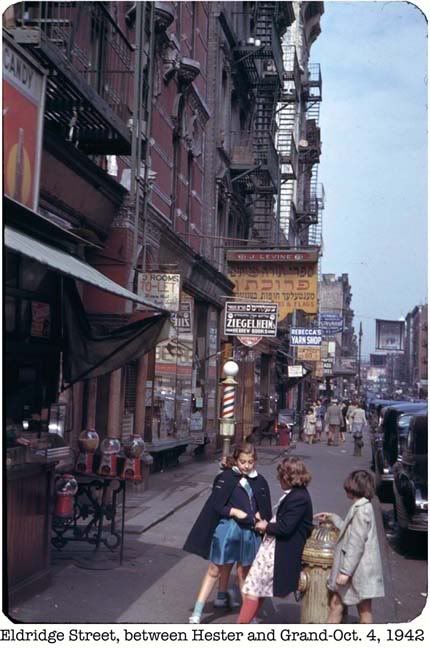
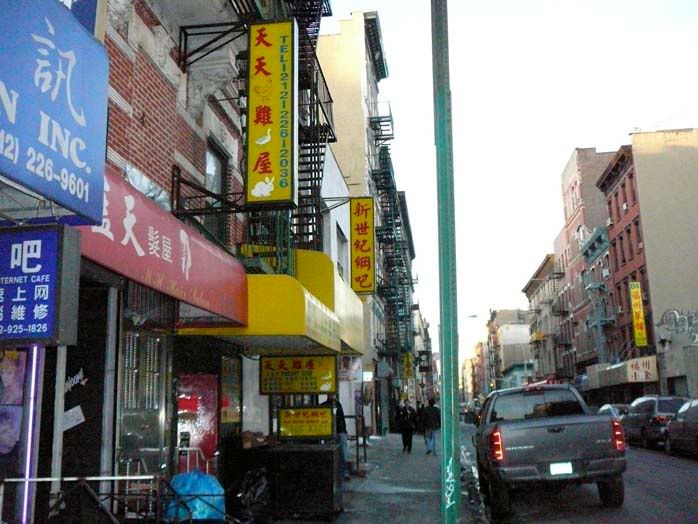
103 Eldridge Street: Then And Now
I was at the Eldridge Street Synagogue yesterday. More on that later. It reminded me of this then and now set I had
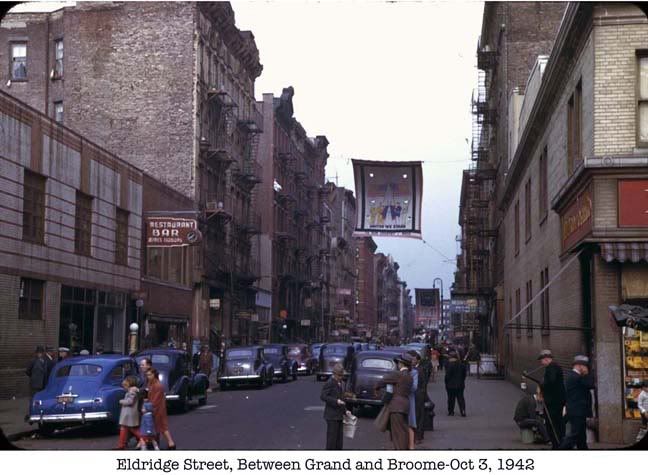
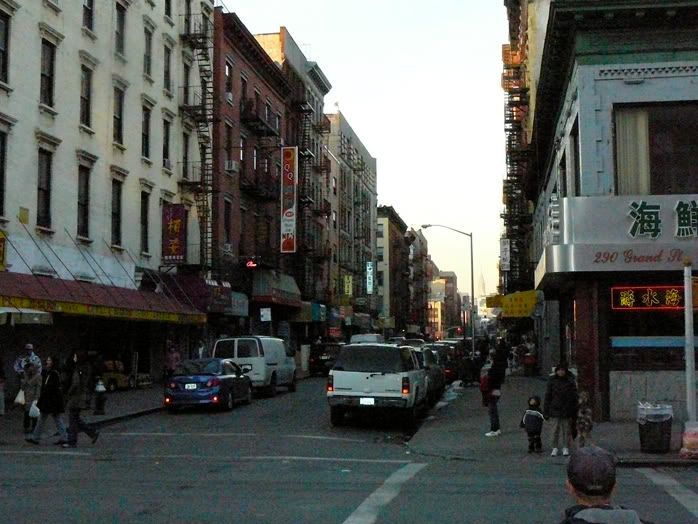
In the summer of 1942 all over the city blocks were raising banners noting how many of their sons were serving. We mentioned this in two previous postings.
One on Madison Street
and
One on Mott Street
In the summer of 1942 all over the city blocks were raising banners noting how many of their sons were serving. We mentioned this in two previous postings.
One on Madison Street
and
One on Mott Street
Subscribe to:
Posts (Atom)


 Posts
Posts