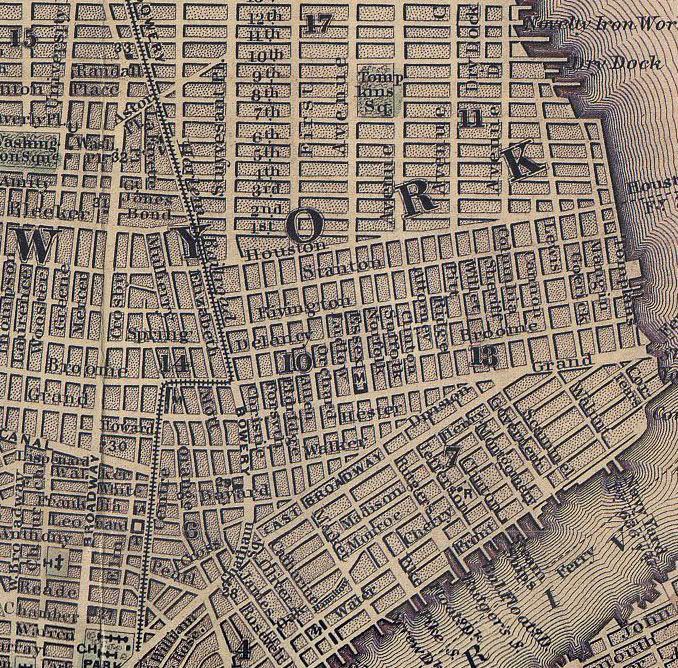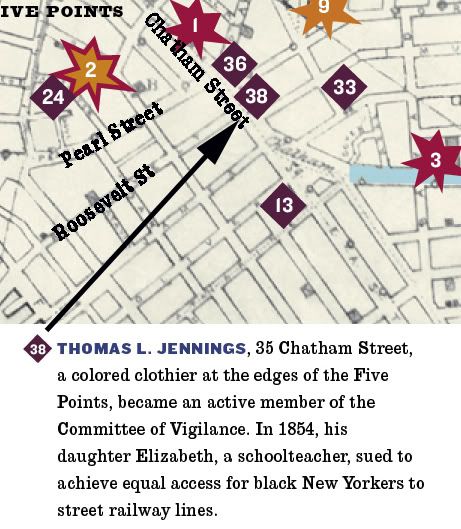
map portion comes from
a 1834 riot map from the ny divided exhibit below from wikipedia
Thomas L. Jennings (1791–1856) was a leading abolitionist. He was a free black tradesman who operated a dry-cleaning business in New York City, New York and was the first African American to be granted a patent.
Jennings' skills were so accepted that people near and far-off came to him to alter or custom-tailor objects of clothing for them. When he was thirty years old, in 1821, he was granted a patent for a dry cleaning process called "dry scouring." This enabled him to build up his business.
The first money Jennings earned was spent on the legal fees to purchase his family out of slavery, and then to support the abolitionist cause.
In 1831, Jennings became assistant secretary to the First Annual Convention of the People of Color in Philadelphia, Pennsylvania.
In 1857, Oscar Stuart, a slave owner, patented a "double cotton scraper." He did not, in fact, invent the double cotton scraper; historical records show that the only name given for the actual inventor was Ned, his slave. In his defense, Stuart claimed that "the master is the owner of the fruits of the labor of the slave, both manual and intellectual."
In 1793 and 1836, it was legal for both slaves and free Negroes to receive patents for their inventions. In a challenge to the patent, of Stuart vs. Ned, the Patent Office decided in Stuart's favor. They changed the law in 1858 to exclude the granting of patents to slaves, as they were not considered citizens.
from black history every month from fox sports network's series of vignettes that chronicle compelling stories of African Americans
from the The New York State Council for the Social Studies
On July 14, 1854, Elizabeth Jennings and her friend, Sarah Adams, walked to the corner of Pearl and Chatham streets in lower Manhattan. They planned to take a horse-drawn street car along Third Avenue to church.

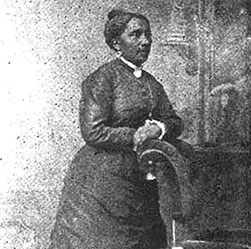
Instead, they entered into the pages of history. Elizabeth was a young African American woman who taught black children in New York City’s racially segregated public schools. Her father Thomas L. Jennings was a leading local abolitionist. An account of what happened to Elizabeth was presented on July 17 at a protest meeting at the First Colored Congregational Church in New York City. Elizabeth wrote the statement but did not speak because she was recovering from injuries. Peter Ewell, the meeting’s secretary, read Elizabeth’s testimony to the audience. The group passed resolutions protesting what happened to Elizabeth and sent copies to the New York Tribune and Frederick Douglass’ Paper. Both newspapers printed Elizabeth’s account and the resolutions of protest. At the meeting at the First Colored Congregational Church, a Black Legal Rights Association was formed to investigate possible legal action. Elizabeth Jennings decided to sue the street car company. She was represented in court by a young white attorney named Chester A. Arthur, who later became a military officer during the Civil War and a politician. In 1880, Chester A. Arthur was elected Vice-President of the United States and he became president when James Garfield was murdered in 1881. The court case was successful. The judge instructed the jury that transit companies had to respect the rights all respectable people and the jury awarded Elizabeth Jennings money for damages. While she had asked for $500 in her complaint, some members of the jury resisted granting such a large amount because she was “colored.” In the end, Elizabeth Jennings received $225 plus an additional ten percent for legal expenses.
.
 from black history every month
The video above is new but the rest is from 12/12/05 from pseudo-intellectualism
Actually, it should be titled, "Alabama's Elizabeth Jennings." In my blog hiatus I missed this article in the Times' by LES journalist Katharine Greider. I guess that's one advantage of having a Times' subscription is that I can access the archives now through the premium upgrade. Here's the excellent article.
The cartoon images from the slide show come from Patrick Reynold's great collection
of New York City history called the Big Apple Almanac
Singing We Shall Not Be Moved is Malvina Reynolds
We shall not, we shall not be moved
We shall not, we shall not be moved
Just like a tree that's standing by the water
We shall not be moved
We shall not, we shall not be moved
We shall not, we shall not be moved
The union is behind us,
We shall not be moved
We shall not, we shall not be moved
We shall not, we shall not be moved
We're fighting for our freedom,
We shall not be moved
We shall not, we shall not be moved
We shall not, we shall not be moved
We're fighting for our children,
We shall not be moved
We shall not, we shall not be moved
We shall not, we shall not be moved
We'll building a mighty union,
We shall not be moved
We shall not, we shall not be moved
We shall not, we shall not be moved
Black and white together,
We shall not be moved
We shall not, we shall not be moved
We shall not, we shall not be moved
Young and old together,
We shall not be moved




 Posts
Posts