Showing posts with label meeting halls. Show all posts

Monday, October 17, 2011

106 Forsyth Street: 1906, The Progressive Lyceum Hall, McKinley Assasination and Leon Czolgosz

106-forsyth-mckinley-1906
About the McKinley Assassination, by Scott Miller, from Sept. 6, 2011
On a sweltering afternoon 110 years ago today, President William McKinley stood in a receiving line at the Pan-American Exposition in Buffalo, New York. Shortly after 4:00, a slightly built man in his mid-20s stepped forward as if to greet the affable and popular president, but instead withdrew from his pocket a .32 caliber revolver wrapped in a white handkerchief. Before McKinley or any of his security men realized what was happening, the man, Leon Czolgosz, fired two shots point blank into the president's torso. McKinley died eight days later.
Czolgosz, a staggered American public would soon learn, subscribed to theories of anarchism. Almost forgotten today, anarchists were at the turn of the century a widely known and feared group, determined to destroy the power of the rich and improve lives of the working class. Already Americans had read of numerous attacks in Europe and in the United States where a small but ruthless minority of anarchists practiced a violent strategy they called Propaganda of the Deed. Today, we would call their tactics terrorism.
It's worth noting on the anniversary of McKinley's death, and five days before another tragic anniversary, that America has long faced radicals who employ violence and murder and that such attacks have much in common, whether aimed at American involvement in the Middle East, or the power of big business.
Read the literature of radical anarchists in the 1880s and 1890s, and time and again the same justification for violence is put forward: The authorities -- the police, the courts, the government -- had been the first to employ violence and murder, through the courts and the execution chamber. By replying with bombings and attacks of their own, radical anarchists felt like they were only repaying in kind. Such was the case, for example, when Italian-American Gaetano Bresci traveled to Italy from New Jersey to murder King Umberto I because, in the view of American anarchists, he ruthlessly oppressed his people.
Likewise, anarchists of the 1880s and '90s were every bit as willing to lay down their lives for their cause as are modern terrorists. In France in the 1890s, one social radical after another set off bombs or attacked public figures, knowing that he would be caught and sent to the guillotines. In 1887, an American anarchist by the name of Albert Parsons was sentenced to death for the murder of a Chicago policeman, even though he was not at the scene of the attack. He could have escaped the hangman's noose if he had simply made a written request to the governor of Illinois for a pardon. Maintaining his innocence, he refused. Parsons and three others went to their deaths as unrepentant anarchists.
Finally, regardless of the century, terrorism begets terrorism. Then, as now, each attack only seemed to inspire another. Alexander Berkman, who attempted to murder steel magnate Henry Clay Frick in 1892, hoped to punctuate his attack by committing suicide just as another anarchist had done in a Chicago jail cell. Both his attack and his suicide attempt failed and he served a lengthy prison sentence. McKinley's assassin, similarly inspired, carried a newspaper clipping of Bresci's attack in Italy to his final days.
In the end, of course, anarchists failed to achieve their goals. Rather than engendering sympathy for the cause, these terrorist attacks only hardened the public against them and led to new laws to stomp out anarchism altogether.
McKinley's shooting over a century ago is a reminder that terrorism is neither the product of a particular religion nor place in the world. Terrorism rather should be seen in a historical context. The decades show us that extremists can convince themselves that violence is perfectly justifiable and that suicide is a price worth paying to achieve their beliefs.
Scott Miller's book, The President and the Assassin: McKinley, Terror, and Empire at the Dawn of the American Century, was published in June by Random House.
a podcast on the subject with Scott Miller

106 Forsyth Street: 1913, Joseph Ettor and the Barber Strike

106-forsyth-1913

Wednesday, April 21, 2010

283 Grand Street History

I forgot to include these in the thread about the recent fire at 283 Grand Street
283 Grand History
The connection to 283 Grand Street in the second article has to do with Joseph Pate, a resident of 283, who was arrested at the Dreamland Dance Hall on 125th Street.
a link to another post about dance halls
Prior to 283 being a tenement it was evidently the Columbian Meeting Hall. It was there in 1870 (the first article) that a Cooperative of Cabinet Makers met. The group appeared to be mostly German.

Saturday, January 30, 2010

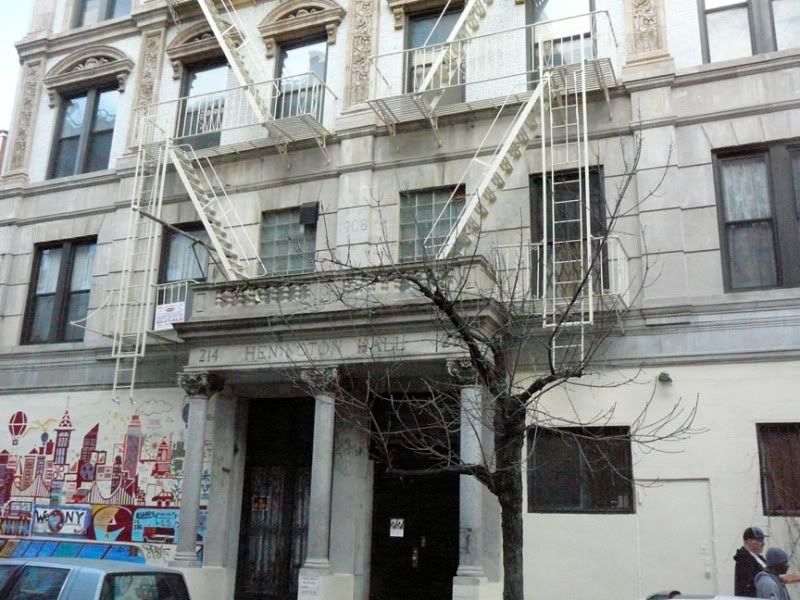
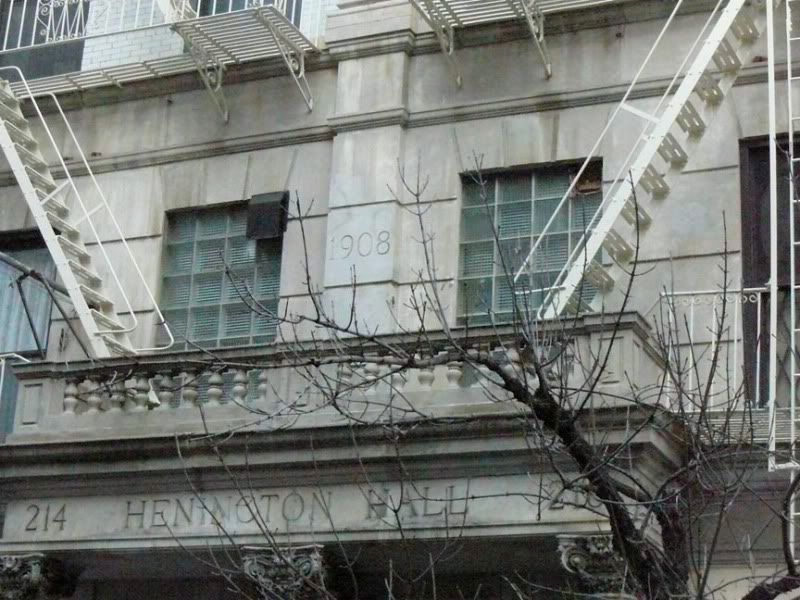
Henington Hall 2

Hennington History

Henington Hall

I came across this old meeting hall on one of my 11th Ward explorations


When I googled Henington Hall I discovered a great site called papa's diary
Took half day off for "Yizkor"
for my beloved father (olam haba)
Evening at Country mens
synagogue at Henington Hall
for the "Hakufos"
Enjoyed in the midst of
old country men and
school friends.
1 - Hennington Hall, located at 214 Second Street near Avenue B, was a meeting space often used for political gatherings and speeches. I think the "Country men's synagogue" Papa refers to in this entry means Congregation Sniatyner Agudath Achim, which was made up of landsmen (the Yiddish term for people from the same place that literally translates as "country men") from Papa's home town of Sniatyn. I think this congregation normally met at a multi-use facility called Broadway Manor at 209 East Broadway, but I wouldn't be surprised if they moved around a bit. In any event, Papa has never bothered to specify the congregation's location before, so I assume he deliberately mentions Hennington Hall because it wasn't their usual spot.

About Papa's Diary
My grandfather, Harry Scheurman, kept a diary in 1924 when he was twenty-nine years old. He had been in America for 11 years, but much of his family still lived in the central European, Jewish ghetto of his youth. He was a garment worker, union activist and Zionist fundraiser. He was also unmarried and terribly lonely.
I've always found his diary to be fascinating reading, and I've always wanted to share it with people who might find it interesting. So, each day in 2007 (*2008 update below) I'll transcribe and post each day's corresponding entry, and I'll also annotate with contextual details about his life, historical details about the social, political and cultural subjects in circulation that year, and whatever thoughts and feelings his words bring to mind.

An excerpt from an article about Papa's Diary from the nytimes
1924, Through an Ancestor’s Eyes,
by Les Stone
“My father went to bid me farewell on my long journey to America,” the son later wrote. “The train is waiting, a long embrace, a kiss, tears streaming down from his eyes. Did he have a premonition that we would see each other no more? The train is moving out slowly, and by the light of the moon I could see through the window in the distance my father, weeping and wiping his tears.”
That passage comes from Harry Scheurman’s diary, a slim volume in which he wrote nearly every day of 1924, when he was a single 29-year-old garment worker and ardent Zionist living in a Lower East Side tenement. Since last January, in an extraordinary act of meta-journaling, Mr. Scheurman’s grandson, a 40-year-old Web production executive named Matt Unger, has begun transcribing, posting and annotating a page of the diary each day at a blog he has created, called Papa’s Diary Project.
The diary is an intimate record of Mr. Scheurman’s romantic and emotional life, shadowed by deep homesickness. Mr. Scheurman contrasts the “mechanical” Purim celebrations of New York with those of Sniatyn, and chronicles countless nights at home alone with his radio. On May 12, he learns of his father’s death in Sniatyn, an event that leaves him heartbroken.
But the journal also provides a rich glimpse of the minutiae of a New York life in the 1920s. Mr. Scheurman writes of visiting the “2nd Avenue Baths,” of riding the subway from Brooklyn to the Bronx in the middle of the night with “a pretty girl who is unusually gifted with knowledge,” of dickering with a crooked English-school instructor on behalf of his brother-in-law. On New Year’s Eve, he visits “an East Side joint where Prohibition drinks were freely served.”

Friday, September 18, 2009

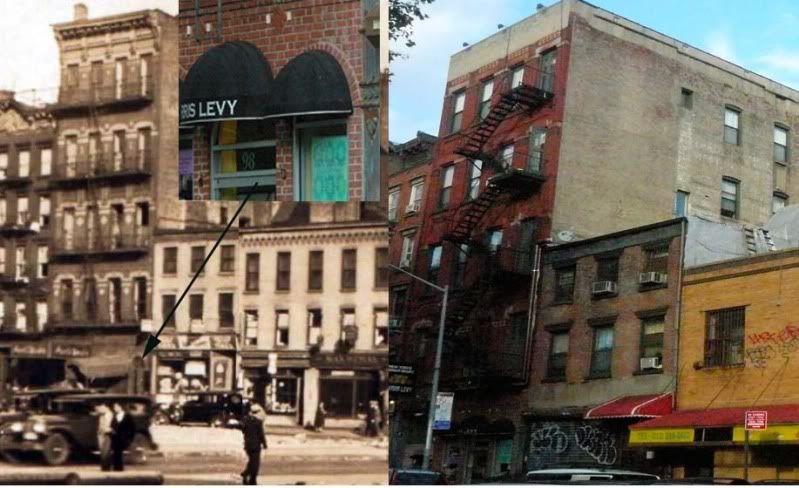
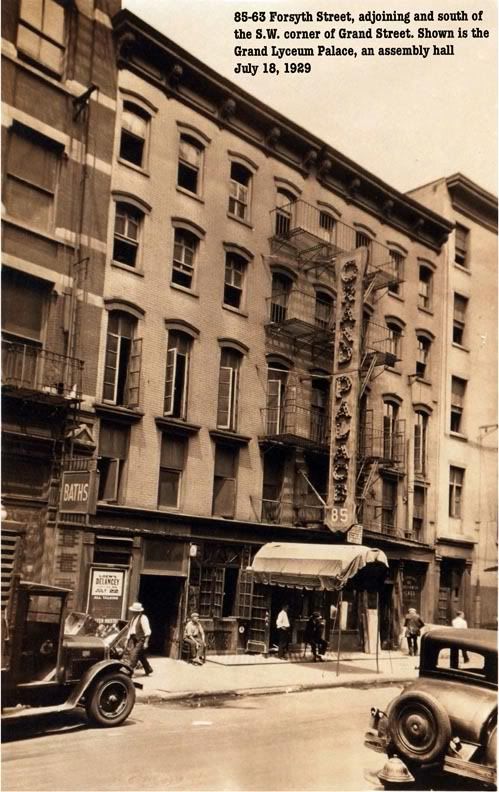
Odd Fellows Hall: Then And Now


I was on the LES last Sunday and was able to match up an 80 year old photo of the Odd Fellows Hall on 98 Forsyth Street. It's now the location of the historic Harris Levy store which was formerly on Grand Street. 98 Forsyth was the scene of a big gambling raid
in 1930

Friday, September 11, 2009

Friday, July 10, 2009

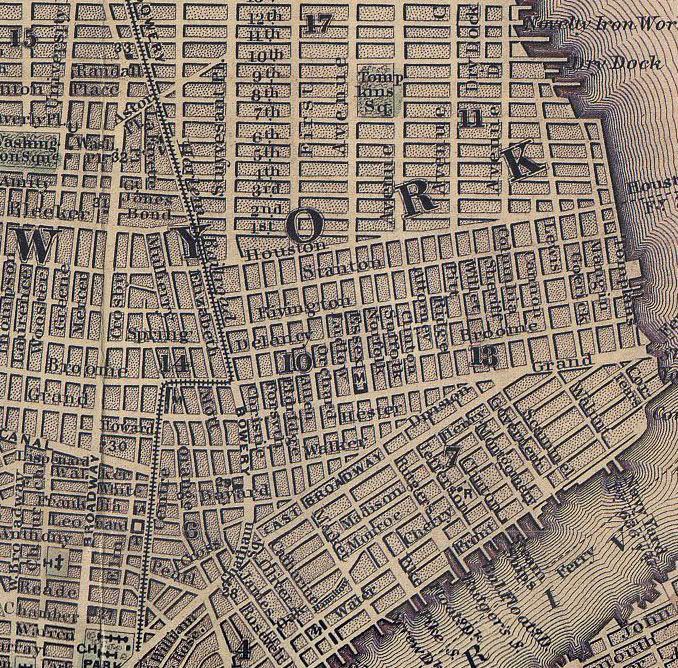
Clinton Street: 1891 Map


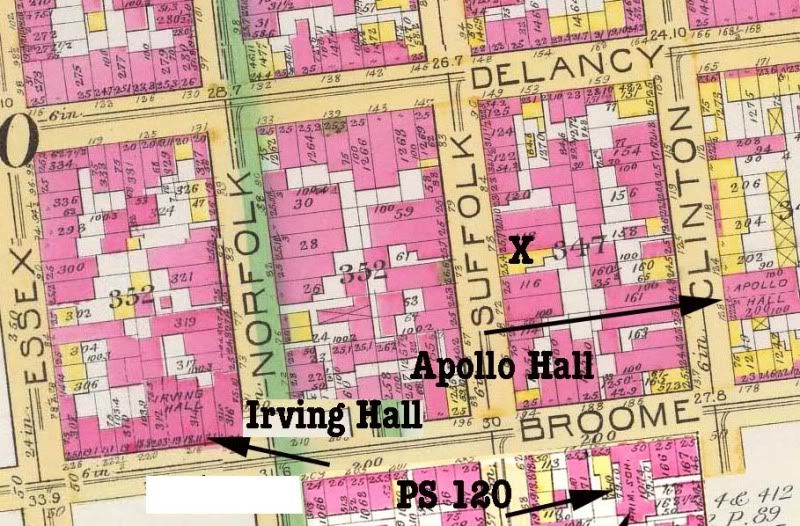
Here's where the Apollo Hall was located. The map also shows where Irving Hall was located and the old PS 120 which later became a fire house and later a film production site, owned by the Levinson/Fontana Company, i.e. Barry Levinson and Tom Fontana. X marks the spot of 76 Suffolk Street, my first home as well as the former address of Jack Kirby. Read more about this locale in a December 2007 post as well as a March 2009 post and a November 2007 post

Liberty Hall: Then And Now

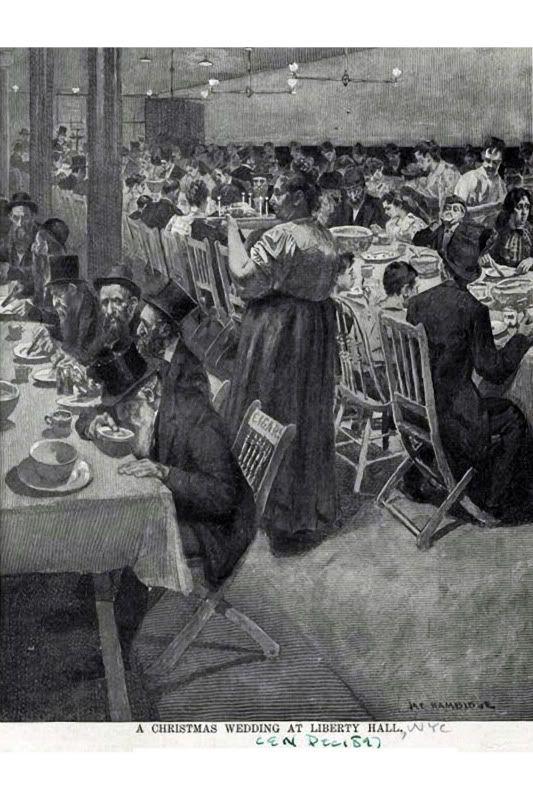
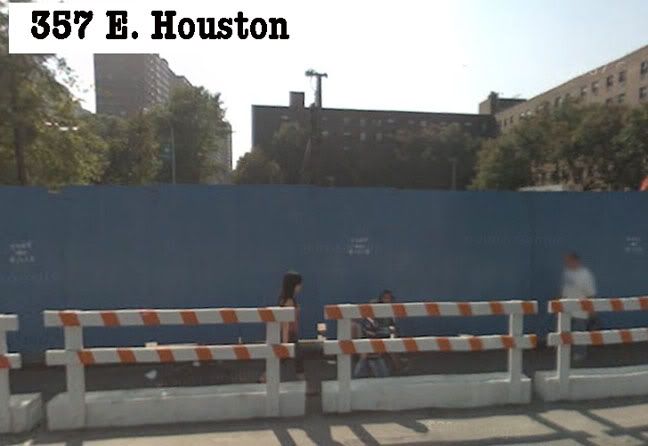
I can't find 1900 era pics of the Apollo Hall, but it may have looked like a wedding at the Liberty Hall, which was located at 357 E. Houston Street. The site later was occupied by a Boys' Club.

An 1898 Wedding Record

Apollo Wedding 1898
I wonder where Louis Lichtenstein had his store on Monroe Street?

Friday, June 12, 2009

Lost In Paradise: Samuel J. Chotzinoff's Autobiography: A Wedding At Pythagoras Hall

Lost Paradise Chapt 8 Lost Paradise Chapt 8

Meeting Halls, Saloons, Candy Stores, Bars And LES History

Gateway Meeting Halls Gateway Meeting Halls

Henry George And Richard Croker At Pythagoras Hall

Henry George Pythagoras Henry George Pythagoras steinbl

Pythagoras Hall: 177 East Broadway

Pythagoras Hall Pythagoras Hall steinbl

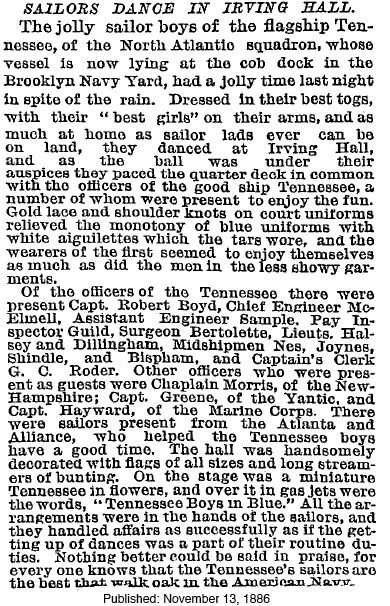
A Dance At Irving Hall: 1886

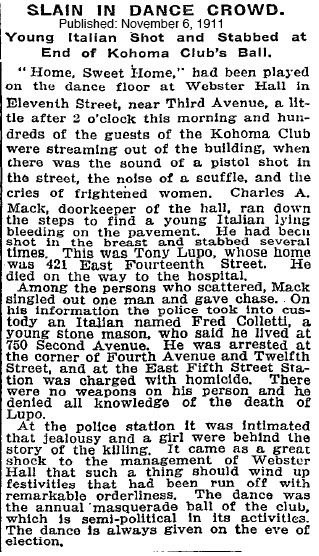
Slaying At Webster Hall: 1911


Ah, sometimes those dances get those passions stirring, except Home Sweet Home??
Lupo should have had Lucky Luciano around. Lucky lived nearby at 265 East 10th Street. My mother used to go to Webster Hall with my grandmother in the 1920's.
About Home Sweet Home, you can hear it here
"Home! Sweet Home!" (also known as "Home, Sweet Home") is a song that has remained well-known for over 150 years. Adapted from American actor and dramatist John Howard Payne's 1823 opera Clari, Maid of Milan, the song's melody was composed by Englishman Sir Henry Bishop with lyrics by John Howard Payne. The opening lines
Mid pleasures and palaces though we may roam,
Be it ever so humble, there's no place like home;
have become famous. It is also used with Sir Henry Wood's Fantasia on British Sea Songs and in Alexandre Guilmant's Fantasy for organ Op. 43, the Fantaisie sur deux mélodies anglaises, both of which also use "Rule, Britannia".
More recently, in 1909, it was featured as being played in the silent film The House of Cards by Thomas A. Edison. In the particular scene, a frontier bar was hurriedly closed due to a fracas. A card reading "Play Home Sweet Home" was displayed, upon which an on-screen fiddler promptly supplied a pantomime of the song. This may imply a popular association of this song with the closing hour of drinking establishments.
This song is famous in Japan as "Hanyū no Yado" ("埴生の宿"?) ("A Lodging"). It has been used in such movies as The Burmese Harp and Grave of the Fireflies. It is also used at Senri-Chuo Station on the Kita-Osaka Kyuko Railway.
Key phrases from the song have been a cultural staple for several generations.
* The song was very popular with troops on both sides of the American Civil War.
* It was a particular favorite of President Abraham Lincoln and his wife, who requested it in an 1862 performance at the White House by opera singer Adelina Patti.
* Needlework portraits of a house with the phrase "Home Sweet Home" have long been an icon.
* The song's melody played in the underscore as Dorothy spoke of "No Place Like Home" near the end of the 1939 film The Wizard of Oz.
* Tom Lehrer's satire of the old southern United States finished with the line, "Be it ever so decadent, there's no place like home."
* The song is featured in the film Arsenic and Old Lace (1944), when Jonathon first speaks with his Aunts.
Mid pleasures and palaces though we may roam,
Be it ever so humble there's no place like home!
A charm from the skies seems to hallow us there,
Which, seek through the world, is ne'er met with elsewhere:
Chorus:
Home! Home! sweet, sweet Home!
|: There's no place like Home! :|
2. I gaze on the moon as I tread the drear wild
And feel that my mother now thinks of her child
As she looks on the moon from our own cottage door
Through the woodbine whose fragrance shall cheer me no more.
3. An exile from home splendor dazzles in vain
Oh, give me my low, thatched cottage again,
The birds singing gaily that come at my call,
Give me them with that peace of mind, dearer than all.
Chorus:
4. How sweet 'tis to sit neath a fond father's smile,
And the cares of a mother to soothe and beguile.
Let others delight 'mid new pleasures to roam,
But give me, oh give me the pleasures of home.
Chorus:
5. To thee I'll return overburdened with care,
The hearts dearest solace will smile on me there
No more from that cottage again will I roam,
Be it ever so humble, there's no place like home.
Chorus:
Chorus:

Thursday, June 11, 2009

Goran Bregovic & His Weddings & Funerals Orchestra At Prospect Park 2

Goran Bregovic & His Weddings & Funerals Orchestra At Prospect Park


Balkan music is pretty hip these days. There are elements in it that appeal to many ethnicities and nationalities , plus it really has a kick. I bet all those Romanian Yid families from KV would have liked it in addition to my Sephardic Peeps
Sarajevo-born Goran Bregovic is a seminal figure in the Yugoslav rock world, a film composer who has been likened to Ennio Morricone and Nino Rota, and a collaborator of artists as varied as Iggy Pop and Cesária Évora. Kicking off his first North American tour at Celebrate Brooklyn with his enormous band—featuring brass, a classical string ensemble, an all-male choir and traditional Bulgarian and Roma singers—he marries the dance music of a raucous gypsy wedding with Eastern European choral arrangements in what Spain’s La Vanguardia has called, “a mind-blowing return trip with no destination or port of arrival…a magnificent concert, one of the greatest marvels to be heard on stage today."
Goran Bregović (Cyrillic: Горан Бреговић) (born March 22, 1950 in Sarajevo) is a Yugoslav musician, from Bosnia and Herzegovina of Serbian and Croatian descent, and one of the most internationally known modern composers of the Balkans.
Bregović has composed for such varied artists as Iggy Pop and Cesaria Evora. He rose to fame playing guitar with his rock band Bijelo dugme, a group that set the groundwork for the Yugoslav rock scene. Among his better known scores are Emir Kusturica’s films (Time of the Gypsies, Arizona Dream, Underground).
Bregović’s compositions, extending Balkan musical inspirations to innovative extremes, draw upon European classicism and Balkan rhythms.
Bregović's music carries both South Slavic and Romani themes and is a fusion of popular music with traditional polyphonic music from the Balkans, tango and brass bands.
Although he is a very popular musician in Eastern Europe, Bregović has been accused on several occasions of 'stealing' original Romani and folk music of the Balkans and ultimately rewriting and branding it as his own creation.