Showing posts with label 12 monroe street. Show all posts

Sunday, July 15, 2012

Who's Who In Knickerbocker History: Morris Groob

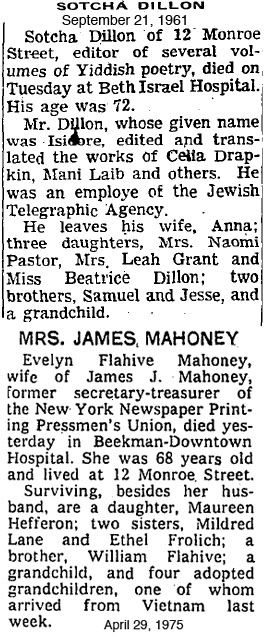
In 1940 Morris lived at 12 Monroe Street with his wife Bertha. His children were Irving, Phillip, Martin and Naomi. Another article from the forward about that celebration in 1997
Max Fuchs, 89, had come to the day’s event with his wife, Naomi, and their children. A cantor for many decades, he recalled leading services at the Eldridge Street Synagogue in the 1940s, after returning from service in World War II. “I was the last cantor to conduct High Holiday services,” he said. He gave his family members much credit for their part in keeping the Eldridge Street Synagogue alive even during its declining years. “My in-laws were big machers here,” he said, referring mostly to Morris Groob, a longtime congregant and leader at the synagogue.

Saturday, May 26, 2012

Who's Who In Knickerbocker Village History: Harry Essex, 1940 Census

Harry Essex lived at 12 Monroe Street in 1940. Among his neighbors were Seth and Rose Babits, Irving Romm, Emmanuel Leef and Sam Gershenson. from Harry Essex's biography:
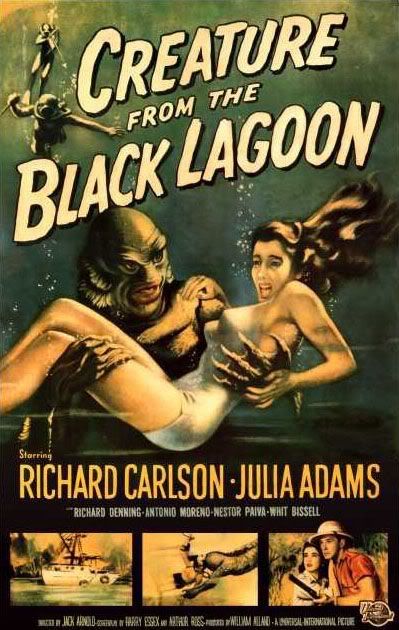
Harry Essex was a prolific American screenwriter. He was born on 29 November 1910 in New York City. He died on 5 February 1997 in Los Angeles. His career spanned more than fifty years. His film credits include: Dragnet (1947) I, The Jury Creature from the Black Lagoon It Came from Outer Space The Las Vegas Story The Sons of Katie Elder Desperate Man Made Monster Kansas City Confidential The Killer That Stalked New York What Ever Happened to Baby Jane? New York-born Harry Essex planned on a writing career throughout his young life. Among his first jobs were stints on the New York newspapers "The Daily Mirror" and "The Brooklyn Eagle", short stories for "Collier's" and "The Saturday Evening Post" and even a Broadway play titled "Something for Nothing" (which Essex later called "a resounding failure"). Writing for the movies was uppermost in Essex's mind throughout the period (and he DID co-write the original story for Universal's Man Made Monster (1941)), but "the big break" never came, and World War II intervened. Five or six days after Essex's discharge, he ran into an old acquaintance whose new job was finding playwrights to turn into screenwriters for Columbia Pictures. Essex wrote or co-wrote dozens of movies and numerous TV shows during his lengthy Hollywood career. Shortly before memorably cooling herself by standing over a subway grating in Billy Wilder's The Seven Year Itch (1955), the nameless "Girl Upstairs" (Marilyn Monroe) told her escort (Tom Ewell) how sorry she felt for the leading character in the film they had just seen: the hideous, slimy Creature from the Black Lagoon. Harry Essex, one of the screenwriters who brought this monstrous but somehow appealing half-man, half-fish to the screen, was also responsible for another 1950s science fiction classic. Born in New York City, Essex wanted to be a writer from early boyhood. After graduating from St John's University in 1936, he did welfare work by day, while writing for the theatre by night. His play Something for Nothing was produced on Broadway in 1937. He went to Hollywood in the early 1940s, and was starting to do well in films when wartime service intervened. After demobilisation from the US Army Signal Corps, he and Martin Rackin wrote Desperate (1947), a taut thriller directed by Anthony Mann. In Essex's screenplay for Frightened City (1950), smallpox was unknowingly carried around New York by a smuggler (Evelyn Keyes). Unfortunately, while the film was still in production, 20th Century-Fox released Panic in the Streets, in which pneumonic plague was unknowingly carried around New Orleans by a murderer (Jack Palance); consequently, Frightened City was shelved for nearly a year. Essex co-wrote Universal's The Fat Man (1951), which starred J. Scott Smart as the obese detective Brad Runyon, a role he had played on radio since 1946. The series was developed especially for radio by Dashiell Hammett, creator of The Thin Man, but as he had just been jailed for refusing to co-operate with the House of Representatives' Committee on Un-American Activities, Hammett's name was conspicuous by its absence on the screen credits of The Fat Man. Another sign of those paranoid times was that Essex and Earl Felton received screenplay credit on The Las Vegas Story (1952), but not their co-writer Paul Jarrico, who had been blacklisted. Essex directed four films, beginning with Mickey Spillane's I, the Jury (1953), which he also wrote. That same year, he adapted Ray Bradbury's story "The Meteor" as It Came from Outer Space, in which, unusually, the bug-eyed aliens weren't bent on world conquest, but were only on earth long enough to repair their spaceship. With the same production team, Essex co-wrote The Creature from the Black Lagoon the following year. He wrote such westerns as Wyoming Mail (1950), Raw Edge (1956), The Lonely Man (1957), and John Wayne's The Sons of Katie Elder (1965), in which four straight-shootin' brothers avenged the family honour. Because Essex shared script credit with Talbot Jennings, Allan Weiss, and William H. Wright, one critic wondered if each Elder sibling had his own writer. In the 1950s he wrote television scripts for Philco TV Playhouse and Playhouse 90, and in the 1960s for The Untouchables. He also wrote many plays, novels and short stories. In 1954, when his I, the Jury, It Came from Outer Space, Devil's Canyon, The Creature from the Black Lagoon and Southwest Passage - all 3-dimensional films - were on release, a Hollywood trade paper quipped, "Harry Essex has so many 3-D pictures out, you have to wear special glasses to see him".

Wednesday, November 14, 2007

Not Necesarily This Day In Knickerbocker Village History: May 28, 1939


from the nytimes: MODEL KILLED IN SUICIDE BLAST IN KNICKERBOCKER VILLAGE
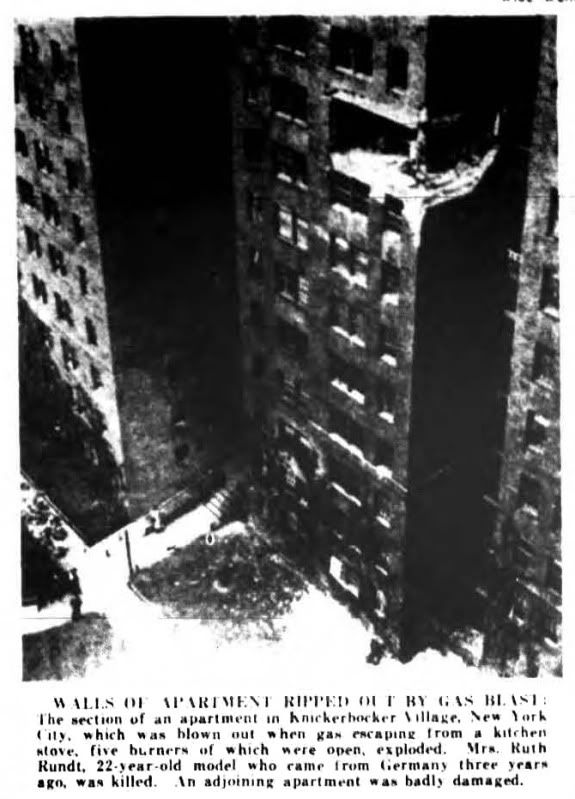
One woman was killed and two other persons were slightly injured shortly after midnight when an explosion that was heard throughout the East Side from the Battery to Fourteenth Street wrecked two apartments in Knickerbocker Village, 130 Cherry Street, and caused damage to others throughout the building, The woman who was killed was Mrs. Ruth Rundt, 22 years old, a model, who came to the United States from Berlin, Germany, three years ago. She lived in apartment H F 0 on the ninth floor, the scene of the blast. She was found under the overturned range in her kitchen. Five jets were open on the range and the police expressed the belief that she had committed suicide by gas poisoning and that the escaping fumes had become ignited, causing the explosion, Miss Jean Sayer, a school teacher, roommate of Mrs. Rundt, was not in the apartment at the time. In the adjoining apartment Mr. and Mrs. Jack Velleman, who were asleep, were blown out of bed. Mr. Velleman was treated for a cut on the knee and his wife for shock. The body of Mrs. Rundt, who wad said to have been separated from her husband, was identified by a friend, Heinz Norden, executive of a publishing company. Firemen worked over her for two hours in a vain effort to revive her. The blast shook the apartment building to Its foundations and all the occupants fled to the street. The Rundt apartment is on a corner and faces on a court. Both outer walls and three windows, were blown out and the apartment completely wrecked. The adjoining Velleman apartment was badly damaged. The explosion, the cause of which was not determined, occurred at 12:45 A. M. Fire apparatus and police emergency squads were rushed to the scene, drawing in their wake huge crowds that augmented the hundreds who had fled from the building. The impact of the blast was so severe that many tenants ran into the street believing they had felt an earthquake. Windows were shattered, china broken and furniture overturned. Extra police were rushed to the scene from the Oak Street station when the crowds seemed to be get-ting out of control. Motorists from all parts of the city added further congestion to the area.