Showing posts with label garment industry. Show all posts
Showing posts with label garment industry. Show all posts
Sunday, August 14, 2011
Emma Mistrusts Labor Leader Persky: 1895


Tailors Locked Out: 1895
Tailor Lock Out
There is mention here of the fire from the previous post which created
excess labor which would favor the contractors (bosses). Kudos to Abraham Wolf of 106 Attorney Street who honored the contract. A meeting of the locked out tailors took place at Walhalla Hall.
There is mention here of the fire from the previous post which created
excess labor which would favor the contractors (bosses). Kudos to Abraham Wolf of 106 Attorney Street who honored the contract. A meeting of the locked out tailors took place at Walhalla Hall.
Sunday, January 30, 2011
Memories Of The Rag Trade In Save The Tiger, 2
a clip from an excellent movie starring Jack Lemmon and Jack Gilford
from wikipedia
Save the Tiger is a 1973 film about moral conflict in contemporary America. It stars Jack Lemmon, Jack Gilford, Laurie Heineman, William Hansen, Thayer David, Lara Parker and Liv Lindeland. The film is adapted from the novel of the same title by Steve Shagan, (the first book by the author of The Formula and other thrillers, and generally regarded to be his most successful novel by literary standards).
Jack Lemmon plays Harry Stoner, an executive at a Los Angeles apparel company on the edge of ruin. Throughout the film, Stoner struggles with the complexity of modern life versus the simplicity of his youth. He longs for the days when pitchers wound up, jazz filled the air, and the flag was more than a pattern to put on a jock-strap. He wrestles with the guilt of surviving the war and yet losing touch with the ideals for which his friends died. To Harry Stoner, the world has given up on integrity, and threatens to destroy anyone who clings to it. He is caught between watching everything he has worked for evaporate, or becoming another grain of sand in the erosion of the values he once held so dear.
Memories Of The Rag Trade In Save The Tiger
a clip from an excellent movie starring Jack Lemmon and Jack Gilford
from wikipedia
Save the Tiger is a 1973 film about moral conflict in contemporary America. It stars Jack Lemmon, Jack Gilford, Laurie Heineman, William Hansen, Thayer David, Lara Parker and Liv Lindeland. The film is adapted from the novel of the same title by Steve Shagan, (the first book by the author of The Formula and other thrillers, and generally regarded to be his most successful novel by literary standards).
Jack Lemmon plays Harry Stoner, an executive at a Los Angeles apparel company on the edge of ruin. Throughout the film, Stoner struggles with the complexity of modern life versus the simplicity of his youth. He longs for the days when pitchers wound up, jazz filled the air, and the flag was more than a pattern to put on a jock-strap. He wrestles with the guilt of surviving the war and yet losing touch with the ideals for which his friends died. To Harry Stoner, the world has given up on integrity, and threatens to destroy anyone who clings to it. He is caught between watching everything he has worked for evaporate, or becoming another grain of sand in the erosion of the values he once held so dear.
Saturday, October 24, 2009
Sidney Hillman
on excerpt from wikipedia. The last 4 paragraphs (bold-faced) mention the ILGWU/mob connection which Hillman tried to put a stop to after it had got out of hand.
Sidney Hillman (March 23, 1887 - July 10, 1946) was an American labor leader. Head of the Amalgamated Clothing Workers of America, he was a key figure in the founding of the Congress of Industrial Organizations and in marshaling labor's support for Franklin Delano Roosevelt and the Democratic Party.
Born in Zagare in Lithuania, Hillman left home to attend rabbinical school at age 14, but soon left school and became a member of the General Jewish Labor Union, a Jewish and socialist labor union within the Pale which the Czarist authorities tried to repress. After being arrested twice for political activity and spending several months in prison, Hillman fled the country in the wake of the suppression of the Russian Revolution of 1905, moving first to Manchester, England, and then in 1907 to Chicago.
Hillman found work there as an employee of Hart Schaffner & Marx, a prominent manufacturer of men's clothing. When a spontaneous strike by a handful of women workers there led to a citywide strike of 45,000 garment workers in 1910, Hillman was a rank-and-file leader in the strike.
That strike was a bitter one and pitted the strikers against not only their employers and the local authorities, but also their own union, the United Garment Workers, a conservative AFL affiliate. When the UGW accepted an inadequate settlement, the membership rejected the offer and continued the strike, winning some gains at Hart, Schaffner. Hillman became a business agent for the new local.
The leadership of the international union mistrusted the more militant local leadership in Chicago and in other large urban locals, which had strong Socialist loyalties. When it tried to disenfranchise those locals' members at the UGW's 1914 convention, those locals, representing two thirds of the union's membership, bolted to form the Amalgamated Clothing Workers of America.
Hillman had taken the position of Chief Clerk within the International Ladies' Garment Workers' Union in New York in early 1914. He found that job, in which he tried to maintain the stability imposed on a ferociously competitive industry by the Protocols of Peace, and in which the internal rivalries within the union threatened to flare up into all-out conflict, frustrating. When the insurgents who had walked out of the UGW convention to form the Amalgamated sent him a telegram imploring him to accept the Presidency—followed by another telegram from Bessie Abramowitz, one of the original leaders of the 1910 strike, an important figure in union politics and his fiance—he accepted and left the ILG after less than a year.
Hillman knew the risks he was taking. The AFL refused to recognize the new union and the UGW regularly raided it, furnishing strikebreakers and signing contracts with struck employers, in the years to come. He helped the Amalgamated solidify its gains and extend its power in Chicago through a series of strikes in the last half of the 1910s and to extend the union's membership into important garment centers in Baltimore and Rochester, New York, where the union had to overcome divisions within garment workers on ethnic lines and the opposition of the Industrial Workers of the World.
The ACWA also benefited from the relatively pro-union stance of the federal government during World War I, during which the federal Board of Control and Labor Standards for Army Clothing enforced a policy of labor peace in return for union recognition. Hillman was particularly receptive to the opportunities that government intervention in labor relations presented the union; he not only did not have the ingrained distrust of governmental regulation that now marked Samuel Gompers and other leaders of the AFL, but had a firm belief in the sort of industrial democracy in which government helped mediate between labor and management. The government's interest in maintaining production and avoiding disruptive strikes helped the Amalgamated organize non-union outposts such as Rochester and control the cutthroat competition that had prevailed in the industry for decades.
That policy ended in 1919, when employers in nearly every industry with a history of unionism went on the offensive. The ACWA not only survived a four month lockout in New York City in 1919, but came away in an even stronger position. By 1920, the union had contracts with 85 percent of men's garment manufacturers in the city and had reduced the workweek to 44 hours.
The ACWA pioneered a version of "social unionism" in the 1920s that offered low-cost cooperative housing and unemployment insurance to union members and founded a bank that would serve labor's interests. Hillman had strong ties to many progressive reformers, such as Jane Addams and Clarence Darrow, who had assisted the Amalgamated in its early strikes in Chicago in 1910 and New York in 1913. While other unions, notably the railroad brotherhoods and building trades unions within the AFL also founded banks of their own, the Amalgamated also used its banks to supervise the business operations of those garment businesses that came to it for loans.
Under Hillman's leadership, the union tried to moderate the fierce competition between employers in the industry by imposing industry wide working standards, thereby taking wages and hours out of the competitive calculus. The ACWA tried to regulate the industry in other ways, arranging loans and conducting efficiency studies for financially troubled employers. Hillman also favored "constructive cooperation" with employers, relying on arbitration rather than strikes to resolve disputes during the life of a contract. As Hillman explained his philosophy in 1938:
Certainly, I believe in collaborating with the employers! That is what unions are for. I even believe in helping an employer function more productively. For then, we will have a claim to higher wages, shorter hours, and greater participation in the benefits of running a smooth industrial machine....
Hillman's belief in stability as the basis for progress was coupled with a willingness to embrace industrial engineering approaches, such as Taylorism, that sought to rationalize the work processes as well. This put Hillman and the ACW leadership at odds with the strong anarcho-syndicalist tendencies within the union's membership, many of whom believed in direct action as a principle as well as tactic. On the other hand, it made Hillman receptive in the early 1920s to the Soviet Union's reconstruction efforts, particularly during its New Economic Policy phase. Hillman led the union into a joint business project with the Soviet Union that brought western technology and principles of industrial management to ten clothing factories in the Soviet Union.
Hillman's support for the Soviet experiment won him the enthusiastic support of the Communist Party USA in the early 1920s; it also further alienated him from those in the Socialist Party and associated with the Daily Forward under the leadership of Abraham Cahan, with whom Hillman and the Amalgamated already had strained relations. While Hillman's relationship with the Communist Party ultimately broke up in the conflict over whether to support Robert La Follette, Sr.'s candidacy for President on the Progressive Party ticket in 1924, Hillman never faced the sort of volcanic upsurge that nearly tore apart the International Ladies' Garment Workers' Union during this period and never undertook the wholesale purges that David Dubinsky and other leaders of the ILGWU used to stay in power. By the end of the decade, after fighting and losing battles in Montreal, Toronto and Rochester, the CP was no longer a significant force in the union. While battling the CP, Hillman turned a blind eye to the infiltration of gangsters within the union. The garment industry had been riddled for decades with small-time gangsters, who ran protection and loansharking rackets while offering muscle in labor disputes. First hired to strongarm strikers, some went to work for unions, who used them first for self-defense, then to intimidate strikebreakers and recalcitrant employers. ILG locals used "Dopey" Benny Fein and his sluggers, who were more often hired by unions than employers although they were thugs for hire.
Internecine warfare between labor sluggers eliminated many of the earliest racketeers. "Little Augie" Jacob Orgen took over the racket, providing muscle for the ILGWU in the 1926 strike. Louis "Lepke" Buchalter had Orgen assassinated in 1927 in order to take over his operations. Buchalter took an interest in the industry, acquiring ownership of a number of trucking firms and control of local unions of truckdrivers in the garment district, while acquiring an ownership interest in some garment firms and local unions.
Buchalter, who had provided services for some locals of the Amalgamated during the 1920s. also acquired influence within the ACWA. One of his allies within the ACWA was Abraham Beckerman, a prominent member of the Socialist Party with close ties to The Forward, whom Hillman used to inflict strongarm tactics on his communist opponents within the union. Beckerman and Philip Orlofsky, another local officer in Cutters Local 4, made sweetheart deals with manufacturers that allowed them to subcontract to cut rate subcontractors out of town, using Buchalter's trucking companies to bring the goods back and forth.
In 1931 Hillman resolved to act against Buchalter, Beckerman and Orlofsky. He began by orchestrating public demands on Jimmy Walker, the corrupt Tammany Hall Mayor of New York, to crack down on racketeering in the garment district, Hillman then proceeded to seize control of Local 4, expelling Beckerman and Orlofsky from the union, then taking action against corrupt union officials in Newark, New Jersey. The union then struck a number of manufacturers to bar the subcontracting of work to non-union or cut rate contractors in Pennsylvania and New Jersey. In the course of that strike the union picketed a number of trucks run by Buchalter's companies to prevent them from bringing finished goods back to New York.
While the campaign cleaned up the ACWA, it did not drive Buchalter out of the industry. The union may, in fact, have made a deal of some sort with Buchalter, although no evidence has ever surfaced, despite intensive efforts of political opponents of the union, such as Thomas Dewey and Westbrook Pegler, to find it. Buchalter claimed, before his execution in 1944, that he had never had any deal with either Hillman or Dubinsky, head of the ILGWU. He did claim to have murdered a factory owner and labour opponents of Hillman at Hillman's behest, a claim which was never corroborated.
Friday, October 23, 2009
Schmatta And The Union Label
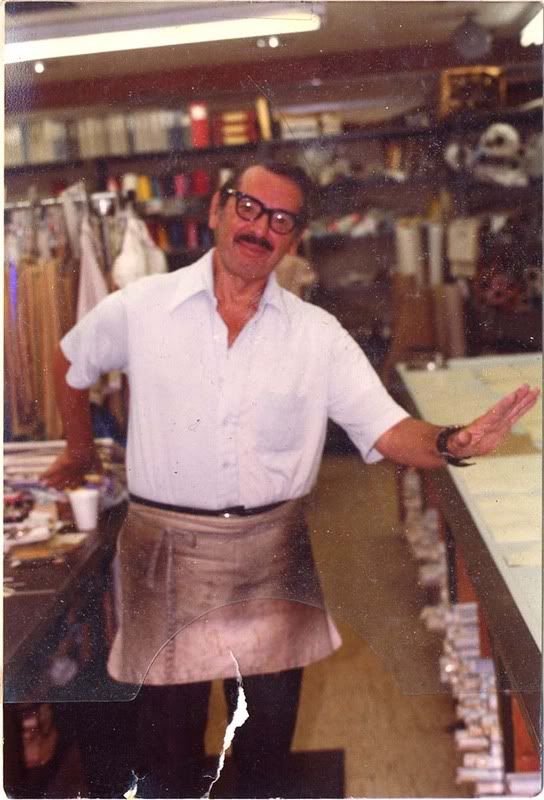 Two older posts that are noteworthy in regard to the recent Schmatta movie on HBO. One was on 12/27/07 And the other followed it the next day on 12/28/07
Garment Gangsters 2
 portions of a 1914 nytimes article mentioning Benny Fein's use as a starker or strong arm for labor. Images are by Pat Hamou. Pat has a great mobster site six for five and he sells his art work, very reasonably, on etsy
a biography of Benny Fein
Benjamin "Dopey Benny" Fein (c. 1889-1962) was an early Jewish American gangster who dominated New York labor racketeering in the 1910s. With a criminal record dating back to 1900, Fein's arrest record included thirty charges from petty theft and assault to grand larceny and murder (of which he was acquitted twice due to lack of evidence). Fein was nicknamed "Dopey Benny" because of his eyes always being halfway-closed due to a medical condition.
Born in New York City, New York in 1889, Fein grew up in a poor neighborhood on Lower East Side becoming a petty thief and pickpocket as a child. A talented organizer Fein had formed his own gang of robbers in 1905 and during the next 5 years Fein would be sent to Elmira Reformatory several times particularly serving 3 1/2 years for armed robbery. Soon after his release in 1910 Fein joined "Big" Jack Zelig's organization soon becoming involved in labor union and extortion of the garment district. Fein also used his gang as labor sluggers, renting his gang out to either unions or companies, dominating much of New York's East Side eventually earning $20,000 a year. In 1913 several minor labor slugger gangs formed to break the monopoly held by Fein and rival Joseph Rosenzweig in which a large shootout took place on Grand Street and Forsyth Street lasting several hours, although few were killed, beginning the New York Labor slugger war which would last almost 4 years. Arrested for assault in 1914, Fein agreed to testify against several members involved in labor slugging when his political connections refused to help Fein resulting in the indictments of 11 gangsters and 21 union officials however none would be brought to trial. That same year Fein was again arrested for the murder of court clerk Frederick Strauss, who was killed in the crossfire during a shootout near St. Mark's Place, however he was later released when witnesses could not identify Fein at the scene. After his release in 1917 for labor slugging Fein's power had declined and by the end of the gang war, with Rosenzweig in prison for manslaughter, Fein decided to retire becoming a successful garment businessman.
In July 1931, appearing in court for the first time in 13 years, Fein was arraigned at Essex Market Court on felonious assault charges along with Samuel Hirsch and Samuel Rubin after throwing acid on local Brooklyn businessman Mortimer Kahn.
In 1941, Fein was arrested by detectives in a police raid ordered by District Attorney Thomas E. Dewey during which mobsters Abraham Cohen, John Ferraro and two Dallas businessmen, Herman Fogel and Samuel Klein, were also taken into custody after purchasing a recently stolen garment shipment valued at $10,000.
He and Cohen were named as the ringleaders of a criminal gang which, from armed robbery and burglary, took in an estimated $250,000 over a three-year period raiding the city's garment industry. Held in The Tombs until their trial, Fein was spared a mandatory life sentence for fourth time offenders and instead received a reduced sentence of ten to 20 years disappearing from public records sometime after.
Garment Gangsters
The Schmatta documentary doesn't touch on the gangster influence in the industry. Originally "good" mobsters were employed to counter the boss' use of mobsters to intimidate workers and break strikes. However, their influence soon transferred into control and ownership of several garment concerns, especially trucking. Little Augie and Benny Fein (mentioned in the article below) were part of that group. Benny Fein was mentioned before in April
SCHMATTA: RAGS TO RICHES TO RAGS
Currently on HBO.
from the hbo site of the movie
Youtube has a few more clips of this excellent movie. Clip two is here. A third clip is here. The Boston Globe has a review, strangely nothing in the nypress. I'm sure my father knew many of the oldtimers in the movie. I believe he worked for a while as a cutter and a marker/grader at Russ Togs. Amongst my KV friends, the Schumer and the Hyman dads were employed in the Schmatta trade on 7th Avenue. I'm sure there were many more KV Schmatta families, past and present, but today it's a dying breed. That's part of the problem with the U.S. economy.
from the hbo site of the movie
SCHMATTA: RAGS TO RICHES TO RAGS
A cautionary story of labor and greed, Schmatta: Rags to Riches to Rags follows the decline of the once-robust apparel manufacturing industry in the U.S., while chronicling the industry's relationship with unions and government. From the "Garmento" to the seamstress, from the designer to the marketing maven, from the small businessman to the financier, Schmatta offers a firsthand account of how the industry helped generations of Americans march out of poverty and right into the golden age of the American middle class. But while Schmatta reminds us of the early days of the garment industry and its heyday, it also probes its troubling decline, which has occurred largely within the last 30 years. In 1965, 95% of American clothing was made in the U.S.A.; by 2009, only 5% is manufactured here.
Director Marc Levin focuses his lens on Manhattan's Garment District, an eight-block area on Manhattan's West Side which gave birth to the domestic industrial labor movement, and played a key role in major American political activities. From its immigrant origins in the 19th Century, the labor movement rose quickly against deplorable sweatshop conditions. In recent years, however, the realities of automation, deregulation, globalization and outsourcing - all part of the race to the bottom line - eventually eroded the industry's unprecedented momentum.
This film tells some of the stories of the workers, labor organizers, designers, fashion execs and manufacturers who built their careers in the Fashion District, including: Joe Raico, a fabric cutter who took great pride in his workmanship, and laments that America doesn't produce anything anymore; Charles Kernaghan of the National Labor Committee, whose open letter to Kathy Lee Gifford caused a media circus in 1996; Irving Ruosso, owner of Russ Togs, one of the U.S.'s largest sportswear companies; Stan Herman, a designer who has worked in the District for five decades, and others.
Youtube has a few more clips of this excellent movie. Clip two is here. A third clip is here. The Boston Globe has a review, strangely nothing in the nypress. I'm sure my father knew many of the oldtimers in the movie. I believe he worked for a while as a cutter and a marker/grader at Russ Togs. Amongst my KV friends, the Schumer and the Hyman dads were employed in the Schmatta trade on 7th Avenue. I'm sure there were many more KV Schmatta families, past and present, but today it's a dying breed. That's part of the problem with the U.S. economy.
Subscribe to:
Posts (Atom)


 Posts
Posts