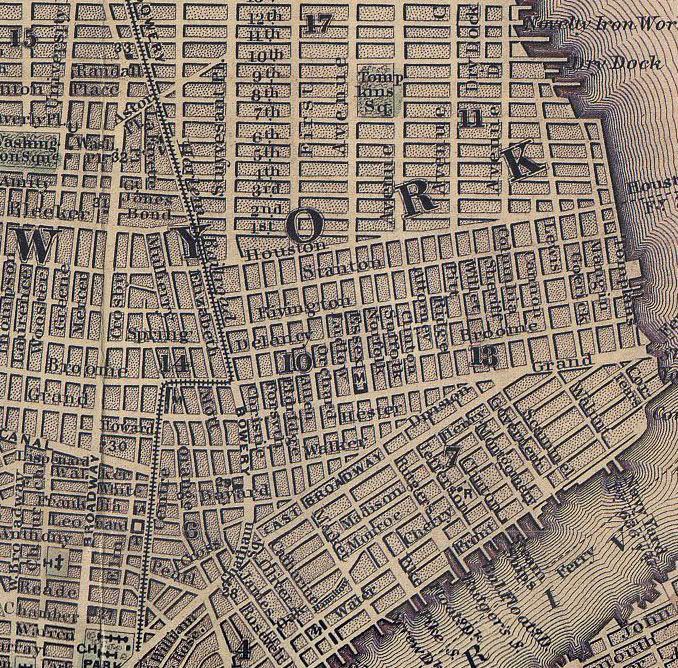
The site of a major LES riot on July 30, 1902.
From the jewishpress:In a recent front-page essay (February 29, 2008) and in last month’s “Glimpses” column we traced the life of Rabbi Jacob Joseph (1840-1902). Rabbi Joseph, who studied in the famed Volozhiner Yeshiva, was an outstanding Talmudic scholar and one of Rav Yisroel Salanter’s main students.
In 1888 he came to America to serve as the chief rabbi of New York. Unfortunately, his efforts at bringing order to the chaotic situation in the kosher meat business were unsuccessful. In addition, the organization that had brought him here, the Association of American Orthodox Hebrew Congregations, declined to the point where it began to renege on its obligation to pay Rabbi Joseph’s salary.
Conditions took a serious turn for the worse in the spring of 1895, when the retail butchers banded together and rejected the chief rabbi’s authority and dispensed with his supervision.
A contemporary wrote, “The Rabbi was left without any income and is in dire straits, and there is nothing that can be done with him now. He and his whole family are in very serious difficulties.”
Reduced to abject poverty, Rabbi Joseph was forced to move his family to a squalid Lower East Side tenement flat.
To Rabbi Joseph’s financial distress was added physical illness. He was confined to his bed, an invalid the rest of his life. The community that had once hailed him now completely neglected him. Forgotten was all he had done to elevate the position of the East European Jew in New York and to establish dignity and integrity in the religious institutions that served him. All but forgotten, he lay on his bed of pain, remembering what had been and musing no doubt on what could have been.
At the end of July 1902, the Chief Rabbi once again became the topic of discussion. On the 28th of the month he breathed his last, and headlines announced his demise the next day. He died at fifty-nine, after a five-year confinement to his bed because of paralysis. Word of the rabbi’s death spread rapidly throughout the Lower East Side, and the very people who ignored him while he was alive felt obligated to honor him in death. There was an unprecedented outpouring of grief from all segments of the Jewish community. A funeral procession through the streets of the Lower East Side was planned, with stops at the main Orthodox synagogues, where the chief rabbi was to be memorialized.
It soon became clear that thousands, perhaps even tens of thousands of mourners planned to participate. Recognizing both the probable enormity of the crowd and the legal requirement to procure a permit for such an event, one of the organizers [of the funeral] called upon the local police. After receiving permission for the march, he informed the police official on duty that as many as 20,000 people might participate. He left assured that twenty-five policemen would be in place the next day and that more could be had if requested. The morning of July 30, 1902 witnessed a huge funeral procession following the casket of the chief rabbi.
Behind it stretched a line of 200 carriages bearing family members, local officials, wealthy merchants, and dozens of prominent rabbis from around the country. Standing before them on both sides of the street stretched a crowd of 50,000 to 100,000 mourners.
Weeping, wailing, and the chanting of Psalms filled the air as the massive entourage made its way to each of the main Orthodox synagogues. The crowds struggled and occasionally surged as particularly zealous mourners sought to touch the casket, but remarkably no serious incident occurred. Two hours later, after recitation of the final prayers, the last leg of the march to the ferry at the end of Grand Street (the cemetery was in Brooklyn) commenced. Turning east on Grand Street, the procession soon came upon a massive brick factory that housed the famed printing press manufacturing firm of R. H. Hoe and Co.
There, unbelievably, a full-fledged riot began. The chronology of the events that led to this riot is given below. presented in stages.
Stage One: As the procession began to pass the Hoe factory, some workers who had climbed onto the roof or gone to upper-story windows to get a better view of the procession, started throwing a variety of items including food, water, oily rags, and pieces of wood and metal at the mourners.
Stage Two: The mourners were outraged at such disrespect for so solemn an occasion. Some of them began throwing the missiles back at those who had tossed them; others burst into the factory in an effort to stop the assault.
Stage Three: The first-floor office workers were unaware of what was transpiring outside. Therefore, when the irate mourners, many of them screaming in Yiddish, burst into the first floor of the factory, they panicked. The police were called. In addition, in an attempt to “protect” themselves from what appeared to be an unruly mob, they turned on the fire hose and doused the “invaders.” Some anti-Semitic remarks were shouted at the mourners, who were quickly expelled from the factory building.
Stage Four: Meanwhile, out in the street, a general melee ensued. The fire hose was aimed indiscriminately at those outside the building, whether they had been in the building or not. The mourners responded by hurling bricks, rocks and other items at the Hoe Building. Most of the building’s windows were shattered. However, this situation did not persist for very long. Indeed, the scene outside the factory began to calm down by the time the head of the funeral procession began boarding the ferry to Brooklyn, located a half mile past the factory.
Stage Five: “A few minutes later, at 1:20 p.m., a squad of 200 policemen, summoned at the outbreak of hostilities by the Hoe employees, arrived on the scene under the leadership of Inspector Adam A. Cross. ‘Without a word of warning or any request to disburse,’ stated the report on the incident commissioned be the mayor, the police ‘rushed upon the remnant of the gathering, some of them with great roughness of language and violence of manner.’”
In the end, hundreds of people were injured, primarily by the clubs and fists of the policemen. Eleven Jews were arrested. Nine were fined between five and ten dollars each and then released. The other two were held for $1,000 bail for inciting a riot. Eventually, four employees of the Hoe Company were also arrested.
The Jewish community of New York was outraged. Charges of anti-Semitism were leveled at the workers of the Hoe Company as well as at police. In addition, the police were accused of treating as criminals people whose only “crime” was that they had peacefully participated in the chief rabbi’s funeral possession.
Protest meetings were organized demanding that Mayor Seth Low, who had been elected a year earlier on a pledge to reform the police department, form an investigative committee to look into this incident.
Such a committee, consisting of notable reformers and including two prominent Jews, was indeed formed. It took testimony from many witnesses and issued a comprehensive report that condemned, in no uncertain terms, the brutal actions of the police. The police commissioner, Colonel Partridge, eventually stepped down. Two officers also resigned, and a number of others were transferred to precincts that did not include the Lower East Side.
The tragic story of Rabbi Jacob Joseph’s tenure as chief rabbi of New York had concluded with an infamous anti-Semitic incident at his funeral. It marked the end of the attempt to establish a central rabbinical authority over New York’s Jewish community.
The chief rabbi was survived by his wife, a son, and two daughters.

 from a 7/4/06 posting on pseudo-intellectualism with a linked slide show (at the end of the post)


 Posts
Posts