A young boy travels across the ocean, from Europe to New York, carrying only letters, stereoptican photos, and a viewer. The letters and photos were sent over a hundred years ago by a long dead relative. He wanders around New York City trying to use the letters and photos, he has no address, to locate his family--the only family he has left. He meets many different people in the city who try to help him, but most cannot visualize any other New York than the one they know. Wonderful voice-overs from the letters and amazing juxtapositions of the old photograph against the same location decades later. The boy is clever and resourceful--you find yourself cheering him on. Fun, all ages movie. Good history of multicultural New York.
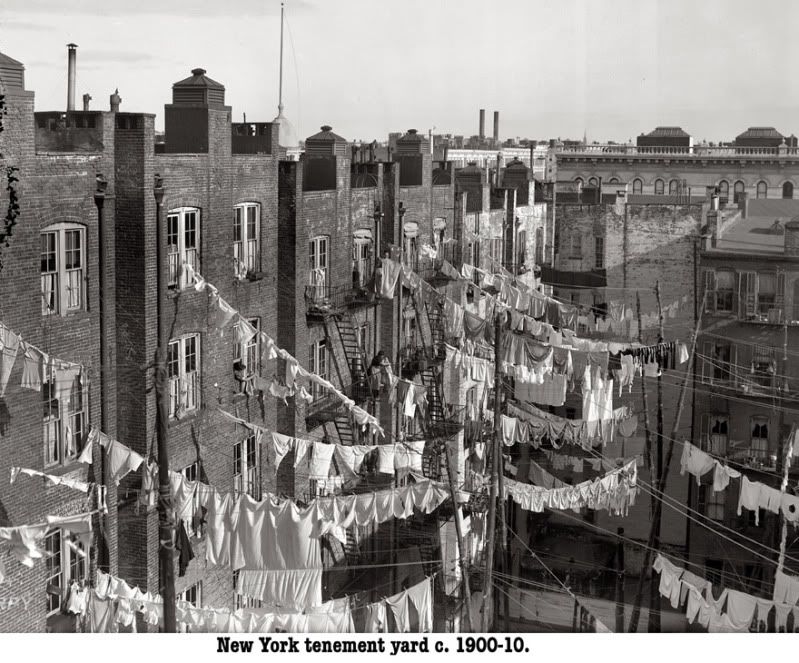
Housekeeping in the Tenements Housekeeping in a tenement was no easy task for the women and children who generally did it. There were no automatic machines to wash and dry clothes and dishes or get the dirt off the floors and carpets. And for much of the nineteenth century, few tenements even had running water. Perhaps most importantly, tenement dwellers didn't have the household help which middle and upper class new Yorkers could afford. One of the most basic household chores was taking out the trash to the garbage boxes on the street. Although there had been some street cleaning since the days of the Dutch, primarily done by "cartmen," the City did not organize a department of street cleaning until 1881. Effective street-cleaning, however, did not arrive until the appointment of George Waring to direct the department in 1895. Trash also tended to accumulate in the rear yards and airshafts of tenements. Another basic chore was keeping dust and dirt off the floors, rugs, and upholstery. During most of the nineteenth century, wood and coal burning stoves made the task difficult since they produced soot, which tended to get into just about everything. Gas burning stoves, standard by the 1930s, significantly alleviated this problem. Women used the same tool to battle dirt and dust that had been used for centuries throughout the world - the broom. Until the twentieth century, brooms were made from twigs or tufts from a corn plant. Since brooms did little to remove dust from rugs and upholstery, these items had to be periodically taken outside and beaten. This was an important part of the annual spring cleaning. Mechanical carpet sweepers were invented in the late 1870s, but electric vacuum cleaners weren't common until the 1930s, and then still mostly among the middle class. Since most tenements didn't have indoor plumbing until the turn of the century, water had to be brought in for baths, washing clothes and dishes, or cleaning the apartment itself. If hot water was needed it had to be heated on the stove. During the 19th century, laundry was usually washed outside by the water pumps - weather permitting - in order to save the labor of hauling it up or down dark tenement stairways. Of course if the tenement had indoor plumbing, as most did by the 1910, washing was done in the kitchen and the clothes were usually boiled in the water. Under the best of conditions, the wet laundry was hung to dry on the roof or on clothes lines strung between buildings. But poor weather, water dripping from clothes on higher lines, pollution, falling refuse, and thieves frequently made it necessary to dry laundry in the kitchen. Ironing was done by heating several irons on the stove and then using them alternately as they cooled. Needless to say, it was hot and exhausting work. After the turn of the century, even the working poor began sending some of their clothes out to commercial laundries, frequently owned and run by Chinese immigrants. While many middle class Americans had their own automatic washing machines by the 1930s, tenement dwellers didn't often have the money or the space and continued to use commercial laundries. The kitchen was generally the central work-place of a tenement apartment, especially if it had running water, which most did after the tenement act of 1901. Families hooked up their stoves (which they usually brought with them in the 1870s) to the kitchen chimney, and it was here that food preparation, cooking, and eating took place. Because tenements had no reliable food storage facilities (the refrigerator was common in middle class households in the 1930s, but not in working class tenements), children were sent to purchase food as many as three times a day. During the 1870s, children also helped their mothers by scavenging for wood and coal to use as fuel in their stoves. Since few tenements had central steam heat as late as the 1930s, stoves were usually used for heating as well as cooking. Women could earn money for their housekeeping labor if they took in boarders. Part of the boarder's rent was often meant to pay for the woman (or women) of the tenement apartment to do the boarder's laundry, cooking, cleaning, etc. However, this was the only time a monetary value was placed on this exhausting work.
Labor Temple A couple of posts ago Stephen Lewis reminded me of the historic significance of the labor temple on 14th Street. I did some research. Lo and behold it was right by the second avenue stop I often used to return to Knickerbocker from Stuyvesant. The Temple and it's leader, Reverend Dr. Edmund Chaffee, were deemed subversives in the late nineteen teens and early 1920's as part of the first Red Scare Some additional info. from the American Guild Of Organists
Fourteenth Street Presbyterian Church - New York City Labor Temple was founded in 1910 by the Rev. Charles L. Stelze of the Presbyterian Home Mission Board. The first Labor Temple occupied the former Fourteenth Street Presbyterian Church, located at 225 Second Avenue near Union Square, and built in 1851. Under Stelze's leadership, Labor Temple would be "entirely unsectarian, where every man, if he have a message, may give it expression, and if it be good it will receive attention." On its opening day, Labor Temple was attended by five hundred members of labor unions, Socialist, Anarchists, and persons who took interest in labor matters and sociologists. In 1924, developers built a new Labor Temple that fronted 14th Street on the site of the former church. Emory Roth designed the six-story building that included a chapel, an auditorium, and a gymnasium for the temple, and additional commercial space was provided and controlled by the developers. The Labor Temple disbanded in 1957, after which the building was used by the Presbyterian Church of the Crossroads and, later, Congregation Tifereth Israel.
Bold and optimistic indeed is the man who sets up shop as a religious journalist. Small in number, his subscribers are choosy, opinionated. Few church magazines are currently given denominational subsidies. Almost no big advertisers buy space in them. (Exception: the homey, nondenominational Christian Herald.) With theological controversy and petty driblets of church news as his stock-in-trade, the religious editor must cut his thoughts to a consistent pattern. And of all denominations the one whose journalists are the most orthodox is the Presbyterian Church in the U. S. A. Its magazines are: The Presbyterian (conservative weekly), The Presbyterian Ban ner (middle-of-the-road weekly), Christianity Today (arch-Fundamentalist monthly) and The Presbyterian Advance. The last, a journal founded 24 years ago, has, like many another church paper, accumulated a handsome deficit—$101,044. Last week it became known The Presbyterian Advance would cease publishing this month. Undeterred by the hazards of the field a Manhattan preacher was ready to take it over, call it The Presbyterian Tribune and give Presbyterians nothing less than a liberal journal. Editor of the new biweekly is Rev. Dr. Edmund B. Chaffee, an energetic, square-faced, 40-year-old churchman with a great passion for social betterment. Born near Detroit, he studied law at the University of Michigan, went to Union Theological Seminary, got a Manhattan pastorate in 1916 which he promptly lost because of his pacifism. Mr. (as he prefers to be called) Chaffee served in Jerusalem as a Red Cross captain. When he returned to the U. S. he took the job he still holds—director of the Presbyterian Labor Temple on Manhattan's radical 14th Street. Founded by the New York Presbytery which, to the great pain of its conservative members, foots half its bills, the Labor Temple is a forum for people of all sects. Because "people who are willing to work among Labor should live among them." Director Chaffee lives with his wife and two children on the top floor. A grey-haired, wiry man who much resembles Economist Stuart Chase, he sits on New York's Central Trades and Labor Council as a representative of the city churches, is head of the pacifist Fellowship of Reconciliation. Though Methodists and Congregationalists are more famed for radical zeal, there are nevertheless plenty of Presbyterian liberals. To those members of his great, cautious, rock-like church Editor Chaffee will address himself, avoiding theological controversy. Says he: "We seek unity in the Presbyterian Church, not divisions." Guided by a council of able Manhattan pastors, The Presbyterian Tribune will be backed by Presbyterians whose names he declines to reveal.
Last week 30 New York ministers signed a petition urging the American Federation of Labor to grant a charter to the Ministers' Union of America. Local No. 1. The petition was seconded by the Manhattan teachers', musicians' and typographers' unions. That a ministers' union even existed was news to many a churchgoer. Actually the Manhattan local, first of its kind, is four years old, has thus passed the period of probation necessary to A. F. of L. affiliation. Interracial and interdenominational, it was founded with the help of Presbyterian Rev. Edmund B. Chaffee, now editor of the Presbyterian Tribune, holds its monthly meetings at his Labor Temple in radical 14th Street (TIME, Sept. 24). Though the union members know that ministers' salaries are unstable, averaging $2,500 a year throughout the U. S., they sedulously avoid suggesting that raising them is their aim. Their stated purpose is to express religion's approval of ''the right and necessity of organization on the part of all those who labor with hand and brain." Likewise they wish to promote the use of union goods and services in churches, help strikers' families, secure proper mediation in strikes, take active part in picketing, and get ministers in other communities to unionize. President of the Manhattan local is Rev. Dr. David M. Cory, Brooklyn Presbyterian who won his labor spurs and a mauling by police when he picketed the Brooklyn Edison Co. two years ago. Vice President is Rev. William Lloyd Imes, Negro pastor of Harlem's St. James Presbyterian Church. Others of the 75 union members: Rabbis Israel Goldstein, Alexander Lyons and Sidney Goldstein; Dean Henry Pitney Van Dusen of Union Theological Seminary; Presbyterian Rev. Cameron P. Hall; Methodist Rev. F. Theodore Minor. Least parochial to carry a union card is Rev. James Myers, able researcher, idealistic unionizer, industrial secretary of the Federal Council of Churches.
Loew's Commodore Theater in 1968 New York, NY 105 Second Avenue When it opened in 1926, the Commodore was the largest of the 10 movie theatres in operation on Second Avenue between Houston and 9th Street. Screens: Single Screen Style: Adam Seats: 2830 Architect: Harrison G. Wiseman Originally opened in 1926 as the independently operated Commodore Theater, this movie house/Yiddish theater was taken over by Loew's Inc. and later became known as the Village Theater. It can credit Lenny Bruce as appearing on its stage. In March 1968 it became the Fillmore East concert venue. Over the years, innumerable bands played here including Santana and Chicago. After decades of success, the Fillmore finally closed. In the fall of 1980, it was converted into what was to become New York City's best and most celebrated gay disco 'The Saint', which became famous world-wide. This continued until May 2, 1988 when the doors closed following a non-stop 48 hours party. The building was used spasmodically for a couple of years for live events, then stood empty for a few years until the auditorium was demolished in around 1996. Today the narrow facade remains and the lobby is now remodeled as an Emigrant Savings Bank. Apartments/condos called Hudson East were constructed on the site of the auditorium. In the lobby of the bank are pictures of the Fillmore, Village Theater and Loews Commodore Theatre as well as some posters from the Fillmore days.
RKO Jefferson Theatre 214 E. 14th Street Status: Closed/Demolished Screens: Single Screen Seats: 1916 Architect: George Keister, Thomas W. Lamb The old Jefferson Theatre opened in 1913 as a B.F. Keith's vaudeville theater in what is now known as the edge of the East Village. Later the RKO Jefferson, this theater was located at 214 E. 14th Street near Third Avenue. The entrance was a narrow space between two tenement houses with the bulk of the theatre (auditorium) located in 13th Street. The Jefferson operated at least into the 1970's and was demolished in 2000. Today, the site is filled with bricks and debris from the demolition and the old Jefferson as passed on. Also known as B.F. Keith's Jefferson Theatre Last owner was a relative of the owner of the Wetson hamburger chain. He was almost singlehandedly trying to restore it with only one helper. A visit to the upstairs proved he was wasting his time as vandals had removed all the plumbing by that time & the inside of the theater was in shambles. He quickly found this out and gave up on this vanity project posted by WilliamMcQuade on Mar 20, 2002 at 8:39am The East 13th Street portion (or rear of this theatre's building) can be seen in Taxi Driver. The action with Robert De Niro, Jodie Foster and Harvey Kietel all take place around the corner from The Jefferson. posted by Greenpoint on Feb 8, 2004 at 3:38pm The Jefferson was another Adam design by Thomas W. Lamb, and was built by B.S. Moss and Sol Brill. It first opened on January 25, 1913 with Keith's vaudeville. During the heyday of vaudeville, the Jefferson was one of the top NYC houses. New acts that registered well with the audience were assured of getting a booking at the Palace on Broadway, which was the ultimate reward for an entertainer in those days. Through its Keith's affiliation, the Jefferson became an RKO movie theatre, but retained vaudeville on the programs until well into the 1930s. posted by Warren G. Harris on Mar 22, 2004 at 1:32pm George Keister was the Jefferson's architect. Thomas Lamb did only some minor alterations in the 1930s. The Jefferson was built by the Irvington Construction Company, and took nine months to complete. The original seating plan showed 1,885 seats-- 1,124 in the orchestra, 689 in the balcony, and 72 in boxes...George Keister's other NYC theatres included the Astor, Belasco, George M. Cohan's, Selwyn, Chaloner (later Town), and both versions of the Earl Carroll. posted by Warren G. Harris on Mar 27, 2004 at 7:47am The narration above says it was closed by the early 60's but I seem to recall when going to Luchows in the seventies triple kung fu bills playing? Maybe an independant took over when RKO gave it up? Yes, it was operated by "indies" after RKO left. It would be very difficult to track the exact closing as a movie house because the operators never advertised in the newspapers or sought listings in magazines like New York. When I last had a chance to visit the dingy interior in 1981, the Jefferson was closed and awaiting re-development as a disco/rock palace, but that never happened.
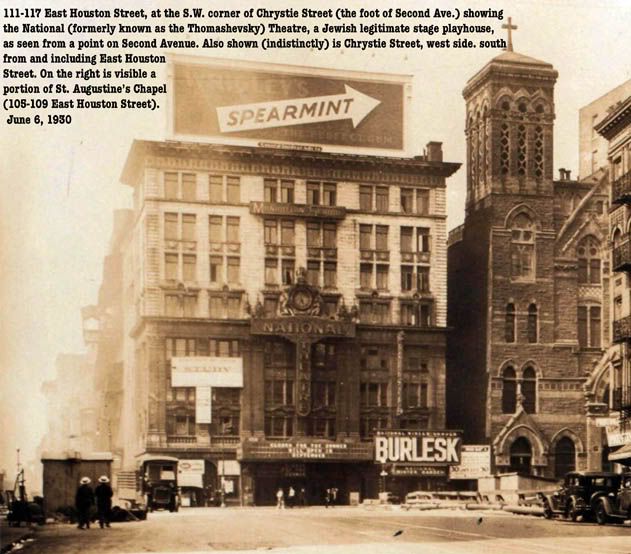
National Theatre & Roosevelt Theatre 111 - 117 E. Houston Street Seats: 2863 Architect: Thomas W. Lamb Built as a twin 'piggy-back' theatre , it was planned by Louis Minsky to be called the Unique Theatre and be used for burlesque. However when built (to the designs of noted theatre architect Thomas W. Lamb) it opened on 6th May 1913 as the National Theatre (on the lower level seating 1,900) which was leased to Thomasefsky & Adler for use as a Yiddish theatre. The upper theatre had a seating capacity of 963 and was named the Crown Theatre. Programming varied from Yiddish stage shows to burlesque and it ran Russian films from 1936 to 1939 when the Crown Theatre was re-named Roosevelt Theatre. The building was closed in 1941 and was later reopened as two movie theatres known as the National Theatre (seating 1,800) and Roosevelt Theatre (seating 963). These closed in 1951 and lay empty until they were demolished in 1959 for a parking lot. The 1941 edition of Film Daily Yearbook lists this theatre as the Roosevelt Theatre, Houston Street. The seating capacity given is for 400 and it is listed as 'Closed' A 1934 NY Times article mentions the Roosevelt Little as another name for the National Theatre (legit). The National was on the SW corner of Houston and Christie which maps now as 273 Bowery, 10002, The site had been home to a household supply manufacturer from 1871-1911. I believe the theatre was built by Louis Minsky and Max Steuer, open by May 1913, and was known originally as the National (along with the National Winter Garden). In March 1935, it became the combination house known at the New Roosevelt Theatre. Simply the Roosevelt by September 1936, it exhibited Ukrainian, Soviet, Yiddish, and Chinese movies in the late 1930s and early 1940s. The National Winter Garden, located on the sixth floor, seated 299 and was known as the Rooftop Theatre from at least the mid-1940s through the building's closing. The theatre proper was known as the Downtown National from at least 1941-1951. The theatre was closed when it was purchased by the Transit Authority in 1958. I believe the lot on which it existed sat empty until the recent construction of the first building in the large Avalon Chrystie Place mixed-use development currently underway on both sides of East Houston. The particular building on the site, the foundation of which had to be built around 4 subway lines underground, will include a new community center and gym jointly operated by the Chinatown YMCA and University Settlement, a 60,000-sq.-ft. Whole Foods supermarket — the chain’s largest in Manhattan — and 361 rental apartments, 80 percent of which will be market rate and 20 percent for low-income tenants.
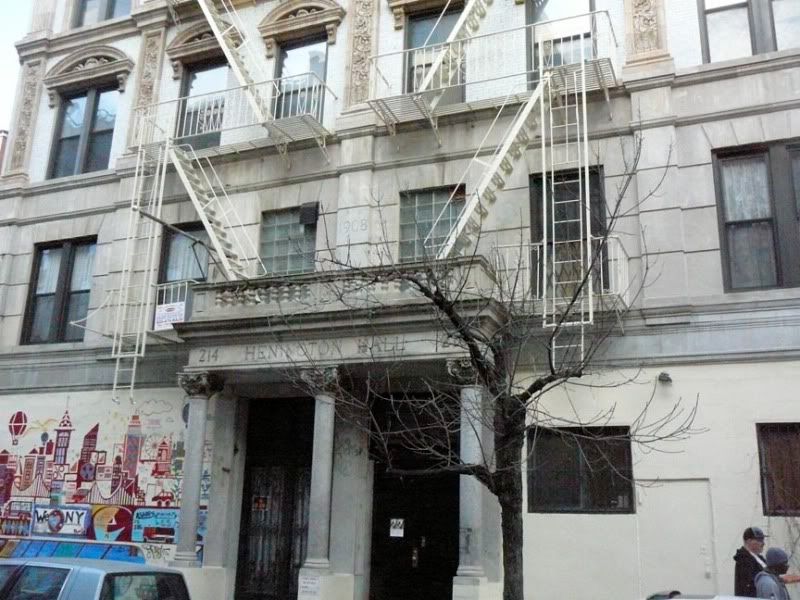
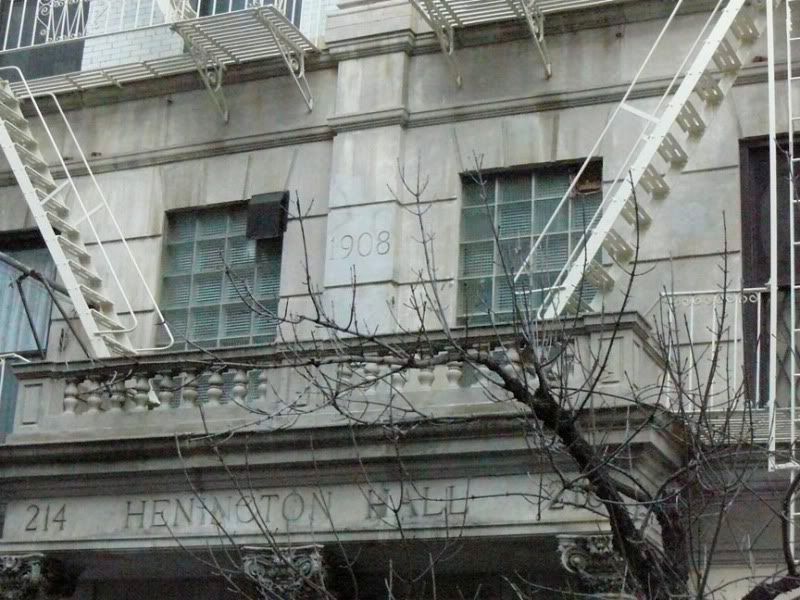
I came across this old meeting hall on one of my 11th Ward explorations When I googled Henington Hall I discovered a great site called papa's diary
Took half day off for "Yizkor" for my beloved father (olam haba) Evening at Country mens synagogue at Henington Hall for the "Hakufos" Enjoyed in the midst of old country men and school friends. 1 - Hennington Hall, located at 214 Second Street near Avenue B, was a meeting space often used for political gatherings and speeches. I think the "Country men's synagogue" Papa refers to in this entry means Congregation Sniatyner Agudath Achim, which was made up of landsmen (the Yiddish term for people from the same place that literally translates as "country men") from Papa's home town of Sniatyn. I think this congregation normally met at a multi-use facility called Broadway Manor at 209 East Broadway, but I wouldn't be surprised if they moved around a bit. In any event, Papa has never bothered to specify the congregation's location before, so I assume he deliberately mentions Hennington Hall because it wasn't their usual spot.
My grandfather, Harry Scheurman, kept a diary in 1924 when he was twenty-nine years old. He had been in America for 11 years, but much of his family still lived in the central European, Jewish ghetto of his youth. He was a garment worker, union activist and Zionist fundraiser. He was also unmarried and terribly lonely. I've always found his diary to be fascinating reading, and I've always wanted to share it with people who might find it interesting. So, each day in 2007 (*2008 update below) I'll transcribe and post each day's corresponding entry, and I'll also annotate with contextual details about his life, historical details about the social, political and cultural subjects in circulation that year, and whatever thoughts and feelings his words bring to mind.
1924, Through an Ancestor’s Eyes, by Les Stone “My father went to bid me farewell on my long journey to America,” the son later wrote. “The train is waiting, a long embrace, a kiss, tears streaming down from his eyes. Did he have a premonition that we would see each other no more? The train is moving out slowly, and by the light of the moon I could see through the window in the distance my father, weeping and wiping his tears.” That passage comes from Harry Scheurman’s diary, a slim volume in which he wrote nearly every day of 1924, when he was a single 29-year-old garment worker and ardent Zionist living in a Lower East Side tenement. Since last January, in an extraordinary act of meta-journaling, Mr. Scheurman’s grandson, a 40-year-old Web production executive named Matt Unger, has begun transcribing, posting and annotating a page of the diary each day at a blog he has created, called Papa’s Diary Project. The diary is an intimate record of Mr. Scheurman’s romantic and emotional life, shadowed by deep homesickness. Mr. Scheurman contrasts the “mechanical” Purim celebrations of New York with those of Sniatyn, and chronicles countless nights at home alone with his radio. On May 12, he learns of his father’s death in Sniatyn, an event that leaves him heartbroken. But the journal also provides a rich glimpse of the minutiae of a New York life in the 1920s. Mr. Scheurman writes of visiting the “2nd Avenue Baths,” of riding the subway from Brooklyn to the Bronx in the middle of the night with “a pretty girl who is unusually gifted with knowledge,” of dickering with a crooked English-school instructor on behalf of his brother-in-law. On New Year’s Eve, he visits “an East Side joint where Prohibition drinks were freely served.”
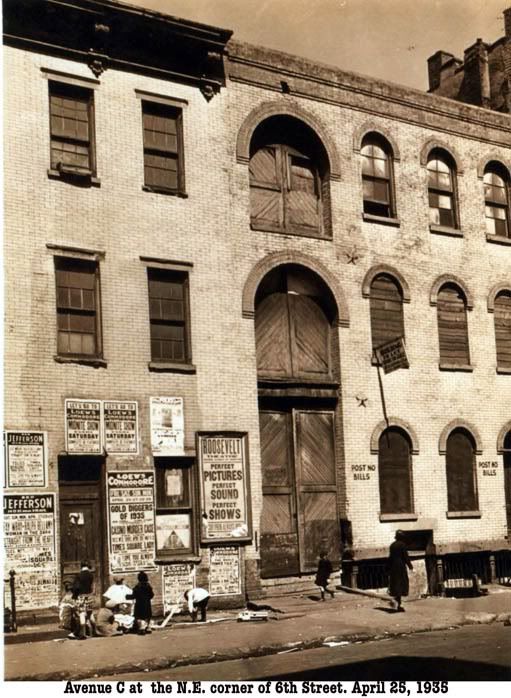
East Village Now Then 2 I've been hanging out a lot in the 11th and 17th Ward working on local history project for first and second graders. In putting together some then and now photos it's obvious how much movie theaters were so much a part of our lives back in the 1920's and 30's.
Knickerbocker Village at the 2010 Conference on New York State History, June 4
click on picture above for conference schedule
All copyrights acknowledged. For research and educational purposes only.
June 1974
PS 177: June, 1959, Nancy with Mrs. Jonas
About Knickerbocker Village
I found that a recurring topic on my blog, Pseudo Intellectualism, would be my memories of the wonderful place I grew up in on the Lower East Side, Knickerbocker Village. I lived there from 1952-1964. There has also been an avalanche of new information coming in from my old friends through our group emails. All of this has refreshed our collective minds and I decided to shift my old posts (from the last two years) to this dedicated site as well as add new recollections. Hopefully other lost KVer's can arrive here and feel free to share as well. Note 1: Many posts are an outgrowth of history projects I did with kids while teaching on the LES. Note 2: As this blog has evolved it has also become a view of life in NYC during the 50's and 60's. You can contact me at davidbellel.mac.com.
Stewie Brokowsky R.I.P., photo by Murray Schefflin
Help In Understanding Various Blog Posts, The KV Mind Map: Click On Image Below
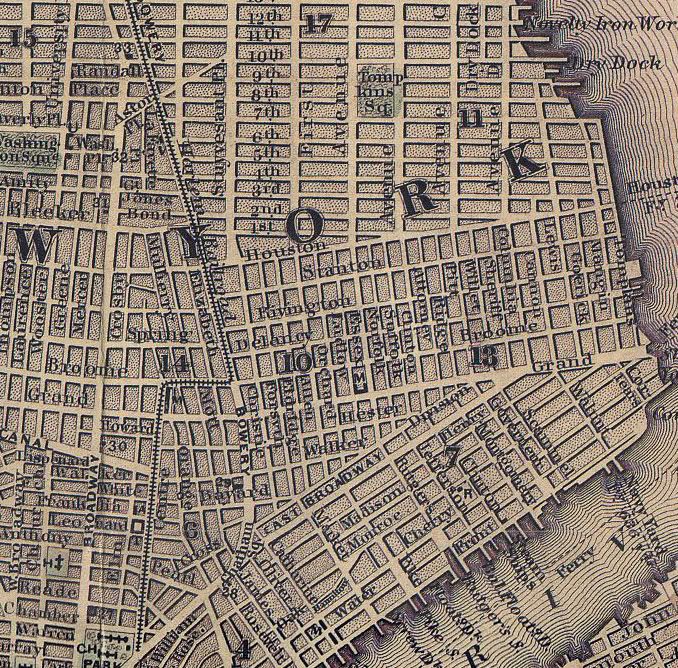
1847 LES Ward Map Section: A Geographic Tool For Locating Blog Posts
Click For A Better View
Deep Thoughts
#1. Annie Dillard talks about her fascination with science and minerals in particular. Then she goes on to details anecdotes concerning various Americans who became obsessed with the possibility of discovering valuable or interesting mineral deposits or rock formations within or close to their home environments. She speaks about men - almost all these scientific minded people are male - who discover veins of coal, copper, bauxite, and so on. She depicts the ordinariness of their fascination and the fact that it tapped into the extraordinary. Like nature had these incredible finds waiting to be unearthed all around. People who could see the worth of what was all around them or, in some cases, beneath them, excavated and found, just beneath the surface of their obsessive preoccupations, depths of riches and fascination. So in exploring the history of KV we go back into what had been the ordinary and find it layered in a criss-cross of historical significance. A transmutation of the lung block, redeemed as a bold social experiment tinged with ambitions as immodest as a revolution and as commonplace as sandwiches - ordinary though it may be but still - the most delicious sandwiches of the twentieth century. Buried beneath the surface of the KV heritage are connections to so may aspects of our culture and NYC's greatness as to be not only unfathomable but irrefutable. Do you know what I'm saying here?
Son Of Salvatore
FAQ's: Click On Image
KV Honorary Members (And Their Corresponding Sponsors)
Tim Russert-Mark
George Carlin-Allan
Paul Newman-David
Pete Seeger-Bob
John F. Kennedy Jr.-Joe
To be is to do - Plato To do is to be - Socrates Do be do be do - Frank Sinatra
Yes. I was thrown out of the Canal theater a number of Saturdays for rolling on the floor, in the aisles laughing. I think one of the movies that prompted my gaiety was "Psycho" - the shower scene. What can I tell you? I guess I wasn't tuned into the mood. At the time. Also saw many rock and roll movies at the Canal, Elvis films and the Murray the K fests. Saturday I often would go there with Joey Maldonado and his cousins. We would load up on candy by the quarter pound from that obscure bakery that was just around the corner on Madison Street, quarter block from Catherine - around the corner from the Brokowsky's fruit store, Gogol's and the pharmacy on the corner. Next to the newstand. Remember? By the bus stop. See what I'm saying? (In your mind, can you see it?) Bakery had golden and tan tile design but couldn't hold a candle to Savoia. No marble floors either.
guest memorist Howie: the first movie I ever went to was at the Tribune Theatre (near City Hall, now by the site of Pace University), a Disney cartoon 'Lady and the Tramp', also remember going there with Ronnie, David and maybe Paul, think it was '62 to see 'Safe at Home' starring Mickey Mantle and Roger Maris....I saw 'The Time Machine" with David at the Canal theatre in 1960 (academy award to George Pal - special effects), we were so taken by the notion of time travel that we proceeded to go home and build a time machine...somehow we got hold of some wood, nails, rope and wheels..after a couple of days the time machine started to take shape although it looked remarkably like a pretty decent scooter so we decided it needed a safe haven and hid it in a pit on Monroe St...one that we were able to climb...on the third day the time machine was stolen from the pit...we never saw it again...probably in the year 3000 by now..
guest memorist Neal Hellman on BLT's (the non Ref Luncheonette variety) A great B.L.T. is a complex eatable symphony. One in which all the parts maintain their individuality, yet at the same time, surrender their tasty nuances in the true spirit of gastronomic gestalt and dwell as one.This equinox I choose Sumano's Bakery Ciabatta bread. Though I was skeptical about it's naked, pale texture, I felt it would toast up well and its many crevices would add some fun places for the mayo to go.With the mayonnaise choice I have to stay with tradition and of course go with Hellmann's though for some reason it's known west of the Mississippi as “best foods”. Please do not waste my time with this hippie safflower oil concoction or some other type of healthy alternative. For when it comes to mayonnaise for my Ultimate B.L.T. there is no east or west, there is only Hellmann's…. case closed. My ingredients are now all together, but the intense work has just begun. For now without the correct timing and the correct application of all the ingredients, my ritual could easily plummet into a spiritual abyss. All ingredients must sit together (as one) at room temperature as I invoke the spirit of all the great B.L.T. makers in all the luncheonettes in the greater metropolitan area of New York. I heat my cast iron skillet (using a Teflon pan would be heresy) to a comfortable medium heat. I lay the bacon down 4 strips per sandwich and as I do the strips greet the metal with a friendly sizzle “hello”. As they are slowly cooking I cut the tomato's, neither too thin or too thick and lay them down ever so gently on a plate to await their glorious marriage. The lettuce has been carefully washed and spun with all traces of ribs removed. The mayonnaise jar is open and waiting to join this eatable canvass. Once the bacon is turned the toast swings into action. It has to be brown all the way but with no traces of crusty darkness.As the toast is finishing I remove the bacon and pat it down with a paper towel. Now it's time to assemble my edible equinox creation. Mayo on both pieces of toast, then the tomato's and I prefer the lettuce between the tomato and the bacon, for I feel it's texturally more secure that way. I don't want an immediate confluence of tomato and bacon; I like the lettuce to work as a buffer. Here's where many folks really go askew: they push the bread down so hard that the bacon is crushed. No, no a thousand times no. One must gently, ever so gently caress the concoction together. After which one will take a sharp knife and make a diagonal cut. A straight cut is what people from small towns in Nebraska and Ohio do. Those of use who are members of the B.L.T. illuminati always make a diagonal cut. The masterpiece will then be placed on a plate and then consumed in a way as to enjoy the warm and crunchy (yet still pliable) bacon, the exploding sensation of a dry farm Molino tomato, the juicy lettuce, the condiment-ing mayonnaise and ever so supportive bread. My first Ultimate B.L.T. goes to my neighbor for her birthday. With that offering I realize now that I am truly invoking the Japanese Equinox celebration of Hign-e. Yes with my ultimate B.L.T. offering I am illustrating the six perfections: perseverance, effort, meditation, wisdom, observance of precepts, and giving.
KV Journeyman
11/13/07: Even standing in the cold rain, the Baroque facades on these buildings are fantastic. Brussels has some of the best architecture in the world, all types, all styles. Standing in the middle of the main town square one is overwhelmed with the magnitude of detail and size.
11/14/07: I am currently in Brugge in NW Belgium. It appears to be a quiet town with all old and small buildings, perhaps pre-Victorian, with a network of canals similar, but without the gondolas and singing rip-off-the-tourist gondoleers. I'll learn more tomorrow as we get a tour prior to dinner.
12/5/07: Just finished a fresh grilled tilapia sandwich while sitting outside looking at the expansive white sands of Clearwater Beach and the far reaches of the Gulf of Mexico, realizing I am flying back to DC tomorrow morning into the remnants of the latest Alberta Clipper to wreak havoc on the Nation's Capitol. Enough to upset the strongest and staunchest among us.
Time Magazine: 10/15/1934
Smack in the middle of the slum-mulligan of Manhattan's lower East Side two barefaced, rectangular apartments rear their bricks twelve stories into the air. Jointly christened Knickerbocker Village, they cover four whole city blocks. Between the two units is a concrete playground, and within each will be a garden. Each of the 1,593 apartments has wooden parquet floors, electric refrigeration, tiled bathrooms, outside windows. The elevators are self-operating. Rentals range from $22.50 for 2½ rooms on the ground floor to $87.50 for a 5½-room penthouse. Average is $12.50 a room. Knickerbocker Village will cost about $9,000,000, and with the exception of Rockefeller Center is the only large structure which Manhattanites have noticed abuilding these last two years. Last week it was ready for occupancy.
Because Knickerbocker Village is also Manhattan's first experiment in government-financed, low-cost housing, RFC's Chairman Jesse H. Jones, East-Sider Alfred E. Smith, many a minor wig gathered in its banner-decked playground to mark the day. Said Al Smith: "I was tempted to swap the Empire State Building." Chairman Jones thumped the tub of slum clearance. Informed that the first of the two units was already 95% rented, while the second unit (to be opened Dec. 1) was 50% rented, he waved an expansive hand at the holiday bunting, declared: "I know of no ... safer investment for public funds than to clear about 500 acres of your slums."*
Whether or not Knickerbocker Village was a fitting inspiration for such official rejoicing was last week a red hot sociological question.
In 1929 Realtor Fred Fillmore French began buying land on the lower East Side. By swearing his 42 brokers to secrecy and using dummy corporations, he managed to get some 15 acres for $5,000,000. Then in 1931 he announced a grandiose scheme for the erection of a $50,000,000 development for junior Wall Street executives. At this point he found that he could not get credit. At the same time Fred F. French Operators, Inc. began passing its dividends on $14,000,000 of preferred stock. The project remained only a scheme with a staggering upkeep in land taxes.
When Congress authorized the RFC to make loans on slum clearance projects, Realtor French picked out the worst block in his holdings and ecstatically presented it to Mr. Jones as a worthy subject for clearance. His choice was "Lung Block," so called because of its high tuberculosis mortality rate. On it lived 650 families. In its backyards were seven jakes. On this fester Mr. French proposed to build a low-cost housing project. Mr. Jones agreed to do business, and RFC lent 85% of the required $9,000.000.
Average cost of "Lung Block" to Knickerbocker Village was high: $3,116,000, or $14 per square foot. The tax assessment was therefore reduced by two-thirds to bring the monthly room rental down to the $12.50 stipulated by the RFC. Because the average rental on "Lung Block" had been about $5 a room, Knickerbocker Village remained a low-cost housing project only in the minds of the white collar workers, who proceeded to fill it.






 Posts