Showing posts with label artie shaw. Show all posts
Showing posts with label artie shaw. Show all posts
Wednesday, May 23, 2012
Comes Love: Artie Shaw's Version
Here writing credits go to Sam Stept, Charles Tobias and Lew Brown. Rumshinsky was often plagiarized. Sammy Cahn supposedly "borrowed" Bei-Mir-Mister-Schoen from him. Charles Tobias'
roots are within blocks of Knickerbocker Village


Saturday, May 22, 2010
Jonathan Shaw: Artie's Son On The Lower East Side
Born in New York City on Independence Day 1953, Jonathan moved to Hollywood, CA with his mother Doris Dowling at an early age. There he was introduced to comic books, from where his love of drawing spawned. He immersed himself there until the age of fourteen, when he discovered drugs and alcohol as a form of escapism from a troubled family life with his mother Doris and stepfather, writer and producer Leonard B. Kaufman. During this time Jonathan was estranged from his biological father. In his late teen years, Jonathan began writing for the Los Angeles Free Press, one of the most widely distributed underground newspapers of the 1960s. At the LA Free Press he met Charles Bukowski, who became an influence on his writing. Around the age of 21, after much struggle and the deaths of close friends due to heavy use of heroin, Jonathan decided to leave Los Angeles and began hitch-hiking through South America. He spent time in various port towns, eventually becoming a merchant marine. In his travels he learned how to tattoo, and it became a quick way to make art and pocket change for the road. He eventually found himself in Rio De Janeiro, Brazil where he stayed until returning to Los Angeles in the mid-1970s.
Upon arrival there, Jonathan was taken under the wing of Bob Shaw, a widely respected first generation American tattoo artist. Bob Shaw trained Jonathan on the art of tattooing and they worked together on the legendary Long Beach Pike (aka “The Pike”) until Jonathan’s itch to be on the road again came back full force, along with his increasing alcoholic behavior.
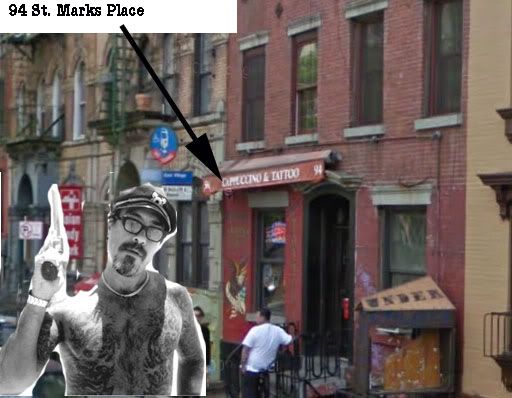
Jonathan worked out of his own studio by appointment only on 1st Avenue and 1st Street for a few years until 1991, when--even though tattooing had been illegal in New York City since 1961--he took the leap and opened the first store-front, public tattoo parlor in New York City, Fun City Tattoo. Located at 94 St. Mark's Place in the East Village, Fun City became a neighborhood hangout and New York pit stop for such notables as Johnny Depp, Dee Dee Ramone, Howie Pyro, Johnny Winter, Jim Jarmusch, and the Maysles Brothers of Gimme Shelter Fame. In the early 2000’s, after much pain and loss of love for tattooing, Jonathan sold Fun City to a local operator, and moved to Rio de Janeiro, where he has spent the last several years writing novels, short stories, poetry and an extensive autobiographical memoir of his life, travels, adventures and career.
During the time Jonathan was the owner of Fun City, he founded International Tattoo Art Magazine. ITA took the common grassroots tattoo mag and pushed it up to the level of a legitimate fine art magazine, changing the way tattoos would be perceived by the public. It focused greatly on tattoo history, making sure that priceless archives, information and legend was not kept hidden away. It maintained a high standard of the industry by showcasing world class works of art.
Jonathan’s tattoo style was considered trend-setting and innovative in the field, and he tattooed (including but not limited to) The Cure, David Lee Roth, Vanilla Ice, Marilyn Manson, Johnny Depp and supermodels Naomi Campbell and Kate Moss. His neo-tribal work and original full back-pieces made a lasting stain on the tattoo world, especially of a large abstract/cubist painting that he tattooed on the back of Luke Miller, one of his employees at Fun City. Featured in tattoo magazines world wide Jonathan’s first-of-a-kind tattoos of Robert Williams and Joe Coleman paintings, were copied in loving tribute to his old friends and mentors, each tattoo looking like the painting from which it came. Jonathan’s style was mainly described as an old school approach to new school ideas. Keeping the bold, thick, heavy handed style taught to him by Bob Shaw but using an innovative roster of new art and breaking away from traditional sailor flash, including his own work, which was much of the time tattooed on large blocks of skin freehand, in the end looking like the pipes in a wall, or the inside of a clock, interwoven and detailed.
Jonathan retired definitively from the tattoo world in 2002 and moved to South America in order to pursue his career as a journalist and writer of novels and fictional as well as autobiographical prose on a full-time basis.
After leaving ITA and Fun City, Jonathan continued to devote himself to the edification of tattoo buffs and the art world by curating a number of tattoo flash exhibits, including the historical Psychedelic Solution show in New York and another well-documented event at La Luz de Jesus Gallery in Los Angeles. He has a large collection of rare antique and modern tattoo flash art by many important artists, and his own paintings can be seen in collections and shows with artists like Robert Williams and Joe Coleman. He is currently compiling works from his extensive collection of turn-of-the-century tattoo designs for a coffee table art book, soon to be released by a major US publishing house.
Jonathan began working on his first novel, Narcisa Our Lady of Ashes, in July 2007. After several edits and re-writes, a first-edition limited edition of the novel was released by Heartworm Press on July 1, 2008 . The story is a wild fictional account of a middle aged Brazilian Gypsy and his violent and tragic love-hate relationship with a teenaged prostitute and crack cocaine addict. The evolving work and characters are continued through short stories on Jonathan's blog, Scabvendor . Another heavily edited rewritten final draft of the original version of NARCISA is scheduled for publication by a major US-based publishing house, along with a sequel-in-progress.
His second published book, LOVE SONGS TO THE DEAD, was released by Heartworm Press in October, 2009. Jonathan is currently working on several other books, including an epic memoir: SCABVENDER - CONFESSIONS OF A TATTOO ARTIST. Since the release of his first published novel, Jonathan has traveled the world extensively, promoting his work as an author with several well-publicized readings and book signing events in different US cities. His books are currently undergoing translation into several languages, including Russian, Portuguese, French, Japanese and German.
Do You Know What Time It Is Now? Tomorrow Is......Artie Shaw's 100th Birthday
Born on the lower east side on 255 E. 7th Street.
Thursday, May 20, 2010
The Great Stanton Street Trumpet Player: Manny Klein
The Song Is Called That's A Plenty
Featuring Benny Goodman On Clarinet, Ray Sherman On Piano, Dick Nash On Trombone, Manny Klein On Trumpet, Jimmy Wyble On Guitar, Morty Corb On Bass, Mickey Sheen On Drums.Recorded June 1961.
Along with the many gigs Manny had, he played in Artie's Shaw band in the early 1940's. He was 2 years older than Artie. Could their paths have crossed on the LES? Did Manny (living at 83 Stanton Street) go to PS 20 along with next door neighbor Jacob Javits (living at 85)? btw on May 23rd it will be Artie Shaw's 100th birthday.
Monday, May 17, 2010
The Wives Of Artie Shaw
I guess they were bewitched, bothered and bewildered. They picture, in order:
Lana Turner, Betty Kern, Ava Gardner, Kathleen Winsor, Doris Dowling and Evelyn Keyes. Not pictured are wives no. 1 and 2: Jane Cairns and Margaret Allen. Shaw's 100th birthday is May 23, 2010. He was born on the LES at 255 E. 7th Street. He had a son, Jonathan Shaw, with Doris Dowling. He also had a son, Steven, with Betty Kern. His whereabouts are unknown. Neither had any kind of relationship with their father. He was a miserable guy, but what a musician!
from an interview with Jonathan Shaw:
"SINATRA really went crazy when he broke up with Ava - Artie was married to her first. One day Ava came running into Artie's apartment to hide, and Sinatra came in with one of his henchman. Sinatra had a gun. Artie made fun of him. He said, 'What do you think, you're HUMPHREY BOGART? She's not here. And if she was, she wouldn't want to see you.' "
Mr. Shaw, who died late last month, could be charming, Mr. Stuart said, but he was not an easy man. He said Mr. Shaw was self-absorbed and brutally frank; he was estranged from his two sons.
His son STEVE KERN was the product of Mr. Shaw's 1941 marriage to ELIZABETH KERN, the daughter of JEROME KERN. His 1952 marriage to the actress DORIS DOWLING produced JONATHAN SHAW. Once, Mr. Stuart said, Steve, who had not seen his father in several years, came to see him at his office. When Mr. Shaw abruptly asked what he wanted, his son said he was a musician and wanted to play for his father. Mr. Shaw reportedly told his son he should seek another profession.
Steve Kern could not be reached. KAY PICK, a longtime friend of Mr. Shaw's, told us "no one knows where Steve is." She also said Steve and his father had not talked in years.
We were, however, able to speak with Jonathan Shaw, who is 52 and lives in Rio de Janeiro. A painter who for several years ran a tattoo parlor on St. Marks Place, and who said he was a recovering alcoholic, he has written a screenplay about his relationship with his father and has just completed the first draft of book on the same subject.
"My father was a deeply miserable human being," Jonathan Shaw said in a telephone conversation yesterday. "That's the side of him that most people who haven't been closely associated with him don't get to see. He was a genius, and he was also a very difficult man."
Where was his brother Steve?
"God only knows," Jonathan Shaw said, adding that he had written a long letter and sent a copy of his manuscript to a post office box address, but had never heard back.
"According to Artie's version," he went on, "when my brother first went to visit him, my father said, 'What do you want? You're nothing but a biological happenstance to me.' He had said the same thing to me. I just made it difficult for him to dodge me."
Jonathan Shaw was estranged from his father for most of his life, he told us. Then, about two years ago, he made contact and spent a year with him. When Jonathan Shaw started having a relationship with his own son, he said, his father cut him off.
"I got to know him very well and we had some great times together," Jonathan Shaw said, "but bottom line is that he was absolutely unable to maintain a relationship. He was abusive, condescending, mean-spirited. I felt it was to my advantage to maintain the relationship because it was in many ways cathartic, but no one with any self-respect will put up with that kind of abuse."
So he was not with his father when he died? "No," Mr. Shaw said. "He died alone and miserable, as he chose to do."
Thursday, May 13, 2010
Artie Shaw: Someone To Watch Over Me
One of Shaw's last recordings and a song played at the end of his funeral. It was written by the Gershwins, former lower east siders. The version used at his funeral was sung by Lee Wiley, his favorite singer and one of his former girl friends. Images of David Stone Martin's album and magazine covers are mostly from the jump with joey blog. Did I mention before that May 23rd is the 100th birthday of the LES born Artie Shaw?
About David Stone Martin. That's him in the first image from the slide show above.
David Stone Martin (1913–1992), born David Livingstone Martin, was an influential American artist best known for his illustrations on jazz record albums.
He attended the Art Institute of Chicago and was greatly influenced by the line art of Ben Shahn. By 1950, Martin had produced more than 100 covers for Mercury, Disc and Dial record albums. Many assignments came from his long time friend, record producer Norman Granz.
For various companies, Martin eventually created illustrations for more than 400 record albums. Many of these were simply line art combined with a single color. Martin's favorite tool was a crow quill pen which enabled him to do delicate line work. CBS-TV art director William Golden gave Martin many print ad assignments during the 1950s, and Martin soon expanded into illustration for Seventeen, The Saturday Evening Post and other slick magazines of the 1950s and 1960s.
His studio was located in Roosevelt, New Jersey.[2] He is represented in the Museum of Modern Art, the Metropolitan Museum of Art, the Art Institute of Chicago and the Smithsonian Institution.
Wednesday, May 12, 2010
Monday, May 10, 2010
Artie Shaw: Marinella
 One of my uncle's favorite songs (at least of the non-Greek variety) was a little known Artie Shaw number called Marinella. My father and uncle were childhood friends as well as sons of immigrants from Janina, Greece. They belonged to a social club on East Broadway in December 1941. I think it might have been named the Allbros (short for Allen and Broome Street, the vicinity from where many of the Greek Jews lived. Marinella was near the top of the charts on December 7th. When news of Pearl Harbor reached home the club members knew things would change and that they would all eventually be drafted. They played Marinella, with it's strange haunting melody, over and over that day. Here's Marinella
Artie Shaw: Things Are Looking Up
by former lower east siders' George and Ira Gershwin. Could their paths have crossed as children? The Gershwin's were around ten years older.
If I should suddenly start to sing,
Or stand on my head, or anything,
Don't think that I've lost my senses,
It's just that my happiness finally commences!
The long, long ages of dull despair
Are turning into thin air,
And it seems that suddenly I've
Become the happiest man alive.
Things are looking up.
I've been looking the landscape over,
And it's covered with four-leaf clovers.
Oh, things are looking up
Since love looked up at me.
Bitter was my cup,
But no more will I be the mourner,
For I've certainly turned the corner.
Oh, things are looking up,
Since love looked up at me
See the sunbeams?
Every one beams
Just because of you.
Love's in session
And my depression
Is unmistakably through
Things are looking up,
It's a great little world we live in.
Oh, I'm as happy as a pup
Since love looked up at me
Saturday, May 8, 2010
Artie Shaw: They Can't Take That Away From Me
The way you wear your hat,
The way you sip your tea,
The mem'ry of all that --
No, no! They can't take that away from me!
The way your smile just beams,
The way you sing off key,
The way you haunt my dreams --
No, no! They can't take that away from me!
We can never, never meet again
On the bumpy road to love,
Still I'll always, always keep
The mem'ry of --
The way you hold your knife,
The way we danced 'til three.
The way you changed my life --
No, no! They can't take that away from me!
No! They can't take that away from me!
Friday, May 7, 2010
The 100 Year Celebration Of Artie Shaw Confirmation

Thursday, May 6, 2010
LES Greenery, May 6, 2010
In accordance with the Artie Shaw (born on the LES) centennial,
vocal by Lee Wiley, Artie Shaw's favorite singer
Shaw’s recollection of what it was like to be in bed next to the gorgeous Lee Wiley in 1938: “In bed, she would say things like, ‘You are lying next to the greatest ass in New York.’”from all about jazz
Born: October 9, 1915 | Died: December 11, 1975
Sensual and dignified, sophisticated and warm, Lee Wiley has inspired outbursts of sheer poetry from many a captivated listener. Her sound induces a “marvelous,” “ticklish” sensation, akin to “running your hand over a piece of fine Harris tweed,” marveled producer Dave Garroway. She “blows smoke rings, each note a puff that melts into wisps of vibrato,” conceptualized author Will Friedwald. Her voice and style “have long since made me extremely eager to go to bed with her,” disclosed critic James Frazier. Not content with this daring confession, he also bluntly labeled her “one bitch of a singer.”
Protested singer and Wiley scholar Barbara Lea: “She had more fire, more rhythm, more roughness, more silkiness, more deep personal warmth, than the job description of Pop Singer called for.” Asked writer Richard Hadlock, in an open letter to Wiley, “Lee, have you ever wondered why so many… from road-tough musicians to jaded pub-crawlers, act like kids on Christmas when they hear you sing?” (Wiley did wonder.) The eulogies could go on for pages, but the point is clear enough: Lee Wiley is a singer with a certain mystique.
The Wiley mystique was generated by both personal and professional circumstances, and further fed by some willful biographical manipulation by her musical associates, her record labels, and the artist herself. Nicknamed “Pocahontas” and characterized as regal by her friends, Wiley descended from the princess of a Cherokee tribe and from an English missionary who married an American parishioner... according to publicity material. Her birth date remains uncertain - initially given as 1915, then moved back to 1910, still more recently to 1908 - and revisionism has taken over the more sensational aspects of her biography (running away from home in the late 1920s, temporary blindness after a fall from a horse in the early 1930s, a near encounter with tuberculosis in the mid-1930s, etc,).
Her looks most certainly contributed to the Wiley allure. Her brother Ted once reported that everybody wanted to marry the tall, strikingly attractive Oklahoman with corn-colored hair and olive skin. (”Everybody” included the eight-times-married bandleader Artie Shaw, whose offer was declined by the twice-married singer.) One motivation for her long retirement (from about the age of 50 until the years preceding her death from cancer, in 1975) was the apparently high price that Wiley placed on physical attractiveness. It was her contention in 1971 that “singing includes a number of things ... aside from the voice ... these girls who are trying to get up on the bandstand at forty years old ... doesn't make any sense to me.”
An enigmatic personality likewise fueled the fascination. Various oral and written accounts paradoxically depict her as difficult and easy to work with; proud and/or bitter about the treatment received from the music business; heavily addicted to alcohol but outspokenly intolerant of other musicians' addictions; foul-mouthed, even unkind to other singers yet fiercely loyal to those within her own circle; hesitant while speaking though assured when singing. Friends and colleagues further portray her as a woman with a strong sense of integrity and a fierce sense of independence, traits that caused her to give up on various “golden” opportunities to further her career. The best documented of such opportunities happened in 1935 when she departed from a feature role in the top-rated Kraft radio show because its producers refused to give billing to composer Victor Young, who was then personal and musical partner.
Wiley's relatively small discography further contributes to her mythic status. Over a four-decade career, she recorded less than ten albums and about 40 singles; live and radio broadcasts make up for the remainder of her material in circulation. Thus her mystique stems not only from her biography and her persona, her looks and her sound, but also from a sort of bittersweet adoration accorded to great but under-recorded artists.
Sunday, May 2, 2010
Around 2 Corners From Artie Shaw
lived Nat Schumer At 346 E. 3rd Street to be exact. In fact Nat was born in the same year as Artie Shaw. Who knows they could have gone to PS 15 together
Above from the 1940 film Second Chorus
Above from the 1940 film Second Chorus
Saturday, May 1, 2010

Artie Shaw: Three Chords For Beauty's Sake
shaw-bio
From Three Chords For Beauty's Sake I included google street views of the Shaw, i.e. Arshawsky, family's lower east side addresses in the scribd document.
From Three Chords For Beauty's Sake I included google street views of the Shaw, i.e. Arshawsky, family's lower east side addresses in the scribd document.
The 100 Year Celebration Of Artie Shaw
This May will mark 100 years since the birth of Artie Shaw, the bandleader and clarinet player. As WNYC’s Sara Fishko tells us in this edition of the Fishko Files, Shaw is worth remembering for more than just his music...
View Full Audio on WNYC
View Full Audio on WNYC
Artie Shaw: Who's Almost Who In KV History 2
Not a cardboard god, but in my opinion a musical one. I chose a foreign language version of the above clip, Shaw's band playing behind Astaire and Eleanor Powell, for better resolution. I once speculated on a LES connection to Artie Shaw, but I couldn't find out where he lived in his earliest years. Now coinciding with his 100th birthday a new biography of Shaw provides the missing information. He was born on May 23, 1910 and his first home was at 255 E. 7th Street, between C and D. Later he moved to 43 Avenue C, between 3rd and 4th Streets. He may have gone to PS 15 just around the corner. He lived there until 1918, moving then to New Haven. A year later my mother would be born and lived within two blocks of Shaw's birthplace. Elinor Hecht's grandma had her chicken market nearby as well.
excerpts from the nytimes review of Three Chords For Beauty's Sake, The Life of Artie Shaw by Tom Nolan
Artie Shaw, the swing era’s other great clarinetist, knew just about every romantic self-immolator in the history of jazz. He roomed with both Bix Beiderbecke and Bunny Berigan, he hired Billie Holiday to sing with his band and — at least by his own account — he turned down Charlie Parker’s bid to join his saxophone section. (“I said, ‘Bird, you couldn’t play in my band, you’re too much of an individualist!’ ”) Superficially, Shaw couldn’t have been less like these doom-bound drunks and drug addicts. In “Three Chords for Beauty’s Sake,” Tom Nolan’s absorbing if somewhat sketchy new biography, we see him drunk exactly once — when he was in his teens and a prankish band mate fed him shots of rye with beer chasers — and once, at about 20, “half-stoned” on weed with Berigan. Thanks to clean living, good luck and, surely, a measure of cussedness, Shaw lived to be 94 and died, in 2004, the way Robert Frost recommended: “Better to go down dignified / With boughten friendship at your side / Than none at all. Provide, provide!” He even kept his sense of humor, or at least his memory of an old Myron Cohen joke. His personal assistant (who stayed with him for 11 years, sometimes by dint of repeating the word “mortgage” to himself) and his home-hospice caregiver were changing the old man’s bedclothes during his last days and asked if he was comfortable. “I make a living,” he said. He did, too. Though Nolan’s book doesn’t say so, Shaw’s estate was probably worth around $3 million, and he hadn’t played on a record for half a century.
Yet “Three Chords for Beauty’s Sake” is as grimly fascinating as any story of a young flameout dying in the gutter. Shaw spent his first 44 years acquiring artistic mastery — Ray Charles called him “one of the greatest musicians that ever lived” — as well as money, fame and an array of America’s choicest sexual trophies. ......
He was born Avraham Ben-Yitzhak Arshawsky, on Manhattan’s Lower East Side, in 1910; his immigrant parents called him Arthur. The family moved to New Haven, Conn., where he was taunted for being Jewish; where his father, a tailor, abandoned them; and where he heard a vaudeville saxophonist perform a tune called “Dreamy Melody.” Arthur would have been around 13 (Nolan doesn’t tell us exactly). Within two years, he’d saved up, bought a sax of his own, taught himself to play and gotten himself expelled from school to make his living with it, under the hyper-American name Art Shaw. By the time he was 21, he’d also mastered the clarinet and was playing in the CBS Radio Orchestra. “They used the best musicians in New York,” he said, “for some of the worst music.” In fact, he had such contempt for the gig, which most musicians would have regarded as a godsend during the Depression, that he staged the first of his many retirements — to a farmhouse in Pennsylvania with no electricity or running water, where he earned money by cutting firewood and began writing a novel. How conflicted was he? Let him tell you. One day he nearly chopped off a finger, and “the very first thought I had was, ‘I’ll never have to play the clarinet again.’ ” Many years later, just before his last retirement, one of his sidemen noticed the same ambivalence. “It’s one of those strange contradictions: he seemed much happier when he was playing — but he hated to play.”
Tuesday, June 17, 2008
Who's Almost Who In Knickerbocker Village History: Artie Shaw
This is a reach and mostly an excuse just to use this great clip. Artie Shaw was born in 1910 somewhere on the LES, but I don't know where. There is no listing for an Arshawsky (his real name). I found him New Haven in 1920 and he was listed with the name Arthur Arskhawsky and he was 7 not 10 (perhaps the 1910 date is wrong)
from brightlights film
from brightlights film
Cole Porter wrote "Begin the Beguine" for the 1935 Broadway show Jubilee. It holds the curious distinction of being the longest popular song ever written. The tune was not really a hit until 1938, when clarinetist Artie Shaw recorded a swing version that swept the nation and can still be heard today.
The number begins in an ultra-languorous manner, with the sensuous and sultry Carmen D'Antonio undulating in harem garb as she sings (actually, she's being dubbed by Lois Hardnett). The camera backs away to reveal a chorus of harem girls, clad in silver costumes and dancing on a set that's all-black except for the occasional silver palm tree.
As D'Antonio/Hardnett works her way through the tempestuous lyrics ("What rapture divine, what passion serene", Powell makes her entrance, also wearing a harem outfit, including a bikini top that shows us just how small her bust was, something we really didn't need to know.
Powell does a number of high kicks to demonstrate her technique and then dances away from the chorus until she's alone on a bare stage made entirely of black glass, including the floor. A curious white shape appears behind her, the shrunken figure of a man. All of a sudden Fred enters stage left. It was his reflection that we were seeing.
Like Eleanor, Fred is seriously costume-challenged, wearing a Spanish outfit that features both sequins and tight pants, two things he definitely did not need. It's frustrating that they're both poorly dressed, because the number is excellent, essentially a near-endless series of turns snapped off with perfect precision. There's no real development or story, just the pleasure of watching two great performers executing an impossibly demanding routine without the slightest hesitation or error.
As they finally click off stage we think Broadway Melody has shot its bolt, but in fact things are just getting started. The Music Maids, four bouncing babes clad in Scottish plaid, come strutting out to usher in the swing version of the Beguine.
The music here is amazingly good, a clarinet and vibraphone lead that draws its inspiration from Benny Goodman rather than Artie Shaw. The girls get our motor running, and then out come Fred and Eleanor once more. They're changed costumes, fortunately (white on white to go with the all-black stage), and they're ready to push tap as far as it can go, including a cutting contest that is, as we say, smokin'.
Subscribe to:
Posts (Atom)


 Posts
Posts