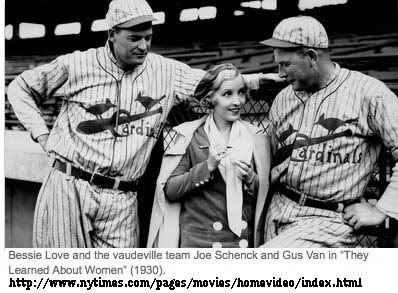
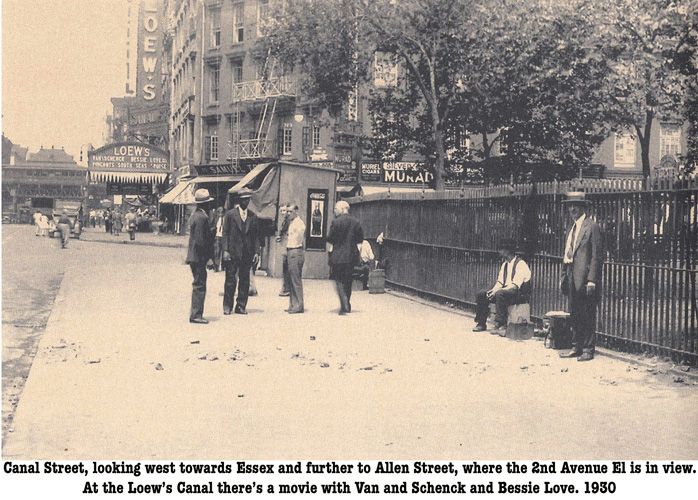
There was a mention of the DVD release of a 1930 movie with Bessie Love and the vaudeville team of Van and Schenck in the nytimes of 1/15/10. That movie played at Loew's Canal. We mentioned it back in April of last year

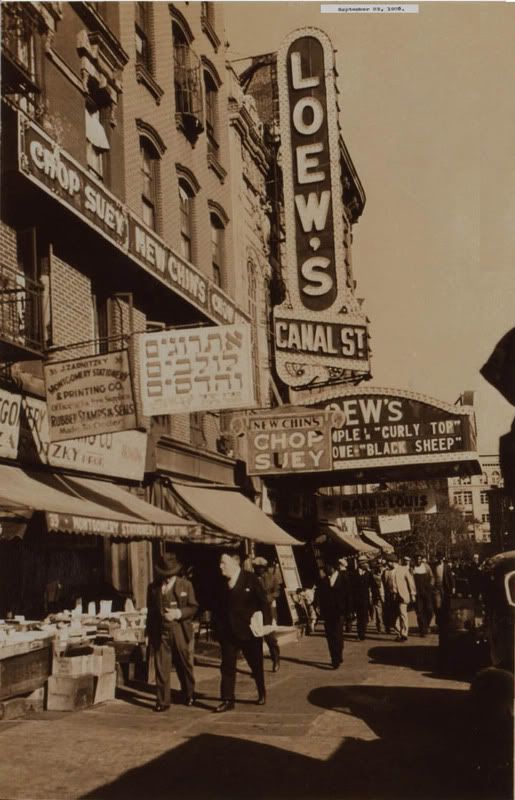
The long-shuttered Loew’s Canal Theater in Chinatown could get a new life as a performing arts center.
The proposal to fix up and reopen the 83-year-old theater is far from a done deal, but the space’s owner agreed last week to do a feasibility study.
“It would be the first theater opening in Chinatown in over a generation, probably several generations,” City Councilmember Alan Gerson said. “It’ll bolster the arts and culture of Chinatown and it will also bolster the economy.”
Gerson began fighting for a performing arts center for Chinatown after 9/11. Amid many disagreements over the future of the neighborhood and how revitalization money should be spent, a cultural center was one of the few ideas that garnered no opposition, recalled Amy Chin, president of the nonprofit leading the project’s planning.
“There’s no central gathering space, no place indoors for large-scale community events,” Chin said. “Virtually all cultural groups [in Chinatown] are operating out of spaces that are just decrepit.”
Progress on the performing arts center has been slow over the past eight years, in large part because it is difficult to find a large, available space in Chinatown. With the nonprofit CREATE in Chinatown (Committee to Revitalize and Enrich the Arts and Tomorrow’s Economy), Chin has looked into dozens of possibilities.
But no space is quite like the Loew’s Canal, at 31 Canal St. near Ludlow St. Designed by renowned theater architect Thomas Lamb, the 2,339-seat theater opened in 1926. Many of the original, ornate, terra-cotta details remain, although the seats were cleared out long ago when the theater was turned into a warehouse.
For about the last 25 years, the theater has been owned by Thomas Sung, founder of the Abacus Federal Savings Bank in Chinatown. CREATE started talking to Sung about the space three years ago and even sent Rogers Marvel Architects in to examine it.
But Sung initially had other ideas, hoping to rent the theater to a commercial tenant and build condos above. He filed plans to that effect with the city Department of Buildings during the summer, though they have not yet been approved, possibly because the city is looking to landmark the building.
But then, this week, Sung and CREATE released a joint statement saying they are committed to rebuilding the theater. In an interview Tuesday, Sung said a theater would be good for the community, especially because it would offer a central place to experience Chinese culture.
Sung said he is willing to give up the rent he could make from the ground-floor theater space, but only if he is able to use the building’s air rights to build 12 or 13 stories of condos on top. It is unclear how feasible it would be to build the condos, because they would have to be supported by the theater below, which is an open space with no columns. Sung is consulting with an engineer.
“We are very much dedicated to seeing this happen,” Sung said, “but there are always financial constraints and physical constraints.” On the chances of the theater being built, he said, “I hate to speculate.”
What's playing at the Roxy?
I'll tell you what's playing at the Roxy.
A picture about a Minnesota man falls in love with a Mississippi girl
That he sacrifices everything and moves all the way to Biloxi.
That's what's playing at the Roxy.
What's in the daily news?
I'll tell you what's in the daily news.
Story about a man bought his wife a small ruby
With what otherwise would have been his union dues.
That's what's in the daily news.
What's happening all over?
I'll tell you what's happening all over.
Guy sitting home by a television set
That used to be something of a rover.
That's what's happening all over.
Love is the thing that has nipped them.
And it looks like Nathan's just another victim.
When you see a guy reach for stars in the sky
You can bet that he's doing it for some doll.
When you spot a John waiting out in the rain
Chances are he's insane as only a John can be for a Jane.
When you meet a gent paying all kinds of rent
For a flat that could flatten the Taj Mahal.
Call it sad, call it funny.
But it's better than even money
That the guy's only doing it for some doll.
When you see a Joe saving have of his dough
You can bet there'll be mink in it for some doll.
When a bum buys wine like a bum can't afford
It's a cinch that the bum is under the thumb of some little broad.
When you meet a mug lately out of the jug
And he's still lifting platinum folderol
Call it hell, call it heaven
But it's probable twelve to seven
That the guy's only doing it for some doll.
When you see a sport and his cash has run short
Make a bet that he's banking it with some doll.
When a guy wears tails with the front gleaming white
Who the hell do you think he's tickling pink on Saturday night?
When a lazy slob takes a goody steady job,
And he smells from vitalis and barbasol.
Call it dumb, call it clever
Ah, but you can get odds forever
That the guy's only doing it for some doll
Some doll, some doll
The guy's only doing it for some doll!
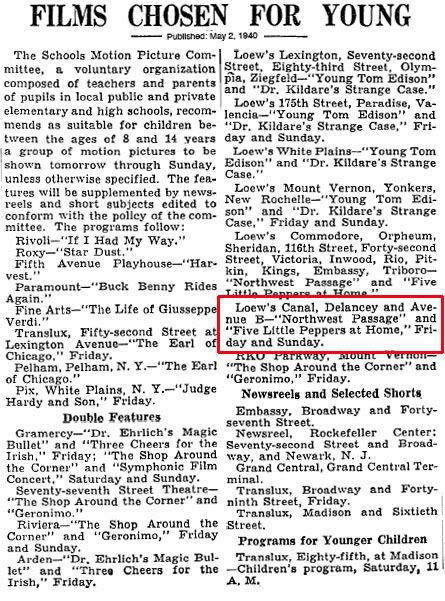
Love fared better in the comedies. The Idle Rich (1929) is a droll little film based on a stage play. She plays the kid sister in a middle-class home where the older sister (Leila Hyams) has snagged a rich husband (Conrad Nagel). The kicker is that he decides to give up his fortune and live like “ordinary” people. Once again Love is given a hysterical scene when she learns Nagel is relinquishing his millions. The Girl in the Show (1930) saw Love once again as a trouper in a traveling show. They Learned About Women (1930) saw Love teamed with Vaudeville stars Van and Schenck (who specialized in ethnic humor).

Bessie Love (September 10, 1898 - April 26, 1986) was an American motion picture actress who achieved fame largely in the silent films and early talkie era. Petite and very pretty, she played innocent young girls, flappers, and wholesome leading ladies. Besides being an actress, she wrote the 1919 movie A Yankee Princess.
Love was born Juanita Horton on September 10, 1898 in Midland, Texas. She attended school in Midland until she was in the eighth grade, when her chiropractor father moved his family to Hollywood. Bessie graduated from Los Angeles High School and then received from her parents (as a graduation present) of a trip around the United States. After six months of traveling, she finally returned home to Los Angeles.
To help with the family's financial situation, Love's mother sent her to Biograph Studios, where she met pioneering film director D.W. Griffith. Griffith, who introduced Bessie to films, also gave the actress her screen moniker. He gave her small roles in his films The Birth of a Nation (1915) and in Intolerance (1916). She also appeared opposite William S. Hart in The Aryan and with Douglas Fairbanks in The Good Bad Man, Reggie Mixes In, and The Mystery of the Leaping Fish (all 1916).
In 1922 Love was selected one of the WAMPAS Baby Stars. As her roles got larger, so did her popularity. She performed the Charleston in the movie The King on Main Street in 1925. Also that same year she starred in The Lost World, a science fiction adventure based on the novel of the same name by Sir Arthur Conan Doyle. Three years later she starred in The Matinee Idol, a romantic comedy directed by a young Frank Capra.
Love was able to successfully transition to talkies, and in 1929 she was nominated for the Academy Award for Best Actress for The Broadway Melody. She also appeared in several other early musicals including The Hollywood Revue of 1929 (1929), Chasing Rainbows (1930), Good News (1930), and They Learned About Women (1930).
However, by 1932 her American film career was declining. She moved to England in 1935 and did stage work and occasional films there. As war came in Europe she returned to the US for a while, worked for the Red Cross, and entertained the troops. After the war she moved back to Britain where she kept her main residence, and continued to play small film roles for film companies in both the US and Britain. She appeared in films like The Barefoot Contessa (1954) with Humphrey Bogart, and as an American tourist in The Greengage Summer (1961) starring Kenneth More. She also played a small role as an American tourist in the James Bond thriller On Her Majesty's Secret Service (1969).
Her career came to a quick halt soon after that however, and she moved to the United Kingdom, where she had roles in several films. She made a comeback in the 1980s with roles in Ragtime (1981), Warren Beatty's Reds (1981), and (her final film) The Hunger (1983) starring Catherine Deneuve, David Bowie, and Susan Sarandon. In her lifetime, Love starred in 131 films and TV episodes.
Love was married once, from 1929 to 1935, to film producer William Hawks (the brother of film director Howard Hawks), and she had a daughter from that marriage. She died in London, England from natural causes on April 26, 1986.
She has a star on the Hollywood Walk of Fame at 6777 Hollywood Blvd.

"Que Sera, Sera (Whatever Will Be, Will Be)" first published in 1956, is a popular song which was written by the Jay Livingston and Ray Evans songwriting team.
The song was featured in Alfred Hitchcock's 1956 film, The Man Who Knew Too Much, with Doris Day and James Stewart in the lead roles. Day's recording of the song for Columbia Records was a hit in both the United States— where it made it to number two on the Billboard charts—and the United Kingdom. From 1968 to 1973, it was the theme song for the situation comedy The Doris Day Show, becoming her signature song.
It reached the Billboard magazine charts in July 1956. The song received the 1956 Academy Award for Best Original Song with the alternative title "Whatever Will Be, Will Be (Que Sera, Sera)". It was the third Oscar in this category for Livingston and Evans, who previously won in 1948 and 1950.
There has been some minor controversy about the reputed language in the song's title and lyrics. The phrase was lyricist Jay Livingston's own variation on "Che sera sera," a fictional motto which he had seen in the 1954 film The Barefoot Contessa.


 Posts
All Comments
Posts
All Comments