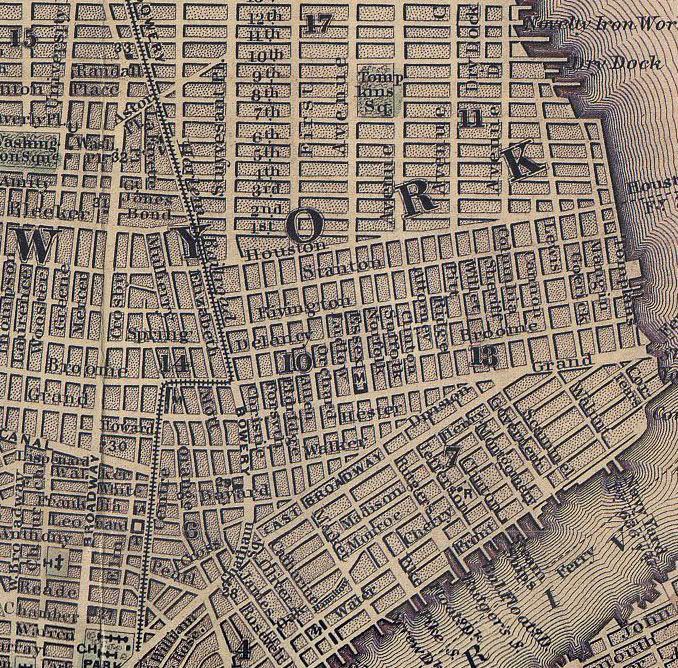
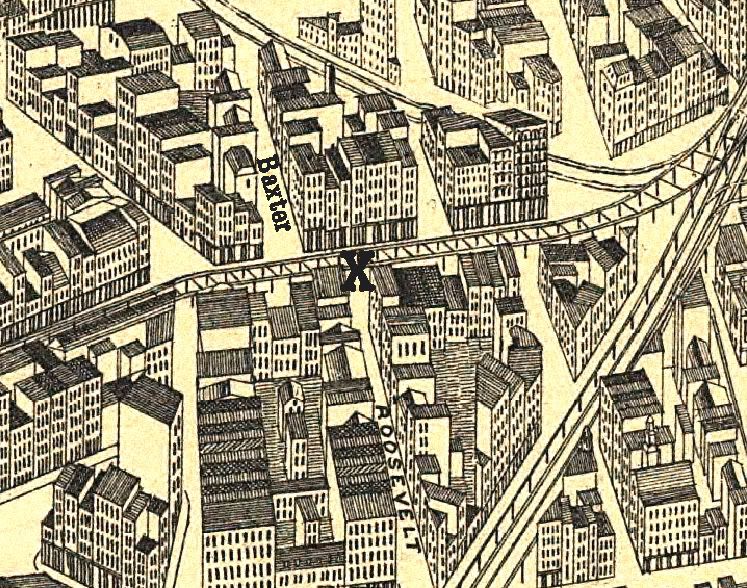
A follow up to story about Mazie told to me by Bruno in Tanahey Park last week Bruno probably lived near where the X is the top map before he moved to Knickerbocker Village. It's a section I cropped from the Galt Hoy map (circa 1900) found on the library of congress site. In the bottom section you can see the Venice Theater where Mazie Phillips (Gordon) worked.
Up in the New Old Hotel We mentioned this book and its reference to former Knickerbocker resident Mazie Phillips (or Gordon) before Recently I found a picture of the Venice Theater where she worked. I met a current KVer, Bruno, in Tanahey Park recently who remembered Mazie and remembered how she would let him sneak in to see a movie when he was kid living on Baxter and Roosevelt. That was not too far away from the theater which was located at 209 Park Row. The hotel referred to in the article, the Fulton Ferry Hotel, was right where Sloppy Louie's was on Fulton and South Street.
The following pages come from the introduction to his autobiography, "A Philosopher's Story." He mentions Mazie. White lived at 76 Madison Street! About the book and White from Amazon
A vivid tale of the author's journey from the Lower East Side of New York to some of the greatest centers of higher learning. "A happily detailed chronicle of decades at the heights of American academe, teeming with shrewd observations about the stars of Ivy League intellectual life." -Carlin Romano, The Philadelphia Inquirer "White's autobiography is a worthy addition to all collections, both for its insights into the world of university teaching and as a mirror held up to one corner of a turbulent century."-Library Journal "Although a great many memoirs are being published these days, this autobiography by Morton White has special significance because professional philosophers seldom write their memoirs and, when they do, they rarely produce books as engaging as this one. . . . Indeed, White's autobiography should attract more attention among the educated public than any book written by an American philosopher in many years."-Peter H. Hare, SUNY As historian of ideas and a philosopher, White is able to situate his life in the deeper and broader intellectual currents of his time, and therefore the story of his experiences at Columbia, Harvard, and the Institute for Advanced Study is a brilliantly conceived contribution to the history of American philosophy in the twentieth century. Readers concerned with the development of higher education will be fascinated by White's description of the struggles over religion at Harvard in the 1950s, while historians of urban life will be much interested in his vivid account of his boyhood on the Lower East Side of New York. And students of pragmatism will learn much about the twentieth-century attack on the distinction between analyt! ic and synthetic statements from a letter written to White by the Polish logician Alfred Tarski, and from the three-way correspondence of Nelson Goodman, W. V. Quine, and White reproduced in an appendix. The author's discussion of his contact with such influential thinkers as John Dewey, G. E. Moore, and Isaiah Berlin, and especially his extensive correspondence with Berlin, will further enhance the book's appeal to a broad audience. Indeed, White's autobiography should attract more attention among the educated public than any book written by an American philosopher in many years." -Peter H. Hare, SUNY Distinguished Service Professor of Philosophy and Editor, Transactions of the C. S. Peirce Society: A Quarterly Journal in American Philosophy. About the Author Morton White is Professor Emeritus at the Institute for Advanced Study in Princeton, New Jersey. Among his many well-known books are Social Thought in America (Viking, 1948), Foundations of Historical Knowledge (Harper & Row, 1965), Science and Sentiment in America (Oxford, 1972), and The Question of Free Will (Princeton, 1993).
Knickerbocker Village at the 2010 Conference on New York State History, June 4
click on picture above for conference schedule
All copyrights acknowledged. For research and educational purposes only.
June 1974
PS 177: June, 1959, Nancy with Mrs. Jonas
About Knickerbocker Village
I found that a recurring topic on my blog, Pseudo Intellectualism, would be my memories of the wonderful place I grew up in on the Lower East Side, Knickerbocker Village. I lived there from 1952-1964. There has also been an avalanche of new information coming in from my old friends through our group emails. All of this has refreshed our collective minds and I decided to shift my old posts (from the last two years) to this dedicated site as well as add new recollections. Hopefully other lost KVer's can arrive here and feel free to share as well. Note 1: Many posts are an outgrowth of history projects I did with kids while teaching on the LES. Note 2: As this blog has evolved it has also become a view of life in NYC during the 50's and 60's. You can contact me at davidbellel.mac.com.
Stewie Brokowsky R.I.P., photo by Murray Schefflin
Help In Understanding Various Blog Posts, The KV Mind Map: Click On Image Below
1847 LES Ward Map Section: A Geographic Tool For Locating Blog Posts
Click For A Better View
Deep Thoughts
#1. Annie Dillard talks about her fascination with science and minerals in particular. Then she goes on to details anecdotes concerning various Americans who became obsessed with the possibility of discovering valuable or interesting mineral deposits or rock formations within or close to their home environments. She speaks about men - almost all these scientific minded people are male - who discover veins of coal, copper, bauxite, and so on. She depicts the ordinariness of their fascination and the fact that it tapped into the extraordinary. Like nature had these incredible finds waiting to be unearthed all around. People who could see the worth of what was all around them or, in some cases, beneath them, excavated and found, just beneath the surface of their obsessive preoccupations, depths of riches and fascination. So in exploring the history of KV we go back into what had been the ordinary and find it layered in a criss-cross of historical significance. A transmutation of the lung block, redeemed as a bold social experiment tinged with ambitions as immodest as a revolution and as commonplace as sandwiches - ordinary though it may be but still - the most delicious sandwiches of the twentieth century. Buried beneath the surface of the KV heritage are connections to so may aspects of our culture and NYC's greatness as to be not only unfathomable but irrefutable. Do you know what I'm saying here?
Son Of Salvatore
FAQ's: Click On Image
KV Honorary Members (And Their Corresponding Sponsors)
Tim Russert-Mark
George Carlin-Allan
Paul Newman-David
Pete Seeger-Bob
John F. Kennedy Jr.-Joe
To be is to do - Plato To do is to be - Socrates Do be do be do - Frank Sinatra
Yes. I was thrown out of the Canal theater a number of Saturdays for rolling on the floor, in the aisles laughing. I think one of the movies that prompted my gaiety was "Psycho" - the shower scene. What can I tell you? I guess I wasn't tuned into the mood. At the time. Also saw many rock and roll movies at the Canal, Elvis films and the Murray the K fests. Saturday I often would go there with Joey Maldonado and his cousins. We would load up on candy by the quarter pound from that obscure bakery that was just around the corner on Madison Street, quarter block from Catherine - around the corner from the Brokowsky's fruit store, Gogol's and the pharmacy on the corner. Next to the newstand. Remember? By the bus stop. See what I'm saying? (In your mind, can you see it?) Bakery had golden and tan tile design but couldn't hold a candle to Savoia. No marble floors either.
guest memorist Howie: the first movie I ever went to was at the Tribune Theatre (near City Hall, now by the site of Pace University), a Disney cartoon 'Lady and the Tramp', also remember going there with Ronnie, David and maybe Paul, think it was '62 to see 'Safe at Home' starring Mickey Mantle and Roger Maris....I saw 'The Time Machine" with David at the Canal theatre in 1960 (academy award to George Pal - special effects), we were so taken by the notion of time travel that we proceeded to go home and build a time machine...somehow we got hold of some wood, nails, rope and wheels..after a couple of days the time machine started to take shape although it looked remarkably like a pretty decent scooter so we decided it needed a safe haven and hid it in a pit on Monroe St...one that we were able to climb...on the third day the time machine was stolen from the pit...we never saw it again...probably in the year 3000 by now..
guest memorist Neal Hellman on BLT's (the non Ref Luncheonette variety) A great B.L.T. is a complex eatable symphony. One in which all the parts maintain their individuality, yet at the same time, surrender their tasty nuances in the true spirit of gastronomic gestalt and dwell as one.This equinox I choose Sumano's Bakery Ciabatta bread. Though I was skeptical about it's naked, pale texture, I felt it would toast up well and its many crevices would add some fun places for the mayo to go.With the mayonnaise choice I have to stay with tradition and of course go with Hellmann's though for some reason it's known west of the Mississippi as “best foods”. Please do not waste my time with this hippie safflower oil concoction or some other type of healthy alternative. For when it comes to mayonnaise for my Ultimate B.L.T. there is no east or west, there is only Hellmann's…. case closed. My ingredients are now all together, but the intense work has just begun. For now without the correct timing and the correct application of all the ingredients, my ritual could easily plummet into a spiritual abyss. All ingredients must sit together (as one) at room temperature as I invoke the spirit of all the great B.L.T. makers in all the luncheonettes in the greater metropolitan area of New York. I heat my cast iron skillet (using a Teflon pan would be heresy) to a comfortable medium heat. I lay the bacon down 4 strips per sandwich and as I do the strips greet the metal with a friendly sizzle “hello”. As they are slowly cooking I cut the tomato's, neither too thin or too thick and lay them down ever so gently on a plate to await their glorious marriage. The lettuce has been carefully washed and spun with all traces of ribs removed. The mayonnaise jar is open and waiting to join this eatable canvass. Once the bacon is turned the toast swings into action. It has to be brown all the way but with no traces of crusty darkness.As the toast is finishing I remove the bacon and pat it down with a paper towel. Now it's time to assemble my edible equinox creation. Mayo on both pieces of toast, then the tomato's and I prefer the lettuce between the tomato and the bacon, for I feel it's texturally more secure that way. I don't want an immediate confluence of tomato and bacon; I like the lettuce to work as a buffer. Here's where many folks really go askew: they push the bread down so hard that the bacon is crushed. No, no a thousand times no. One must gently, ever so gently caress the concoction together. After which one will take a sharp knife and make a diagonal cut. A straight cut is what people from small towns in Nebraska and Ohio do. Those of use who are members of the B.L.T. illuminati always make a diagonal cut. The masterpiece will then be placed on a plate and then consumed in a way as to enjoy the warm and crunchy (yet still pliable) bacon, the exploding sensation of a dry farm Molino tomato, the juicy lettuce, the condiment-ing mayonnaise and ever so supportive bread. My first Ultimate B.L.T. goes to my neighbor for her birthday. With that offering I realize now that I am truly invoking the Japanese Equinox celebration of Hign-e. Yes with my ultimate B.L.T. offering I am illustrating the six perfections: perseverance, effort, meditation, wisdom, observance of precepts, and giving.
KV Journeyman
11/13/07: Even standing in the cold rain, the Baroque facades on these buildings are fantastic. Brussels has some of the best architecture in the world, all types, all styles. Standing in the middle of the main town square one is overwhelmed with the magnitude of detail and size.
11/14/07: I am currently in Brugge in NW Belgium. It appears to be a quiet town with all old and small buildings, perhaps pre-Victorian, with a network of canals similar, but without the gondolas and singing rip-off-the-tourist gondoleers. I'll learn more tomorrow as we get a tour prior to dinner.
12/5/07: Just finished a fresh grilled tilapia sandwich while sitting outside looking at the expansive white sands of Clearwater Beach and the far reaches of the Gulf of Mexico, realizing I am flying back to DC tomorrow morning into the remnants of the latest Alberta Clipper to wreak havoc on the Nation's Capitol. Enough to upset the strongest and staunchest among us.
Time Magazine: 10/15/1934
Smack in the middle of the slum-mulligan of Manhattan's lower East Side two barefaced, rectangular apartments rear their bricks twelve stories into the air. Jointly christened Knickerbocker Village, they cover four whole city blocks. Between the two units is a concrete playground, and within each will be a garden. Each of the 1,593 apartments has wooden parquet floors, electric refrigeration, tiled bathrooms, outside windows. The elevators are self-operating. Rentals range from $22.50 for 2½ rooms on the ground floor to $87.50 for a 5½-room penthouse. Average is $12.50 a room. Knickerbocker Village will cost about $9,000,000, and with the exception of Rockefeller Center is the only large structure which Manhattanites have noticed abuilding these last two years. Last week it was ready for occupancy.
Because Knickerbocker Village is also Manhattan's first experiment in government-financed, low-cost housing, RFC's Chairman Jesse H. Jones, East-Sider Alfred E. Smith, many a minor wig gathered in its banner-decked playground to mark the day. Said Al Smith: "I was tempted to swap the Empire State Building." Chairman Jones thumped the tub of slum clearance. Informed that the first of the two units was already 95% rented, while the second unit (to be opened Dec. 1) was 50% rented, he waved an expansive hand at the holiday bunting, declared: "I know of no ... safer investment for public funds than to clear about 500 acres of your slums."*
Whether or not Knickerbocker Village was a fitting inspiration for such official rejoicing was last week a red hot sociological question.
In 1929 Realtor Fred Fillmore French began buying land on the lower East Side. By swearing his 42 brokers to secrecy and using dummy corporations, he managed to get some 15 acres for $5,000,000. Then in 1931 he announced a grandiose scheme for the erection of a $50,000,000 development for junior Wall Street executives. At this point he found that he could not get credit. At the same time Fred F. French Operators, Inc. began passing its dividends on $14,000,000 of preferred stock. The project remained only a scheme with a staggering upkeep in land taxes.
When Congress authorized the RFC to make loans on slum clearance projects, Realtor French picked out the worst block in his holdings and ecstatically presented it to Mr. Jones as a worthy subject for clearance. His choice was "Lung Block," so called because of its high tuberculosis mortality rate. On it lived 650 families. In its backyards were seven jakes. On this fester Mr. French proposed to build a low-cost housing project. Mr. Jones agreed to do business, and RFC lent 85% of the required $9,000.000.
Average cost of "Lung Block" to Knickerbocker Village was high: $3,116,000, or $14 per square foot. The tax assessment was therefore reduced by two-thirds to bring the monthly room rental down to the $12.50 stipulated by the RFC. Because the average rental on "Lung Block" had been about $5 a room, Knickerbocker Village remained a low-cost housing project only in the minds of the white collar workers, who proceeded to fill it.



 Posts
Posts