Showing posts with label parks. Show all posts
Showing posts with label parks. Show all posts
Tuesday, April 27, 2010
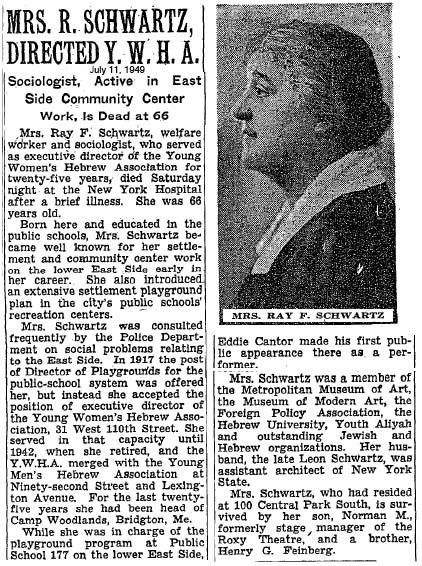
July 11, 1949: Mrs. Ray Schwartz, Former Playground Director Of PS 177 Passes Away


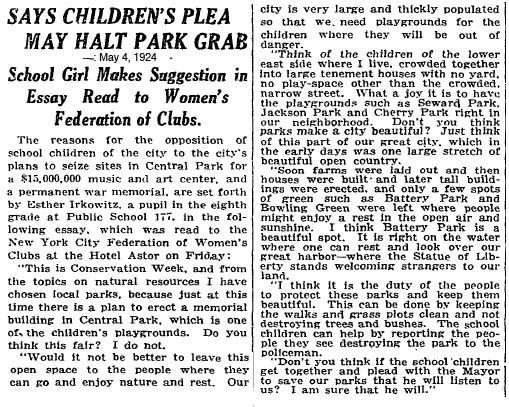
May 4, 1924: Esther Itzkowitz Of PS 177 Writes To Save Central Park Playground
Friday, March 5, 2010
Ahearn Park
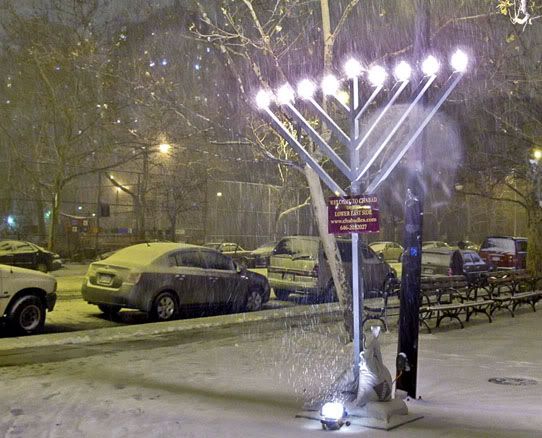
from nycparks
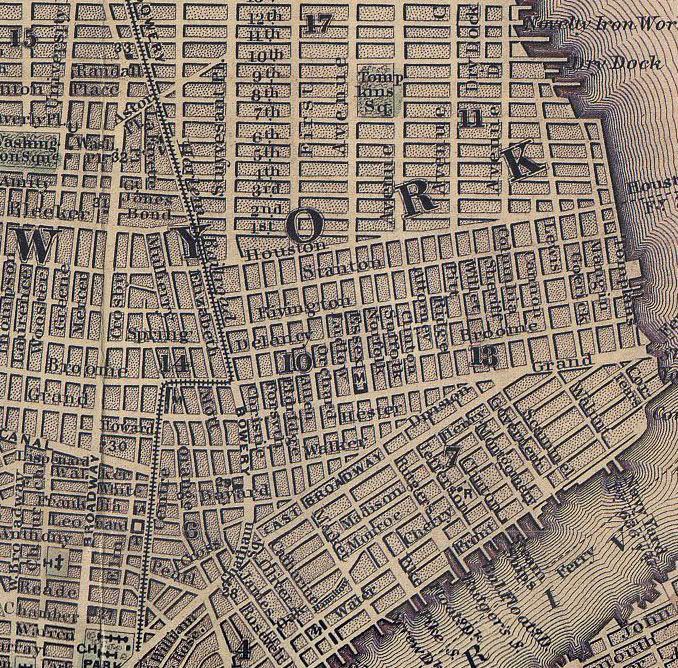
This small Lower East Side park is one of New York City’s oldest. On August 2, 1824, the Common Council agreed to take a triangular piece of land between Grand, Harman (now East Broadway), and Scammel Streets as a public place. The City acquired the parcel by condemnation the following year for $3158.23.
In 1870 all of New York’s public parks, from small public squares in Lower Manhattan to the not-yet-complete Central Park, were placed under the control of the newly created Department of Public Parks. Sweeping improvements were initiated immediately. Between 1871 and 1872, Grand Street Place (as this park was then known) was surveyed and received new lampposts, plantings, curbs, water and drain pipes, and an iron railing. It was one of fourteen New York parks that featured a program of music and fireworks on Independence Day in 1873.
By the early 1910s, this site was known as Oriental Park. According to Department of Parks Annual Reports from 1911 and 1913, several trees were removed and replaced with four European lindens, three Norway maples, and eight Oriental plane trees. In 1923 the Board of Aldermen named the park for John Francis Ahearn (1853-1920), a Tammany Hall sachem who rose to power around the turn of the century. Ahearn’s leadership style was marked by his intense political game-playing and by his devotion to the personal needs of his constituents.
Born in New York City, Ahearn was educated at public schools and worked as a business clerk. He served one term in the State Assembly, from 1882 to 1883, and five terms in the State Senate, from 1890 to 1902. Senator Ahearn championed the interests of firemen, policemen, and school teachers. Elected Manhattan Borough President in 1903, he was the subject of a damaging report made by Commissioner of Accounts John Purroy Mitchel to Mayor George McClellan. Without accusing Ahearn of personal dishonesty, Governor Charles Evans Hughes denounced Ahearn’s administration as flagrantly inefficient and wasteful, and he removed Ahearn from office. The Board of Aldermen then selected Ahearn in 1907 to fill his own vacancy. After a legal struggle, Mayor McClellan removed Ahearn from office just before the end of both of their terms in December 1909. Ahearn died in his home at 296 East Broadway in 1920.
Ahearn Park assumed its present dimensions in the early 1960’s. A portion of the property was eliminated by the widening of Grand Street, and two parcels to the west were transferred to Parks and incorporated into the site. The park was renovated in 1998 under a $83,000 requirements contract funded by Mayor Giuliani. Improvements included installing new world’s fair benches, resetting the Belgian block, repaving the park and sidewalks, and creating a planted area enclosed by a steel picket fence. The renewed Ahearn Park is an enduring oasis in the Lower East Side.
Friday, September 18, 2009
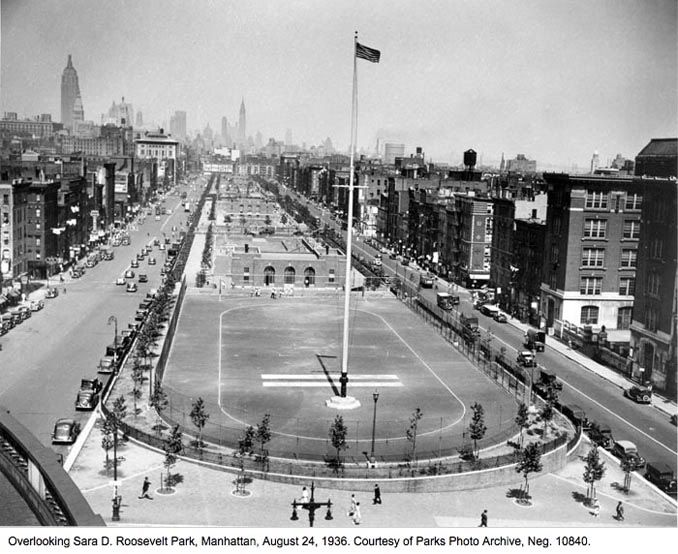
Sara Delano Roosevelt Park: Now And Then
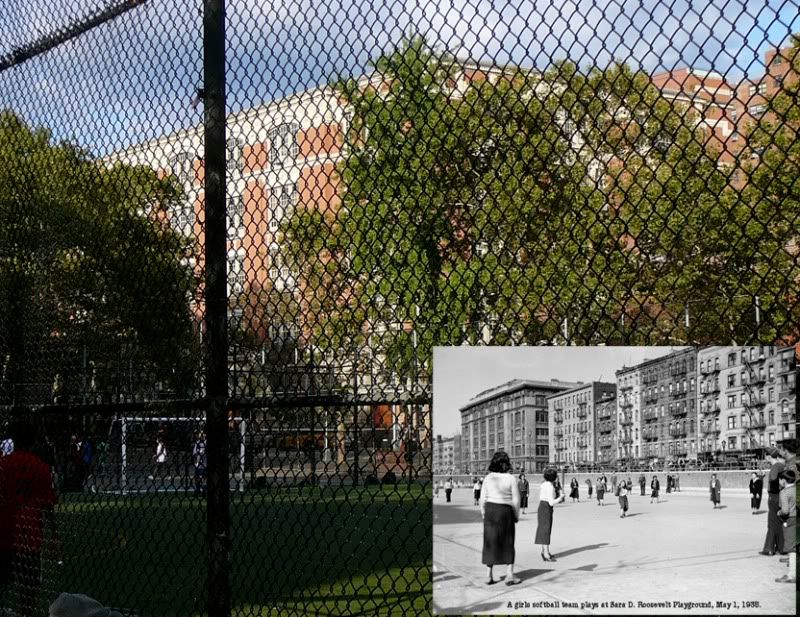 I tried my best to match up the scene from the last post. Soccer and basketball now reign in the park, not softball.
Tuesday, April 28, 2009
"Falling" In The KV Playground: 1945
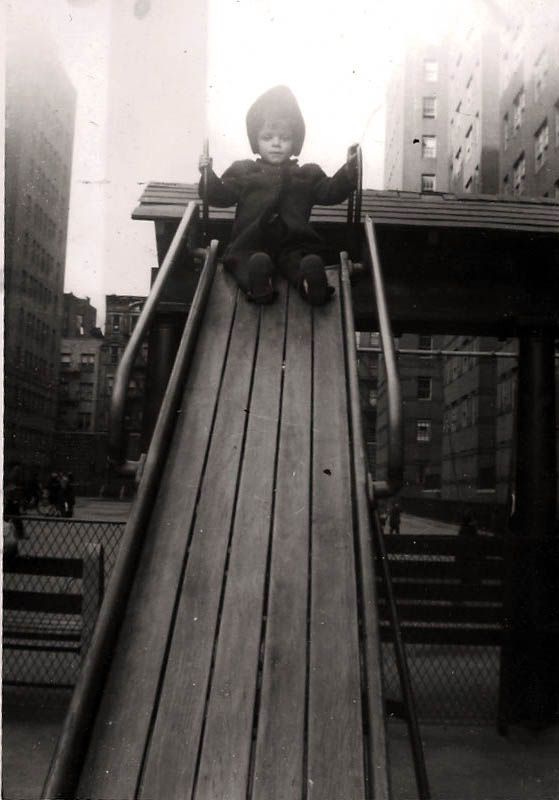
Back in those day there were wooden slides. A gem courtesy of Zamira Portnoy
Monday, April 20, 2009
Sophie Loeb: The Namesake Of Sophie Loeb Park
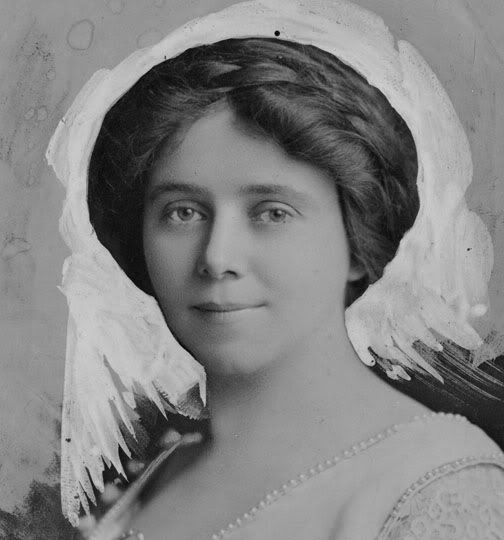
It's on the east side of Market Street, between Henry and East Broadway
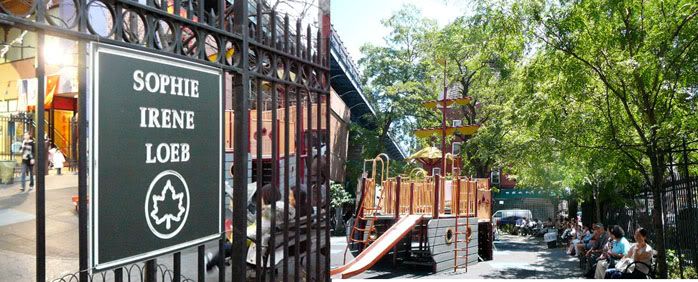
In addition to the park above, there's a fountain in Central Park named after her. from wikipedia:
Sophie Irene Loeb (July 4, 1876, Rovno / Rivne, Volhynia, Russia (now Ukraine) - 1929) was a US journalist and social-welfare advocate.
She was born Sophie Irene Simon.
She was the president of the Board of Child Welfare of New York for seven years, and in 1921 she established the first child welfare building. In 1924, she became president of the Child Welfare Committee of America.
SOPHIE IRENE LOEB FOUNTAIN
James Michael Levin Playground, Central Park
Frederick George Richard Roth (1872–1944) created this decorative, reinforced concrete drinking fountain inspired by Lewis Carroll’s children’s story Alice in Wonderland (1865). The fountain commemorates newspaperwoman and social worker Sophie Irene Loeb (1876-1929), who was the founder and first president of the Child Welfare Board of New York City. Loeb is recognized in this context for her support of recreational opportunities for children in Central Park.
In 1926 philanthropist August Heckscher (the grandfather of the Parks Commissioner of the same name) pledged funds to create what would become later known as James Michael Levin Playground. Loeb campaigned fervently for the construction of the playground and was appreciated by the Parks community for her efforts. The fountain was commissioned by Parks when it rebuilt the playground in 1935, and it was dedicated in 1936 in Loeb’s memory. Roth is well known for his animal sculptures and limestone reliefs that appear in and around both the Central and Prospect Park Zoos. Some of his well-known works include Dancing Bear and Dancing Goat (both 1937) at the Central Park Zoo and Balto (1925), also in Central Park.
Born in Russia, Sophie Irene Simon immigrated with her family to the United States when she was six years old. Soon after settling in Pennsylvania, Loeb’s father died, leaving the family with no means of support. As the eldest of six children, sixteen-year-old Sophie was forced to work in a store to help her mother support their large family. These financial struggles prompted Loeb’s later concern for social reform and welfare.
After graduating from high school, Sophie began teaching young children. In 1896, she married Anselm Loeb, a storeowner and her former employer. Marriage freed Sophie from teaching and allowed her to pursue other interests such as art, poetry, and writing. Her writing came to the attention of several publishers, including those at the New York Evening World. In 1910, Loeb moved to New York City after divorcing her husband. Keeping the surname Loeb, she began working at the Evening World as a reporter.
Loeb focused her journalistic and social attentions on welfare for widowed mothers. New York City had struggled for years over the idea of civic versus state economic relief for “destitute mothers.” The City maintained homes for children of widowed mothers, but many women refused to send their children to these homes, leaving them to the mercy of private charities. Believing that private aid was insufficient, Loeb sought state relief as well. She wrote several articles that argued for the establishment of such a system, and worked closely with Hannah Bachman Einstein, who founded the Widowed Mothers’ Fund Association in 1909. Elected President of the New York City Welfare Board in 1923, Loeb helped to found the Child Welfare Committee of America in 1924. She also fought for immigrant use of New York City schools as civic centers; and the cleaning and fireproofing of movie theaters; installation of public baths; funding of school lunches, and support for housing reform.
Ten years after Loeb’s death, Congress amended the Social Security Act of 1935 to include provisions for the protection of widows and children of laborers. Although she died childless, Loeb nevertheless was known as the “godmother of American children.”
Monday, December 3, 2007
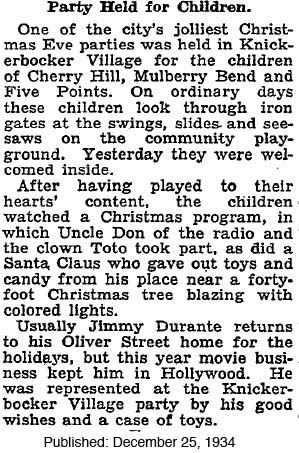
Knickerbocker Village: Christmas Party 1934
I never quite understood what the open space between the two KV courts was all about.
In my days, 50's-60's, it was unused, a waste of space. Evidently early on it was an active "gated" playground to keep out the riff raff. This article clued me into that.
A party given for neighborhood kids featuring an appearance by Uncle Don of radio fame and presents from Jimmy Durante.
 The slide show above contains an Uncle Don jingle and related images. Tanahey Park on Cherry Street wasn't built until 1949. At that point the courtyard park was probably mothballed. BTW, there's an urban myth about Uncle Don. Evidently it's untrue:
The affable host finished telling his last story of the day, wished a good night to all the children in his audience, and sang his familiar sign-off ditty. As the station went to a commercial break, he leaned back in his chair, sighed, and said to no one in particular, "There, that oughta Uncle Don hold the little b.......!" Unfortunately for the ill-fated host, the engineer was late in cutting to the station break, and the host's disparaging remark was picked up by the still-open microphone and broadcast into millions of homes. The station was immediately flooded with thousands of telegrams from outraged listeners, and the humiliated host was fired before the day was out, never to broadcast again. Disgraced beyond redemption, he lived out the rest of his life in obscurity and died, an impoverished drunk, several years later.
Everyone has heard this story. And almost everyone who has heard this story has a friend or relative (a parent or grandparent, perhaps) who remembers actually hearing the infamous broadcast. At the very least, most everyone knows someone who recalls the national uproar caused by the incident, or who remembers reading about the firing of the hapless host in the newspaper. Very few of the people who recollect this event could tell you the name of that unlucky host, however, or recall the year the notorious broadcast took place. And even if you managed to find a few individuals who could supply some of these particulars, you probably wouldn't get the same answers from any two of them. How is it that so few people can provide any specifics about such a widely-known incident? Why do so many people unquestioningly accept accounts of this event as true, in spite of all the disparities and missing details? The answer is that this tale is one of the most well-known pieces of modern folklore — it is a classic among urban legends, and legends don't stand on detail. For the benefit of those who do have an interest in detail, however, let's take a closer look at this legend's background.
More on the story can be found here
Subscribe to:
Posts (Atom)


 Posts
Posts