Showing posts with label civil war. Show all posts
Showing posts with label civil war. Show all posts
Friday, May 7, 2010


A LES Shaw, Not Artie
Shaw Kindergarten
The Shaw Memorial kindergarten referred to was at 61 Henry Street. It was part of the Church of Sea and Land. It was established by the Shaw family in memory of their
civil war hero son Robert Gould Shaw who was portrayed by Matthew Broderick in the movie Glory
About the Shaw's
The Shaw Memorial kindergarten referred to was at 61 Henry Street. It was part of the Church of Sea and Land. It was established by the Shaw family in memory of their
civil war hero son Robert Gould Shaw who was portrayed by Matthew Broderick in the movie Glory
About the Shaw's
Francis George and Sarah Blake (Sturgis) Shaw, were Unitarian philanthropists and intellectuals who encouraged their five children to study, learn and become involved in their communities. They lived for some years in France and Italy, and then settled on Staten Island. Their daughter Josephine Shaw Lowell was an activist and their son Robert led the 54th Massachusetts Regiment in the Civil War
Tuesday, April 13, 2010
The Colored Seamen's Home On 2 Dover Street: 1863
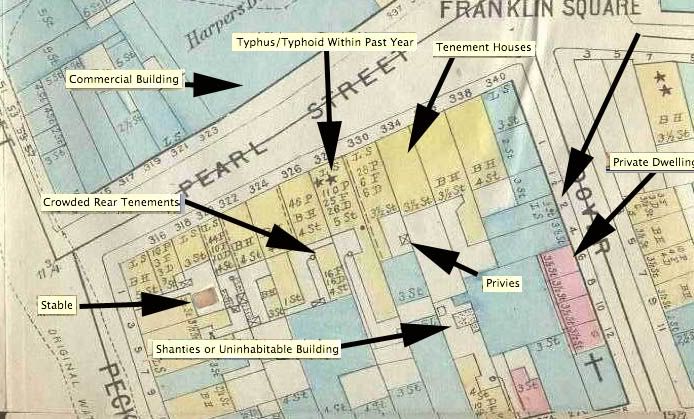
Excerpts from "The Reign of the Rabble," New York Times, Wednesday, July 15, 1863
In Roosevelt-street, near Pearl-street, about 4 p.m., an immense crowd reassembled, and it was evident that they required but a spark to enkindle the most angry passions. The character of the population in that vicinity is one well calculated to take the most active and energetic part in the general riot. Several negro habitations have been entirely demolished in that neighborhood, and the poor tenants turned into the streets helpless. The poor creatures look perfectly bewildered -- they are unable to designate between friend or foe. Many have lost all they ever had in the world, and some of them may become charges on the county. The crowd carried away the weather boards, and every part of the negro habitations that can be detached to make firewood of......
At 6 o'clock P.M., the building, No. 64 [probably a typo for 74 --ed.] and 76 Roosevelt-street, occupied by Mr. BEVERLY as a colored seaman's boarding house, was attacked by the rioters. The inmates were taken from the premises, which were robbed and then set on fire. WILLIAM ARMSTRONG, WM. HEATH and THEODORE TURNER, all boarding there, were badly beaten. They were sent to the New-York Hospital.
The colored boarding house of ALBRO LYONS, No. 20 Vandewater-street, was attacked by the rioters about 6 1/2 o'clock P.M., the doors broken open and the windows entirely demolished; nine of the inmates were injured.
A man named JAMES SCOTT, aged 40 years, residing at No. 81 Roosevelt-st., in the rear, was badly injured by the rioters; he was taken to the hospital.
About the same time THOMAS JOHNSON, a colored man, had one of his arms broken by jumping from the third story window of a house No. 62 Roosevelt-street, while the house was on fire. He was rescued from the rioters by the police and was taken to the station-house .
WILLIAM W. HILL, also colored, was dangerously injured by leaping out of a third-story window of the same house.
MARY WILLIAMS, a colored woman, 24 years old, while being pursued by the infuriated mob, jumped from a window of No. 74 Roosevelt-street to the pavement, and was terribly injured -- the building was then on fire. She was taken to Bellevue Hospital.
About 7 o'clock P.M. the house No. 2 Dover-street, occupied by WM. P. POWELL, as a Colored Seamens' House, was attacked by the rioters, the doors and windows broken, the occupants driven out and the furniture destroyed. The occupants were rescued by the Police and taken to the Station-house for safety.
At 6 o'clock P.M. the house No. 11 James-slip, occupied by JAMES E. VALENTINE as a liquor store, was attacked by the riotous mob in consequence of a colored woman taking refuge there; she escaped when the rioters entered the place, who stole and destroyed all the contents.
The mob took an iron safe from the store of Mr. BEARELY [Beverly?], No. 74 Roosevelt-street, and Officers PENDERGAST and SWEENY, of the Fourth Ward, took it from them.
About 3 o'clock P.M., a mob of from five to seven hundred persons commenced an attack on some colored persons, in Baxter-street, near Park [in the Sixth Ward]. They then went to the dining saloon of Mr.. CROOK, Chatham-street, to beat the colored waiters. Capt. JOURDON, sergeants WALSH and McGIVEN, with a platoon of men, were promptly on hand and dispersed the crowd. They then left for the Fourth Precinct. Mr.. CROOK was compelled to close his place [and] no persons were assaulted or injured there.
At 5 o'clock P.M., a colored woman named ELIZABETH HENNESSY, while standing at the corner of Mott and Pell streets [in the Sixth Ward], was struck on the head by an unknown ruffian, receiving a severe wound. She was taken to the New-York Hospital.
A gang of nearly 500 rioters attacked the colored people residing at Nos. 104 and 105 Park street [in the Sixth Ward], drove them into the street, assaulting them with stones and other missiles; the Sixth Ward Police rescued the blacks, and took them to the station-house. Capt. JONEDON, Sergts WALSH, QUINN, and KENNEDY, with a force of men, soon dispersed the mob.
JOHN BROWN, a colored man, 40 years of age, of No. 74 Roosevlt-street [sic], was attacked late at night in the own [sic] house by a mob, and severely beaten about his head and face. He escaped from the ruffians and ran to the station-house for protection.
Sunday, October 25, 2009
Saturday, October 24, 2009
Fourth Ward Civil War Draftees
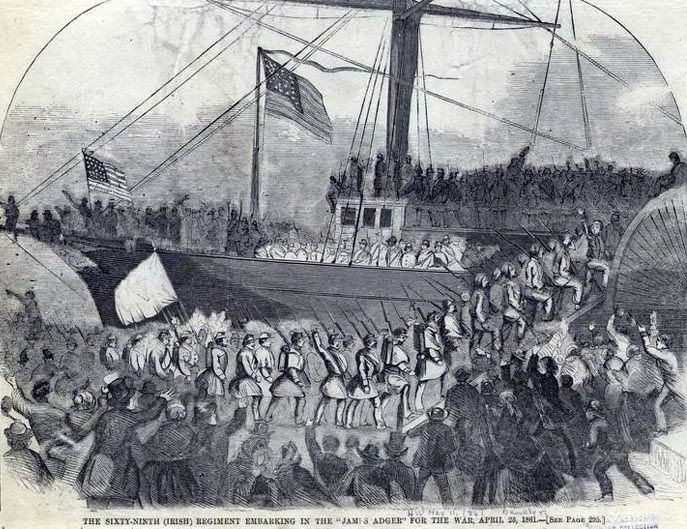
Many of them probably fought in the Irish Brigade, the Fighting 69th Regiment.
From Peter Baldwin's great Fourth Ward site
Civil War Draftees
From Peter Baldwin's great Fourth Ward site
Civil War Draftees
Garry Owen And The Irish Brigade And The Fourth Ward
The Irish Brigade was an infantry brigade, consisting predominantly of Irish immigrants, that served in the Union Army in the American Civil War. Many of them came from New York's Fourth Ward. The designation of the first regiment in the brigade, the 69th New York Infantry, or the "Fighting 69th", continued in later wars. The "Fighting 69th" adopted Garry Owen as their song.
They Died with Their Boots On is a 1941 western film directed by Raoul Walsh and starring Errol Flynn and Olivia de Havilland. Despite being rife with historical inaccuracies, the film was one of the top-grossing films of the year, being the last of eight Flynn-de Havilland collaborations.
The film follows the life of George Armstrong Custer (Errol Flynn) from attending West Point, wooing of Elizabeth Bacon (Olivia de Havilland) who becomes his loving wife, the American Civil War, and the Battle of Little Big Horn. In the film, the battle is blamed on unscrupulous corporations and politicians craving the land of Crazy Horse (Anthony Quinn) and his people.
Custer is portrayed as a fun-loving, dashing figure who chooses honor and glory over money and corruption. Though his "Last Stand" is probably treated as more significant and dramatic than it may have actually been, Custer (Flynn) follows through on his promise to teach his men "to endure and die with their boots on." In the movie's version of Custer's story, a few corrupt white politicians goad the Western tribes into war, threatening the survival of all white settlers in the West. Custer and his men give their lives at Little Bighorn to delay the Indians and prevent this slaughter. A letter left behind by Custer absolves the Indians of all responsibility.
...The character of "Queen's Own" Butler, while English, is essentially a composite of two real-life officers who were from other parts of the British Empire: Canadian William W. "Queen's Own" Cooke, and Irishman Myles Keogh, who is linked to an apocryphal account of introducing the song "Garryowen" to the 7th Cavalry.
the origins of Garryowen are unclear, but it emerged in the late eighteenth century, when it was a drinking song of rich young roisters in Limerick. It obtained immediate popularity in the British Army through the 5th (Royal Irish) Lancers, who were garrisoned in Limerick and was played throughout the Napoleonic War, becoming the regimental march of the 18th Foot (The Royal Irish Regiment).
Garryowen became the marching tune for the 69th Infantry Regiment, New York Militia, (the famed "Fighting 69th" ) in the mid-1800s. The "Fighting 69th" adopted Garry Owen before the Civil War and recently brought it back to combat in Operation Iraqi Freedom
It later became the marching tune for the US 7th Cavalry Regiment during the late 1800s. The tune was a favorite of General George Armstrong Custer and became the official air of the Regiment in 1867. According to legend it was the last tune played before the Battle of the Little Bighorn.
The name of the tune has become a part of the regiment, the words Garry Owen are part of the regimental crest, and there is a Camp Garry Owen, north of Seoul, Korea, which houses part of the 4th Squadron of the regiment.The Seventh Cavalry regiment became a part of the US 1st Cavalry Division in 1921, and "Garryowen" became the official tune of the division in 1981.
The word garryowen is derived from Irish, the proper name Eóghan ("born of the yew tree") and the word for garden garrai - thus "Eóghan's Garden". The term refers to an area of the town of Limerick, Ireland.
Instead of spa, we'll drink brown ale
And pay the reckoning on the nail;
No man for debt shall go to jail
From Garryowen in glory.
2. We are the boys who take delight
In smashing Limerick lamps at night,
And through the street like sportsters fight,
Tearing all before us
Chorus
3. We'll break the windows, we'll break down doors,
The watch knock down by threes and fours,
And let the doctors work their cures,
And tinker up our bruised
Chorus
4. We'll beat the bailiffs out of fun,
We'll make the mayor and sheriffs run
We are the boys no man dares dun
If he regards a whole skin.
Chorus
5. Our hearts so stout have got us fame
For soon 'tis known from whence we came
Where'er we go they fear the name
Of Garryowen in glory.
Chorus
They Got Caught With Their Watch On
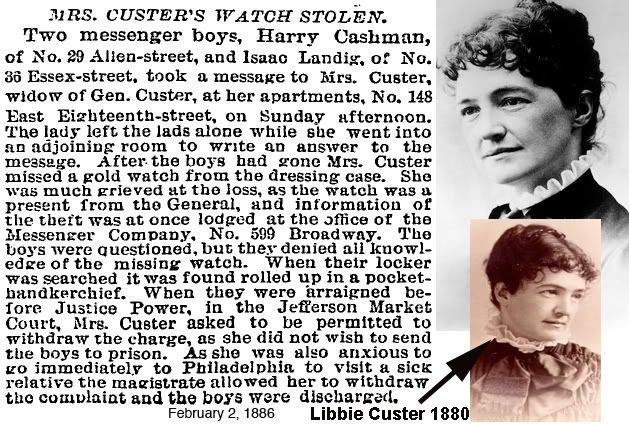
from Civil War Women
...After Custer's death, Libbie moved to New York, where she sought work to supplement her small widow's pension. She wrote three books about their life at frontier posts in order to ensure that Custer's memory would always be honored. In Boots and Saddles: Life in Dakota with General Custer, published in 1885, she describes her life from 1873 to 1876, and compellingly presents the shared anxiety of wives left at Fort Lincoln while their husbands fought and died at Little Big Horn.
In Tenting on the Plains: General Custer in Kansas and Texas (1887), she describes her experiences following General Custer in Kansas and Texas from 1865 to 1867. Insects, illness, and scorpions dominate her recollections of the march to Texas, and her Kansas memories include prairie fire, flood, and cholera.
In 1890, Libbie published her last book, Following the Guidon, in which she picks up the story when her husband returned to duty in Kansas in 1868 to join the campaign culminating in the Battle of Washita. She vividly recalls her fearful visits with captured Native Americans and tribal peace council delegates, while glorifying her husband's honest treatment of those he helped defeat.
Throughout her 57 years of widowhood, Mrs. Custer worked untiringly to defend her husband's reputation and transform him into a hero. She influenced a number of writers, and in all her works, her husband emerged as an exemplary son, brother, husband, and conscientious commanding officer. Since the army and the public saw Libbie as a model wife and a devoted widow, many Custer critics withheld their comments during her lifetime.
Known throughout her life for her undying devotion to her husband, Libbie was the only officer's wife to live in a tent on the edges of a Civil War battlefield, ride in the ranks with the soldiers, and accompany the 7th Cavalry on many of its expeditions. During those adventures, she wore her own uniformed dresses to show her dedication to her husband and the US Army.
Libbie Bacon Custer remained utterly devoted to her husband and never remarried. She died at her home in New York City on April 4, 1933, a few days before her 91st birthday. She was buried at West Point Military Academy next to her husband. They had no children.
Subscribe to:
Posts (Atom)


 Posts
Posts