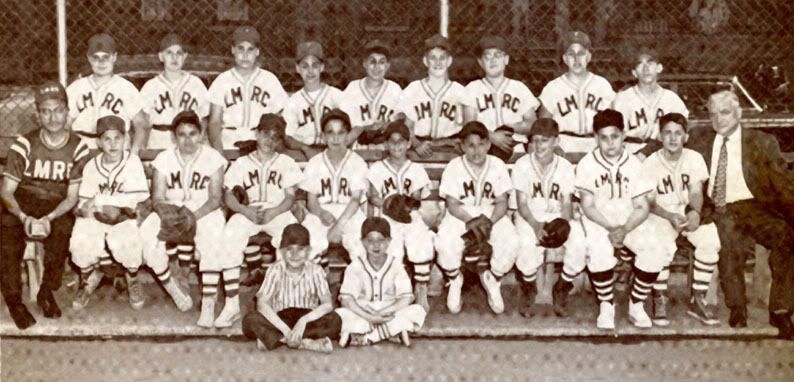
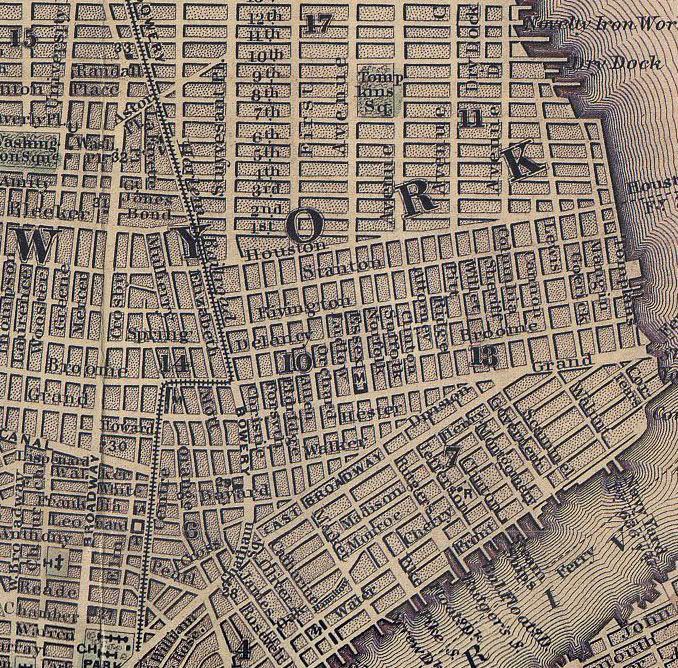
st.joachim
Note that the women who were poisoned were employed at the Cherouney Printing Plant on Vanderwater Street. At that time the Fourth Ward had many factories and blue collar jobs.
Showing posts with label St. Joachim. Show all posts
Showing posts with label St. Joachim. Show all posts
Sunday, November 29, 2009


Mary Malchiodi Of The Fourth Ward: Part 4
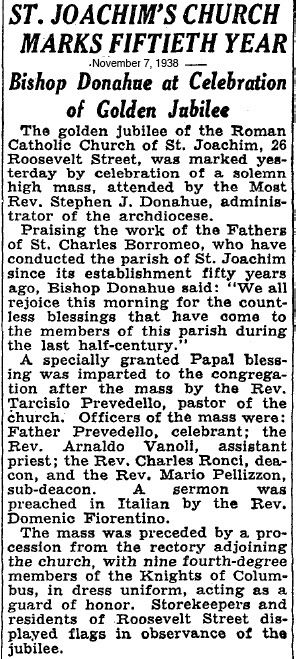
More on the Church of St. Joachim and the Congregation of Missionaries of St. Charles Borromeo
(Roman Catholic)
26 Roosevelt Street, New York, N.Y. 10002
The Roman Catholic parish of St. Joachim was founded in 1888 as a haven for Italian immigrants. Previously, Italian Catholics had been relegated to attending mass in the basements of neighboring churches. In 1967, a six-block area that included the church was cleared so that the Park Row housing development could be constructed. The parish of St. Joachim was merged into St. Joseph's Catholic Church, located nearby at 5 Monroe Street.
Founded by John Baptist Scalabrini, Bishop of Piacenza, Italy (d. 1 June, 1905); approved in principle by Leo XIII in a Brief dated 25 November, 1887; constitution definitively approved by a decree of the Sacred Congregation of Propaganda , 3 October, 1908. The expediency of providing for the spiritual — and also, in some degree, for the temporal — needs of Italian emigrants to America was forcibly brought home to Bishop Scalabrini by the pathetic spectacle of a number of such emigrants waiting in the great railway station of Milan. Acting upon this inspiration, and encouraged by Cardinal Simeoni, then Cardinal Prefect of Propaganda, the bishop acquired at Piacenza a residence which he converted into "The Christopher Columbus Apostolic Institution", forming there a community of priests which was to be the nucleus of a new congregation.
This congregation, which was henceforth to be known as the "Missionaries of St. Charles Borromeo", was to be governed by a superior-general, dependent upon the Congregation of Propaganda ; its aim was to maintain Catholic faith and practice among Italian emigrants in the New World, and "to ensure as far as possible their moral, civil, and economical welfare"; it was to provide priests for the emigrants, as well as committees of persons who should give the good advice and practical direction needed by poor Italians newly arrived in foreign ports; to establish churches, schools, and missionary homes in the various Italian colonies in North and South America, and to train youths for the priesthood. The members of the congregation promise obedience to their superiors in the congregation and the ecclesiastical hierarchy.Seven priests and three lay brothers of Bishop Scalabrini's institute left Italy, on 12 July, 1888, of whom two priests and one lay brother were bound for New York, five priests and two lay brothers for various parts of Brazil. On this occasion, Cesare Cantú, the famous Italian historian, addressed to the Bishop of Piacenza some memorable words of congratulation, asking leave to add to the bishop's blessing on the departing missionaries, "the prayers of an old man who admires a courage and an abnegation so full of humility ". A welcome had already been assured these first missionaries of the congregation by a commendatory letter (1 June, 1888) of Leo XIII addressed to the American bishops.
Immediately after their arrival in New York the new missionaries were enabled to secure a favorable site in Centre Street, where there was a colony of Italians, and in a short time a chapel was opened; soon after this the church of the Resurrection was opened in Mulberry Street; lastly, a building in Roosevelt Street, which had been a Protestant place of worship, became the property of the mission fathers who transformed it into the church of St. Joachim, the first specially Italian church in the Diocese of New York. The Society of St. Raphael (see Emigrant Aid Societies ) was organized at Ellis Island. The good work thereafter spread rapidly through the continent. The United States and Canada now (1910) contain 21 parish churches, besides several chapels, served by the congregation; in Brazil the fathers have charge of 13 parish churches, mostly with schools attached, and 2 important orphanages. The two provinces (Eastern and Western) of the congregation in the United States number 45 priests and 3 lay brothers, while the single province of Brazil numbers 35 priests and 5 lay brothers.
a previous post where St. Joachim was mentioned
Friday, April 10, 2009
1937: The Procession Of San Vinenzo, St. Joachim's Church On Roosevelt Street
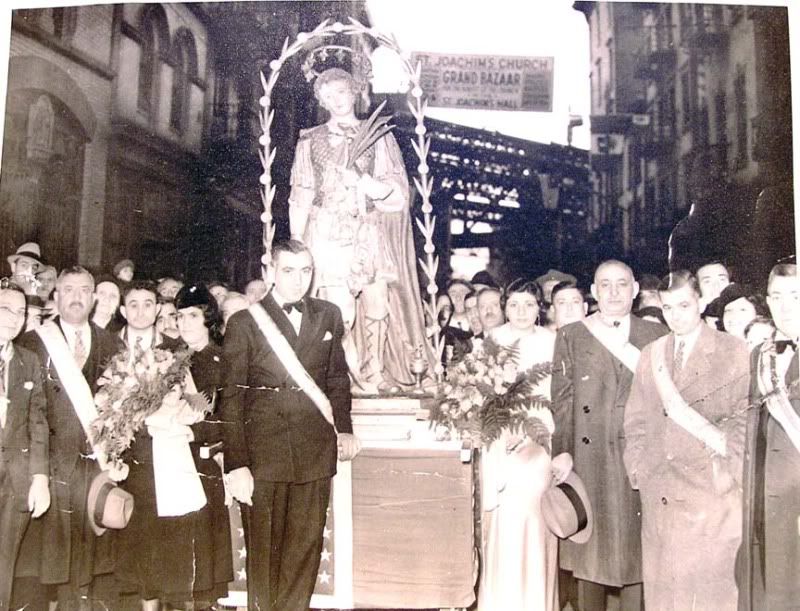 A great photo of the procession of San Vinenzo taken in 1937, outside of St. Joachim's Church on Roosevelt St.(courtesy of the Gallo family), from the Craco Society There's much more interesting history to explore there.
The St. Rocco Society Of Potenza
 I was curious about the picture of the group kneeling in front of St. Joseph's that I included in the previous post so I researched the St. Rocco Society. An excerptFrom the St. Rocco Society site from an article written last August
Once again, with tremendous pride, Stephen S. La Rocca, Esq., President of the St. Rocco Society of Potenza announces the 119th Annual feast of St. Rocco to be held on Sunday, August 17, 2008 at St. Joseph’s Church, 5 Monroe Street, New York, New York. The Solemn high Mass will be held at 12:00 noon followed by the procession, the highlight of the event, at 1:30 p.m. The procession will begin at the Church and wind it’s way through the streets of Little Italy as it has done since August 1889.
History:
The St. Rocco Society was founded in 1889 by immigrants from the Southern Italian City of Potenza in the Basilicata region, on Roosevelt Street in Manhattan’s Lower East Side. Every year since it’s founding, without interruption, the society has celebrated St. Rocco’s feast with procession. It is one of the oldest Italian American Societies in New York State.
After the demolition of Saint Joachim’s Church on Roosevelt Street, the original home of the St. Rocco feast due to urban renewal, the feast was and is still celebrated at St. Joseph’s Church on Monroe and Catherine Streets a few blocks from the original site.
Although the Society was founded by men from the Italian city of Potenza (some of whose descendants are still members of the society), from it’s earliest days immigrants from many towns in the provinces of Potenza and Matera participated in the procession. Eventually, those who participated came from every area of Southern Italy and Sicily.
The focus of the feast is the procession of the Statue of St. Rocco. Even before St. Rocco begins “his walk” through the neighborhood he is nearly covered with the money offerings of his faithful. The statue carried on the shoulders of the members is accompanied by an Italian street band for the entire length of the approximately three hour long walk. Following the statue, march the devotees as a means of thanking the saint for his powerful help and looking forward to future graces and blessings through his intercession.
Well into the 1940’s thousands of people traveled to St. Rocco’s feast to honor their beloved Saint by walking in his procession in the scorching August heat. However, with the passing of the years and a diminishing Italian population in the neighborhood, attendance, through remaining strong, lost some of its original strength. Through it all, Angela and Anna Carnevale, two dynamic sisters and daughters of one of the founding members of the society, kept the procession going without interruption. For too many years to count, their dedication kept the feast alive. It was at Angela Carnevale’s urging that Mr. La Rocca was asked to become President of the Society and assume it’s leadership eight years ago.
Thursday, March 5, 2009
The Original Statue Of San Rocco
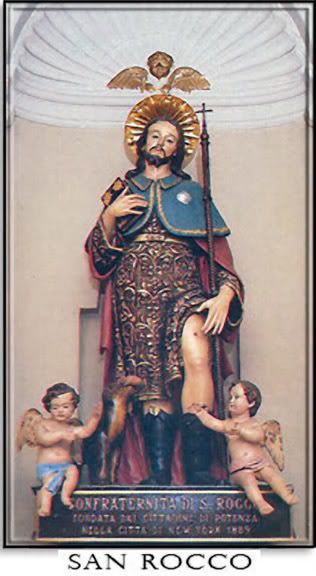
a h/t to Joseph Barone for this info
from the saint rocco society
The statue was kept in a special chapel in St. Joachim's Church on Roosevelt Street. When St. Joachim's was demolished, the statue was taken to St. Joseph's Church, 5 Monroe Street, where it remains enshrined to this day.
The original statue is of magnificent artistic quality, made of Italian papier mache'. It weighs with it's base over 100 lbs.
As the statue aged, Angela Carnevale the Treasurer of the St. Rocco Society and then it's acting President and sole organizer decided to purchase the new statue, fearing the original priceless statue might be damaged while carrying it in the procession.
For the last 25 years or so a duplicate statue has been used for the Feast and Procession.
The original statue was "rented" by Francis Ford Coppola and used in the filming of "The Godfather II" during it's Festa di San Rocco scene. Only members of the Society were allowed to carry the statue in the film. The statue is the oldest Italian American religious society statue in New York.
The original statue can be seen at the rear left of the Church of St. Joseph, 5 Monroe Street, New York, New York. The "Feast" statue is stored during the year and brought out and placed on the main alter under a special canopy for the week prior to the Feast.
from Joseph Barone
A number of people from the parish were used in the filming, among them were the men carrying the canopy. One of them was Mikey Tramatola (sic) who lived on the ground floor in the K Building. There were two boys (one named Paul -- about a year or so younger than I was), a girl (I think the middle child) and the dad. The mom had died a number of years back. They later moved to the apartment complex across from the South St. Seaport., Southbridge Towers
The altar boys were also from the parish. They got the part because they walked into the St. Joseph rectory at the right time and had a short haircut. (If I had walked in about 10 minutes earlier, I would have gotten a part in it. I could have been a contender...I could have been somebody.)
The guys were out of school for two weeks and got paid well for the work.
In addition, there is a small platform with candles on it (looks like a cake covered w/ candles). This was also traditionally carried in the St. Rocco procession each year in August by the women of the St. Rocco Society.
Saturday, June 14, 2008
St. Joseh's Church/PS 1 Panoramic Scene
A scene linking the intersection of Catherine and Monroe Street to Madison and Catherine Street (slightly NW ) on the Lower East Side. A better version than a panoramic movie posted back in November 2007
St. Joseph's Church is on Monroe St and PS1 is on Madison, 1 block NW (approx).Background: St. Joseph’s Church at 5 Monroe Street was built in 1925 to serve the Italian population. Its parishioners are now 70% Chinese. In mid-August, it hosts the annual St. Rocco’s feast, once held at St. Joachim’s Church, where Mother Frances Xavier Cabrini, the first U.S. citizen to be declared a saint by the Roman Catholic Church, began her ministry in 1889. She established a network of hospitals and social services extending from New York to Chicago, Golden, Colorado, and Seattle. Despite protests by former parishioners including Jimmy Durante, the church was demolished in 1959 to build apartments. P.S.1 at Oliver and Henry streets, a school dating from 1806 attended by Eddie Cantor, Jimmy Durante, and Luther Vandross, among others.
St. Joseph's Church is on Monroe St and PS1 is on Madison, 1 block NW (approx).Background: St. Joseph’s Church at 5 Monroe Street was built in 1925 to serve the Italian population. Its parishioners are now 70% Chinese. In mid-August, it hosts the annual St. Rocco’s feast, once held at St. Joachim’s Church, where Mother Frances Xavier Cabrini, the first U.S. citizen to be declared a saint by the Roman Catholic Church, began her ministry in 1889. She established a network of hospitals and social services extending from New York to Chicago, Golden, Colorado, and Seattle. Despite protests by former parishioners including Jimmy Durante, the church was demolished in 1959 to build apartments. P.S.1 at Oliver and Henry streets, a school dating from 1806 attended by Eddie Cantor, Jimmy Durante, and Luther Vandross, among others.
Friday, November 23, 2007
QuickTime VR: St. Joseph's-Catherine Street
St. Joseph's Church-Catherine Street QuickTime VR Movie
St. Joseph's Church is on Monroe St and PS1 is on Madison, 1 block NW (approx).Background: St. Joseph’s Church at 5 Monroe Street was built in 1925 to serve the Italian population. Its parishioners are now 70% Chinese. In mid-August, it hosts the annual St. Rocco’s feast, once held at St. Joachim’s Church, where Mother Frances Xavier Cabrini, the first U.S. citizen to be declared a saint by the Roman Catholic Church, began her ministry in 1889. She established a network of hospitals and social services extending from New York to Chicago, Golden, Colorado, and Seattle. Despite protests by former parishioners including Jimmy Durante, the church was demolished in 1959 to build apartments. PS 1 at Oliver and Henry streets, a school dating from 1806 attended by Eddie Cantor, Jimmy Durante, and Luther Vandross, among others.
Subscribe to:
Posts (Atom)


 Posts
Posts