Showing posts with label what was I thinking?. Show all posts

Wednesday, June 10, 2009

June Is Busting Out All Over 3


from the youtube description. From a June 2, 1956 show
The TV seasons were long back in 1956 for Gisele MacKenzie, Dorothy Collins, Russell Arms, Snooky Lanson, Raymond Scott (orch) and Ray Charles (chorus)! Running into June, here Gisele MacKenzie is seen doing a "Your Hit Parade" extra, June Is Busting Out All Over, from the musical Carousel. This little piece of video became a good representation of Gisele's musical/comedy abilities and through the years she starred in Gypsy, Hello Dolly, Unsinkable Molly Brown, Mame, Kind & I, South Pacific, Annie Get Your Gun, etc. Gisele was the all-around performer...perfect for TV and musical-comedy.

I watched this show with my parents and liked it. Looking back, "What was I thinking?"
Gisele MacKenzie may have been an all around performer-all around bland.

Thursday, October 30, 2008

Not This Day In Knickerbcker Village History: Oct. 31, 1962, The Beverly Hillbillies, Episode 6


After a steady diet of this crapola it's no wonder that there was youth rebellion in the later 60's. This show aired from 9-9:30 on Channel 2 and was entitled Trick Or Treat. from wikipedia:
The Beverly Hillbillies is an American television series about a hillbilly family transplanted to Beverly Hills, California after finding oil on their land. A Filmways production, the series aired on CBS from September 26, 1962 – September 7, 1971 and comprises 274 episodes—106 in black-and-white (1962–1965) and 168 in color (1965–1971). The show starred Buddy Ebsen as Jed Clampett, Irene Ryan as Daisy May "Granny" Moses, Donna Douglas as Elly May Clampett and Max Baer, Jr. as Jethro Bodine.
At the beginning of The Beverly Hillbillies series, the OK Oil Company discovers oil in a swamp in the Ozarks owned by family patriarch Jed Clampett. Jed moves with his family to the wealthy Los Angeles County city of Beverly Hills, California, where he attempts to live a rural lifestyle despite his wealth. This sequence of events was recapitulated in the title credits for each show and was described in the lyrics of the theme song, so that new viewers would easily understand who the Hillbillies were and why they were in Beverly Hills (although the credits and song portray Jed finding the oil while hunting as opposed to knowing the oil was there but being unaware of the value). Lasting nine seasons and accumulating 7 Emmy nominations, it remains in syndication on several cable stations including TV Land.
The Hillbillies themselves were Buddy Ebsen as the widowed patriarch Jed "J.D." Clampett; Irene Ryan as his mother-in-law, Daisy May "Granny" Moses; Donna Douglas as his daughter Elly May Clampett; and Max Baer Jr. as his cousin's son Jethro Bodine.
The supporting cast featured Raymond Bailey as Jed's greedy banker Milburn Drysdale; Harriet E. MacGibbon as Drysdale's snobbish wife Margaret Drysdale; and Nancy Kulp as Drysdale's secretary, "Miss" Jane Hathaway, who pined for the clueless Jethro.
Jed's cousin Pearl Bodine (played by Bea Benaderet) was Jethro's mother. She appeared in several episodes during the first season, as did Jethro's twin sister Jethrine, played by Baer in drag, using Linda Kaye Henning's voiceover.
Although not a major character, actress Sharon Tate had a recurring role during the early years of the series. Tate appeared in a dark wig as Janet Trego, an assistant to Miss Hathaway at the Commerce Bank. Two episodes before Janet's debut episode, Sharon had appeared (sans wig) as one of Elly May's classmates in "Elly Starts to School"
Veteran canine actor Stretch portrayed Jed's bloodhound Duke, and the many other animal actors on the series came to be known as "Elly May's critters".
The theme song "The Ballad of Jed Clampett" was written by producer and writer Paul Henning and originally performed by Bluegrass artists Flatt and Scruggs. The song was sung by Jerry Scoggins (backed by Flatt and Scruggs) over the opening and end credits of each episode. It was #44 on the music charts in 1962 and a #1 country hit.
The series generally featured no country music beyond the bluegrass banjo theme song, although country star Roy Clark and the team of Flatt and Scruggs occasionally played on the program. Pop singer Pat Boone appeared on one episode as himself, with the premise that he hailed from the same area of the country as the Clampetts.
Despite being panned by some critics, the show shot to the top of the Nielsen Ratings shortly after its premiere and stayed there for several seasons. During its first two seasons, it was the number one program in the U.S. During its second season, it earned some of the highest ratings ever recorded for a half-hour sitcom. The season 2 episode The Giant Jackrabbit also became the most watched telecast up to the time of its airing, and still remains the most watched half-hour episode of a sitcom as well It was ranked in the top ten most watched prime time programs for six of its nine seasons.
The series received two Emmy nominations for Best Comedy Series as well as nominations for cast members Irene Ryan and Nancy Kulp.
Because of the show's high ratings, CBS asked creator Paul Henning to pen two more folksy comedies, spawning a mini-genre of rural sitcoms during the 1960s. Petticoat Junction featured an extended family, including three pretty young women of marrying age, running a small hotel in the isolated rural town of Hooterville. Green Acres flipped the Clampetts' fish-out-of-water concept by depicting two city sophisticates moving to Hooterville, which was populated by oddball country bumpkins.
* Bea Benaderet, who had played Jethro's mother during the first season of The Beverly Hillbillies, was the mother of the family on Petticoat Junction.
* Linda Kaye Henning, who provided the voiceover for the Beverly Hillbillies character Jethrine, portrayed Benaderet's daughter Betty Jo Bradley on Petticoat Junction.
* Edgar Buchanan, who starred in all 222 episodes of Petticoat Junction and guest-starred in 17 episodes of Green Acres, also guested in 3 episodes of The Beverly Hillbillies, always as the character Uncle Joe Carson.
Nielsen ratings for the 1970-71 season indicate that the bottom had dropped out for the perennial Top 30 series but was still fairly popular when it was canceled in 1971 after 274 episodes. The CBS network, prompted by pressure from advertisers seeking a more sophisticated urban audience, decided to refocus its schedule on several "hip" new urban-themed shows, and to make room for them, all of CBS's rural-themed comedies were simultaneously canceled. This action came to be known as "the Rural Purge". Pat Buttram, who played Mr. Haney on Green Acres, famously remarked that, "It was the year CBS killed everything with a tree in it."
In addition to The Beverly Hillbillies, the series that were eliminated included Green Acres, Mayberry R.F.D. and Hee Haw, the latter of which was resurrected in first-run syndication, where it ran for another 21 years. Petticoat Junction had been canceled a year earlier due to declining ratings following the death of its star Bea Benaderet.

Wednesday, August 6, 2008

Ferrante & Teicher: What Was I Thinking?

Louis Teicher passed away on 8/3. May he rest in peace. We had a lot of their albums and we actually listened to them. Why? It's insipid drivel. One reason is that I remember that my mother's best friend's father worked for ABC Paramount Records and we got a lot of brand new freebies. My father however figured out a way to scam Sam Goody's by returning them, e.g. titles like "Frank Fontaine Sings," in order to get credit for Glenn Miller albums. Ferrante and Teicher should have suffered the same fate.
from wikipedia
Ferrante & Teicher were a duo of American piano players, known for their light arrangements of familiar classical pieces, movie soundtracks, and show tunes.
Arthur Ferrante (born September 7, 1921, New York City) and Louis Teicher (born August 24, 1924, Wilkes-Barre, Pennsylvania died August 3, 2008) met while studying at the Juilliard School of Music in New York. Musical prodigies, they began performing as a piano duo while still in school. After graduating, they both joined the Juilliard faculty.
In 1947, they launched a full-time concert career, at first playing nightclubs, then quickly moving up to playing classical music with orchestral backing. Between 1950 and 1980, they were a major American easy listening act, and scored four big U.S. hits: "Theme From The Apartment" (Pop #10), "Exodus" (Pop #2), "Tonight" (Pop #8), and "Midnight Cowboy" (Pop #10). They performed and recorded regularly with pops orchestras popular standards by George Gershwin, Jerome Kern, Cole Porter, Richard Rodgers, and others.
The duo also had a more avant-garde side. They experimented with prepared pianos, influenced by avant-garde composer John Cage. By adding paper, sticks, rubber, wood blocks, metal bars, chains, glass, mallets, and other found objects to piano string beds, they were able to produce a variety of bizarre sounds that sometimes resembled percussion instruments, and at other times resulted in special effects that sounded as if they were electronically synthesized.
Ferrante and Teicher ceased performing in 1989 and retired in Florida. CDs of their music, some of it not previously released, have continued to appear.

Monday, July 21, 2008

Highway Patrol


"Whenever the laws of any state are broken, a duly authorized organization swings into action. It may be called the State Police, State Troopers, Militia, the Rangers or the Highway Patrol. These are the stories of the men whose training, skill and courage have enforced and preserved our state laws."
Besides that snappy intro I can't figure out now why I liked this program
Frequently Asked Questions about Highway Patrol:
When did the Highway Patrol pilot Prison Break premiere?
Monday, October 3, 1955. The episode was filmed April 11-13, 1955.
What are the locations of the opening shot of the auto driving around a curve, and the "roadblock" shot?
Both locations were on the 101 freeway before it was finished; it was closed and therefore they could have full control of it. The precise locations are still unknown, but probably near Thousand Oaks.
Driving his car going up to the roadblock was Babe Unger with Guy Daniels as passenger [according to Guy].
What about the closing turnout sequence, backing out of the restaurant parking lot ?
This was at the Golden Pheasant restaurant on Highway 101, probably near Medford Road. This turnout sequence was the closing shot of the pilot episode.
A contemporary photograph of the Golden Pheasant , taken by Ron Hurwitz, is available.
How long did Highway Patrol run ?
For 4 seasons, from 1955-1959, and a total of 156 episodes. It was one of the most popular syndicated programs in television history. After the original run, it was sometimes rerun with the name "Ten-4".
When and where was Highway Patrol rerun ?
In the United States, reruns could be seen daily throughout the 1960s. Any American over 40 can probably remember Broderick Crawford bellowing "10-4" into his microphone. The reruns continued to be seen sporadically in some cities in the 1970s and even the 1980s.
In some reruns, the show was called Ten-Four. The opening of Ten-Four had Mathews in a '58 Dodge doing a turnout from a 4th season episode calling in on his radio - "I'm on my way, 10-4."
an Emmy Award ?
No. Syndicated programs were not eligible at that time (is this correct?).
What is a syndicated program ?
A program that is sold to independent TV stations all across the country; this is an alternative to selling a show to one of the major networks (ABC, CBS, Dumont, NBC) which would, in turn, feed the programming to its affiliates.
Who created Highway Patrol ?
Guy Daniels, who was the CHP's civilian public relations man, was told by the Commissioner, Bernard Caldwell, to go to Hollywood and "get us a show like Dragnet". So Guy approached Jack Webb who accepted the idea and was set to do a pilot. However, at about the same time Jack, who was passionate about jazz, got his pilot for Pete Kelly's Blues picked up by the network so he reneged doing a show based on the CHP. In the end, Ziv productions who needed a couple more shows to fill out it's 1955 season decided to do the pilot using Broderick Crawford as the lead. A lunch meeting between Brod Crawford and Herb Strock with Ziv executives was then arranged to discuss its filming.
A quote from Frederick Ziv:
"Well, in television my favorite program was Highway Patrol. It was a dynamic program. It was a dynamic program because the man with the badge had proved its appeal. Not the man in uniform. You put a man in uniform and you downgrade him. So, Dan Mathews, our head of our highway patrol, was not in uniform - he was head of the patrol. And the part was played by Brod Crawford who moved so fast that we edited our film accordingly. Today we hear about quick cuts, but quick cutting technique really was first put into television film in Highway Patrol. And if you look at previous television film, you'll find that it is not cut the way Highway Patrol is cut. It started a whole new trend." - Frederic W. Ziv (September 6, 1974)
source: Rouse, Morleen Getz. A History of the F.W. Ziv Radio and Television Syndication Companies, 1930-1960. Ph.D. dissertation, University of Michigan,

Wednesday, December 26, 2007

What Was I Thinking? Don Rickles


I watched an HBO special on Don Rickles last night. I was looking for a good laugh. It was directed by John Landis and it was done with all kinds of editing flourishes. The bottom line, "Why is this guy considered a comic genius?" I laughed at him back in the 60's and 70's etc with my father, especially when Rickles was on the tonight show. But the insult act is so tired and his rationalizations so bogus. It's one thing to "shoot down" a Sinatra and the rich and powerful and pretentious, but not a Mexican immigrant.
Compare him to the timeless comic genius of a Steve Allen and a Sid Caesar, not a chance. Ok, I'm thru pontificating.
Now the above clip I find funny, Rowan And Martin roasting Rickles with his own material

Tuesday, December 25, 2007

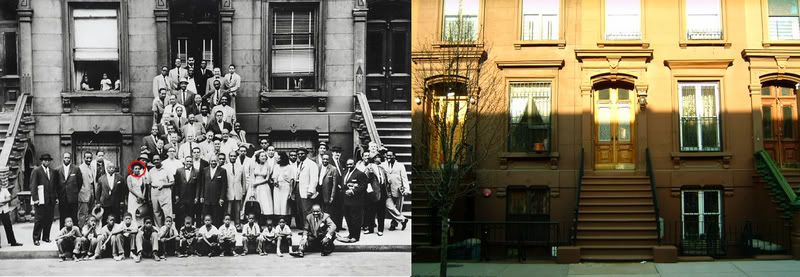
What Was I Thinking? A Great Day In Harlem 1958


Now what was I doing in the summer of 1958? Probably playing a lot of punch ball in Tanahey Park, when I could have been a kid sitting on a curb in front of this collection of all time great musicians. Harlem was probably thought of as a foreign country to those on the LES
A Great Day in Harlem or Harlem 1958 is a 1958 black and white group portrait of 57 jazz musicians photographed on a Harlem street.

Art Kane, a freelance photographer working for Esquire magazine, took the picture at around 10 a.m. in the summer of 1958. The musicians had gathered on 126th Street, between Fifth and Madison Avenues in Harlem, New York City.

Esquire published the photo in its January 1959 issue. Jean Bach, a radio producer of New York, recounted the story behind it in her 1994 documentary film, A Great Day in Harlem. The film was nominated in 1995 for an Academy Award for Documentary Feature.


The photo was also a key object in Steven Spielberg's film, The Terminal. The film starred Tom Hanks as Viktor Navorski, who came to the United States in search of Benny Golson's autograph to complete his father's collection of autographs by the jazz musicians pictured in the classic 1958 photo.

When I was working in Harlem the last few years I went back to locate the spot to see what it looks like now. It's at 17 East 126th Street.

Friday, December 21, 2007

What Was I Thinking In 1959?


Lamberts, Hendricks and Ross singing "With The Spirit Beat" in 1959 accompanied by Count Basie. It looks like one of those "Live At The Penthouse" Shows. And to think I was listening to the McGuire Sisters and Jimmie Rodgers! One of the precursors to rap music?

Thursday, December 20, 2007

As Good As It Gets


From 1965. The Chairman of the Board and a Riddle arrangement! Looking back how could Fabian, Avalon, etc. be so popular? I know every generation needs to define itself and bring with them their own music, but I don't think this happened in the 30's and 40's. I remember, I was about 15 and I played this as a 45 and I thought, "How did I miss this?" Appreciating Frank, the music, not necessarily the man, should be part of a mandatory test for those seeking political office.
Those fingers in my hair
That sly come hither stare
That strips my conscience bare
Its witchcraft

And Ive got no defense for it
The heat is too intense for it
What good would common sense for it do

cause its witchcraft, wicked witchcraft
And although, I know, its strictly taboo

When you arouse the need in me
My heart says yes indeed in me
Proceed with what your leading me to

Its such an ancient pitch
But one I wouldn't switch
cause theres no nicer witch than you

Monday, December 17, 2007

One More Time


I love this song. Here's the Count's version. Eric Dixon and Sal Nistico I believe are the tenor sax soloists. Sonny Payne on drums. Freddie Green, of course, on guitar.
This has very little to do with Knickerbocker except the link to Bobby Darin, which is a suspicious link in itself. Well, also it's a very 1950's-60's era piece.