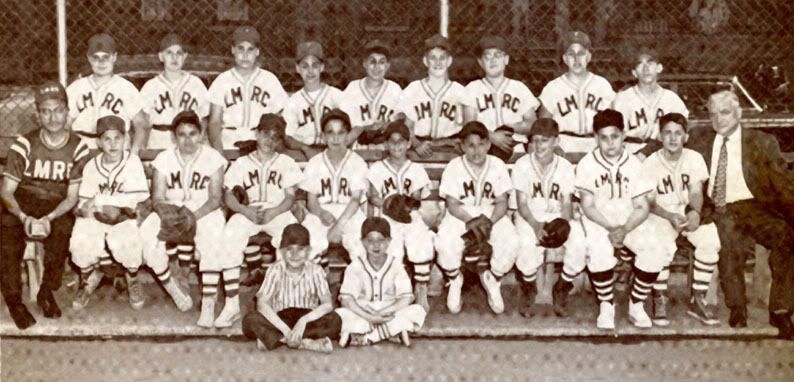
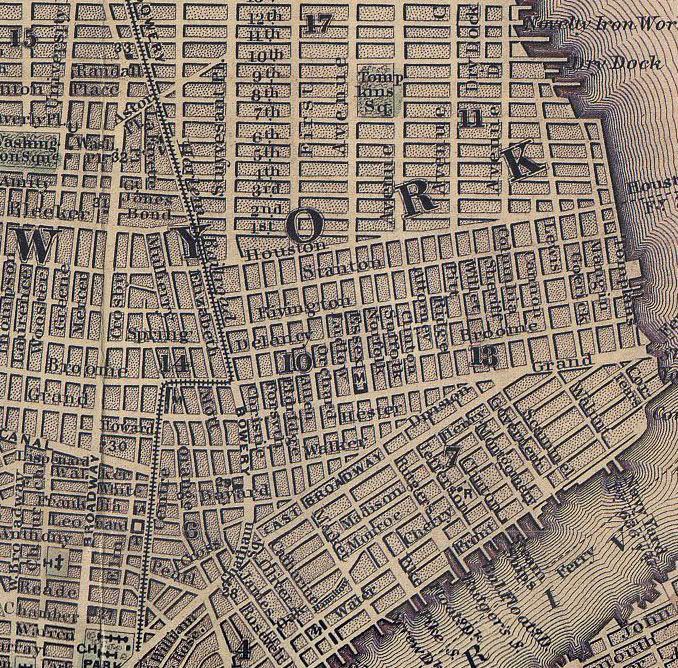
Pike Street
above from the nyc landmark's designation report
Showing posts with label pike street. Show all posts
Showing posts with label pike street. Show all posts
Tuesday, April 27, 2010


Pike Street Synagogue (Congregation Sons of Israel)
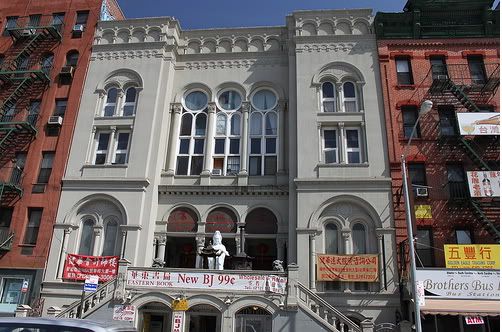
an excerpt From the 1997 NYCLPC Landmark Designation Report
The Pike Street Synagogue, constructed in 1903-04 for the Congregation Sons of Israel Kalwarie, is a rare surviving synagogue building from that period of New York's history when the Lower East Side served as America's main portal for millions of Jewish immigrants. Designed by the architect Alfred E. Badt, this limestone-fronted building with its twin, lateral staircases up to the porticoed main entrance, and double stair towers projecting from the main facade creates an imposing presence on the crowded street. The basic form and massing of the building followed a stylistic precedent deriving from the Romanesque Revival and the German
At the same time, the architect included details which relate to the general classicizing tendencies in American architecture of the turn of the century. When constructed, this synagogue was one of the largest on the Lower East Side, and one of the few built specifically for this purpose. The Congregation Sons of Israel Kalwarie, started in 1853, continued to worship in this building until the 1980s. The building stood vacant for several years, but recently has been rehabilitated for a variety of uses with a Buddhist temple on the main level, apartments above, and commercial space on the ground floor.
The Jewish Community in New York
The first Jews arrived in the Dutch colony of Nieuw Amsterdam in 1654, coming from Brazil in an unsuccessful attempt to reach Holland. Although the Jews were allowed to stay in the colony, they gained political as well as religious rights only when the British took control in 1664. Around 1682, the first Jewish congregation in New York was established: Congregation Shearith Israel or Remnant of Israel. It was not until 1729 that the congregation constructed its first synagogue building, a small structure on Mill Street (now William Street) which served until 1818, when it was replaced with a larger one.
Between 1815 and 1825 the Jewish population of New York swelled to 500, with immigrants coming mostly from Europe primarily because of the fall of Napoleon. In 1825 a group of German and Polish Jews broke away from Congregation Shearith Israel to farm their own synagogue, Congregation B 'nai Jeshrun. This was the beginning of a trend, as numerous other congregations were then created out of existing groups because of political differences, different interpretations of religious law and customs, or simply because of the desire to worship with fellow countrymen using common rituals.
By 1860 there were approximately 27 synagogues in New York City, most of which resulted from divisions within existing synagogues. This growth in the number of congregations was supported by, but not wholly attributable to, the increasing Jewish population which rose to 10,000 in 1846 and then to 60,000 in 1880.
During the early eighteenth century, most of New York's Jews lived close together downtown, indicated by the fact that Shearith Israel built, and then rebuilt its synagogue on Mill Street. Typically, immigrants of common backgrounds often chose to live near each other in an effort to provide mutual support in their new land. As they became more comfortable in their new home and achieved more financial success, they were often willing to move away from the original group.
Thus by the 1820s, the area of Broadway, Laight, Charlton, Greene, and Wooster Streets began attracting some wealthier Jews. By the 1830 s and 1840s the area around Bayard, Baxter, Mott, and Chatham Streets was home to many Dutch, German, and Polish Jews, while Chrystie, Market, Henry, and Division Streets began to attract many other new Jewish immigrants and became the nucleus of what came to be known as the Jewish Lower East Side.
As this neighborhood became more densely populated, synagogue congregations subdivided based on kinship and on countries and towns of origin, each group supporting its own synagogue.
Wednesday, April 21, 2010
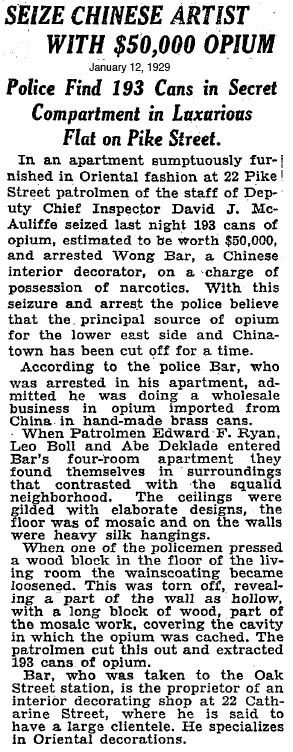
The Complaints Of Candee, Smith and Howland Company of Pike Street

when there was price fixing in the trade. :)
Tuesday, January 15, 2008
Trommer Beer
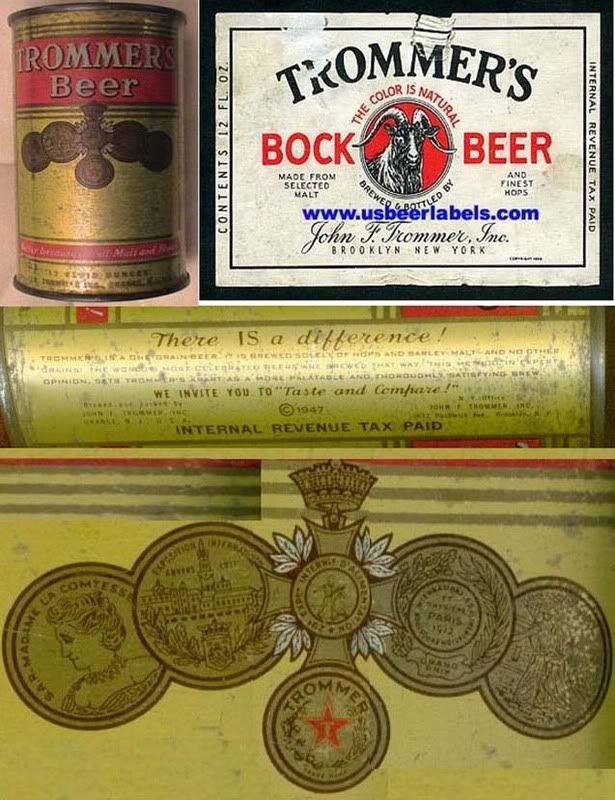
More on Trommer Beer which was being sold in 1950 at 21 Pike Street:
from rusty cans
One of my favorite late 1940s cans. I like the design, especially the medals on the front. I think these are actually TWO medals, both back and front showing. The ones on the left read "S.A.R. Madame Contesse" and "Exposition Internation (sic) Envers 1911." The ones on the right read "International Dalimentation Exposition Et Dmygiene Paris 1912" (I think, those are TINY letters!) and "Grand Prix." The center medalion reads "Internale D'Alimentation 29th Exp."
Once again we have the story of a German immigrant who sailed to America and became a giant. of the brewing industry (I'm sensing a pattern here). John F. Trommer immigrated from Hersfeld, Germany in the 1840s and settled in Portland, Maine where he worked in a small ale brewery. He eventually moved to Boston and worked in several breweries there. He moved to Brooklyn's Bushwick district where a number of breweries were congregated at some point and became brewmaster for William Ulmer. By the late 19th century there were 58 breweries in a 12 block stretch of road in this area along what was called "Brewer's Row." In 1897 Trommer bought an interest in a new company called Stehlin & Breitkopf and soon changed the name to J.F. Trommer's Evergreen Brewery. John Trommer didn't have time to enjoy his success, however, as he died in 1898 and his son George Trommer took over the brewery. speakers!
At first making only lager beer, Trommer's beer was an all-malt beer. Here's how a buddy of mine who is a professional brewer explained it. Brewers called beers (in the old days, made with 100% barley and wheat malt) "all-malt" or "malt" beers to differentiate them from the newer, cheaper beers using proportions of corn, rice, or cane sugar. Any grain can be malted (germinated to grow like the grass seed that it is, just until all the starch in the seed has been solubilized and the enzymes made to break down the starch) to use for growth, then (cruelly, to the seed) kilned and dried to kill the growth and keep the starches intact). This all happens by the time the root is 1/8 in or so long. Wanna make cheaper beer, that's lighter in body and flavor than an all-malt beer, that will appeal to more people? Use adjuncts (add junk!) like corn grits, corn starch, cane sugar, rice, rock candy (Belgium), millet if you're in Africa, you name it. Old-fashioned or wintertime hearty brews called themselves all-malt to distinguish themselves as a mark of quality. Trommer's continued making an all-malt beer until they closed in 1951. It was a constant them in their advertising.
Pike Street Guys?

A young Sol Hellman is on the right. Sol's father had the Sewing Machine Shop at 19 Pike before he did, so Sol had a long history on Pike Street. I just recently found his census record. In 1920 he lived at 10 Montgomery Street. He was born in 1915. Neal told me his dad knew Zero Mostel and that they went to Seward Park High School and CCNY together. Zero lived on Columbia Street and was also born in 1915. The two of them probably knew Sammy Cahn as well.
Note: I don't know if this was taken on Pike Street or not. A slightly a gayish pose by the guy on the left, but in the 1930's when I suspect this pic was taken I don't think so. Not that there's anything wrong....yada, yada
Pike Street Blacksmith
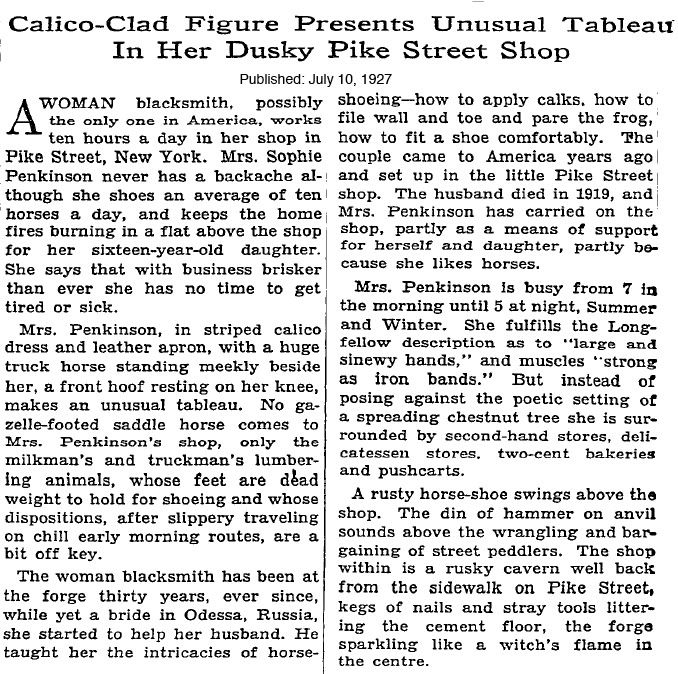
No information on the address of the store, but Pike Street only extended between East Broadway ans South Street, so that encompassed just 5 blocks in length (Henry, Madison, Monroe, Water, South)
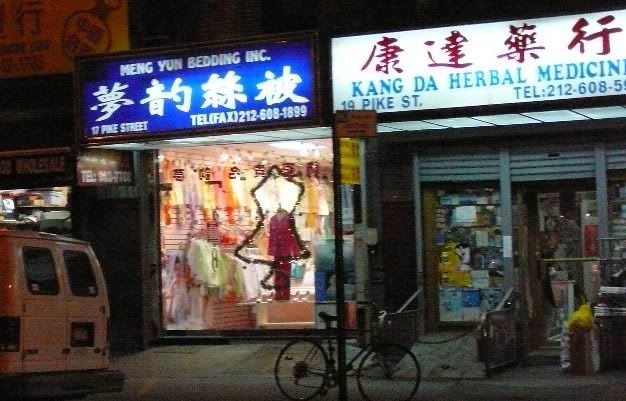
Crossing Pike Street: Shul Collapse
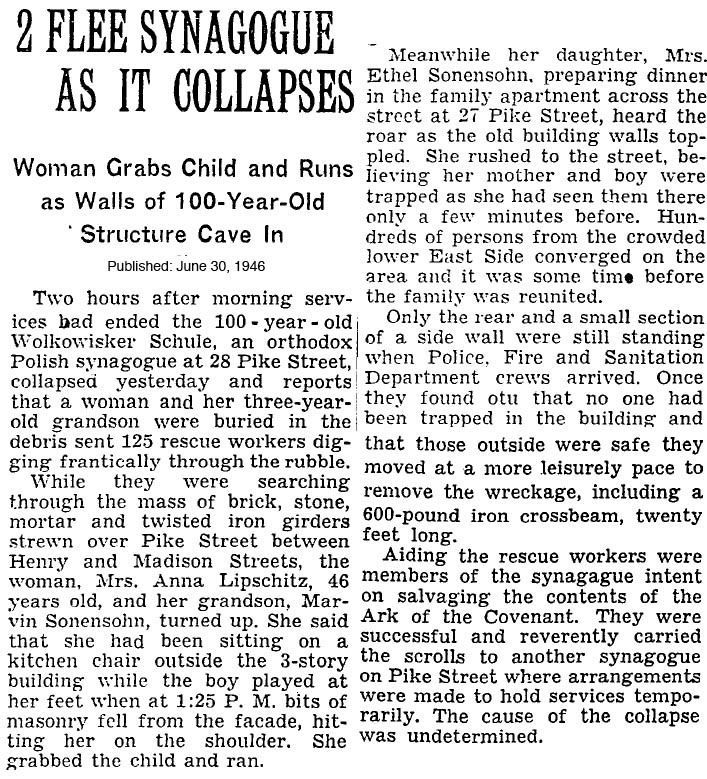
I never knew there was a synagogue on the even side of Pike Street. I wonder whether Marvin Sonensohn went to PS 177?
Crossing Pike Street
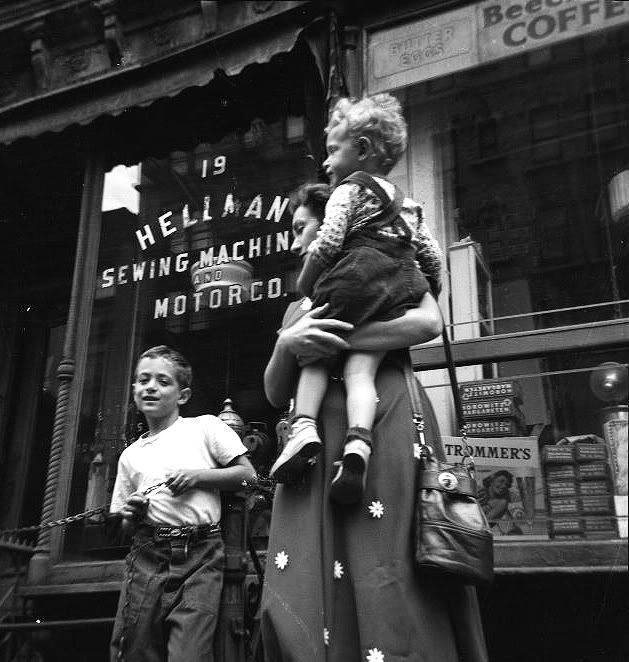
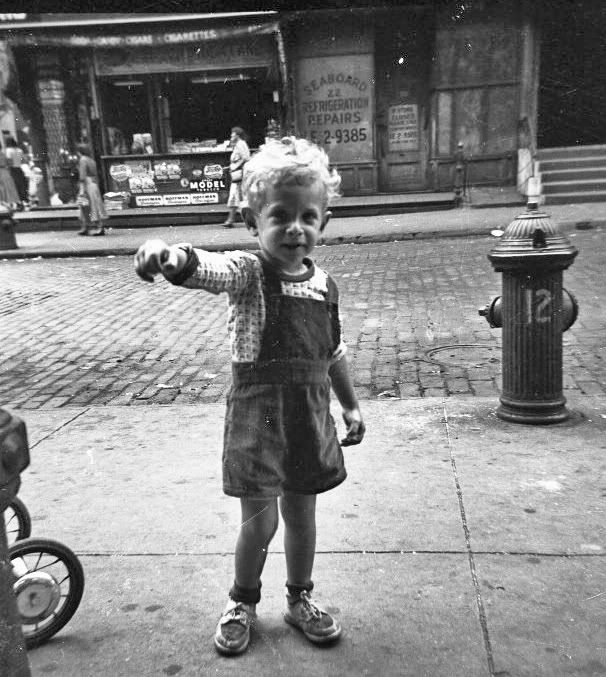 More from the fabulous Hellman archives of KV West. These appear to be from around 1950. The first show Neal's mom, Molly with his older brother Bill, in front of the family Sewing Machine repair shop at 19 Pike Street. The second gives us a view of the eastern, even numbered side. Today that side is dominated by Chinese produce markets. Visible is a button on Mrs. Hellman's pocketbook. I wonder what it says. Also visible is a calendar from Trommers' Beer in the grocery store at 21 Pike.Trommers was located in Brooklyn and Orange, New Jersey. From rustycans
Immediately after the war Trommer's marketed their all-malt beer as "Trommer's White Label" which appeared in bottles but not in cans. The brand appeared before the war as well, but, judging from the advertisements, the brewery pushed this brand more after the war. The brewery seemed to be doing well, they even added a three-stoy stock house to the Orange facility in 1948. However, late that same year a 29 day brewery driver's strike hit New York. Drivers demanded a shorter workday and two man teams for each truck, rather than the then prevailing single-man units. Unfortunately for Trommer's strikers took over some of the plant facilities. Each brewery has its own strain of yeast that they use in producing their beer. The strikers did not properly take care of the yeast while they occupied the brewery and Trommer's strain died. As a result, when the brewery reopened they had to use a completely different strain and the beer tasted radically different. Sales began to drop. In 1950 George Trommer sold the Orange, New Jersey brewery to Leibmann and in 1951 the original Brooklyn facility went to to Piel's. Piel's continued making Trommer's until 1962 but the brand was then discontinued. The Brooklyn brewery was closed in about 1955 and the Orange facility in 1977
Monday, January 14, 2008
1893: Pike Street Anarchist Arthur Press
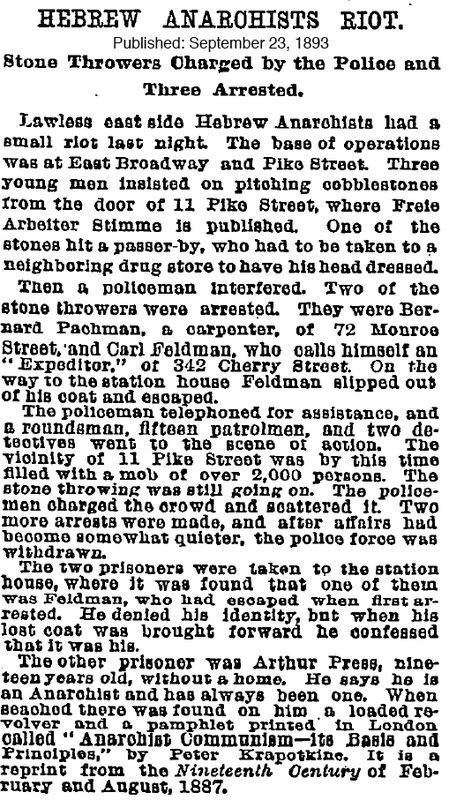
Could Arthur be a relative of PS 177 principal, Sol? In the 1920 census there is no Arthur living with the Press family on Madison Street.
Wednesday, January 2, 2008
Up On The Roof 2
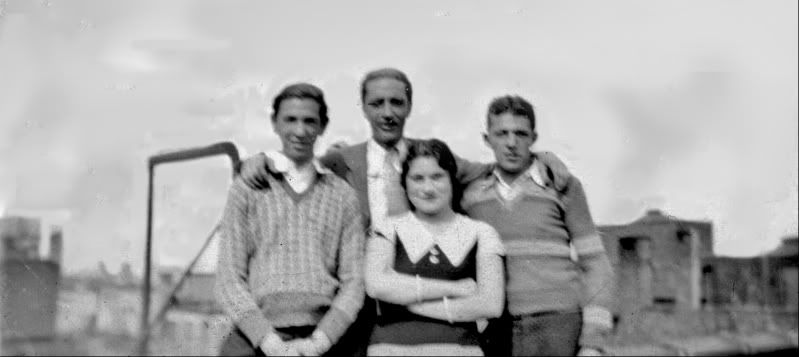
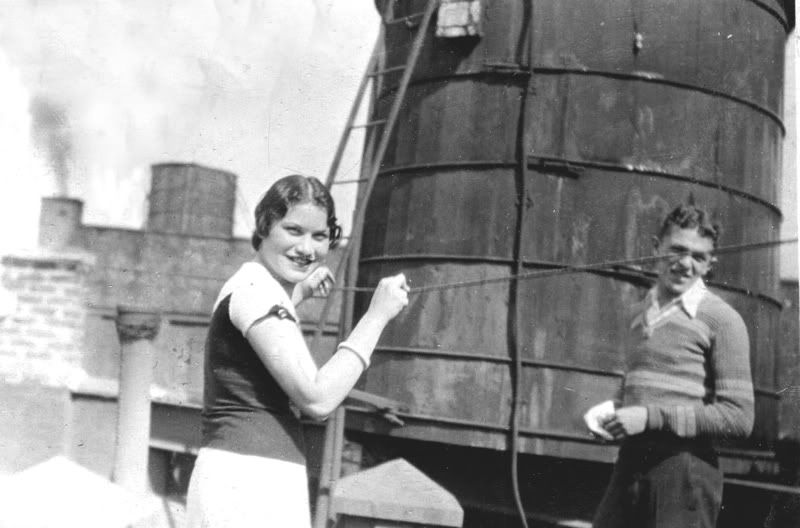
From The Neal Hellman archives. That's his father Sol (solo) on the roof of I guess the sewing machine repair shop on Pike Steeet, since I recognize the steeple from St. Teresa's Church on Henry and Rutger's in the background. Neither I or Neal know where the other's were taken, but some of the guys are the same from this post on 12/30/07 
When this old world starts getting me down
And people are just too much for me to face
I climb way up to the top of the stairs
And all my cares just drift right into space
On the roof, the only place I know
Where you just have to wish to make it so
Let me tell you now
When I come home feelin' tired and beat
I go up where the air is fresh and sweet (up on the roof)
I get away from the hustling crowd
And all that rat-race noise down in the street (up on the roof)
On the roof, the only place I know
Where you just have to wish to make it so
Let's go up on the roof (up on the roof)
At night the stars put on a show for free
And, darling, you can share it all with me
I keep a-tellin' you
Right smack dab in the middle of town
I've found a paradise that's trouble proof (up on the roof)
And if this world starts getting you down
There's room enough for two
Up on the roof (up on the roof)
Up on the roof (up on the roof)
Oh, come on, baby (up on the roof)
Oh, come on, honey (up on the roof)
Everything is all right (up on the roof)
City's all right (up on the roof)
Oh . . .
When this old world starts getting me down
And people are just too much for me to face
I climb way up to the top of the stairs
And all my cares just drift right into space
On the roof, the only place I know
Where you just have to wish to make it so
Let me tell you now
When I come home feelin' tired and beat
I go up where the air is fresh and sweet (up on the roof)
I get away from the hustling crowd
And all that rat-race noise down in the street (up on the roof)
On the roof, the only place I know
Where you just have to wish to make it so
Let's go up on the roof (up on the roof)
At night the stars put on a show for free
And, darling, you can share it all with me
I keep a-tellin' you
Right smack dab in the middle of town
I've found a paradise that's trouble proof (up on the roof)
And if this world starts getting you down
There's room enough for two
Up on the roof (up on the roof)
Up on the roof (up on the roof)
Oh, come on, baby (up on the roof)
Oh, come on, honey (up on the roof)
Everything is all right (up on the roof)
City's all right (up on the roof)
Oh . . .
Sunday, December 30, 2007
Google Street View: Pike Street South To Cherry Street West
This street view movie goes past the old synagogue on Pike mentioned in the previous post. It continues south until it turns west to go under the Manhattan Bridge arch on Cherry Street.
Auld Lang Syne Pike Street
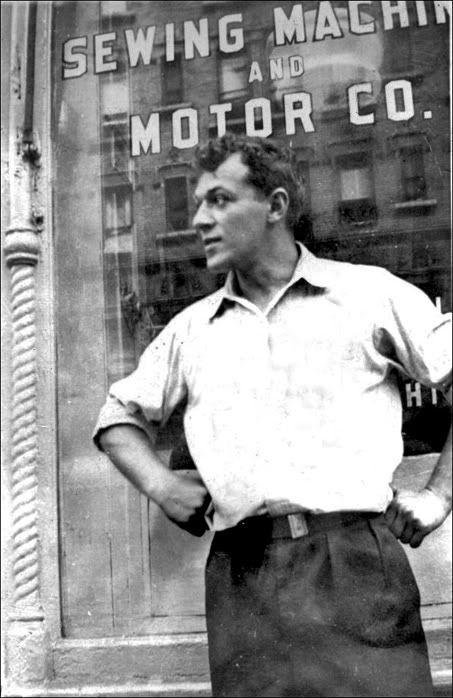 From the Neal Hellman archives,
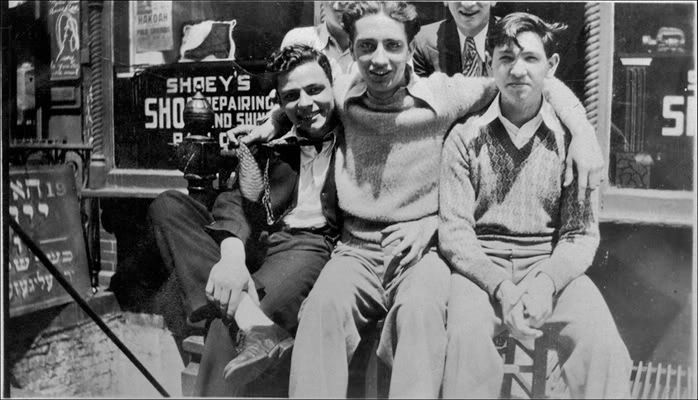
 aka the KV Man WestThat's Neal's father, Sol Hellman, in front of his store, which was on Pike Street (east) between East Broadway and Henry. The other picture shows some guys hanging out in front of the shoe shine place (19 Pike) which was on the same block as Sol's shop. Check out the left hand of the guy on the left. The block has an old synagogue that now houses a 99 cent discount and variety store
from the landmarks commission:
The Pike Street Synagogue (13-15 Pike Street), constructed in 1903-04 for the Congregation Sons of Israel Kalwarie, is a rare surviving synagogue building from that period of New York's history when the Lower East Side served as America's main portal for millions of Jewish immigrants. Designed by the architect Alfred E. Badt,this limestone-fronted building with its twin, lateral staircases up to the porticoed main entrance,and double stair towers projecting from the main facade creates an imposing presence on the crowded street. The basic form and massing of the building followed a stylistic precedent deriving from the Romanesque Revival and the German Rundbogenstil. At the same time, the architect included details which relate to the general classicizing tendencies in American architecture of the turn of the century. When constructed, this synagogue was one of the largest on the Lower East Side, and one of the few built specifically for this purpose. The Congregation Sons of Israel Kalwarie, started in 1853, continued to worship in this building until the 1980s. The building stood vacant for several years, but recently has been rehabilitated for a variety of uses with a Buddhist temple on the main level, apartments above, and commercial space on the ground floor
Subscribe to:
Posts (Atom)


 Posts
Posts