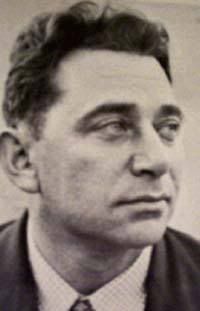
He was a member of the Objectivist group of poets. He was a friend of Whittaker Chambers.
about the Objectivists:
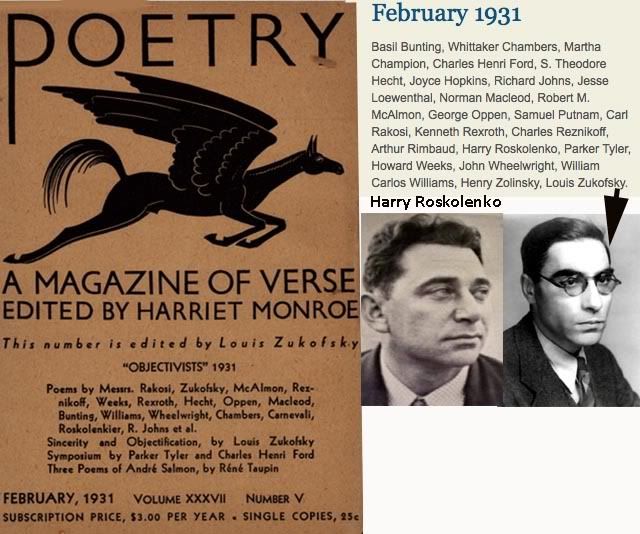
What was the nature of the "Objectivist" experiment, as represented by Zukofsky's selection for Poetry, a selection that included, aside from the obvious names (Basil Bunting, George Oppen, Carl Rakosi, Charles Reznikoff, Zukofsky himself), Robert McAlmon and Kenneth Rexroth, Whittaker Chambers and Henry Zolinsky, John Wheelright and Martha Champion? And in what sense was the work of these poets a departure from that of the "once-revolutionary imagists"? Williams, for one, seems to have been skeptical, even though Zukofsky's "Objectivists" Anthology of the following year contains a large selection of his own poems. "Your early poems," he told Zukofsky in a letter of 1928, "even when the thought has enough force or freshness, have not been objectivized in new or fresh observations. But if it is the music, even that is not inventive enough to make up for images which give an overwhelming effect of triteness. . . . The language is stilted 'poetic' except in the places I marked. Eyes have always stood first in the poet's equipment. If you are mostly ear--a newer rhythm must come in more strongly than has been the case so far."Two of Zolinsky's poems:
The Objectivist poets were a loose-knit group of second-generation Modernists who emerged in the 1930s. They were mainly American and were influenced by, amongst others, Ezra Pound and William Carlos Williams. The basic tenets of Objectivist poetics as defined by Louis Zukofsky were to treat the poem as an object, and to emphasize sincerity, intelligence, and the poet's ability to look clearly at the world. Note that while the name is similar to Ayn Rand's school of philosophy, the two movements are not affiliated, and are, in fact, radically different.
Will Power
By Henry Saul Zolinsky
I WOULD rather grind my teeth to powder,
I would rather tread barefoot on thin, sharp stones,
I would rather let the blood of my veins freeze to red ice,
And the muscles of my legs stiffen to cold stone,
Than be drawn by the warm breath
Of transient things.
I would rather—
But … yet …
I am being drawn … I am being drawn …
Pain
By Henry Saul Zolinsky
IT is
The hush that falls
When screaming chords, drawn taut,
Break with a sudden snap!—and then
Recoil.




 Posts
Posts