Showing posts with label call it sleep. Show all posts

Wednesday, June 16, 2010

Public National Bank & Trust Company of New York Building


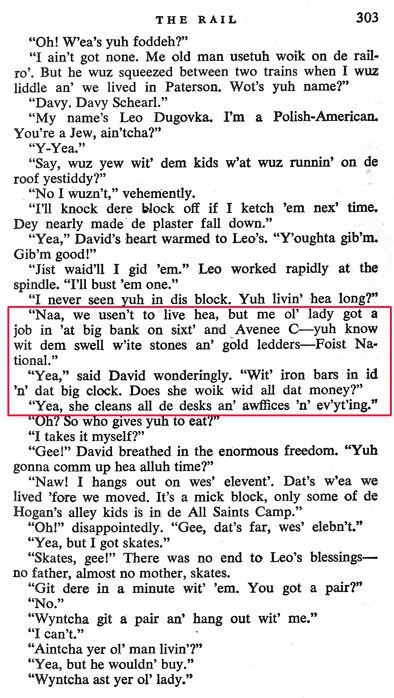
In Call It Sleep Davy meets Leo whose mother works in the Public National Bank on 7th Street and Avenue C

The Public National Bank of New York Building in the East Village is a highly unusual American structure displaying the direct influence of the early-twentieth ­century modernism of eminent Viennese architect/designer Josef Hoffmann. Built in 1923, the bank was designed by Eugene Schoen (1880-1957), an architect born in New York City of Hungarian Jewish descent, who graduated from Columbia University in 1902, and soon after traveled to Europe, meeting Otto Wagner and Hoffmann in Vienna.
Although little remembered today other than as a furniture designer (whose objects are highly sought by collectors), Schoen was for the first half of the twentieth century in the forefront of modern American design, a revered contemporary of many well-known colleagues. He practiced architecture primarily from 1904 until 1925, when he was said to have been inspired to become largely an interior designer after attending the international exposition in Paris, opening his own New York gallery. The New York Times at his death stated that “Schoen was regarded as one of the leading exponents of modern architecture and design and as such helped to develop the movement here.”
This was one of the many branch banks that Schoen designed between 1921 and 1930 for the Public National Bank of New York (Public National Bank & Trust Co. of New York after 1927), which had its headquarters on the Lower East Side. Originally two stories, the structure had a monumental ground-story banking floor and upstairs offices. Clad in light grey granitex (having the color and texture of grey granite) terra cotta (recently painted) above a polished grey granite base, it was designed with an angled corner bay with the entrance, flat capital-less fluted pilasters, and a broad, highly stylized molded cornice with a lower band with bosses, the latter features direct references to Hoffmann’s work.
The entrance is surmounted by notable polychrome Viennese-inspired terra­cotta ornament in the form of a decorative band above which is a cartouche with a wreath of fruit (which originally held a clock) above an eagle, flanked by curvilinear forms and decorative urns. The building’s terra cotta was manufactured by the New York Architectural Terra Cotta Co. Sold in 1954, the building was converted into a nursing home, with the addition of an intermediate floor, and into apartments in the 1980s.

Tuesday, June 15, 2010

Henry Roth On The Lower East Side 4

roth-bio
from Redemption: the life of Henry Roth By Steven G. Kellman and here I thought I was such a "big macher" because I figured out where Roth lived on the les when the information was available in his biography! Last night I heard a discussion about Roth's last book, An American Type . I have to admit I just don't get why Call It Sleep is considered such a masterpiece. There all kinds of reasons given by the panelists as to the motivation for his later writings. The discussion last night barely touched upon the aspect of Roth's life cited below. No wonder he was seeking redemption! By many accounts Roth wasn't the great guy that his editor, Robert Weil, was describing. For most people it is tough to rise above a brutalized childhood (Roth's father) to become the sweetheart that Weil encountered. An excerpt from the nyobserver
A Sister's Angry Letter Unravels Roth Incest Tale, By Elizabeth Manus, May 17, 1998
Did the late Henry Roth, like Ira Stigman, his fictional alter ego in the four-volume autobiographical novel Mercy of a Rude Stream , carry on an incestuous relationship with his sister? A newly revealed letter written to Roth by his younger sister, Rose Broder, and a curious contract agreement between the two, may finally help settle that question. The true nature of Roth's relationship with his sister–hinted at by Roth, tugged at by critics–has been pointed to as the reason for the decades-long writer's block that followed Roth's 1934 publication of the classic Call It Sleep . While finally writing, in veiled form, about brother-sister incest in 1995's A Diving Rock on the Hudson may have unblocked Roth's creative spirit, it unblocked something else in his sister. So troubled was Broder by the portrayal of Ira's lustful relationship with his younger sister that she threatened to sue Roth and his publisher, though it was unclear on what grounds. Eventually, Broder released Roth from the threat by accepting $10,000, and something of arguably even greater value: his agreement to edit out sibling incest material from the already written manuscripts of the remaining two volumes of his opus.

Saturday, June 12, 2010

Henry Roth's Sleepy Serenade


As mentioned before, I believe Roth may have lived at 749 E. 9th Street. The second image is of Henry with his father Hyman, his mother Lena and his sister Rose. It was taken in 1911.
Other images are representative of that era and area of the les from Berenice Abbott
below
an excerpt from the nytimes
Breathing Life Into Henry Roth
By CHARLES McGRATH
Published: May 23, 2010
The writer Henry Roth was a tortured, hard-luck case who at the end life enjoyed an unexpected redemption. Blocked for decades, full of doubt and self-loathing, he began writing again in his late 80s, even though crippled by rheumatoid arthritis, and finished four new novels, two of which he lived to see into print before his death in 1995. Now, almost miraculously, there is a fifth, “An American Type,” which W. W. Norton will publish on June 7.
That the book exists at all is largely due to the efforts of Willing Davidson, a 32-year-old fiction editor at The New Yorker, who in background and bearing couldn’t be less like the prickly, self-doubting Roth, but nevertheless felt a deep connection to his life and work.
“An American Type,” like everything Roth wrote, is autobiographical, and describes a trip he made to the West Coast and back in 1938, hitchhiking and riding on freight trains for part of the way. It’s by far the sunniest thing Roth ever wrote and ends with the marriage of Ira Stigman, his fictional alter ego, to a character called M, a stand-in for Muriel Parker, a composer who was married to Roth for 51 years of Job-like hardship.
Roth’s first novel, “Call It Sleep,” is now considered a classic, a luminous evocation of a Jewish immigrant childhood on the Lower East Side; but when it came out in 1934, it sold poorly and was attacked by left-wing critics for being too artsy and politically unaware. A chastened Roth, then an ardent Communist, determined to write a proletarian novel and worked on it unsuccessfully for years before finally burning most of it. In 1964 “Call It Sleep” was reissued in paperback, and in a front-page essay in The New York Times Book Review the critic Irving Howe called it “one of the few genuinely distinguished novels written by a 20th-century American.” Roth, however, tried to dissociate himself from the novel. “The man who wrote that book at the age of 27 is dead,” he said. “I am a totally different man.” He was living in self-imposed exile in rural Maine, where after a series of odd jobs and a stint as an attendant at the state mental hospital he was working as what he called a “waterfowl dresser,” slaughtering and plucking ducks and geese. He hadn’t published a word in years.

Henry Roth On The Lower East Side 2

roth-les-2                                                            
selected pages from Call It Sleep that reference the 9th Street and Avenue C and D area