Early History in America
In 1807, Thomas Jefferson had congress pass the Embargo Act of 1807 which forbade all international trade to and from American ports, and Jefferson hoped that Britain and France would be persuaded of the value and the rights of a neutral commerce. This was the end of importing lead shot from England, France and the rest of Europe where shot towers produced tons of shot for American export. European shot towers had sprung up all over Europe after the construction of the first shot tower by William Watts in 1783 in Bristol, England and the American colonies were major buyers.
With this turn of events (Jefferson's embargo), shot towers began to be constructed in the colonies for American consumption. The first two were in Philadelphia (Sparks Shot Tower) in 1808 and the Jackson Ferry Tower in Wytheville, Virginia in 1807. Both these towers produced shot and bullets for the War of 1812. The Sparks Shot Tower in Philadelphia is the first "smoke stack" type tower in America. The tower produced tons of ammunition during the War of 1812 and the Civil War. Four generations of the Sparks family kept the tower in operation until 1903. The tower is now part of a city playground with a recreation center at the base. It's a prime example of Philadelphia's reputation for superb brickwork. The operation was completely above ground while the Jackson Ferry Tower in Wytheville, built one year earlier, has much of it's drop underground. The combined drop (above and below ground) of the Jackson Ferry Tower is 150' with the above ground rectangular tower standing 75 feet and the underground shaft another 75 feet.
In 1774 Thomas Jefferson purchased 157 acres of land including the Natural Bridge in the Shenandoah Valley of Virginia from King George III of England for 20 shillings. Later, Jefferson himself used the "Watts Method" of making shot by dropping molten lead from the top of the Natural Bridge into the stream below. That small stream is Cedar Creek.
Early shot towers where found in the New England states in the early 18th century and flourished in New York, Pennsylvania and Virginia, where they were used in the manufacture of lead shot for shotguns.
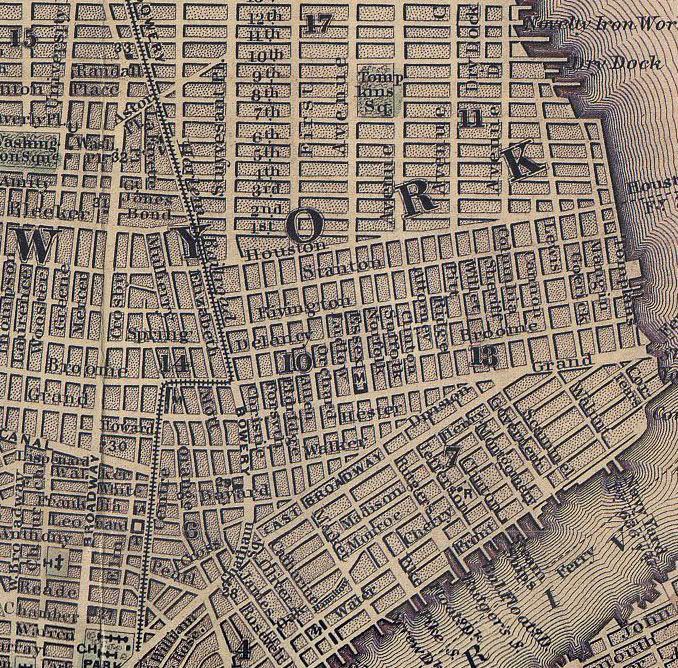
An example of a shot tower was the Youle Shot Tower, built around 1830 on the banks of the East River, beyond Kip's Bay on Manhattan Island in the state of New York. The owner, George Youle, was a dry goods merchant. This particular shot tower operated for years and was quite productive, selling much of its inventory to hardware and sporting goods dealers in New York and Pennsylvania. In turn, the dealers supplied the Indian Bureau, the American Fur Trade and a number of suppliers in the south and west.
About shot towers
Early History in England and Europe and the story of William Watts
British forces had been issued lead shot for their muskets but because of imperfections in manufacture, much of it suffered from pockmarks on the surface, making it inefficient and even dangerous. Then in 1783, William Watts of Bristol, UK took out a patent for his new technique, a process "for making small shot perfectly globular in form and without dimples, notches and imperfections which other shot hereto manufactured usually have on their surface". Up until this time shot had been produced in 8-10 cavity molds. This very time consuming.
What's the shape of a falling raindrop? We like to sketch raindrops with a tear-drop shape. Actually, they're spherical. Once they've fallen far enough, surface tension has pulled them into the shape with the least surface. That's a sphere. In 1782 an English plumber named William Watts saw possibility in that. He realized that if he dropped molten lead far enough through the air, it, too, would form into spheres.
The surface tension of lead is a lot higher than that of water, so it forms very perfect spheres indeed. He saw that he had a new way to make buckshot. Watts went back to his brick row house in Bristol and began adding floors to it. It was already three stories high. He doubled that, He put some castle-like trim on the top and called the design Gothic. He wanted his neighbors to like the addition, but the real action was inside his strange new home.
He knocked holes through each of the floors inside and put a water tank at the bottom. At the top, he poured lead into a sieve. The lead formed into spheres as it fell six floors. By the time the drops hit the water below, they'd started to solidify. The water caught and cooled them the rest of the way. Up to then, most shot was cast. That was very labor-intensive. Shot was also made by pouring lead into a sieve over a barrel. That really did give tear-shaped drops. Before Watts, no one had yet realized that a much longer fall would give spheres. Watts saw how he might greatly cut the cost of making high-quality shot. Then he gambled his home that it would work. And it did. Shot towers like his sprouted all over England and Europe.
Yet the process changed little. Shot makers added an up flow of air, and they invented ways to sort out deformed shot. Yet Watts old patent still gave a pretty good description of 20th-century shot-making. In fact Watt's old house -- his original shot tower -- kept producing shot until 1968. Watt's invention teaches us the two essential elements of good invention. The first is perception. Watts gazed more closely at nature and saw what other people had missed. The other element is simplicity. Others had labored to control the process with their own hands. Watts had the grace to stand aside and let nature do the work for him. The real beauty of this process is that, in the end, there is no human process at all.
from NYPL Digital Gallery, The New York Public Library



 Posts
Posts