Another local gang of the Lower East Side, the Shirt Tails of Corlear's Hook, most likely fought with the Cherry Hill gang, the Batavia Street gang, or maybe even bothYou can read more about the Batavia's foiled robbery in the The American Metropolis. The Tweed bio referenced above is called "Boss Tweed: The Story of a Grim Generation."
We're finally stepping away from the grime of the late 19th century, but not before giving a little shout-out to possibly one of my favorite gangs of the era, the Cherry Hill Gang.
Not much is known about them -- street gangs don't traditionally leave exhaustive archives about themselves -- but current descriptions usually use one word to describe them : dandies.
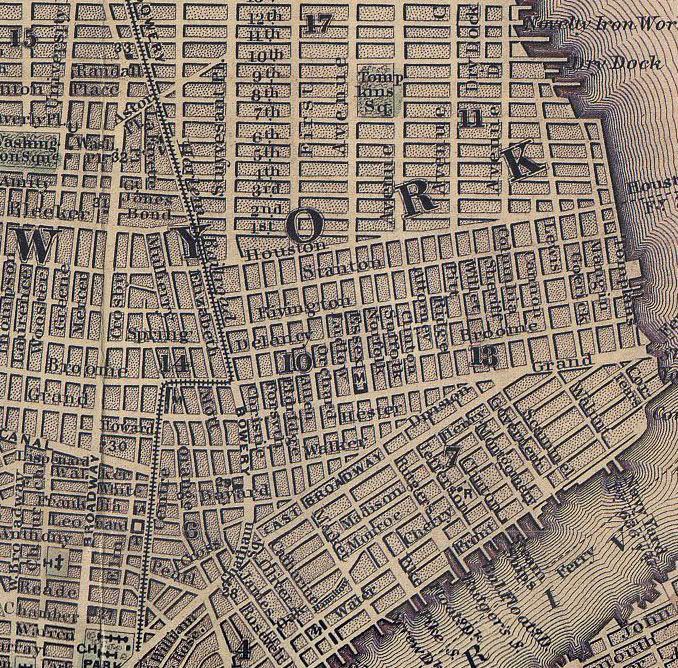
Cherry Hill was the decrepit neighborhood near the waterfront in the Fourth Ward, lined with tenements as awful (and sometimes worse) as the ones in Five Points. Its resident mix of Jewish and Italian suffered the same conditions as those in other poor neighborhoods, and hard times dealt its share of saloons, prostitution, crime and ruffians.
An early variation of the gangs of Cherry Hill included young William 'Boss' Tweed as their leader. According to an early bio on Tweed, the Cherry Hills rivals were the boys on Henry Street, just three blocks away. According to author Denis Tilden Lynch, it was important to stay clean on your turf and spar on somebody elses:
"A gang, to survive, must be peaceful in its own neighborhood. Its petty offenses are invariably directed against peaceful citizens of distant streets. Piracy would never have been an honored profession if the black flag flew only in home waters."
By the 1890s, the "roughs" of Cherry Hill had literally re-tailored themselves. To rob the rich, one must be able to mingle with them convincingly. So the Cherry Hill gang was known for their impeccable dress sense, their stolen funds apparently used to acquire elegant, dressy outfits of the day. Topping these foppish costumes were walking sticks tipped in metal to better thwack an unsuspecting victim.
The Bowery Boys of the 1850s and 1860s were also known as sharp dressers; however their dress sense reflected their well established reputation and political power. The Cherry Hills meanwhile dressed for success merely to infiltrate rich neighborhoods and rob unsuspecting gentlemen. And apparently to intimidate local rivals.
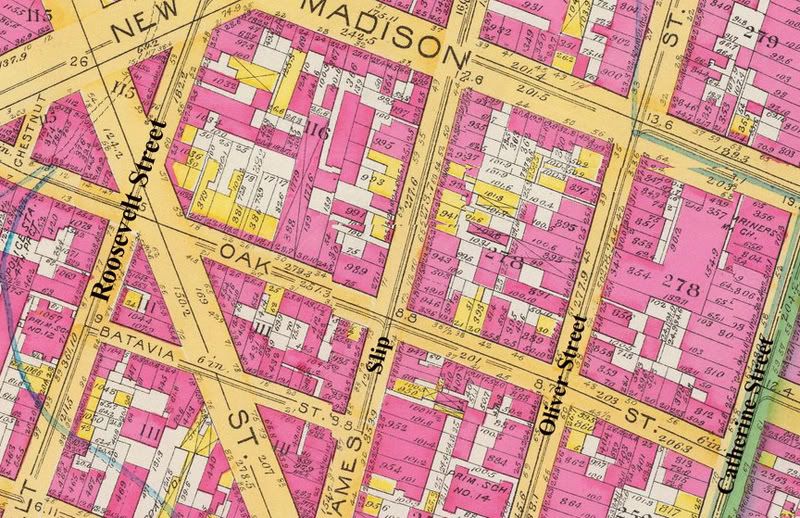
The primary rival of the Cherry Hill gang was the local Batavia Street gang. Batavia Street was a former street in the same area, "in the shadow of the Brooklyn Bridge" and apparently in one account was "the most [Charles] Dickensy street in New York." (It's also referred to in some accounts as Batavia Lane, but the Batavia Lane Gang doesn't sound very menacing, does it?)
Like some Gilded Age variation of West Side Story, the Cherry Hill gang and the Batavia Street gang were set to meet on the dance floor of New Irving Hall (once located on 214 Broome Street). Lower East Side balls in the late 19th century were modeled after their upper class variations, but were far rowdier and certainly more fun.
The Cherry Hill gang were set to dazzle in their finest ensembles, certainly intending to steal the show (if not steal more material things in the process). The Batavias would not be outdone but were desperately broke. After the pawning of a stolen gold watch from Herman Segal's jewelry shop failed to produce enough cash for fancy new threads, the jealous gang returned to the jewelry store and simply smashed the window in, running off with 44 gold rings "worth from $3 to $45 dollars apiece.
The Batavias were eventually captured -- while trying on their newly bought suits, no less, on Division Street -- and thrown in the Tombs. Apparently the Cherry Hill gang attended the ball as planned. They would eventually go on to influence the dress sense of other street gangs. New York has changed so drastically in the 110 years since the New Batavia ball, but it's nice to see that the superficial love of fashion has never been altered.
Showing posts with label bowery boys. Show all posts
Monday, July 25, 2011
More On Batavia Street And The Batavia Street Gang
From the bowery boys
Labels:
batavia street,
bowery boys,
gangs of new york
Sunday, January 2, 2011
Monday, January 4, 2010
Bull's Head Tavern: Then And Now

from the bowery boys
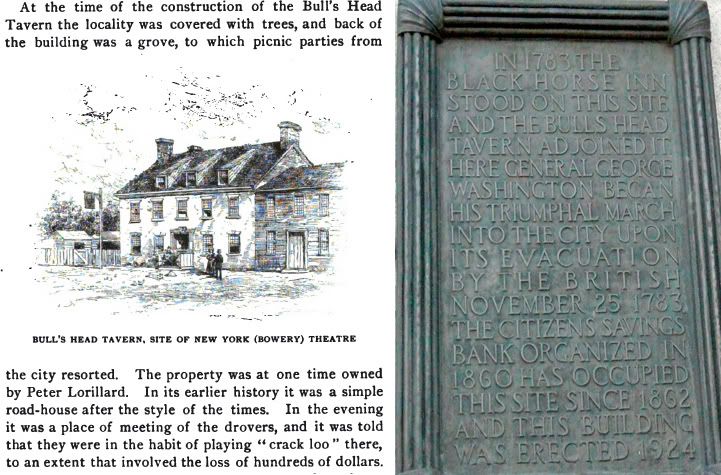
The Bull's Head Tavern was the gathering-place for farmers, drovers, and merchants in the 18th century, located well outside city boundaries just east of Collect Pond. (At the Bowery, right at the entrance to the Manhattan Bridge.)
It soon became the center of Manhattan's entire meat selling and rendering industry, with the area surrounding the nearby Collect overrun with tanneries and slaughterhouses. As the Bull's Head was also located right on the Boston Post Road (later the Bowery), situated at a crossroads of livestock yards and stables, it became an ideal place for both commerce and carousing.
The Bull's Head was in operation as early as 1755, enjoying business as "the last halting-place for the stages before entering the city."
Within the next few decades, industry enveloped the area, transforming the Bull's Head into a cattle market, with pens adjoining the main building where farmers from the surrounding area herded their best specimens for sale. Inside the tavern became a literal stock market, with transactions, news and gossip being shared over brew and a hot meal. Those who lingered well into the night sometimes played a strange game called crack loo -- often gambling away any profits they might have made earlier in the day. Out in the pen, dog fights and "bear baiting" sometimes occured as entertainment.
As Washington Irving describes, at the Bull's Head he would "hear tales of travelers, watch the coaches and envy the more pretentious country gentlemen in Castor hat, cherry-derry jackets and doeskin breeches."
On November 25, 1783, Evacuation Day, the Bull's Head entered history. As the British fled New York that day, George Washington and his entourage met at the Bull's Head, preparing themselves for their triumphant entry into town. Governor George Clinton and over 800 uniformed troops and townfolk gathered right outside, preparing for the procession.
Henry Astor, the older brother of John Jacob, stepped in as owner of the Bull's Head in 1785. Already an accomplished butcher, Henry served his "celebrated cuts of meats" and often outpriced his own clientele when a particularly choice herd of cattle came travelling by.
Of course, New York was outgrowing its old boundaries by then. By 1813, Collect Pond had been drained and high society eyed the Bowery, sweeping away the filthy stockyards and factories to construct homes, shops and theatres. Moving with the changing times, some civic minded businessmen bought out Astor and moved the Bull's Head somewhere safely outside the city -- this time at 3rd Avenue and 24th Street!
In 1830, this new location fell into the hands young rancher and entrepreneur Daniel Drew, who turned the tavern into a sort of bank, marketplace and social club for local cattlemen, upgrading the establishment and building his own reputation as a saavy financier.
As this time, according to an old history, "various types of men mingled in the bar-rroom of the Bull's Head, from the rough country man to the speculative citizen, butcher and horse-fancier. Plain apple-jack and brandy and water... were the principal liquors passed over the bar. Guests were so numerous that at the first peal of the dinner-bell. it was neccessary to rush for the table or fail miserably." And of course, after hearty meal and vigorous drink, came the gambling, "throwing dice for small stakes."
Drew eventually went on to become a steamboat mogul. The location of the old Bull's Head became the notorious Bowery Theatre. It's uptown location on 24th, of course, caved in to a growing residential neighborhood. However, today there is a new Bull's Head Tavern, at that exact location, that probably smells a lot better than the original.
And not to forget, there was also a Bull's Head Tavern in Staten Island, at Victory Boulevard and Richmond Avenue. Built in 1741, this Bull's Head was a popular destination for British-loving Tories before the days of the Revolutionary War. Before it was destroyed in a fire, "people from all over the country made special trips to the old house, just to see the famous Tory headquarters," according to one old history.
The neighborhood that sprouts around that intersection at Victory and Richmond is named Bulls Head in the old tavern's honor.
Subscribe to:
Posts (Atom)