Showing posts with label prohibition. Show all posts
Showing posts with label prohibition. Show all posts
Sunday, January 23, 2011


Saturday, March 13, 2010
Friday, March 12, 2010
Prohbition, Rum Runners And Crooked Agents
from modern mechanix
A Chicago bootlegger recently remarked that there was at least one honest official in that town—Pat Roche, chief investigator for the State’s Attorney—who couldn’t be “fixed.” For eight years Roche was a special agent for the treasury on the trail of crooked dry agents. He tells here the inside story of the rum runners, and why they flourish. by PAT ROCHE, Former Special Agent – U. S. Treasury
IN TWO weeks’ time a few years ago, on the strength of a set of credentials purporting to show that I was a prohibition agent, I had $85,000 in bribes handed me as my share of the money being paid a small ring of dry agents in New York.
“Important money,” as the gangsters call thousand dollar bills when handed out in fist-fuls, can be had at any time, usually without even the asking, by any official of the prohibition or customs services. Less important money can be had by any of untold thousands of policemen, sheriffs, deputies, highway patrolmen, state policemen, township constables and politicians—everybody, in fact, who comes in contact with the vast business of transporting and selling liquor.
Is it any wonder that enough of them fall for the graft to make the liquor business a fairly safe gamble? Most of the men who can make anywhere from $100 to $100,000 by turning the head or being in the wrong place at the right time are earning in the neighborhood of $50 to $75 a week.
I was never a bona fide prohibition agent, but for eight years I was a special agent of the treasury department working, chiefly, to trap crooked dry agents. To do that we usually had to trap the bootleggers and rum runners with whom they dealt, so I saw plenty of the inside of the rum game.
If you draw a line around the United States, about 250 to 300 miles back from the border, you have marked off the chief rum running territory. In the vast hinterland the local moonshiner, the cheating druggist, the home brew maker, and the peddler of poisonous extracts and concoctions is the chief source of supply for intoxicants.
But within a night’s automobile ride of the rum ships along the coast, the export docks of Canada—which are now going out of business—and the Mexican border is the habitat of the rum runner and the big time bootlegger.
It costs, or has cost while the export docks along the Detroit river flourished, about $20 to grease the way for a case of liquor to reach Chicago. Five dollars went to the boatman who ferried the case across the river; $5 to the guard who let it slip past the border, and $10 smoothed the way through Michigan and Indiana into Chicago.
A case of standard brands of Scotch, in 40 ounce, imperial quarts, commission wrapped—that is, bearing the seals and wrapping of the Quebec Liquor Commission—costs $65 in Canada. Add $20 for graft, and the cost of running the liquor down by automobile, 20 cases to a load, and the case costs about $87, delivered in Chicago. The market price is around $125 to $135, depending on the supply.
But you can buy commission wrapped Scotch in Chicago for $55 to $65 a case! The answer is cutting plants, fake labels, fake stamps, and fake wrapping. The Quebec Liquor Commission has a special wrapping paper, with red, blue and green threads woven into it, just like the American treasury notes. But we have seized vast quantities of counterfeit paper that couldn’t be told from the genuine if we didn’t know the liquor commission controlled all the genuine supply.
The cutting plant buys large quantities of genuine liquor from the runners, opens the bottles, and adds an equal part of alcohol and an equal part of water, making three cases out of one. Flavoring and coloring matter also are added to bring the taste and appearance up to the original. Bottles, either purchased new from glass plants which make them to order and duplicate any foreign product in shape, size and appearance, or bought from old bottle dealers who have built up a market for empties, are used. The finished product can not be told from the original.
If the alcohol used in cutting is pure grain, the product itself is no more harmful than the original pure liquor. If it is re-cooked denatured alcohol its harmfulness depends on the skill of the cooker and the state of his equipment. Nobody can remove the government formula denaturants completely, for their evaporation point is too near that of pure alcohol, and some is bound to pass over with the alcohol vapor to be condensed.
An expert cooker can produce a product that is virtually harmless, but so few of them are expert, and, working in dirty basement hideaways, with dirty equipment, they actually cook into the product poisons that were not there before.
Low grade alcohol, produced from corn sugar or other sources, is also largely used in faking real liquor. There again the dirt and poisons from insanitary equipment are the chief source of danger.
Counterfeit American brands have virtually disappeared, and with them has disappeared the counterfeiting of internal revenue strip stamps on a large scale. A certain amount is still made, and only yesterday 17 men, including 11 from Chicago and three from New York, two from Milwaukee and one from Rock Island, were sentenced in a Chicago federal court for that crime.
I broke up one of the biggest counterfeiting rings in history here in Chicago a few years ago and for a time put fake strip stamps off the market.
The tricks by which liquor is slipped past the borders and moved to the nearby cities are legion. It’s a pretty safe bet, though, that tricks alone don’t move one case in 100. Somewhere along the route graft must be paid.
Automobiles are largely used to bring liquor into Chicago. Standard sedans are turned over to expert body builders who specialize in building hidden compartments. A standard five passenger sedan can be altered to hide twenty cases of 12 bottles each, without any of the secret compartments being visible, even under close scrutiny. That’s 240 quarts, and it seems almost impossible to hide that many bottles in the backs of the seats, the sides and the roof of a car without causing undue bulging, but it is being done right along.
The tricks along the sea coast are equally unique. Just the other day a fishing boat came into New York, apparently with a solid concrete ballast in the hold. Dry agents who ripped out the concrete found it was only a thin floor, with a fortune in liquor under it. Some liquor, after it reaches this country, is shipped by rail as freight in large lots, or as express in small quantities. The usual express dodge is to pack six bottles in a tin can, solder it tight, so if one is broken it can’t leak, and pack two tins to a box. The shipper has labels printed purporting to show he is a dealer in radio parts, printing plates, or some similar product that would be shipped in boxes of about that size and weight. The buyer pays cash in advance. If the shipment is detected and confiscated by government agents, it is the buyer who loses his money.
Tuesday, March 9, 2010
Murder By The Drop: The Poisoner's Handbook

A recent book, Murder by the Drop By ELYSSA EAST, discusses the government's complicity in the alcohol poisoning during prohibition,
from a recent nytimes article
At the beginning of Deborah Blum’s “Poisoner’s Handbook,” a murderer named Frederic Mors gets off virtually scot-free after confessing to multiple killings by poison, then disappears without a trace. Though Blum leaves the reader with the impression that Mors — whose adopted surname means “death” in Latin — will return, she never comes back to his story. But death moves throughout her latest book via myriad poisons administered by impatient heirs, unhappy spouses and psychopaths — or innocently ingested, because the science of forensic toxicology has not yet caught up with these deadly chemicals.
To further complicate the situation in this rich history of the development of forensics in New York, which spans the years from 1915 to 1936, Tammany Hall’s corruption has spilled over into one of the grittiest public service jobs, that of coroner. The city’s early-20th-century coroners were notorious bunglers known to appear in court with whiskey breath and to leave crime scenes with palms freshly greased with graft (they would regularly falsify death certificates). Murderers roamed free until enough political will was mustered to implement a new medical examiner system in 1918.
Into this office strode Dr. Charles Norris, the blue-blooded son of a banking power couple, who could easily have chosen a life of leisure over one of public service, and his appointee Alexander Gettler, a forensic chemist with a penchant for gambling, the cigar-chomping progeny of a Hungarian immigrant. Norris and Gettler, Blum’s heroes in white coats, formed a duo whose innovative lab work remains significant. The fruits of their labors helped advance government policy and the science of forensics, and have saved countless lives from exposure to previously hard-to-detect toxic substances like thallium and to the then unknown deadly side effects of radium (once a crucial ingredient in a popular health tonic called Radithor: Certified Radioactive Water).
“The Poisoner’s Handbook” is structured like a collection of linked short stories. Each chapter centers on a mysterious death by poison that Norris and Gettler investigate, but the reader never gets to know these principals well enough to find out what drives their tireless devotion to scientific inquiry. Instead, Blum lavishes her attention on her chosen villains — the poisons — and their deadly maneuverings through the body. A Pulitzer Prize-winning science writer, she provides the gruesome particulars of autopsies and laboratory work — like the pulverizing of organs and the boiling of bones — and a variety of chemical tests. With descriptive talents and a knack for detail, she introduces us to lively killers. One, carbon monoxide, is a “chemical thug” that works “by muscling oxygen out of the way.”
Speakeasies Redux
Speakeasies
an excerpt from a 2009 nytimes article on speakeasies,
an excerpt from a 2009 nytimes article on speakeasies,
Bar? What Bar?, By WILLIAM GRIMESON, a nondescript block in Williamsburg, not far from the Brooklyn-Queens Expressway, a new bar and restaurant called Rye opened last week. Try to find it.
There’s no sign out front. The facade, an artfully casual assemblage of old wooden slats, gives the place a boarded-up, abandoned look. It does have a street number, painted discreetly on a glass panel above the front doors, but that’s it. Like a suspect in a lineup, it seems to shrink back when observed.
There are a lot of bars like this right now. They can be found all over the United States, skulking in the shadows. Obtrusively furtive, they represent one of the strangest exercises in nostalgia ever to grip the public, an infatuation with the good old days of Prohibition.
Their name is legion: the Varnish in Los Angeles; Bourbon & Branch in San Francisco; Speakeasy in Cleveland; the Violet Hour in Chicago; Manifesto in Kansas City, Mo.; Tavern Law in Seattle (scheduled to open later this month). Everywhere, it seems, fancy cocktails are being shaken in murky surroundings.
New York has fallen hard for this fad. Sasha Petraske, the cocktail artist behind Milk & Honey, has just opened Dutch Kills on a bleak commercial strip in Long Island City, Queens. A small sign that says “BAR” is the only tip-off to its existence.
At the Hideout, in Fort Greene, Brooklyn, aspiring customers ring the bell at a forbidding-looking garage door and then stand there as a pair of eyes scrutinize them through a 1920s-style peephole.
The ultimate in speakeasy mystification takes place at PDT (Please Don’t Tell) on St. Marks Place in the East Village. Patrons have to enter through Crif Dogs, the hip hot dog place, then step into a phone booth and identify themselves by speaking into the receiver. A buzzer opens a secret door, revealing a strange, twilight world where artisanal cocktails are consumed under the watchful eyes of a stuffed jackelope and raccoon, and a bear wearing a bowler hat.
Whoopee!
“Speakeasy is a funny term, since the business is legal,” said Eric Alperin, a partner and head bartender at the Varnish. “What people are referring to is the allure, almost like an opium den.”
Brian Sheehy, an owner of Bourbon & Branch, agreed. “People have an affection for this period of American history, and they want the mystery,” he said. To enhance the backroom ambience, Bourbon & Branch assigns customers a password, to be spoken into an intercom, when they make a reservation. Once inside the bar, customers are expected to abide by house rules. “Speak easy,” is one of them, enforced by bartenders when necessary.
Password or no password, deluxe or down-low, all these bars have something in common. None of them really resemble an actual speakeasy from the 1920s, although Bourbon & Branch, oddly enough, sits on top of one, reached through a trap door leading to the basement.
A little history, please.
Prohibition, which took effect in January 1920 and finally ended in December 1933, was the worst cocktail era in the history of the United States, for obvious reasons. Half the liquor was homemade or adulterated, forcing the great classic drinks of the early 20th century to exit the stage. In their places appeared cocktails designed to mask poor ingredients, like rye and ginger ale, or the Alexander, a repellent mixture of gin, crème de cacao and cream.
“The basic raw materials then available, and I use the term raw advisedly, made it imperative that they be polished or doctored or decorated,” Frank Shay wrote in a 1934 Esquire article bidding farewell to the Great Experiment. “Also it was essential that their rougher edges be smoothed down in order that they might pass to their true goal without too great distress to the drinker.”
Division Street Speakeasy: 1932
Alcohol Poison 1932
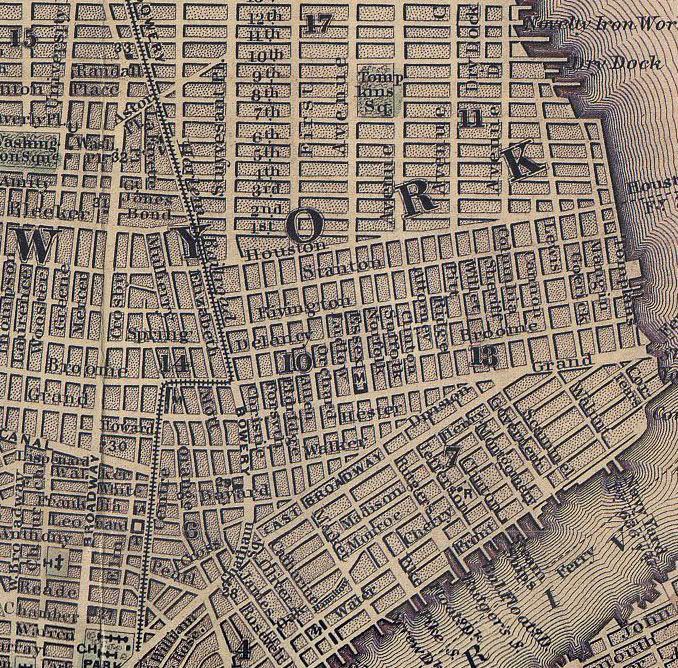
by 1932, the East Broadway, 10th Ward area is no longer fancy. Many local residents were dying of alcohol poisoning.
by 1932, the East Broadway, 10th Ward area is no longer fancy. Many local residents were dying of alcohol poisoning.
Subscribe to:
Comments (Atom)


 Posts
Posts