Monday, January 31, 2011
Triangle Shirtwaist Commemoration 2010: Suzanne Pred Bass Speaks Of Her Aunts
Video I had uploaded but had forgotten to post here. I'm probably wrong about the Eldridge address. Evidently Rosie was living at 119 St, Marks Place and not 119 E. 8 St.


Kitty O'Neil's Champion Jig
Some info from youtube on this and another version of the song
This interesting piece, being unusual with 7 lines of non-repeated themes, comes from Ryan's Mammoth Collection. In it we hear lots of the "Banjo Licks" common in the tutors. Correct me if I'm wrong, but isn't the last one part of the "Dick Van Dyke" TV show from the 60's?
Love your playing of this tune. I suspect it’s about as historically accurate as any I’ve heard, considering your source and the instrument you play. Well done!
You’re probably already be aware of this, but the tune survives in the current repertoire of Irish traditional musicians under the name of Kitty O'Shea’s. Two notable recorded sources are by Tommy Peoples and Kevin Burke.
Kitty O'Neil, the tune's namesake, was a popular New York-based dancer and singer of the 1870s and '80s.
One such melody is “Kitty O'Neil's Champion Jig,” an elaborate, seven-part fiddler's showpiece that has been revived in recent years by Irish traditional musicians on both sides of the Atlantic. Despite the tune's Irish-sounding name and its adoption into the contemporary Irish repertoire, “Kitty O'Neil's Champion” is actually a hardy survivor from 19th-century American minstrelsy and variety theater.
Kitty O'Neil, the tune's namesake, was a popular New York-based dancer and singer of the 1870s and '80s. The revival of Kitty’s “Champion Jig” hasn't done much to revive her reputation, however, because the tune has become widely known as “Kitty O'Shea,” the title under which it mistakenly appeared on a recording by Donegal fiddle great Tommy Peoples, who started playing the tune in concerts during the 1970s and included it on his 1982 LP The Iron Man.
Kitty O'Neil And Wood's Minstrel Hall
Kitty-O'Neil
In the previous post where the Autobiography of a Thief is viewable the protagonist mentions on p 13 (17) that he had gone to Wood's Minstrel Hall. Kitty O'Neil was a big attraction there. I guess I can see why.
In the previous post where the Autobiography of a Thief is viewable the protagonist mentions on p 13 (17) that he had gone to Wood's Minstrel Hall. Kitty O'Neil was a big attraction there. I guess I can see why.
Sunday, January 30, 2011
Hutchins Hapgood: Autobiography Of A Thief, 1905

Hutchins Hapgood, journalist and author, was born on May 21, 1869 in Chicago, Illinois.The_autobiography_of_a_thief
Hutchins Hapgood received his early education in the Alton public schools. Like his father and two brothers, he attended Harvard University, receiving the B.A. degree in 1892 and the M.A. in 1897. In the interim he spent two years in study at the universities of Berlin and Freiburg, Germany, reading sociology and philosophy, and also traveled extensively. For a time he was an instructor in English composition at Harvard and the University of Chicago. After trying his hand at various jobs, Hapgood eventually decided to become a journalist like his older brother Norman.
Charles Hutchins Hapgood had a tremendous influence upon the character of his sons. Although not a religious man, he imparted to them a strong moral sense, an abhorrence of great wealth, and a basic belief in progressive socialism. This, coupled with a liberal Harvard education and appropriate connections, led Hutchins Hapgood into the thick of muckraking journalism.
His first newspaper job was with the New York Commercial Advertiser under the tutelage of Lincoln Steffens. Here he met Steffen's assistant, Neith Boyce, whom he married on June 22, 1899.
In 1904 Hapgood became the drama critic for the Chicago Evening Post.
Returning to New York, he later became an editorial writer for the Evening Post, the Press, and the Globe. While maintaining his career as a journalist, Hapgood also wrote books. During the first decade of the twentieth century, he produced the bulk of his major works, including Paul Jones (1901), The Spirit of the Ghetto (1902), The Autobiography of a Thief (1903), The Spirit of Labor (1907), An Anarchist Woman (1909), and Types from City Streets (1910). The anonymously published Story of a Lover (1919), describing the "open" marriage which he and Neith maintained, was initially suppressed as pornographic. Hapgood's last great work was his autobiography, A Victorian in the Modern World (1933).
Hutchins Hapgood was a close friend of Mabel Dodge Luhan and an habitue of her salon at 23 Fifth Avenue. Other close friends included Bernard and Mary Berenson, Jacob Epstein, Max Eastman, Anton Johanson, Walter Lippmann, Robert Morss Lovett, Gertrude and Leo Stein, Alfred Stieglitz, Maurice Sterne, and Mark Sullivan. He and Neith were founding members of the Provincetown Players.
Hapgood's career declined following the death of his eldest child, Boyce, in 1918 and the end of the muckracking era. The last several years of his life he spent with Neith in Key West, Florida, at their home in Provincetown, Massachusetts, and on a farm in Richmond, New Hampshire.
Hutchins Hapgood died on November 19, 1944, in Provincetown, and was buried in the family plot in East Cemetery, Petersham, Massachusetts
above, an interesting account of life in the fourth ward as well as neighboring ones in the late 1800's.
Memories Of The Rag Trade In Save The Tiger, 2
a clip from an excellent movie starring Jack Lemmon and Jack Gilford
from wikipedia
Save the Tiger is a 1973 film about moral conflict in contemporary America. It stars Jack Lemmon, Jack Gilford, Laurie Heineman, William Hansen, Thayer David, Lara Parker and Liv Lindeland. The film is adapted from the novel of the same title by Steve Shagan, (the first book by the author of The Formula and other thrillers, and generally regarded to be his most successful novel by literary standards).
Jack Lemmon plays Harry Stoner, an executive at a Los Angeles apparel company on the edge of ruin. Throughout the film, Stoner struggles with the complexity of modern life versus the simplicity of his youth. He longs for the days when pitchers wound up, jazz filled the air, and the flag was more than a pattern to put on a jock-strap. He wrestles with the guilt of surviving the war and yet losing touch with the ideals for which his friends died. To Harry Stoner, the world has given up on integrity, and threatens to destroy anyone who clings to it. He is caught between watching everything he has worked for evaporate, or becoming another grain of sand in the erosion of the values he once held so dear.
Memories Of The Rag Trade In Save The Tiger
a clip from an excellent movie starring Jack Lemmon and Jack Gilford
from wikipedia
Save the Tiger is a 1973 film about moral conflict in contemporary America. It stars Jack Lemmon, Jack Gilford, Laurie Heineman, William Hansen, Thayer David, Lara Parker and Liv Lindeland. The film is adapted from the novel of the same title by Steve Shagan, (the first book by the author of The Formula and other thrillers, and generally regarded to be his most successful novel by literary standards).
Jack Lemmon plays Harry Stoner, an executive at a Los Angeles apparel company on the edge of ruin. Throughout the film, Stoner struggles with the complexity of modern life versus the simplicity of his youth. He longs for the days when pitchers wound up, jazz filled the air, and the flag was more than a pattern to put on a jock-strap. He wrestles with the guilt of surviving the war and yet losing touch with the ideals for which his friends died. To Harry Stoner, the world has given up on integrity, and threatens to destroy anyone who clings to it. He is caught between watching everything he has worked for evaporate, or becoming another grain of sand in the erosion of the values he once held so dear.

Saturday, January 29, 2011
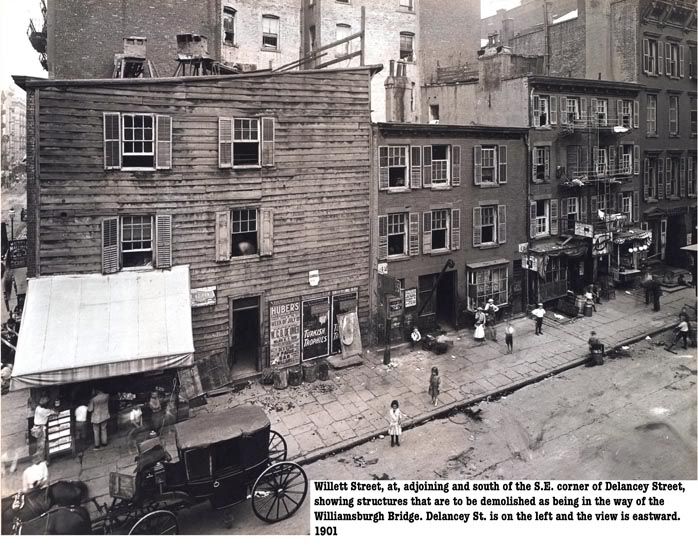
Delancey and Willett Street: 1901
Who's Almost Who In Knickerbocker Village History: Louis Sorin
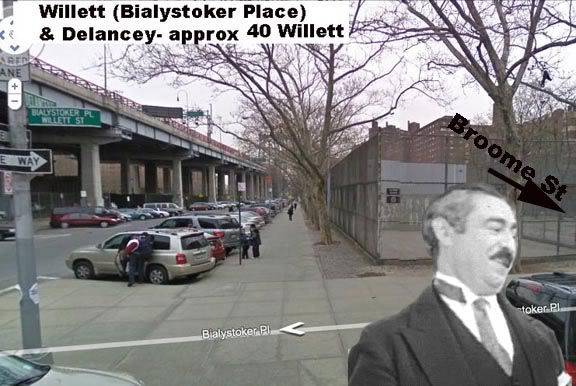
Sorin is perhaps best known to modern audiences for his performances as Roscoe W. Chandler in The Marx Brothers film "Animal Crackers" (a role he also played onstage), and as Mr. Manicotti in the 1956 Honeymooners episode "Mama Loves Mambo".
Sunday, January 23, 2011
Bobbi At Work
Subscribe to:
Posts (Atom)


 Posts
Posts