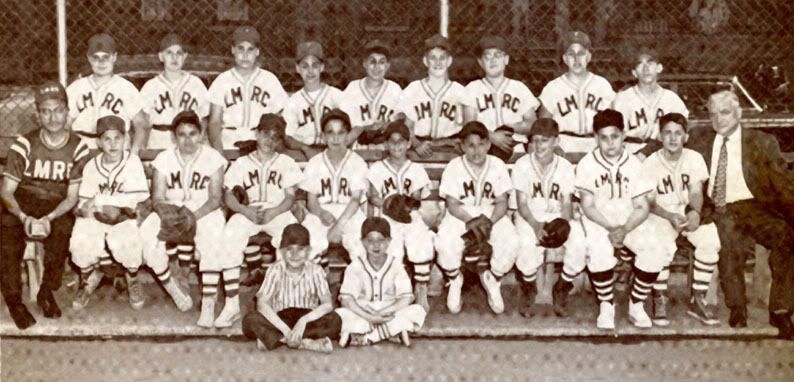
Monday, April 7, 2008
The Punchball Game
Just a one inning affair called because of a tight time schedule, cold weather and excessive bs..ing. Final score I9 led team 2, I10 team 1. Punchball should be declared an olympic event. Amazingly, for a group of 60'ish guys, a lot of them are still in decent shape. Mark Schumer is still a crafty lefty hitter, but slugger Allan couldn't lose his tennis stroke. Best accomplishment, no injuries.


Sunday, April 6, 2008
The Best Looking Mom Of Knickerbocker Village
Another highlight of Reunion 2, the surprise visit of the unofficial Knickerbocker Village best looking mom of the Baby Boomers, Natalie Sosinsky.
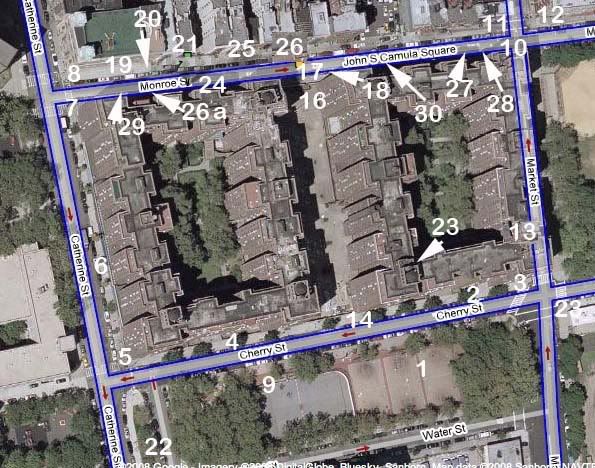


Up On The Roof (With Music)
When this old world starts getting me down
And people are just too much for me to face
I climb way up to the top of the stairs
And all my cares just drift right into space
On the roof, it's peaceful as can be
And there the world below can't bother me
Let me tell you now
When I come home feelin' tired and beat
I go up where the air is fresh and sweet (up on the roof)
I get away from the hustling crowd
And all that rat-race noise down in the street (up on the roof)
On the roof, the only place I know
Where you just have to wish to make it so
Let's go up on the roof (up on the roof)
At night the stars put on a show for free
And, darling, you can share it all with me
I keep a-tellin' you
Right smack dab in the middle of town
I've found a paradise that's trouble proof (up on the roof)
And if this world starts getting you down
There's room enough for two
Up on the roof (up on the roof)
Up on the roo-oo-oof (up on the roof)
Oh, come on, baby (up on the roof)
Oh, come on, honey (up on the roof)
Up On The Roof
The highlight of the second annual KV Reunion. Many thanks to management and especially Mr. Stephen Stanley for making our rooftop tour possible as well as to Edward, from Cambridge Security, who accompanied us.
Saturday, April 5, 2008
The Courtship Of Eddie's Father
The introduction for the second season. One of the big news stories of the Reunion 2
is the expected appearance of the real Eddie, who lived among us in Knickerbocker and played for LMRC.
Come Alive: You're In The Pepsi Generation
from pepsi
1963: In one of the most significant demographic events in commercial history, the post-war baby boom emerges as a social and marketplace phenomenon. Pepsi recognizes the change and positions Pepsi as the brand belonging to the new generation – The Pepsi Generation. "Come Alive! You're in the Pepsi Generation" makes advertising history. It is the first time a product is identified, not so much by its attributes, as by its consumers' lifestyles and attitudes.
1961: Pepsi further refines its target audiences, recognizing the increasing importance of the younger, post-war generation. "Now It's Pepsi, For Those Who Think Young" defines youth as a state of mind as much as a chronological age, maintaining the brand's appeal to all market segments.
Thursday, April 3, 2008
Norman Studer

from the nystate library at albany
Norman Studer, educator, folklorist, author, was born in Whitehouse, Ohio on September 7, 1902. In 1917, Studer left home, enlisted in the United States Navy, and served as a quartermaster aboard the U.S.S. Edgecomb. Upon the conclusion of World War I, Studer returned home to complete his high school education, whereupon he matriculated to Oberlin College. Studer spent three years at Oberlin, leaving after his third year to become an editor of The New Student – a newspaper for "the voice of the student revolt movement" in New York City. Studer eventually returned to college completing his A.B. in History at Columbia University in 1929. He continued his studies at Columbia, earning an A.M in Political Science in 1931.
In 1931 Studer embarked upon a forty-year career in education, commencing with a teaching assignment at Erie Day School in Erie, Pennsylvania. Following two years at Erie, Studer taught at the Little Red School House, a cooperative, experimental school founded by Elisabeth Irwin, located in lower Manhattan. Studer was attracted to the experimental and progressive curriculum cultivated by Irwin and the other educators at the Little Red School House. In 1941, Studer chaired the committee founding the Elisabeth Irwin High School, and worked there as both teacher and administrator for the following ten years.
Studer's association with Elisabeth Irwin proved influential in shaping his pedagogical vision, both in the classroom and beyond. While at the Little Red School House, Studer developed and taught a unit entitled "Slavery and the Negro Problem" that led to a life long interest in ethnic studies and "intergroup relations," the equivalent of the current study of multiculturalism or multicultural studies. It was also during his tenure at the Little Red School House that Studer realized the importance of field trips as an integral component of the curricular experience. Through field trips, Studer discovered that he could inform his students, in a more immediate and kinesthetic sense, of the rich history and heritage that lay just beyond the school walls. As a teacher, Studer also participated in "June Camp" – a one- month field trip to Camp Quannacut, near Pine Bush, New York – in which students lived in a democratic community within a rural environment. Studer ran June Camp from 1936-1940.
In 1938, Studer joined the staff of Camp Hilltop - a progressive educational summer camp - initially as head counselor then as director of education. Camp Hilltop closed in 1940; however, Studer, along with Camp Hilltop's former director, Rose Sydney, and three others, Regine Dicker (Ferber), Sara Abelson (Abramson), and Hannah Studer, founded Camp Woodland in Phoenicia, New York, located in the heart of the Catskill Mountains. Camp Woodland strove to create a democratic environment where children of varying religions, socioeconomic, and ethnic backgrounds from the New York City area could steep in the rich ecology of the Catskill region for two months each summer.
The curriculum and experience of Camp Woodland were deeply rooted in the folklore and folk culture of the Catskill Mountains. Norman Cazden and Herb Haufrecht were Camp Woodland's music directors. Studer attempted to incorporate the endemic culture, history, and rituals of the Catskill region into the Camp Woodland curriculum by cultivating a symbiotic relationship with the camp and the Catskill denizens. He would often take carloads of campers to visit the local residents, then invite the residents back to camp to share their regional folklore and music, as well as teach the traditional crafts of the region. The two-month summer camp concluded each season with a folk festival that brought together the campers and Catskill residents for a weekend of music, drama, dancing, story telling, and song. The folk festivals were the high point of each season and became very popular with the campers, folk musicians, and local residents. The annual event attracted luminary musicians such as Pete Seeger, Bessie Jones, Norman Cazden, and Herb Haufrecht as well as local talent that included Grant Rogers, Harry Siemsen, George Edwards, Ernie Sagan, George Van Kleeck, and Etson Van Wagner. Studer captured the folk festivals on tape, and in many instances the recordings remain the only known extant audio recordings of these local musicians playing and singing the ballads and songs of the Catskills. These recordings were later compiled, transcribed, and edited by Cazden, Haufrecht, and Studer in a book entitled Folk Songs of the Catskills. Studer was director of Camp Woodland from its inception (1940) to dissolution (1961).
In 1951, Studer became director of the Downtown Community School located at 235 East 11th Street in lower Manhattan. The Downtown Community School was a progressive, cooperative, racially integrated school, founded in 1944 by a group of parents and educators. As director, Studer attempted to create a curriculum that was aimed at promoting a healthy concept of self and a deeper understanding of society. Studer brought many of the ideas and philosophies of the Little Red School House, Elisabeth Irwin High School, and Camp Woodland to the Downtown Community School, particularly his interest in ethnic studies, folklore, field trips, and racial integration. Throughout his career as an educator and administrator, Studer championed cultural and racial integration in the educational environment. In 1956, the annual Conference on Intergroup Education – a forum for educators, parents, and community members designed to encourage inter-racial and inter-cultural education – was founded. Studer's approach to the education of children was always direct, active, and personal. He exemplified this by continuing to sponsor and steward annual field trips for the seventh and eighth grade students throughout his tenure at the Downtown Community School. Studer remained director of the Downtown Community School until 1970. The school closed in 1971.
Studer was the author of numerous articles, two books, and one poem, nearly all of which dealt with the themes of folklore and education. Folk Songs of the Catskills, edited by Norman Cazden, Herbert Haufrecht, and Norman Studer, published by SUNY Albany Press in 1982, "is an annotated volume of traditional ballads and songs collected under the auspices of Camp Woodland." Cazden, Haufrecht and Studer assiduously compiled, recorded, transcribed, and edited the songs and music over the course of forty-two years. Both Cazden and Studer passed away prior to its publication, leaving Haufrecht to see the project through to completion. The folk culture of the Catskill region was predominately transmitted orally; therefore, Folk Songs of the Catskills has to be considered the definitive treatment of Catskill folk music, as many of the informants have passed away. Also published posthumously, A Catskill Bear Hunter: Mike Todd's Story by Purple Mountain Press in 1988, is Studer's "folk biography" of Mike Todd, a Catskill native and good friend of Studer's, who spent numerous summers at Camp Woodland; he also serves as the subject of Studer's poem "All the Homespun Days," written in his memory.
Norman Studer died October 27, 1978.
Robert DeCormier
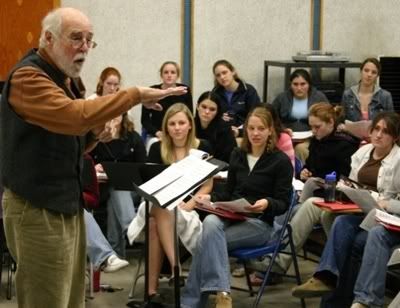
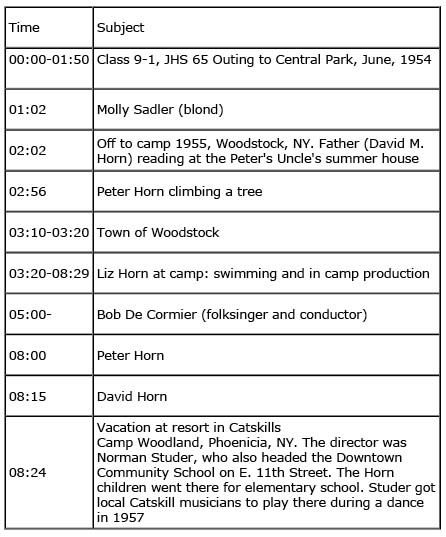
The Robert DeCormier who was conducting campers in the Peter Horn video went on to become quite famous:
from counterpointchorus
ROBERT DE CORMIER acted as music director of the New York Choral Society for seventeen years and under his leadership the group became renowned for its high standard of excellence in choral singing and unique variety of programming. As Music Director Emeritus he guest conducted a performance of the Verdi Requiem in 1990, the Berlioz Requiem at St. Paul's Cathedral, New York City in 1992 and the premiere of a commissioned work, the Missa Iona in 1993 at St. Bartholomew's in New York City.
In 1995 he began a two year project based on the music produced in the concentration camp in Terezin, Czechoslovakia. With funds generously provided by the Vermont State Legislature and Vermont Arts Council, the Vermont Council on the Humanities and the Spielberg Foundation (this was the first grant awarded by this Foundation), as well as many individual contributions, it was possible for Mr. De Cormier to mount and conduct productions of two operas from Terezin; Brundibar, a children's opera by Hans Krasa, and The Emperor of Atlantis, written by Viktor Ullmann. The operas toured throughout Vermont, Massachussetts, and New Hampshire, culminating in a performance at Merkin Concert Hall in New York City. They were the bookends of a project whose initiation was a performance of Verdi's Requiem at the Flynn theater in Burlington, Vermont, in memory of those who had performed it in Terezin.
In January, 2000 he conducted the Vermont Symphony Orchestra and Chorus in performances of the Mozart C Minor Mass, Samuel Barber's Knoxville: Summer of 1915 and PDQ Bach's Bluegrass Cantata. In March of 2000 he conducted the Buffalo Philharmonic and chorus in Arthur Honegger's King David. As part of a year long celebration of his 80th birthday he led the Vt Symphony Orchestra and chorus in two performances of the Brahms Requiem in March and July of 2002; conducted the NY Choral Society and Orchestra at Carnegie Hall in Bernstein's Chichester Psalms, Verdi's Four Sacred Pieces and his own work, Under A Greenwood Tree; and on July 20 the folk trio Peter, Paul and Mary came to Vermont to give a benefit concert for and with Counterpoint, DeCormier's 11 member professional vocal ensemble, as a birthday gift to their musical director of more than twenty years.
A graduate of the Juilliard School of Music, Mr. De Cormier's other conducting engagements have taken him from Broadway and opera to the Berkshire Choral Institute, the Zimriya World Assembly of Choirs in Israel and numerous concert tours throughout the United States and Canada with his own professional group, the Robert De Cormier Singers. He spent many years as conductor and arranger for Harry Belafonte and has been music director for the popular folk trio, Peter, Paul and Mary for the past twenty years.
In 1993 he helped found the Vermont Symphony Orchestra Chorus and Chamber Chorus and as their director he both prepares and conducts performances with the symphony. In the fall of 2000 he established Counterpoint, an 11 voice professional vocal ensemble based in Vermont. He has written several works ranging from choral to ballet to Broadway scores (music for The Wall and The World of Sholem Aleichem). His cantata, The Jolly Beggars, based on the poetry of Robert Burns, premiered in New York to critical acclaim. His ballet score, Rainbow 'Round My Shoulder, is in the active repertoire of the Alvin Ailey Dance Theater. His choral works, Legacy, Four Sonnets to Orpheus, Shout For Joy and Under A Greenwood Tree were premiered at Carnegie Hall by the New York Choral Society. Spiritual Suite, commissioned by the West Village Chorale premiered in New York in 1991 Mr. De Cormier has also arranged extensively, from African-American spirituals to American and international folk songs.
Recordings include albums of Yiddish folk material for Martha Schlamme, Natanya Davrath and Jan Peerce for Vanguard Records, four Christmas albums on the Arabesque label with the De Cormier Singers, the Kodaly Missa Brevis and Vaughan Williams' Mass in G Minor on Vox Turnabout with the New York Choral Society, Songs of Liberty for Book-of-the-Month Club with the Choral Society and the De Cormier Singers, as well as Carmina Burana for Newport Classics, Paul Alan Levi's Mark Twain Suite and De Cormier's Legacy and Four Sonnets to Orpheus for Centaur and an album of Christmas music with Jessye Norman for Philips. A recording of John Dowland's music, Awake, Sweet Love with Julianne Baird and the DeCormier Singers was released by Arabesque in 1992 and Noel We Sing with the Choral Society was a Musical Heritage release in 1994. Recent Arabesque releases include Oh, You Beautiful Doll, early twentieth century popular American songs, Children, Go Where I Send Thee, international Christmas songs, two operas from the Terezin concentration camp in Czechoslovakia; Brundibar, a children's opera by Hans Krasa and The Emperor of Atlantis, composed by Viktor Ullmann. The Jolly Beggars, De Cormier's settings of Robert Burns' poetry was released by Arabesque in May, 1998.
Counterpoint recordings include A Counterpoint Christmas released by Choral Excellence, When the Rabbi Danced and Misa Criolla on the Albany label and two new CD's, Shir La Shalom (Sing for Peace) and Counterpoint Sings Noel, due for release by Albany Records in the fall of 2005.
Mr. De Cormier's television credits include a three part series of Choral Folk Songs for the BBC and an Emmy award winning special with Harry Belafonte. More recently for Thames TV he conducted Christmastide with Jessye Norman, and for PBS A Holiday Concert, Peter, Paul & Mommy Too, and Lifelines, all with Peter, Paul and Mary. Also for PBS Mr. De Cormier was the choral director for a combined concert, television and recording starring Jessye Norman and Kathleen Battle, conducted by James Levine, as well as Christmas at Carnegie with Kathleen Battle and Frederica Von Stade, conducted by Andre Previn.
Mr. De Cormier has served on the New York State Council on the Arts and been a member of the Choral Panel of the National Endowment for the Arts. He has been honored by the Vermont Arts Council with the 2002 Governor's Award for Excellence in the Arts.
Wednesday, April 2, 2008
Subscribe to:
Posts (Atom)


 Posts
Posts