Wednesday, July 18, 2012
Joe Darion's "Change Partners"
for more on the Joe Darion KV connection Music by Larry Coleman We were waltzin' together to a dreamy melody
When they called out "change partners"
And you waltzed away from me
Now my arms feel so empty as I gaze around the floor
And I'll keep on changing partners
Till I hold you once more
Though we danced for one moment and too soon we had to part
In that wonderful moment something happened to my heart
So I'll keep changing partners till you're in my arms and then
Oh, my darlin' I will never change partners again
Though we danced for one moment and too soon we had to part
In that wonderful moment something happened to my heart
So I'll keep changing partners till you're in my arms and then
Oh, my darlin' I will never change partners again


Monday, July 16, 2012
Joe Darion's Impossible Dream
To dream ... the impossible dream ...
To fight ... the unbeatable foe ...
To bear ... with unbearable sorrow ...
To run ... where the brave dare not go ...
To right ... the unrightable wrong ...
To love ... pure and chaste from afar ...
To try ... when your arms are too weary ...
To reach ... the unreachable star ...
This is my quest, to follow that star ...
No matter how hopeless, no matter how far ...
To fight for the right, without question or pause ...
To be willing to march into Hell, for a Heavenly cause ...
And I know if I'll only be true, to this glorious quest,
That my heart will lie will lie peaceful and calm,
when I'm laid to my rest ...
And the world will be better for this:
That one man, scorned and covered with scars,
Still strove, with his last ounce of courage,
To reach ... the unreachable star . On 9/11/2011 Congressman Dennis Kucinich honored Joe Darion
Mr. Speaker, I rise today to honor the memory of a man who inspired the American people with beautiful song, Mr. Joe Darion, lyricist of ``Man of La Mancha.'' Born in New York City in 1911, Mr. Darion worked throughout his life in every genre of music from popular songs to opera. Mr. Darion attended City College before serving his nation in World War II. In the early 1950's he had three Top-10 hits; the Patti Page ballad ``Changing Partners'', the Teresa Brewer novelty ``Ricochet'', and Red Buttons' comedy hit ``The Ho Ho Song''. Mr. Joe Darion is most known for his beautiful lyrics of ``The Impossible Dream,'' which quickly became one of the most beloved pop anthems of our time. ``Man of La Mancha'' opened in New York in 1956 and ran for an incredible 2,328 performances. In recognition of his heart-warming lyrics, Mr. Darion was rewarded a Tony Award for best score. ``The Impossible Dream'' has affected thousands of people, young and old. His lyrics have inspired and touched countless Americans. His words dive deep into the human soul and character. His words, Mr. Speaker, please join me in honoring the memory of a man who touched millions of Americans with his inspiring lyrics and, enabled countless people everywhere to ``Dream the Impossible Dream'', Mr. Joe Darion.
Whose Who In Knickerbocker Village History: Joe Darion
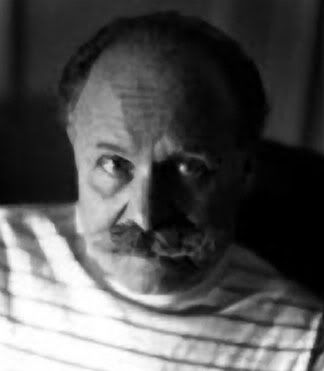
Stanley Rich: FBI Files
Rich Rosenberg
Rich, from this sampling, seems to have come out innocent of any espionage charges.
Note, however, all the informants that are pressed into service.
Whose Who In Knickerbocker Village History: Stanley Rich
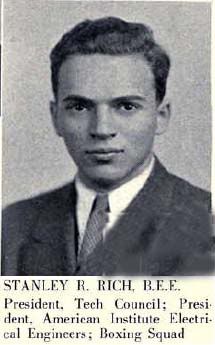
Stanley Rich, Entrepreneur, 76; Invented Submarine Sonar Device By WOLFGANG SAXON Published: November 23, 1993 Stanley Robert Rich, an entrepreneur and inventor who devised a scanning sonar for submarines in World War II, died on Sunday at Youville Hospital in Cambridge, Mass. He was 76 and lived in Grantham, N.H., and Wellesley Hills, Mass. The cause was cancer, his family said. Mr. Rich retired last month as chairman and technical director of Plasmachines Inc. in Natick, Mass., the last of several businesses he started over the years. Plasmachines is an environmental technology company that makes and sells air-pollution control equipment for combustion engines and industrial use. Mr. Rich was granted more than 60 United States patents and about 500 foreign ones since he began his career with the Navy Department of Civil Service and the Harvard University Underwater Sound Laboratory. It was at Harvard that he developed a scanning sonar for which the Navy got the patent and Mr. Rich was awarded two official commendations. A native of Manhattan, he graduated from the City College School of Technology, where he was president of the student body in 1938. After World War II, he worked for the Raytheon Corporation, heading several research departments and developing an ultrasonic machine tool and a motor-speed control system. Over four decades, beginning in 1950, Mr. Rich formed seven corporations to produce and market his inventions, which include high-intensity ultrasonic cleaning devices for industry, acoustic pollution controls and coal-cleaning devices. The companies he headed as president and as technical director include Rich-Roth Laboratories, Ultra-Viscoson Corporation and Teknika Inc. He published more than 50 technical papers, frequently lectured at business meetings and taught entrepreneurship as a Gordon Fellow at Babson College in Babson Park, Mass. He was co-founder of the M.I.T. Enterprise Forum and co-author with David Gumpert of "Business Plans That Win: Lessons From the MIT Enterprise Forum" (HarperCollins, 1987). The book is a business school text. Mr. Rich is survived by his wife, Shirley Cohen Rich; three daughters, the flutist Eugenia Zuckerman of Manhattan, Laurie Rich Alban of Rhinebeck, N.Y., and Dr. Julie Ingelfingfer of Cambridge, Mass., and seven grandchildren.
KVer Eric Weissberg and Pete Seeger
Pete Seeger: Woody Guthrie's 100th Anniversary and the lost song about the Rosenbergs
Pete Seeger, long-time Rosenberg Fund for Children Advisory Board member, performs this "lost" Woody Guthrie song about the Rosenbergs, at the RFC's 10th anniversary celebration in 2001
Celebrating Woody's 100th anniversary on American Routes
10 Monroe Street: 6th Floor and the FBI
Goff 6th Floor
During Julius Rosenberg's incarceration his cellmate Jerome Tartakow was utilized to gather information from Julius. Tartakow passed on a story that prior to her arrest Ethel took $7000 and a Leica camera from the Rosenberg KV apartment and placed it for safe keeping with a sympathizing neighbor. Subsequently there was systematic hunt for that unnamed neighbor and evidence the FBI thought would be further incriminating. Nothing was ever found and some believe Tartakow's story may have been invented. Sophie Goff, Irving's ex-wife was suspected. She was then living on the 6th floor. The above is a record of all of the investigation of people who lived on the 6th floor in 1952.
Sunday, July 15, 2012
Whose Who In Knickerbocker Village History: Irving Goff

Irving Goff (1900 - 17 May 1989) was a member of the Communist Party USA and the Abraham Lincoln Battalion, a unit that volunteered to fight during the Spanish Civil War for the Popular Front. During World War II, he was a member of the American Office of Strategic Services, and was instrumental in setting up guerrilla units working behind enemy lines in North Africa and Italy.[1] His exploits as a guerrilla in Spain are considered to be the inspiration for Ernest Hemingway's novel For Whom the Bell Tolls. Irving Goff's parents, of Jewish origin, emigrated from Odessa, Russia to New York in 1900. He grew up in the streets of Brooklyn and Long Island. He was a premier body builder (famous as the "Adonis" of Coney Island's Muscle Beach) and worked as an adagio dancer and professional acrobat before becoming an organiser for the Communist party in New York. Goff arrived in Spain on 4 April 1937, where he joined the International Brigades, working as a driver. In December 1937, he volunteered for dangerous guerrilla operations which frequently required him to work behind enemy lines for up to weeks at a time. ........ One of their objectives was the destruction of the main supply bridge spanning the Albarracín River. The operation may have been the inspiration for Ernest Hemingway's novel For Whom the Bell Tolls. When the book was published in 1940, Goff was critical of the novelist's ignorance of guerrilla operations and the way in which war was treated from "a romantic adventuristic point of view rather than [as] the grim, practical war that it was". In a later interview he said: "I never saw Ingrid Bergman in all the time I was in the war. If I did, I might still be there [Laughs.] The way Gary Cooper blew that bridge - like blowing a seam in a coal mine. I've blown bridges. You put a detonator in the thing and then you'd better be twenty miles away. You went after bridges and railroads. Usually it'd last five or six days behind the lines." ....... In September 1938, with a Republican defeat in sight, the Abraham Lincoln Battalion was withdrawn from the front line and shortly afterwards disbanded. Irving Goff returned to the United States. Once home, he resumed his activities in the Communist Party, and in 1940 was sent on a mission to investigate pro-fascist "synarchista" organizations in Texas, California and Mexico. Posing as a newspaper reporter, Goff filed regular reports about these groups with party leaders, but failed in his effort to link them with the right-wing group America First. Goff continued to campaign for the Spanish cause, and in February 1941, he led 28 Lincoln veterans in a Peace Motorcade to Capitol Hill to lobby against Francoist Spain receiving Lend-Lease aid. In 1941, Goff was approached by former Abraham Lincoln Battalion commander Milton Wolff to work for British intelligence through the Office of Strategic Services (OSS). On Goff's advice, Wolff invited other Lincoln veterans to participate in the group, including William Aalto, Milton Felsen, Mike Jiminez, Vince Lossowski and Alfred Tanz. After the attack on Pearl Harbor, the OSS leader General William Donovan turned the project into a wholly American operation. In 1942, Goff was transferred to North Africa, where he was put in charge of training Spanish recruits to operate behind German lines. Here, he was promoted by Donovan to second lieutenant. After the Allied invasion of Italy in 1943, the OSS Lincolns moved to Naples, where Goff's previous experience in Spain proved a boon for American intelligence. He was appointed by the OSS as liaison officer to the Italian Communist Party, and the Americans promptly started training programmes, using Italian volunteers to wage guerrilla warfare behind the German lines in northern Italy. Goff's infiltration programs parachuted thirty teams of radio operators and meteorologists into enemy-held areas to provide daily weather reports for the Allied air forces. Working with the Italian Communists, Goff built the most effective intelligence operation in northern Italy. With multiple teams behind German lines, he could count on fourteen separate radio reports every day. "We had guerrillas operating on every highway, every railroad, every German convoy. We had identifications, the material in every car on every highway reported through the network of radios".......
Who's Who In Knickerbocker Village History: Gerald Cook

Gerald Cook was born in St. Louis, Missouri on April 30, 1916 to Catherine and James Cook. He was self educated and was never graduated from high school. As a young man, he moved to New York City and was active in organizing unions, specifically the Department Store Workers union. While on a picket line, he met his first wife, Anne Freedman. They married before he left for Spain to fight in the Abraham Lincoln Brigade. When he returned from Spain, he shipped out to fight the fascists in WWII. He served both on the European front and in the Pacific front. After the war, his first child, Catherine Anne Cook, was born inh 1947. A few years later Gerald and Anne divorced and Gerald married Joan Riddell Barlow, a journalist. They remained married until Jerry did in 1980. They had two children, Joseph Fitzgerald Cook (b. 1952) and Jezebel Cook (b. 1959). He also raised a step-son, John Barlow (b. 1946). Jerry is survived by his two daughters, his step-son and four grandchildren, Alexandra Barlow, Thomas Barlow, James Barlow and Caleb Cook. For most of his post soldier life, Jerry was a journalist, working on various publications. He also worked for local 1199, editing their newsletter. He also worked for the Daily World. He never stopped being an activist and fought all his life for peace and justice. He died firmly believing in his Marxist principles of dialectical materialism.
Milt Felsen: The Anti-Warrior

Who's Who In Knickerbocker Village History: Milt Felsen
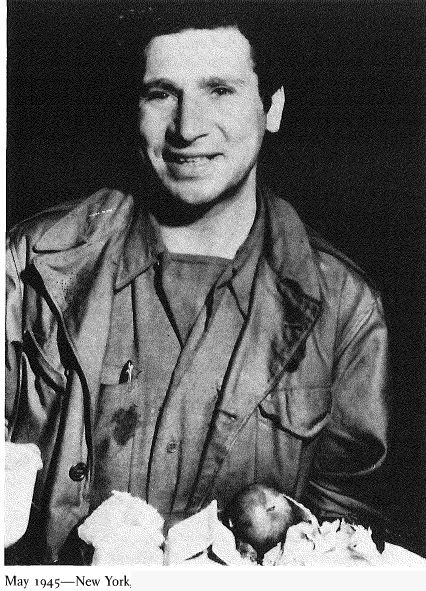

Born in New York City, Milt Felsen left the University of Iowa in his senior year to go to Spain in May of 1937. He served as a machine gunner in the Lincoln battalion and was wounded at Brunete. Upon release from the hospital, he spent the rest of the war as an ambulance driver. In World War Two, Felsen joined the Office of Strategic Services with other Lincoln veterans. Wounded and taken prisoner in North Africa, he spent two years in prisoner of war camps in Italy and Germany. Felsen’s memoir of childhood and the war years, The Anti-Warrior, was published by the University of Iowa in 1989. It is one of the few autobiographies by Lincoln veterans. It is a great read. Milt accomplished many things in peacetime. After the war, he worked for film-related labor unions in New York. In 1960 he ran the East Coast office of the Directors Guild of America. He served on its board for 30 years. He was an associate producer of Saturday Night Fever, the John Travolta film that launched the disco era. His independent producing credits included The Bell Jar and The Directors, a television documentary series. Milt retired to Sarasota, Florida, where he kept in touch with film and theater. Over his busy career, Milt Felsen was staunchly loyal to the Lincolns. He participated in reunions as well as trips to Spain, where his good humor was always appreciated. He will be sorely missed by those who had the good fortune of knowing him. The unassuming and soft-spoken brigadista Milt Felsen passed away on April 8, 2005, in Florida. His wife, Lois Bennett, said of him, “Milt was a sweet guy and a tough guy. Life with him was so much fun.” - Robert Coale
Subscribe to:
Posts (Atom)


 Posts