Saturday, January 5, 2008

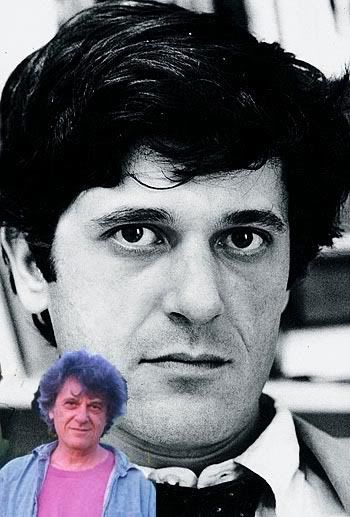
Leonard Michaels And Gilda


There's an online reference, from senses of cinema by Noel King, to Leonard Michaels' reaction to seeing the 1946 movie "Gilda" which featured the steamy (at the time) dance routine of Rita Hayworth.
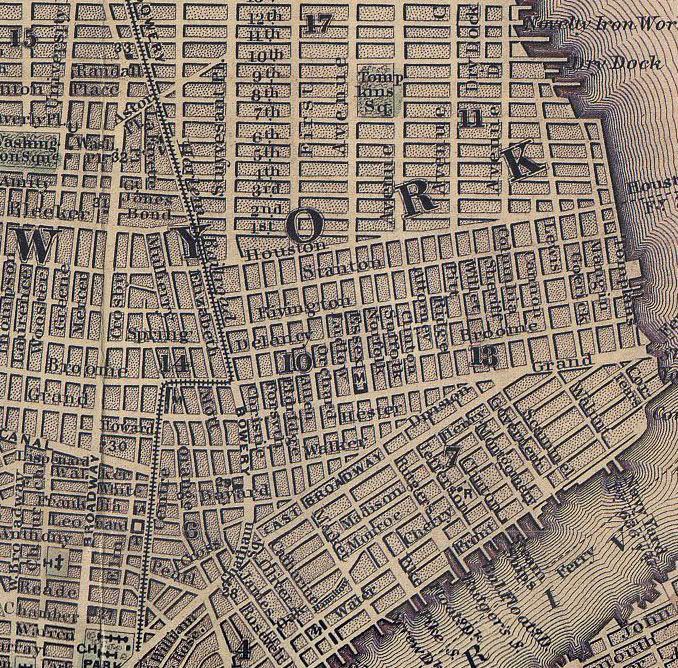
Michaels' essay on watching Gilda has similar moments — he says that seeing the “zipper business” made more of an impression on him than WW II — and is similarly precise about the location of his film-viewing moment. “I saw this movie in the Loew's Theater on Canal Street in the Lower East Side of Manhattan.” After his libinal viewing experience, he says, “I went down Madison Street, passing under the Manhattan Bridge, then turning left on Market Street, walking toward the East River, until I came to Monroe Street, and turned right.” The person writing-remembering this New York street-walking so meticulously is aged 60 or so, across the continent, on the other coast, in California, but the point is clear, and kind of Hemingway-esque. The hard clarity of street names, recited, might undo the terrible moral lesson the film had conveyed: “The creep touched her. I understood that real life is this way. Nothing would be the same for me again.” I first encountered Leonard Michaels' essay on Gilda in the selection of Best American Essays 1992 edited by Susan Sontag. But when I noticed that it had appeared in the Berkeley-based broadsheet cultural journal, The Threepenny Review, it figured. In the early 1990s, while wandering around bookshops in Berkeley, I picked up some copies of The Threepenny Review (though not the issue with Michaels' essay in it) and have kept up with it on and off ever since. (It's partially available on the Net). The Threepenny Review publishes terrific pieces by people I've always enjoyed reading elsewhere — John Berger, Stephen Greenblatt, Luc Sante, Carol Clover, Carlo Ginzburg — and includes poetry, a film section, essays on photography. Hence, it's always a pleasurable and informative reading experience.

Who's Who In Knickerbocker Village History: Leonard Michaels

I was thrilled when I stumbled upon the information that a favorite author of mine, Leonard Michaels lived in Knickerbocker Village.
From Wikipedia:
Leonard Michaels (January 2, 1933- May 10, 2003) was an American writer of short stories, novels, and essays. He was born in New York City and earned a B.A. from New York University and a M.A. as well as a Ph.D. in English Literature from the University of Michigan, before spending most of his adult life in Berkeley, California. Going Places, his first book of short stories, made his reputation as one of the most brilliant of that era's fiction writers; the stories are urban, funny, and written in a private, hectic diction that gives them a remarkable edge. The follow-up, coming six years later (Michaels was perhaps not prolific enough to build a widely popular career), was I Would Have Saved Them If I Could, a collection as strong as the first. The Men's Club, Michaels' first novel, is a story-like, relatively short comedic work that simultaneously attacks and celebrates the absurdities of men as they gather in a kind of urban support group. In 1986, the novel was made into a popular film, directed by Peter Medak, with the screenplay by Michaels, and starring Roy Scheider, Harvey Keitel, Stockard Channing and Frank Langella. Sylvia is a fictionalized memoir of Michael's first wife, Sylvia Bloch, who committed suicide. Michaels was a professor of English at the University of California, Berkeley. His son Jesse Michaels was vocalist in the seminal underground punk rock band Operation Ivy, a precursor to Rancid.

From the threepennyreview of 2003
When I was five years old, I started school in a huge gloomy Vic-torian building where nobody spoke Yiddish. It was across the street from Knickerbocker Village, the project in which I lived. To cross that street meant going from love to hell. I said nothing in the classroom and sat apart and alone, and tried to avoid the teacher’s evil eye. Eventually, she decided that I was a moron, and wrote a letter to my parents saying I would be transferred to the "ungraded class" where I would be happier and could play ping-pong all day. My mother couldn’t read the letter so she showed it to our neighbor, a woman from Texas named Lynn Nations. A real American, she boasted of Indian blood, though she was blond and had the cheekbones, figure, and fragility of a fashion model. She would ask us to look at the insides of her teeth, and see how they were cupped. To Lynn this proved descent from original Americans. She was very fond of me, though we had no conversation, and I spent hours in her apartment looking at her art books and eating forbidden foods. I could speak to her husband, Arthur Kleinman, yet another furrier, and a lefty union activist, who knew Yiddish.

Lynn believed I was brighter than a moron and went to the school principal, which my mother would never have dared to do, and demanded an intelligence test for me. Impressed by her Katharine Hepburn looks, the principal arranged for a school psychologist to test me. Afterwards, I was advanced to a grade beyond my age with several other kids, among them a boy named Bonfiglio and a girl named Estervez. I remember their names because we were seated according to our IQ scores. Behind Bonfiglio and Estervez was me, a kid who couldn’t even ask permission to go the bathroom. In the higher grade I had to read and write and speak English. It happened virtually overnight so I must have known more than I knew. When I asked my mother about this she said, “Sure you knew English. You learned from trucks.” She meant: while lying in my sickbed I would look out the window at trucks passing in the street; studying the words written on their sides, I taught myself English. Unfortunately, high fevers burned away most of my brain, so I now find it impossible to learn a language from trucks. A child learns any language at incredible speed. Again, in a metaphorical sense, Yiddish is the language of children wandering for a thousand years in a nightmare, assimilating languages to no avail.

I remember the black shining print of my first textbook, and my fearful uncertainty as the meanings came with all their exotic Englishness and de-voured what had previously inhered in my Yiddish. Something remained indigestible.

Friday, January 4, 2008

The Crests: Sixteen Candles


From an oldies' show
Happy birthday, happy birthday, baby
Oh, I love you so

Sixteen candles make a lovely light
But not as bright as your eyes tonight
(as your eyes tonight) (Oh)
Blow out the candles, make your wish come true
For I'll be wishing that you love me, too
(that you love me, too)

You're only sixteen (sixteen)
But you're my teenage queen (you're my queen)
You're the prettiest, loveliest girl I've ever seen
(I've ever seen) (OH!)

Sixteen candles in my heart will glow
For ever and ever for I love you so (for I love you so)

You're only sixteen (sixteen)
But you're my teenage queen (you're my queen)
Oh, you're the prettiest, loveliest girl I've ever seen
(I've ever seen) (OH!)

Sixteen candles in my heart will glow
For ever and ever for I love you so
(for I love you so)
For I love you so!!!

The Crests: Six Nights A Week


a 1959 hit:
Well six nights a week I long for you
And then on Saturday night
I hold you in my arms again
I love you so but I'm a fool it seems
For six nights a week I see you only in my dreams
I want to hold you every night
But you won't give me a chance
I have to wait to hold you tight
Until the next Saturday night
So why must we spend six nights a week apart
When night after night I'd love to hold you to my heart

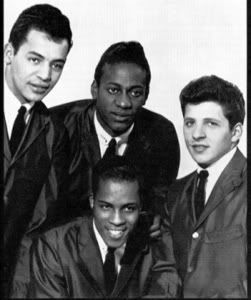
Who's Who In Knickerbocker Village History: The Crests

Not really KV, but certainly close enough. The Up On The Roof post recalled Richard Karney's remembrance that the Crests originated from the Smith Projects, "One of our classmates or grade mates' brother was one of the background singers."
an excerpt from billerocker note: the Patricia Van Dross mentioned was Luther Vandross's older sister
Johnny Maestro and The Crests
0ne of the most popular of the late '50s groups, the Crests were often thought to bean all black aggregation. In fact, they were about as integrated as a group could get, with four men (two blacks, a Puerto Rican, and an Italian), and one black female. Talmadge (Tommy) Gough (first tenor), Harold Torres (second tenor), and Patricia Van Dross (tenor) were all from the Alfred E. Smith housing projects in Chinatown on the Lower East Side of Manhattan. In 1955, while students at P. S. 160 Junior High, they teamed up with Jay (J. T.) Carter (bass) of Delancey Street to forma singing group. With influences ranging from THE MILLS BROTHERS to THE AMES BROTHERS(with THE HARP-TONES, THE CLOVERS, THE 5 ROYALES, THE FIVE KEYS, THE PENGUINS, and THE ORIOLES thrown in for good measure) the unnamed quartet started performing at hospitals and charity functions for experience while learning the craft of harmonizing from an old singer known only as Mr. Morrow.
In 1956, Mulberry Street resident John Mastrangelo met the group at the Henry Street Settlement House. John's previous group had also been integrated, and reportedly included a young Tony Orlando. Mastrangelo's strong voice and natural feel for R&B made him an instant asset to the group and they joined forces. J. T. Carter came up with the name the Crests (a good many years before the toothpaste). The group found the New York subway system to be an excellent place to polish their sound. On one occasion they boarded the Lexington IRT at the Brooklyn Bridge and took the opportunity to practice. To their astonishment, as the train pulled into the next stop, a woman got up, walked over, handed them a business card, and left the train without even mentioning her name. The card read "Al Browne and Orchestra," Mr. Browne being the well-known arranger who backed up THE HEARTBEATS and other acts. The group scrambled to call him, set up an audition, and by June 1957 were recording two original Mastrangelo compositions. The mysterious lady on the train turned out to be Mrs. Al Browne.
The songs "Sweetest One" and "My Juanita" were tremendous first efforts for a new group, especially considering the medieval production work and studio sound. "My Juanita" was an up-tempo rocker with a slow double-chime prelude, a smooth lead from Mastrangelo (now calling himself Johnny Maestro), and a tight background by the Crests. "Sweetest One" was an understated ballad. Its simplicity was classic, but most in the know would have put their money on "Juanita." On July 15, 1957, the tiny Joyce Records (run out of the back room of a Brooklyn record store) bet on "Sweetest One," putting all two minutes and four seconds on the national Top 100 chart peaking at number 86. "My Juanita7 subsequently became a standard rehearsal tune for every street-corner group.
The Crest's next single was "No One to Love," a beautiful ballad with an "Earth Angel" intro followed by wondrous harmony and an original arrangement. Lightning didn't strike twice, but Maestro recalls that each member received a $17.50 royalty for the tune. It probably went to buy the checkered sport jackets and thin black ties they wore at their local gigs (with Pat in her gown, the performers looked like four Bo Diddleys and a prom queen).
After almost a year of shows, the Crests got a break in the form of an introduction by songwriter Billy Dawn Smith to music publisher George Paxton, a veteran of the Brill building. Paxton formed Coed Records and signed the group just as they became a quartet. Pat was forced to leave when her mother refused to let her tour with the older guys (in 1958 the members were 18 to 19 years old). Had Patricia's younger brother been old enough to do more than hang out to hear the group sing, he would have been an interesting vocal addition to the Crests. His name was Luther Van Dross.
The Crests' first Coed single was "Pretty Little Angel" b/w "I Thank the Moon," the former written by Maestro, arranger Bert Keyes, and Luther Dixon (writer of several SHIRELLE's hits), and the latter by Billy Dawn Smith. "Pretty" did well in New York (for example one Rochester station, WRVM's survey had it at number 25 and moving up on March 31st) but soon fizzled out. The next release was "Beside You," a pretty ballad with loads of harmony and a mid250s sound. When deejay Alan Freed and TV's Dick Clark received their copies they both flipped it over and took a liking to a sentimental birthday song called "16 Candles." The record entered the Billboard pop charts on November 24, 1958, and the R&B charts almost two months later. The group then played the first of many shows for Alan Freed's Christmas party at the Loew's State Theatre along with three giants of rock who would all be dead within six weeks: Buddy Holly, Ritchie Valens, and the Big Bopper. In the week of January 26, 1959, "16 Candles" was number four nationally and Vileness' "Donna' was number three. J. T. Taylor had a friendly bet with Valens that week as to whose record would hit number one first. On February 3, 1959, Valens, Holly, and the Big Bopper J. P. Richardson) died in a plane crash while the Billboards chart of February 9 had "16 Candles" at number two and "Donna" at number three. Ironically, neither recording ever made it to number one. The record that kept both from that position was Lloyd Price's "Stagger Lee." At its peak, "16 Candles" was selling 25,000 records a day and well on its way to becoming one of the most popular birthday songs since "Happy Birthday." "16 Candles" actually started out as "21 Candles" written by Luther Dixon and Allyson Kent, but since the average age of targeted record buyers was much younger, the number of candles was brought down a few notches.
The Crests were now playing all the major venues from the Apollo to the Paramount along with the prime-time Saturday night radio version of "American Bandstand." (Dick Clark may remember his first encounter with the Crests at the Little Theatre on 47th Street in New York City. The Crests were cavorting in the dressing room when Clark peeked in to say hello. When one of the boys fell against the door Clark got a black eye for his trouble.) The boys appeared on what in those days were called all-star shows-and they really were. On a given night the Crests would appear with the likes of Jackie Wilson, THE MOONGLOWS, Chuck Berry, the Everly Brothers, Bo Diddley, THE FLAMINGOS, DION AND THE BELMONTS, Frankie Avalon, and more saxophone-led orchestras than you could shake a stick at, including those of Sam "the Man Taylor, King Curtis, Big Al Sears, Red Prysock, Earl Warren, and more. From 1958 to 1960 the group was almost always on the road.
Their first single after "Candles" was a swaying, dreamy stroll-styled ballad called "Six Nights a Week" (#28 Pop, #16 R&B). As was the case with many acts, the charts were a relatively accurate barometer of the quality of the Crests records from this point on. "Flower of Love" was bland in comparison to other Crest cuts and only attained a six-week run up to number 79. But the charting proved that the Crests were out in front with deejays and the public; far superior records of the time (such as "Millionaire Hobo ' by the Fantastics, "MY Heart7' by THE CAROLLONS, and "Lovers Never Say Goodbye" by the Flamingos) had less activity.

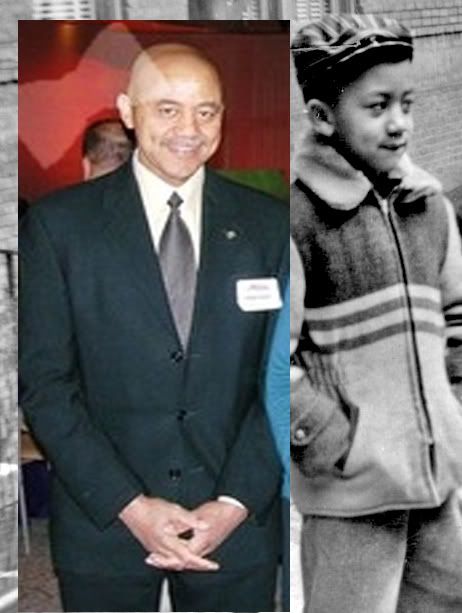
Whatever Happened To: Reggie Ingram


Can this be him in Denver, Colorado? My research team is working on it

Thursday, January 3, 2008

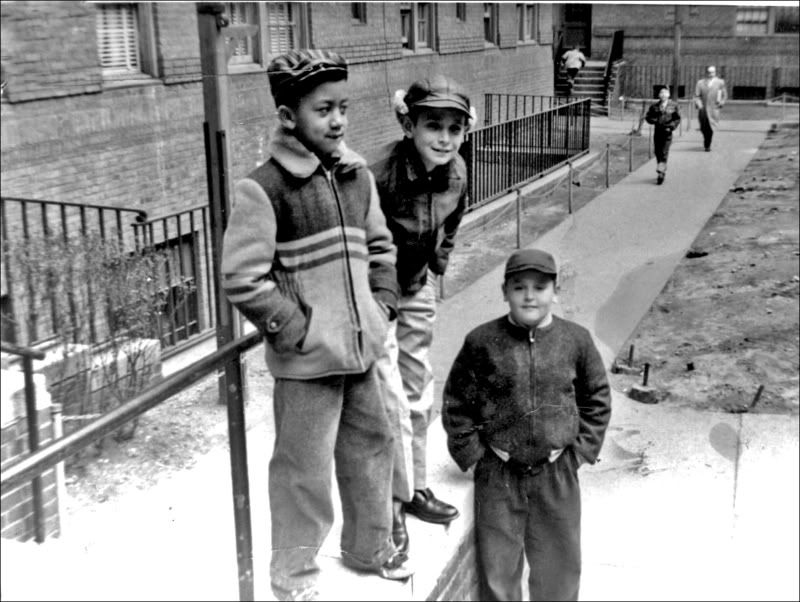
Young Haberdashers Of Knickerbocker Village


Sometime in the mid 1950's. That's Reggie Ingram, Neal Hellman and Bob Simmons.
I didn't know Reggie, he was a year younger and moved not soon afterwards. According to Bob:
Reggie Ingram is the son of Reggie Ingram, Sr. The family moved to Rochester, NY as I recall, and Reggie Sr. may have been involved with community youth programs there.
According to Marty:
I don't remember Reggie that clearly but I remember his father perfectly. A kind of thick build, a little overweight, athletic, very friendly. I remember playing football and having a baseball catch with Reggie Sr. when I was about six or seven in Tanahey.

Line Em Up


Neal Hellman's dad, Sol, must have had an artistic eye. That's fairly evident by this unusual series of photos. It's also proved as his son followed that bent and is a craftsman and a musician. Neal wrote that his dad frequented the Henry Street Settlement. I added to those pics today by taking some additional photos at part of the original scene on Catherine and Cherry. I can't figure out where he took the photos of Neal's brother Billy walking the line on the side of a building. They must have been taken in the mid fifties. I got to use one of my favorite James Taylor songs as a soundtrack. I'm only off by 20 years or so :)
I remember Richard Nixon back in '74
And the final scene at the White House door
And the staff lined up to say good-bye
Tiny tear in his shifty little eye
He said nobody knows me
Nobody understands
These little people were good to me
Oh I'm gonna shake some hands

CHORUS:
Somebody line 'em up
Line 'em all up
Line 'em up
Line 'em all up
Line 'em up
Line 'em all up
Line 'em up
Line 'em all up

At that time my heart was all broke
I looked like ashes and smelled like smoke
And I turned away from my loving kind
Try to leave my body and live in my mind
But it's much too much emotion
To hold it in your hand
They've got waves out on the ocean
They're gonna wear away the land

- Chorus -

Oh I've seen corn in Kansas
And I've seen picket fences
And certain cowboy dances
I've gone lining up for shows
I've been safely placed in rows
Sure I know how it goes

Another day goes by
Little time machine
I'm breaking my brain
Over what it might mean
Just to claim the time
And to turn away
To make today today

Who waits for you
Lonely tired old toad
It's your life laid out before you
Like the broken white line down the center of the doggone road

- Chorus -

Yeah, big moon landing
People all standing up
Smiles for the loved ones
They go walking on down the aisles
Each re-engages stepping into the sun
I watch them turn like pages
One by one by one

- Chorus -

Wednesday, January 2, 2008

Up On The Roof 2

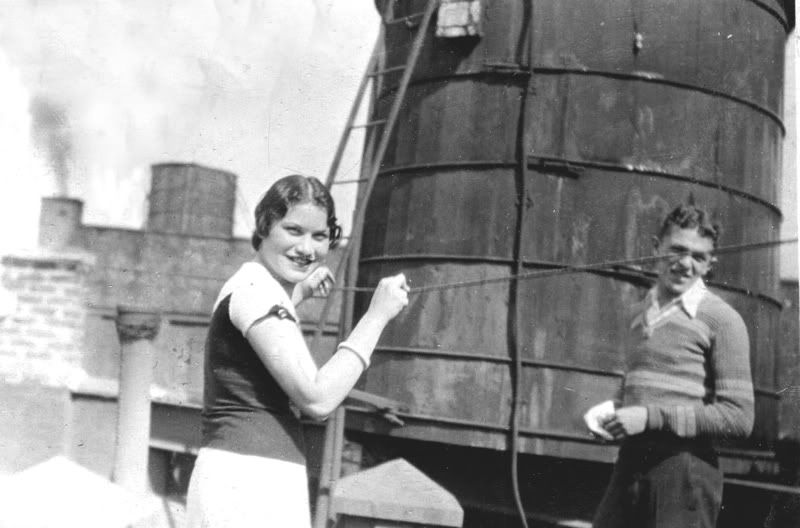
From The Neal Hellman archives. That's his father Sol (solo) on the roof of I guess the sewing machine repair shop on Pike Steeet, since I recognize the steeple from St. Teresa's Church on Henry and Rutger's in the background. Neither I or Neal know where the other's were taken, but some of the guys are the same from this post on 12/30/07


When this old world starts getting me down
And people are just too much for me to face
I climb way up to the top of the stairs
And all my cares just drift right into space
On the roof, the only place I know
Where you just have to wish to make it so
Let me tell you now
When I come home feelin' tired and beat
I go up where the air is fresh and sweet (up on the roof)
I get away from the hustling crowd
And all that rat-race noise down in the street (up on the roof)
On the roof, the only place I know
Where you just have to wish to make it so
Let's go up on the roof (up on the roof)
At night the stars put on a show for free
And, darling, you can share it all with me
I keep a-tellin' you
Right smack dab in the middle of town
I've found a paradise that's trouble proof (up on the roof)
And if this world starts getting you down
There's room enough for two
Up on the roof (up on the roof)
Oh, come on, baby (up on the roof)
Oh, come on, honey (up on the roof)
Everything is all right (up on the roof)
City's all right (up on the roof)
Oh . . .

Up On The Roof


This is setting the groundwork for the next post
from the youtube post along with two comments:
About This Video
Added: August 30, 2007
Ahmet Ertegün of Atlantic Records approached Clyde McPhatter after he left the Dominoes and signed him. McPhatter first recruited several members of his former group, the Mount Lebanon Singers: William "Chick" Anderson (tenor), David Baldwin (baritone), and James "Wrinkle" Johnson (bass), plus David "Little Dave" Baughan (tenor). This aggregation lasted for only a single session (from which "Lucille" was the only song released), after which Atlantic asked McPhatter to form a different group. He finally settled on Gerhart and Andrew Thrasher on baritone and second tenor, respectively, Bill Pinkney on high tenor, Willie Ferbee as bass, and Walter Adams on guitar. This is the group on the second session, which produced the group's first major hit: "Money Honey".
After the session, Ferbee was involved in an accident and left the group and Adams died (to be replaced by Jimmy Oliver). Ferbee was not replaced and the voice parts were shifted around: Gerhart Thrasher became first tenor, Andrew Thrasher was now the baritone, and Bill Pinkney shifted down to bass. The group released several more hits ("Such A Night," [1][2] "Honey Love," "Bip Bam," "White Christmas," and "What'cha Gonna Do") before McPhatter was drafted in May 1954 (after which he pursued a solo career). McPhatter had demanded a large share of the group's profits, which he had been denied in the Dominoes, but, upon his departure, did not ensure that this would continue for his successor. He sold his share of the group to George Treadwell, manager, former jazz trumpeter, and husband of legendary singer Sarah Vaughan. As a result, the Drifters cycled through copious members, none of whom made much money. McPhatter later expressed regret at this action, recognizing that it doomed his fellow musicians to unprofitability.
McPhatter was first replaced by David Baughn, who was on the group's first session. While his voice was similar to McPhatter's, his erratic behavior made him unsuitable in the eyes of Atlantic Records executives. Baughn soon left the group, and was replaced by Cleveland native Johnny Moore (of The Hornets). This lineup had a major R&B hit in 1955 with "Adorable," followed by several others ("Ruby Baby," "I Got To Get Myself A Woman," and "Fools Fall In Love").
In the mid 1950s, the Drifters began working with Jerry Leiber and Mike Stoller, legendary songwriters, who eventually became the group's producers as well. A few fans consider this the group's golden age, inaugurated by the 1956 hit "I Gotta Get Myself a Woman." Low salaries contributed to burnout among the members, particularly Bill Pinkney, who was fired after asking Treadwell for more money. Andrew Thrasher left as well, in protest. Pinkney formed another group, called The Flyers, with lead singer Bobby Hendricks, who would leave to join the Drfiters the next year.
Bill Pinkney was replaced by Tommy Evans (who had replaced Jimmy Ricks in The Ravens). Charlie Hughes, a baritone, replaced Andrew Thrasher. Johnny Moore was drafted in November 1957 and replaced by Bobby Hendricks, but to no success; the group was not able to break into mainstream markets. By early 1958, the lineup was: Bobby Hendricks (lead tenor), Gerhart Thrasher (first tenor), Jimmy Milner (baritone), Tommy Evans (bass), and Jimmy Oliver (guitar).
By May 1958, both Hendricks and Oliver had quit, returning only for a week's appearance at the Apollo Theater. During that week, one of the members got into a fight with the owner of the Apollo. That was the last straw for manager George Treadwell, who fired the entire group. Since Treadwell owned the rights to the name "Drifters," and since he still had a year's worth of bookings for the Apollo, he recruited another group, The Five Crowns, featuring lead singer Ben E. King. The group changed its name to the "Drifters" and went out on the road to tour for almost a year, although this new group had no connection to the prior Drifters. (less)
This video was made just weeks after the tragic death of lead singer, Rudy Lewis, who sang the lead for this song on the actual recording......the song was written by Carole King and Jerry Goffen. The lead singer in this video is Johnny Moore, who takes over for the original lead singer to this song Rudy Lewis who had passed away when this performance was filmed.

Tuesday, January 1, 2008

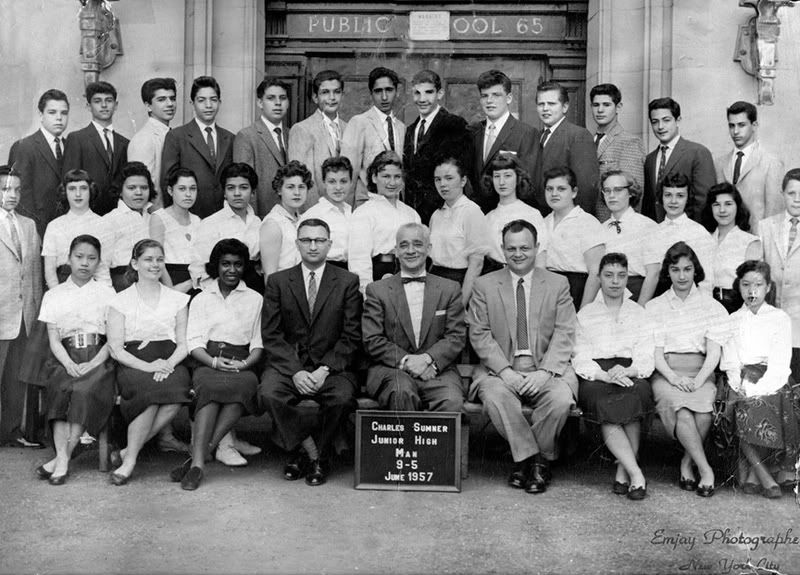
JHS 65: Graduating Class of 1957


from the Neal Hellman archives. His brother William (Billy) is the second from the right on the top row

Breaking News From Knickerbocker Village

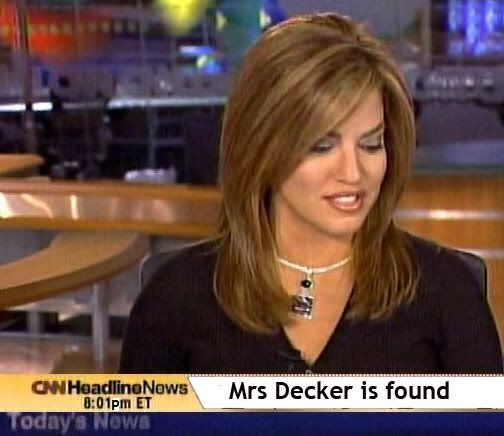
Big stories to inaugurate the new year. To begin with an email from Mrs. Decker, a much loved 5th grade teacher from PS 177:
I am indeed the Ursula Decker who taught at PS 177. That was early in my career and those days are some of the fondest memories I have to this day. It was great to hear from you and realize that some of our students do think of us. Believe it or not we also retain memories of former teaching assignments and the students we met along the way. After leaving PS 177 I continued my career in the public schools on Long Island, retiring in 1993. Along the way I had 3 daughters, finished my doctoral degree, did some part-time teaching at the university level, got in a lot of traveling and am approaching my 54th year of marriage to my marvelous husband, Gene who is also a teacher and continues to teach part time at the college. Thanks for the contact. Have a great NEW YEAR
Ursula

Other breaking stories to follow:
In the Who's Who That Used To Live In Knickerbocker Village Department
1. What former resident of 10 Monroe Street saved George Orwell's life during the Spanish Civil War?
2. What late Kver has been described as such?
"He was one of the most important prose writers of 20th century America - a writer whose sentences were composed with the care of poetry, and whose voice came through clearly in both fiction and nonfiction," said Wendy Lesser, editor of The Threepenny Review, where ...... was an advisor and contributor for more than 20 years.
"Lenny had a wonderful, hilarious, dark sense of humor and a great respect for serious things. He was irreplaceable," said Lesser, who first met.....when she was his student at UC Berkeley. .... received awards from the Guggenheim Foundation, the American Academy and Institute of Arts and Letters, the Pushcart Prize and the National Endowment for the Arts. His work was translated into about 10 languages.

Also I've found out that after Sol Press was the principal of PS 46 in Riverdale he became the Superintendent of District 10 in the Bronx.