Wednesday, July 18, 2012

Joe Darion's "Shinbone Alley"


Before there was Cats, there was Shinbone Alley. Never saw Shinbone in any version and I never understood the popularity of Cats.
Shinbone Alley (sometimes performed as archy & mehitabel) is a musical with a book by Joe Darion and Mel Brooks, lyrics by Darion, and music by George Kleinsinger. Based on archy and mehitabel, a series of New York Tribune columns by Don Marquis, it focuses on poetic cockroach Archy, alley cat Mehitabel, and her relationships with theatrical cat Tyrone T. Tattersal and tomcat Big Bill, under the watchful eye of The Newspaperman, the voice-over narrator and only human being in the show. The project began in 1954 as a Columbia Records concept album with Marquis' original title, featuring Eddie Bracken, Carol Channing, and David Wayne. That same year a concert version was presented by the Little Orchestra Society at The Town Hall in New York City. With an expanded book, the addition of several lengthy ballet sequences, and a cast of animal characters, the rechristened Shinbone Alley preceded Cats by a couple of decades and was a precursor of the far more successful Andrew Lloyd Webber hit. It was one of the first Broadway shows to feature a fully integrated cast. With neither an out-of-town tryout nor a preview period, the Broadway production opened on April 13, 1957 at The Broadway Theatre, and closed on May 25, 1957 after 49 performances. Following "creative differences" with the writers and producers, original director Norman Lloyd requested that his name be removed from the credits. The production was supervised by Sawyer Falk and choreographed by Joe and Rod Alexander, with production design by Eldon Elder, costumes by Motley, and lighting by Tharon Musser. The cast featured Bracken, reprising his role as archy, Eartha Kitt as mehitabel, Erik Rhodes as Tyrone, and George S. Irving as Big Bill. Supporting players included Cathryn Damon, Jacques d'Amboise, Ross Martin, Lillian Hayman, and Allegra Kent. Relative newcomer Chita Rivera was Kitt's standby. The show's sole Tony Award nomination was for Best Costume Design. In lieu of a cast album recorded in a studio, a tape of a live performance was transferred to acetate and released on the Legend label. In 2005 the musical had its Australian premiere in Melbourne, under the name archy & mehitabel. Produced by Magnormos, it was directed by Aaron Joyner and starred Jane Badler in the role of Mehitabel, and Michael Lindner as Archy.[1][2] The "Musicals Tonight!" series presented a staged concert version in November 2006 in New York City.

Joe Darions "Strange Things Are Happening"


"Strange things are happening" became a national catchphrase evolving from the run of The Red Buttons Show. It remained his signature theme. For half a century, he would hop on one foot, clap hands, and palm his ear whenever the music played, a childlike, trademark bit recalled by fans of his TV program. The lyrics were written by Joe Darion.
Ho Ho
Ho Ho
Hee Hee
Hee Hee
Hah Hah
Hah Hah
Strange Things Are Happening
I once had a teacher who flunked me in history
She asked, "Who shot Lincoln?"
I answered, "Don't blame me."
Ho Ho
Ho Ho
Hee Hee
Hee Hee
Hah Hah
Hah Hah
Strange Things Are Happening
I gave golden earrings to someone who turned sweet sixteen
Now, I'm so embarrassed her ears are turning green
Ho Ho
Ho Ho
Hee Hee
Hee Hee
Hah Hah
Hah Hah
Strange Things Are Happening
Strange Things
I went to the movies and witnessed the strangest scene.
One kid brought a tv and tried to dial the screen
Ho Ho
Ho Ho
Hey Hey
Hey Hey
Hee Hee
Hee Hee
Strange Things
Strange Things
"Since girls wear those blue jeans, my troubles just never cease
What looks like my nephew, turns out to be my niece."
Ho Ho
Ho Ho
Hee Hee
Hee Hee
Hah Hah
Hah Hah
Strange Things Are Happening
Strange Things
for more on the Joe Darion KV connection

Joe Darion's "Ricochet Romance"

for more on the Joe Darion KV connection for the more popular Teresa Brewer version
They warned me when you kissed me your love would ricochet Your lips would find another and your heart would go astray I thought that I could hold you with all my many charms But then one day you ricocheted to someone else's arms [Chorus:] And baby I don't want a ricochet romance, I don't want a ricochet love If you're careless with your kisses, find another turtle dove I can't live on ricochet romance, no, no not me If you're gonna ricochet, baby, I'm gonna set you free I knew the day I met you, you had a roving eye I thought that I could hold you, what a fool I was to try You promised you'd be faithful and you would never stray Then like a rifle bullet, you began to ricochet
Amazing that someone who went to CCNY in the thirties during a time of political upheaval and who was suspected of being a fellow traveler could write such lame stuff. Amazing too that is was so popular. Yet, that was the landscape of much of the 1950's

Joe Darion's "Change Partners"


for more on the Joe Darion KV connection Music by Larry Coleman We were waltzin' together to a dreamy melody
When they called out "change partners"
And you waltzed away from me
Now my arms feel so empty as I gaze around the floor
And I'll keep on changing partners
Till I hold you once more

Though we danced for one moment and too soon we had to part
In that wonderful moment something happened to my heart
So I'll keep changing partners till you're in my arms and then
Oh, my darlin' I will never change partners again

Though we danced for one moment and too soon we had to part
In that wonderful moment something happened to my heart
So I'll keep changing partners till you're in my arms and then
Oh, my darlin' I will never change partners again

Monday, July 16, 2012

Joe Darion's Impossible Dream


To dream ... the impossible dream ...
To fight ... the unbeatable foe ...
To bear ... with unbearable sorrow ...
To run ... where the brave dare not go ...
To right ... the unrightable wrong ...
To love ... pure and chaste from afar ...
To try ... when your arms are too weary ...
To reach ... the unreachable star ...

This is my quest, to follow that star ...
No matter how hopeless, no matter how far ...
To fight for the right, without question or pause ...
To be willing to march into Hell, for a Heavenly cause ...

And I know if I'll only be true, to this glorious quest,
That my heart will lie will lie peaceful and calm,
when I'm laid to my rest ...
And the world will be better for this:
That one man, scorned and covered with scars,
Still strove, with his last ounce of courage,
To reach ... the unreachable star . On 9/11/2011 Congressman Dennis Kucinich honored Joe Darion
Mr. Speaker, I rise today to honor the memory of a man who inspired the American people with beautiful song, Mr. Joe Darion, lyricist of ``Man of La Mancha.'' Born in New York City in 1911, Mr. Darion worked throughout his life in every genre of music from popular songs to opera. Mr. Darion attended City College before serving his nation in World War II. In the early 1950's he had three Top-10 hits; the Patti Page ballad ``Changing Partners'', the Teresa Brewer novelty ``Ricochet'', and Red Buttons' comedy hit ``The Ho Ho Song''. Mr. Joe Darion is most known for his beautiful lyrics of ``The Impossible Dream,'' which quickly became one of the most beloved pop anthems of our time. ``Man of La Mancha'' opened in New York in 1956 and ran for an incredible 2,328 performances. In recognition of his heart-warming lyrics, Mr. Darion was rewarded a Tony Award for best score. ``The Impossible Dream'' has affected thousands of people, young and old. His lyrics have inspired and touched countless Americans. His words dive deep into the human soul and character. His words, Mr. Speaker, please join me in honoring the memory of a man who touched millions of Americans with his inspiring lyrics and, enabled countless people everywhere to ``Dream the Impossible Dream'', Mr. Joe Darion.

Whose Who In Knickerbocker Village History: Joe Darion

He and his wife Helen lived at 10 Monroe Street, apt GD6, from approximately 1940-1949. Born in New York City in 1917 his real name was Joseph Schmul. Darion studied journalism at City College of New York and served in the Navy during World War II. After the war, he began writing lyrics. He had three Top 10 hits in the 1950s: "Changing Partners," the Patti Page ballad; "Ricochet," recorded by Teresa Brewer; and "The Ho Ho Song," a comedy number from Red Buttons. He also wrote children's songs such as "The Growing-Up Tree", "The Midnight Train", "The Lollipop Tree", "The Goonie Bird Song" and "Little Red Train to the Zoo". Darion's first Broadway show was "Shinbone Alley," a jazz opera. He also wrote "Illya Darling," an adaptation of the movie "Never on Sunday." His biggest hit was his writing for Man of La Mancha. He wrote the lyrics to the "Impossible Dream!"Joining ASCAP in 1951, he wrote for radio, TV, films, theatre and concerts. His chief musical collaborators include George Kleinsinger, Ezra Laderman, Guy Wood, John Benson Brooks, Herman Krasnow, and Mitchell Leigh. He died in 2001.

Stanley Rich: FBI Files

Rich Rosenberg Rich, from this sampling, seems to have come out innocent of any espionage charges. Note, however, all the informants that are pressed into service.

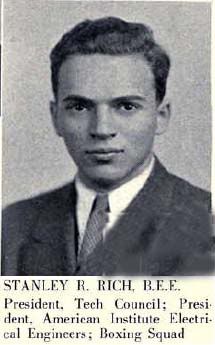
Whose Who In Knickerbocker Village History: Stanley Rich

Above, as seen in his graduation from CCNY in 1938. Beginning in 1940 Stanley lived at 12 Monroe Street, apt HE5 and later moved to the 40 Monroe court. In 1943 his family moved to Cambridge, Mass. He knew Julius Rosenberg at CCNY and was suspected of being part of a group of engineers that Julius and Morton Sobell were attempting to recruit to gather classified information. In Rich's case it would be his expertise in radar. From his nytimes obituary:
Stanley Rich, Entrepreneur, 76; Invented Submarine Sonar Device By WOLFGANG SAXON Published: November 23, 1993 Stanley Robert Rich, an entrepreneur and inventor who devised a scanning sonar for submarines in World War II, died on Sunday at Youville Hospital in Cambridge, Mass. He was 76 and lived in Grantham, N.H., and Wellesley Hills, Mass. The cause was cancer, his family said. Mr. Rich retired last month as chairman and technical director of Plasmachines Inc. in Natick, Mass., the last of several businesses he started over the years. Plasmachines is an environmental technology company that makes and sells air-pollution control equipment for combustion engines and industrial use. Mr. Rich was granted more than 60 United States patents and about 500 foreign ones since he began his career with the Navy Department of Civil Service and the Harvard University Underwater Sound Laboratory. It was at Harvard that he developed a scanning sonar for which the Navy got the patent and Mr. Rich was awarded two official commendations. A native of Manhattan, he graduated from the City College School of Technology, where he was president of the student body in 1938. After World War II, he worked for the Raytheon Corporation, heading several research departments and developing an ultrasonic machine tool and a motor-speed control system. Over four decades, beginning in 1950, Mr. Rich formed seven corporations to produce and market his inventions, which include high-intensity ultrasonic cleaning devices for industry, acoustic pollution controls and coal-cleaning devices. The companies he headed as president and as technical director include Rich-Roth Laboratories, Ultra-Viscoson Corporation and Teknika Inc. He published more than 50 technical papers, frequently lectured at business meetings and taught entrepreneurship as a Gordon Fellow at Babson College in Babson Park, Mass. He was co-founder of the M.I.T. Enterprise Forum and co-author with David Gumpert of "Business Plans That Win: Lessons From the MIT Enterprise Forum" (HarperCollins, 1987). The book is a business school text. Mr. Rich is survived by his wife, Shirley Cohen Rich; three daughters, the flutist Eugenia Zuckerman of Manhattan, Laurie Rich Alban of Rhinebeck, N.Y., and Dr. Julie Ingelfingfer of Cambridge, Mass., and seven grandchildren.

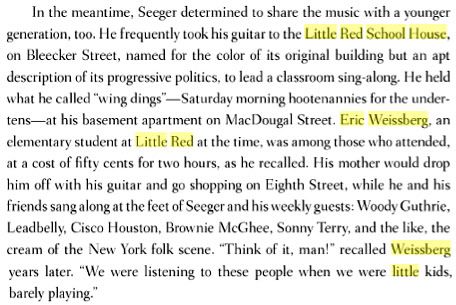
KVer Eric Weissberg and Pete Seeger

The above from Ronald Radosh's book, "Commies: A Journey Through The Old Left, The New Left and the Leftover Left." Radosh went to school with Eric at the Little Red School House. A previous post about Eric Weissberg

Pete Seeger: Woody Guthrie's 100th Anniversary and the lost song about the Rosenbergs


Pete Seeger, long-time Rosenberg Fund for Children Advisory Board member, performs this "lost" Woody Guthrie song about the Rosenbergs, at the RFC's 10th anniversary celebration in 2001
Celebrating Woody's 100th anniversary on American Routes

10 Monroe Street: 6th Floor and the FBI

Goff 6th Floor
During Julius Rosenberg's incarceration his cellmate Jerome Tartakow was utilized to gather information from Julius. Tartakow passed on a story that prior to her arrest Ethel took $7000 and a Leica camera from the Rosenberg  KV apartment and placed it for safe keeping with a sympathizing neighbor. Subsequently there was systematic hunt for that unnamed neighbor and evidence the FBI thought would be further incriminating. Nothing was ever found and some believe Tartakow's story may have been invented. Sophie Goff, Irving's ex-wife was suspected. She was then living on the 6th floor. The above is a record of all of the investigation of people who lived on the 6th floor in 1952.

Sunday, July 15, 2012

Whose Who In Knickerbocker Village History: Irving Goff

an excerpt from his wikipedia entry
Irving Goff (1900 - 17 May 1989) was a member of the Communist Party USA and the Abraham Lincoln Battalion, a unit that volunteered to fight during the Spanish Civil War for the Popular Front. During World War II, he was a member of the American Office of Strategic Services, and was instrumental in setting up guerrilla units working behind enemy lines in North Africa and Italy.[1] His exploits as a guerrilla in Spain are considered to be the inspiration for Ernest Hemingway's novel For Whom the Bell Tolls. Irving Goff's parents, of Jewish origin, emigrated from Odessa, Russia to New York in 1900. He grew up in the streets of Brooklyn and Long Island. He was a premier body builder (famous as the "Adonis" of Coney Island's Muscle Beach) and worked as an adagio dancer and professional acrobat before becoming an organiser for the Communist party in New York. Goff arrived in Spain on 4 April 1937, where he joined the International Brigades, working as a driver. In December 1937, he volunteered for dangerous guerrilla operations which frequently required him to work behind enemy lines for up to weeks at a time. ........ One of their objectives was the destruction of the main supply bridge spanning the Albarracín River. The operation may have been the inspiration for Ernest Hemingway's novel For Whom the Bell Tolls. When the book was published in 1940, Goff was critical of the novelist's ignorance of guerrilla operations and the way in which war was treated from "a romantic adventuristic point of view rather than [as] the grim, practical war that it was". In a later interview he said: "I never saw Ingrid Bergman in all the time I was in the war. If I did, I might still be there [Laughs.] The way Gary Cooper blew that bridge - like blowing a seam in a coal mine. I've blown bridges. You put a detonator in the thing and then you'd better be twenty miles away. You went after bridges and railroads. Usually it'd last five or six days behind the lines." ....... In September 1938, with a Republican defeat in sight, the Abraham Lincoln Battalion was withdrawn from the front line and shortly afterwards disbanded. Irving Goff returned to the United States. Once home, he resumed his activities in the Communist Party, and in 1940 was sent on a mission to investigate pro-fascist "synarchista" organizations in Texas, California and Mexico. Posing as a newspaper reporter, Goff filed regular reports about these groups with party leaders, but failed in his effort to link them with the right-wing group America First. Goff continued to campaign for the Spanish cause, and in February 1941, he led 28 Lincoln veterans in a Peace Motorcade to Capitol Hill to lobby against Francoist Spain receiving Lend-Lease aid. In 1941, Goff was approached by former Abraham Lincoln Battalion commander Milton Wolff to work for British intelligence through the Office of Strategic Services (OSS). On Goff's advice, Wolff invited other Lincoln veterans to participate in the group, including William Aalto, Milton Felsen, Mike Jiminez, Vince Lossowski and Alfred Tanz. After the attack on Pearl Harbor, the OSS leader General William Donovan turned the project into a wholly American operation. In 1942, Goff was transferred to North Africa, where he was put in charge of training Spanish recruits to operate behind German lines. Here, he was promoted by Donovan to second lieutenant. After the Allied invasion of Italy in 1943, the OSS Lincolns moved to Naples, where Goff's previous experience in Spain proved a boon for American intelligence. He was appointed by the OSS as liaison officer to the Italian Communist Party, and the Americans promptly started training programmes, using Italian volunteers to wage guerrilla warfare behind the German lines in northern Italy. Goff's infiltration programs parachuted thirty teams of radio operators and meteorologists into enemy-held areas to provide daily weather reports for the Allied air forces. Working with the Italian Communists, Goff built the most effective intelligence operation in northern Italy. With multiple teams behind German lines, he could count on fourteen separate radio reports every day. "We had guerrillas operating on every highway, every railroad, every German convoy. We had identifications, the material in every car on every highway reported through the network of radios".......