Friday, April 3, 2009


Thursday, April 2, 2009
Cliff's Address Confusion Solved
Cliff wrote in Cliff's KV Notes 12:
Before I get into this installment, I want to throw something out there. I believe, early on, that there was one mailing address for all the buildings in the “10” court—“10 Monroe St..,” and another, “40 Monroe St.” for all the buildings in the “30” court. For evidence, check out Dr. Leon Sussman’s address on his letterhead: --40 Monroe. Check out my address on my war ration book—40 Monroe. Dr. Sussman was in the “E” bldg., and I was in the “D” bldg. at the time. The “F” bldg. is actually designated as 40 Monroe.
When we moved to HG9, I have a very vague recollection (I can push my 68-year-old memory only so far) that our address was 10 Monroe, and it soon was changed to 12 Monroe. While KV did have a package room, maybe they also had a post office on site, otherwise sorting the mail would have been a nightmare for the folks at Knickerbocker Station (unless the change came when the Knickerbocker Station PO opened up—just a guess).
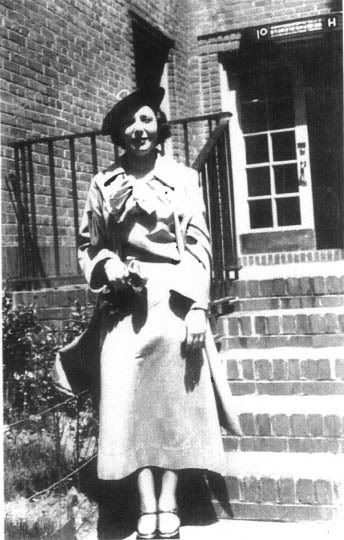
Seeing the previous slide show with Norma's mother Claire Boodman in 1936 reminded me of the discrepancy that Cliff referred to above. The H building is clearly labeled 10 Monroe then later it was changed to 12.
Paula And Norma's Slide Show
Re-posted images from Norma and Paula in a slide show format. Some of these are from the 1930's.
Sarah And Nancy's Slide Show
Arlene's slide show looks so good that I'm re-posting images that Sarah and Nancy shared with us a while ago in a slide show format
Arlene's Slide Show
We interrupt the George Gogel Story for a slide show of family pictures from Arlene Lackow
From Paula Romm Sanders:
The dressed up ladies are all the mahjong group. Peshie Warbet, Rosalyn Romm, Ann Lackow, Ida Schneider, Mildred Cohen and Sue Schumer. Mildred is 99 and still lives in KV,
The George Gogel Story: Part 4

From the 1920 census. Marks is now listed as having a bakery business. George is a clerk in a grocery store. Ben is a clerk in a bakery and Julius is a clerk in a bank. Maybe Marks now has two stores with George running the store on the LES and Ben working in the bakery. Percy is just 15.
The George Gogel Story: Part 3
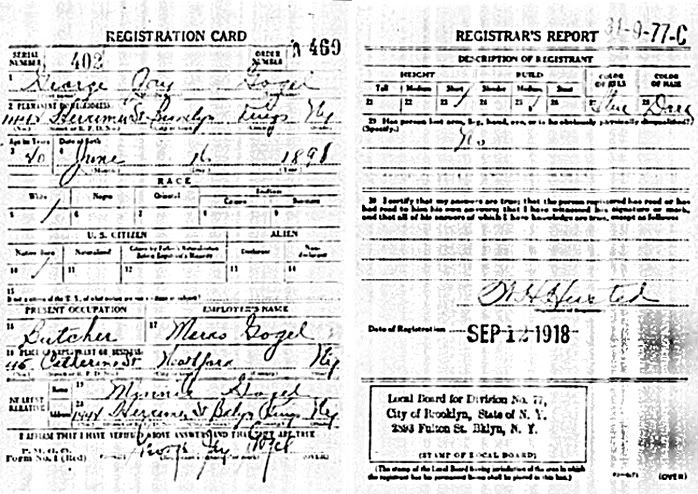
Above: George Gogel's 1918 WW1 draft card. He's 20 years old, short with a medium build. He's working for his father who has a butcher shop at 46 Catherine (Smith Projects now). The family lives at 1442 Herkimer Street. Below: The Gogel house on Herkimer Street, near Sackman Street in the Ocean Hill section of Brooklyn. In the 1910 census Marks Gogel is listed as owning the house. It may have been constructed at around that time.

The George Gogel Story: Part 2
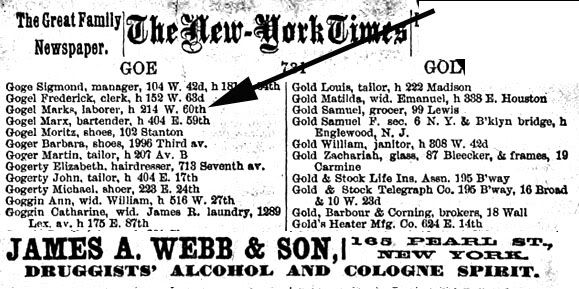
Above from a 1889 directory. Marks' Gogel advertises himself as a laborer available for hire living on 60th Street on the West Side. Below in his 1898 Naturalization papers he's listed as a shoe fitter. Looks like he was a hard worker determined to make a living and move up in the world. 45 Leonard Street is in Williamsburgh, Brooklyn. There are housing projects at that address now. I suspect he came back to Broome Street in 1900 because he may have opened a business in that vicinity. Usually the trend was to move away from the crowded LES as immigrants needed a bigger living space for their families and could afford newer and better accommodations. They either used the newly constructed subways (to go to East Harlem and the Bronx usually) or the newly constructed Williamsburgh Bridge to go to Brooklyn.

The George Gogel Story: Part 1
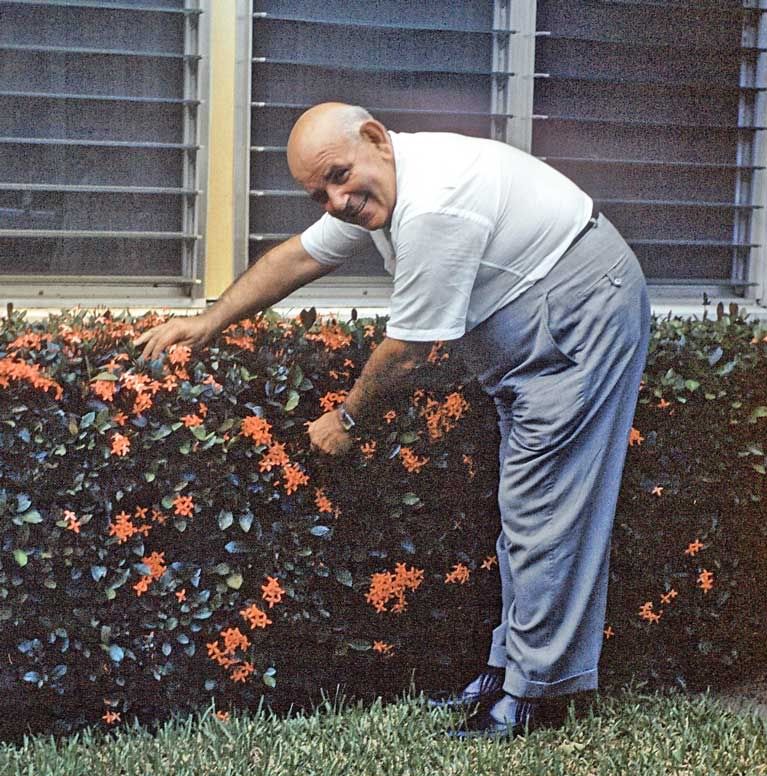
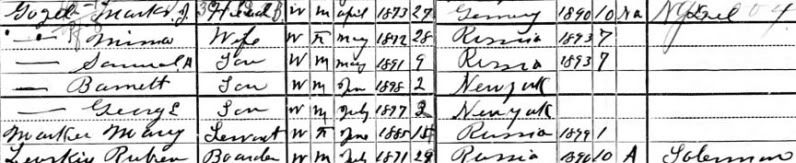
A picture from Cliff. That's George in retirement in Florida. I did research on the Gogel family since the family had an early KV presence. George's father had a store at 46 Catherine Street as early as 1917. George was born in the U.S. in 1897. He must have passed away, unfortunately, not too long after this photo, because he died in 1962. His wife Tessie was born in 1903 and lived until 1988. The Gogel family was here in the United States in 1889. George's father was named Marks, born in Germany in 1873 and his mother was Minnie, born in Russia in 1872. George had older brothers named Sam and Barnett and two younger brothers Julius and Percy. In 1900 the family lived at 315 Broome Street with a servant named Mary Marker and a boarder named Ruben Larkins. Julius and Percy weren't born yet. In the census piece below it's hard to make out what George's father did. I think it might be "Delivery." I'm pretty sure 315 Broome may not exist any more, since it was part of the section of Broome that was demolished around 1930 to make Sara Delano Roosevelt Park, between Forsyth and Chrystie.
Wednesday, April 1, 2009
Who's Who In Knickerbocker Village History: Sheldon Austin
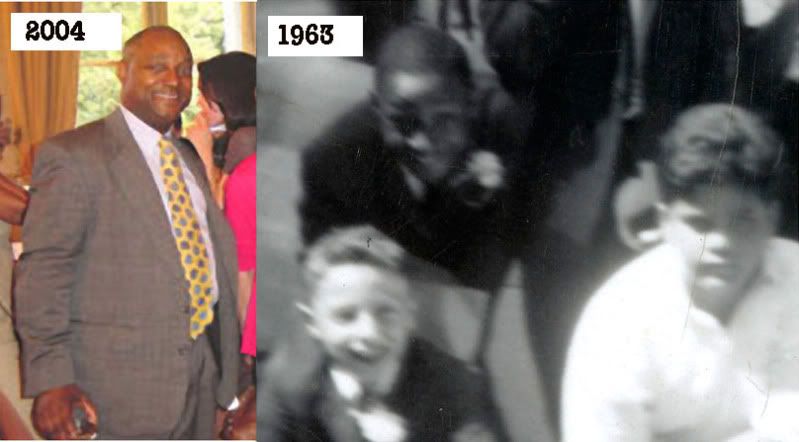
from Carlos Alejandro and Susan Spitzer
PS 177 classmate Sheldon Austin works for the State Department, speaks five languages and lives in France
He graduated from Brooklyn Tech and then went to Cornell where he earned his degree in linguistics
from the US State Department's Algier's Embassy Site from February 2009
In recognition of Black History Month, a month long celebration of the contributions of African Americans to the development and past and present history of the United States, the U.S. Embassy Algiers presented two Digital Video Conference (DVC) presentations. Invitees included students, professors, former scholarship recipients, Access school students, and community residents. The presenters were well informed and enthusiastic, and at the end of the presentations the audience responded with excellent and thought-provoking questions. On February 18, author Eddy Harris spoke on “Black American/Black Africans: What are the Commonalities beyond Race?”
This presentation explored the essence of the Black experience in America and Europe in comparison/contrast to the Algerian experience in Europe, specifically France. Mr. Harris is the author of five books, and currently resides in southern France.
On February 25, retired diplomat Sheldon Austin presented a thorough review of the book “Dreams From My Father: The Autobiography of Barack Obama,” highlighting key moments in the life of the current U.S. President and the possible impact of these events in his life and career. Mr. Austin is a 25 year Foreign Service diplomat currently living in France
April Fool's Day: J. Cheever Loophole, Attorney For Ex-Kvers
Today J. Cheever Loophole was supposed to be contacted by ex-KVers to claim back rent overcharges from 50 years ago. I had established an "office" for him at the Onion Magazine. Some people fell for it.... Some people aren't talking to me. I may have to change my name to Hugo Z. Hackenbush and move to Arizona. From: At The Circus, 1939, Music by Harold Arlen and brilliant lyrics by Yip Harburg, who lived at 55 Hester Street, between Allen and Eldridge, in 1900.
a link to learn all the song's historic and cultural references
My life was wrapped around the circus. Her name was Lydia.
I met her at the world's fair in 1900, marked down from
1940. Ah, Lydia.
She was the most glorious creature
Under the su-un.
Guiess. DuBarry. Garbo.
Rolled into one.
Oooooooh
Lydia oh Lydia, say have you met Lydia,
Lydia, the Tattooed Lady.
She has eyes that folks adore so,
And a torso even more so.
Lydia oh Lydia, that encyclopedia,
Oh Lydia the Queen of Tattoo.
On her back is the Battle of Waterloo.
Beside it the wreck of the Hespherous, too.
And proudly above waves the Red, White, and Blue,
You can learn a lot from Lydia.
La la la, la la la, la la la, la la la
When her robe is unfurled, she will show you the world,
If you step up and tell her where.
For a dime you can see Kankakee or Paris,
Or Washington crossing the Delaware.
La la la, la la la, la la la, la la la
Oh Lydia oh Lydia, say have you met Lydia,
Oh Lydia the Tattooed Lady
When her muscles start relaxing,
Up the hill comes Andrew Jackson
Lydia oh Lydia, that encyclopedia,
oh Lydia the queen of them all!
For two bits she will do a mazurka in jazz,
With a view of Niagara that nobody has.
And on a clear day you can see Alcatraz.
You can learn a lot from Lydia.
La la la, la la la, la la la, la la la
Come along and see Buff'lo Bill with his lasso.
Just a little classic by Mendel Picasso.
Here is Captain Spaulding exploring the Amazon.
Here's Godiva but with her pajamas on.
La la la, la la la, la la la, la la la
Here is Grover Whalen unveilin' the Trilon.
Over on the West Coast we have Treaure Island.
Here's Najinsky a-doin' the rumba.
Here's her social security numba.
(whistles)
Oh Lydia, oh Lydia that encyclopedia,
Oh Lydia the champ of them all.
She once swept an Admiral clear off his feet.
The ships on her hips made his heart skip a beat.
And now the old boy's in command of the fleet,
For he went and married Lydia.
I said Lydia (He said Lydia)
I said Lydia (We said Lydia)
La La!
Cliff's KV Notes, Part 12: Games People Play
Before I get into this installment, I want to throw something out there. I believe, early on, that there was one mailing address for all the buildings in the “10” court—“10 Monroe St..,” and another, “40 Monroe St.” for all the buildings in the “30” court. For evidence, check out Dr. Leon Sussman’s address on his letterhead: --40 Monroe. Check out my address on my war ration book—40 Monroe. Dr. Sussman was in the “E” bldg., and I was in the “D” bldg. at the time. The “F” bldg. is actually designated as 40 Monroe.
When we moved to HG9, I have a very vague recollection (I can push my 68-year-old memory only so far) that our address was 10 Monroe, and it soon was changed to 12 Monroe. While KV did have a package room, maybe they also had a post office on site, otherwise sorting the mail would have been a nightmare for the folks at Knickerbocker Station (unless the change came when the Knickerbocker Station PO opened up—just a guess).
My earliest recollection of being “out there,” must have been before I was five years old. The health gurus of the day professed that kids needed milk and sunshine to survive. My mother would take a wide-mouth jar, like a Mason Ball jar, fill it with milk, wrap wax paper around the top and then screw on the cover. We would stand on Cherry St. next to the playground, and my mother would yak with all the other yentas out there and periodically force-feed me this now-warm milk. Once in a while I’d get a treat—literally. Treat potato chips, probably from Gogels. The chips came in a long thin wax-paper bag and they were the greasiest, saltiest chips you could imagine. Must’ve been fried in lard enriched with extra cholesterol.
The health gurus also said that ultraviolet light was healthy for growing kids (right—especially very fair-skinned ones). So I remember getting a couple of UV sessions at Dr. Kaufman’s office. They did protect your eyes with goggles, so I give them credit for that. I remember a strong smell of ozone, which I rather liked. I guess the UV thing came after vibrators were introduced for the ladies to “relieve tension.”
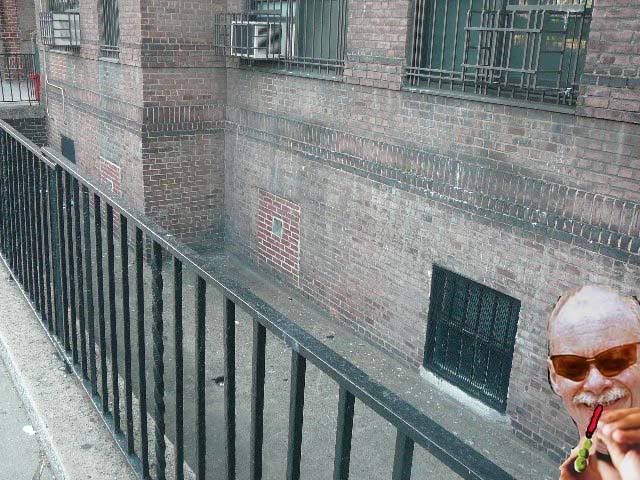
When I was finally cut loose from my mother’s apron strings, there were all kinds of neat things to do. When I graduated from the monkey bars in the playground, the next challenge was the pits. KV is full of pits, as they were called. They allowed basement rooms to have windows. Getting down into a pit was easy, getting back up was more of a challenge. The first hurdle was climbing over the railing. What’s the big deal, you ask. Well, there are all kinds of things going on in kids’ minds that adults would never suspect. Like, “what if I climbed over the rail and slipped and fell down into the pit.” See? All kinds of fears that have to be overcome. Like I said, getting down was easy. When I got stuck down there, one of the big kids would save the day by climbing over the rail and lowering his foot. I’d grab onto his shoe and get a lift up to safety. I’m sure Bob Wilson “gave me the boot” on one or more occasion.
The king of the pits was the deepest one in KV. I believe was on Monroe St. It was the kiddie equivalent of scaling Mt. Everest, only in reverse. It wasn’t something to be taken lightly the first time around. It took a while to psyche myself up, but I knew I had to try it, having conquered all the lesser pits in KV. But I had watched how the other kids made it up, and I gave it a shot. Obviously I’m here to tell about it.
I’d be allowed out of the apartment “to go play” for 2-3 hours. And I had to be back at a certain time. I didn’t own a watch (that came in the second grade) so I’d have to keep asking people the time.
There were two crazes I remember—pea shooters and water guns. All the kids had them at the same time. Water gun fights were cool. We’d chase each other all over the neighborhood, and we’d refill our guns from the slop sink in the incinerator rooms. ‘Course the sink faucets didn’t have handles so only the janitors could turn them on. But we quickly figured out that a roller skate key would do the trick.
The peas shooters were large plastic straws that you loaded with split peas or white beans that came in a box from the grocer. The best part was raiding the Brownies—this was the junior contingent of the Girl Scouts (the equivalent of the Cubs Scouts to the Boy Scouts), and they held their activities in one of the basement rooms. The door was usually open. So it was a simple matter of quietly creeping up and firing off a salvo or two and then running like hell. The whole deal was made infinitely sweeter because my sister was one of the Brownies in the room.
My father introduced me to the world of Spaulding (pronounced “Spauldeen”) by teaching me to play handball against the wall of the Journal-American Building on South St. The Smith houses, with its handball courts hadn’t been built yet. But when it was, I would spend hours on the courts. Handball was my game.
KV had a really great playground., and I’ve never seen a better swing set. The hard rubber seat was connected to the frame with metal rods joined together by eye hooks. At the top, the rods were just hooked, not captivated, into the frame. I always feared that on high altitude arcs, in the millisecond at the top of the arc when the rods went slack, that one of the hooks could slide out, and I’d be launched onto Monroe St. I spent many hours on those swings. It was the closest a 5 or 6-year old could get to flying. After a rain, the rods would grow a slight coating of rust, which would rub off on my hands. Small price to pay. I also developed blisters and then calluses from pumping those bars to pay for my ride—also well worth it.
I remember two instances—one sitting on the swing, the other looking out my apartment window. A loud drone that continually grew in intensity. I looked up, and the sky was filled with U.S. bombers flying over KV at a fairly low altitude. Talk about impressive. Another thing anyone who spent some time in the playground would remember, is the firing up of the incinerator. To the right of the playground (when facing Monroe) was a brick chimney that poured out heavy black smoke from the incinerator. The air would take on an acrid smell and flakes of soot, and particles of grit would filter down onto the playground.
Sitting on the swing facing Cherry St. I could observe the older kids sitting on the green covered bench. They’d be joking and poking one another. One kid, taller than the others, seemed to have a position of authority and respect. He was very self-composed. Now, while younger kids sort of scrutinized the older kids, older kids just ignored younger kids. My mother told me that this tall kid’s name was “Punch.” He had a sister named “Judy.” I never got the connection to the marionettes Punch & Judy. I just thought those were their names.
In 1983, I took my 8-year-old son, Jonathan, down to the Brooklyn Bridge area to see the centennial celebration fireworks. The South Street viaduct was closed to traffic and was packed with people. There wasn’t a good viewing vantage spot left. I told my son, that I had a “secret spot” that would give us a front-row seat for the fireworks—the roof of KV. We went into the lobby of the “L” building to ride up to the penthouse. From there we would climb the stairs to the roof. I don’t know why I chose the “L” building, instead of one closer to Cherry St. Maybe it was because I used to date a girl in that building and wanted to see if the last name was still on the intercom list—it was.
Anyway, you know how over the years people change, but also remain the same? When my son and I walked to the elevators, there was a tall guy standing there. I recognized him as Punch, even though I hadn’t seen him in almost 40 years.. I couldn’t resist.
“Excuse me, but is your name “Punch?”
The guy looked shocked.
“Punch? Nobody’s called me that since the ‘50s…no, the ‘40s!”
He introduced himself—Bob Wilson. Then he tried to figure out who I was. I told him not to bother. Big kids always ignored little kids.
In the playground, my favorite game was punchball. I remember that David Schecter and I were about the only ones who could punch a ball all the way back to the flagpole. Another “Spauldeen” game was bouncing the ball off the chimney where it hipped down into a point. You could whack a really high fly ball off that.
Back to the dirt area around the flagpole--the arena for two other games: marbles and “Charge.” I always lost all of my marbles, and would have to buy another box from the K&K for my next day’s trouncing. The way “Charge.” Was played, was that one guy would stand by the flagpole, while everyone lined up at the edge of the dirt. He would yell “Charge,” and the object was to run across to the other side of the dirt area without being tagged. If you were tagged, you joined the guy in the center, until there was only one man left—the winner. Sort of like “The Night of the Living Dead
The next chapter in Cliff's KV Notes
The previous chapter of Cliff's KV Notes
Subscribe to:
Posts (Atom)


 Posts
Posts