In 1936 the American Labor Party (ALP) was formed by left-wing supporters of Franklin D. Roosevelt and the New Deal. This included Abraham Cahan, Sidney Hillman and David Dubinsky. The ALP put forward a left-wing, non-socialist, program. Its 1937 Declaration of Principles stipulated that there should be a "sufficient planned utilization of the natural economy so that coal, oil, timber, water, and other natural resources that belong to the American people... shall be protected from predatory interests." The following year, ALP member, Vito Marcantonio was elected to Congress where he represented East Harlem's 20th District.
Sunday, July 15, 2012
Michael Sidorovich: 341 East 19th Street
341 19 Communists
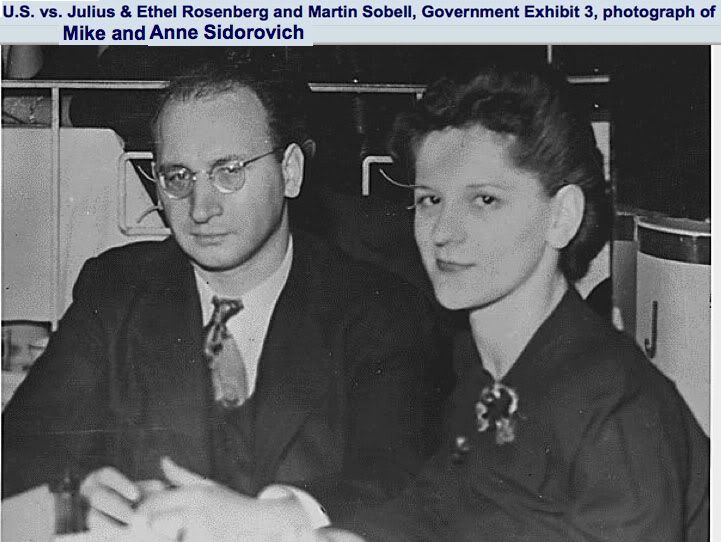
Before moving to Knickerbocker Village Michael Sidorovich lived at the above address. During the early 1950 FBI inquest on Soviet espionage there was a search for evidence implicating Michael and his wife Ann. The above is just a fraction of what was gathered. Pretty amazing that so many of the people that lived here were members of the American Labor Party. Yet in 1937 Fiorello LaGuardia garnered almost a half a million votes or 21.6% of his total from the party. In the 1930's there was no stigma associated to the party, but by 1950 it was considered too "red."About the American Labor Party:


Who's Who In Knickerbocker Village History: Michael and Ann Sidorovich
B. Fischer & Company: Coffee Roasters

Who's Who In Knickerbocker Village History: David Diefenthaler

More about B. Fischer and Co. and the Diefenthaler family:
Following the death of Benedickt Fischer in 1903 the firm passed under the control of William H. Fischer, son of Benedickt, and Mr. Diefenthaler. Mr. Diefenthaler is survived by a widow, two sons, Richard and David A. Diefenthaler, ... SAN SALVADOR— The 1919-20 coffee crop in El Salvador is estimated at approximately 100000000 pounds. ... Mr. Diefenthaler is survived by a widow, two sons, Richard and David A. Diefenthaler, a flight officer with the Army Air Forces B. FISCHER and CO. 190 Franklin Street NEW YORK Name: David Diefenthaler Gender: Male Birth Date: 21 Jul 1913 Death Date: 26 Dec 1970
Who's Who In Knickerbocker Village History: Reverend Robert Dolliver
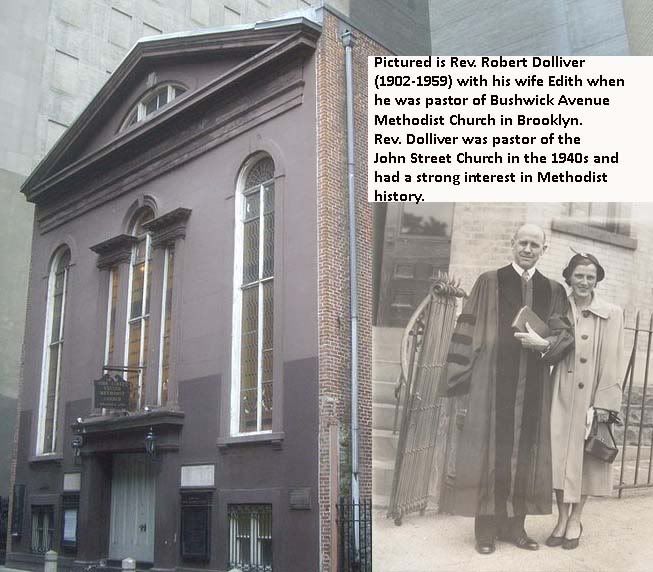
The John Street United Methodist Church is a NYC landmark
The John Street United Methodist Church located at 44 John Street in Manhattan, New York, USA was built in 1841. It is the third church located at the site. It is the home of the oldest Methodist congregation in North America, starting on October 12, 1766.
It was designated a New York City Landmark in 1964.
Below the sanctuary, the Wesley Chapel Museum displays many artifacts from eighteenth and nineteenth century American Methodist history. These include church record books, the Wesley Clock (a gift of John Wesley, 1769), love feast cups, class meeting circular benches, the original 1785 altar rail, the original 1767 pulpit made by Philip Embury, and Embury's signed Bible.
The current pastor is the Rev. Jason P. Radmacher. The organist and choir master is Earl Wentz.
Hymnist Fanny Crosby was a member of the church congregation for many years.
Naomi Groob's Husband Max Fuchs
from global jewish advocacy
Then, on October 26, he wrote to his wife, in Richmond, Virginia, ”A bit of excitement – an NBC reporter phoned me last night…and told me he wanted to broadcast part of my service on this Sunday afternoon…” While Lefkowitz would write and deliver the sermon, Max Fuchs, a First Division rifleman, was given the honor of serving as cantor. Born in Poland, Fuchs had come to America at the age of twelve. Raised on New York City’s Lower East Side, he attended yeshiva, sang in a number of choirs, and had been enthralled by some of the city’s great cantors. He could never have imagined, when he joined the army in 1942, how this background would impact his military service. Fuchs often led services because the First Division, known as the Big Red One, did not have a Jewish chaplain. His religious knowledge and melodic voice were noticed by commanding officers and, after Omaha Beach, he was transferred to division headquarters and made an acting chaplain. So, on October 29, 1944, Corps Chaplain Sidney Lefkowitz, Max Fuchs, NBC war correspondent James Cassidy, and 50 Jewish soldiers gathered not far from the destroyed Aachen synagogue to deliver a message of hope and renewal to the world. “We hear the sound of artillery guns, because the front line is not far from where we are,” Cassidy warned listeners. “How sweet upon the mountain are the feet of the messenger of good tidings!” declared Rabbi Lefkowitz. “The light of religious freedom has pierced through the darkness of Nazi persecution.” Amidst the explosion of artillery shells, Fuchs led the Jewish GIs in the singing of Ein Keloheinu and Yigdal. In a show of brotherhood the broadcast ended with comments by Catholic Chaplain Father Edward Waters and Protestant Chaplain Bernard Henry. “One of the great fruits born of this war,” said Father Waters, “is religious freedom for all men.” Protestant chaplain Bernard Henry closed the service with the hope of Jewish renewal. “I am confident that the Jews everywhere in Europe shall soon again have the opportunity to enter their houses of worship,” said Henry. “That is definitely one of the things we are fighting for and are resolved to preserve.” The broadcast from Aachen reverberated across the U .S. Those that missed the original Sunday morning transmission were able to listen to one of a number of repeat programs. Philip S. Bernstein, director of Jewish chaplains of CANRA, the Committee on Army and Navy Religious Activities, wrote to chaplain Lefkowitz, “The Ayn Kaylohaynu will never have the same meaning for me again. I think that I will never be able to sing it without remembering the American boys singing it from Aachen.” He added, “You have made history Sidney. I believe this with all my heart. It seems to me that in this phase of the war our chaplains have become the symbols of liberation.” Sitting in her Brooklyn home, Naomi Groob also was moved by the broadcast. “What a beautiful voice,” she thought as she listened to Fuchs sing. Shortly after the war, while on a Shabbat walk along the East River, she met Max, the man with the beautiful voice. They married in 1946. After the war, Fuchs became a cantor, serving at the Bayside Jewish Center for 39 years. He also maintained a second career, cutting and polishing diamonds in New York City’s Diamond district, an activity he still engages in at the age of 85.
Who's Who In Knickerbocker History: Morris Groob
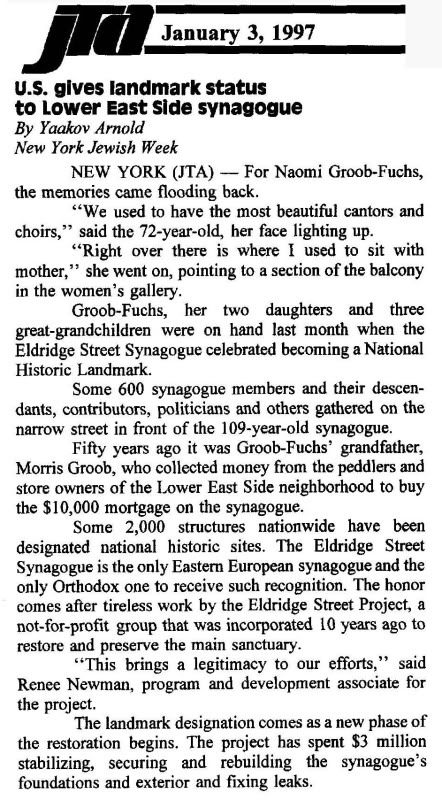
Max Fuchs, 89, had come to the day’s event with his wife, Naomi, and their children. A cantor for many decades, he recalled leading services at the Eldridge Street Synagogue in the 1940s, after returning from service in World War II. “I was the last cantor to conduct High Holiday services,” he said. He gave his family members much credit for their part in keeping the Eldridge Street Synagogue alive even during its declining years. “My in-laws were big machers here,” he said, referring mostly to Morris Groob, a longtime congregant and leader at the synagogue.
Friday, July 13, 2012
Who's Who In Knickerbocker Village History: Eric Weissberg
The Weissberg's were living at 32 Monroe Street in 1940. Eric was only one. His parents were Will and Cecile. from Eric's site Considered by aficionados to be one of the best five-string banjo players ever, Eric Weissberg has been a major force on the folk scene and a ubiquitous prescence on the studio scene for more than four decades. He attended The Little Red School House in Greenwich Village, where he started playing banjo and guitar at the age of seven and violin at ten. Then to the High School of Music and Art as a string bass major, continuing at the University of Wisconsin and The Juilliard School of Music. He taught himself bluegrass style banjo at the age of eleven by slowing down 78rpm records, and in 1958 he was a founding father of the New York bluegrass trio "The Greenbriar Boys". He joined the folk group "The Tarriers" in 1959, recording and touring worldwide for six years. As a top New York studio musician Eric has done over six thousand sessions - jingles, movie tracks, and records - playing guitar, pedal steel guitar, mandolin, Dobro, and fiddle as well as banjo for such diverse artists as Bob Dylan, Barbra Streisand, John Denver, Willie Nelson, Johnny Cash, Arlo, The Talking Heads, Bruce Springsteen, Doc Watson, Judy Collins, Bette Midler, Buddy Rich, Shanana, Jim Croce, Rick Danko and many others. In 1967 he performed the world premiere of Earl Robinson's Concerto for Five-string Banjo, with Arthur Fiedler and the Boston Pops. He had a number one single and album with "Dueling Banjos", the soundtrack from "Deliverance" which earned him two gold records and a "Grammy" award from the National Academy of Recording Arts and Sciences. He is a five-time winner of the New York N.A.R.A.S "Most Valuable Player" award and a Virtuoso award. Lately Eric has reappeared on the live scene singing and picking music in concert, both solo and as accompanist.
Wednesday, May 30, 2012
The Baudelaires of East Broadway
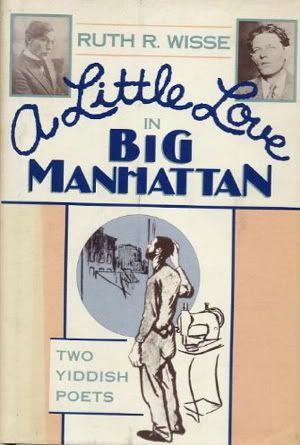
Ruth Wisse will be at the Eldridge Street Synagogue on June 3 as part of a Yiddish Writers Tribute. Reuben Iceland and Anna Margolin, members of the Di Yunge, lived in Knickerbocker Village at 18 Monroe Street
excerpts from a Commentary Magazine review of "A Little Love in Big Mahattan: Two Yiddish Poets."
The story Ruth R. Wisse tells in her latest book is, like the poem from which she takes her title, ironic and bittersweet. It is the story of a group of young Yiddish-speaking immigrants in turn-of-the-century New York who lived for poetry. Their brief, doomed movement to fashion a purified Yiddish aesthetic, one which was committed not to any political or social ideal but to language itself, began in 1907 and was known as Di Yunge (“The Young”). In the two decades between the first major wave of Jewish immigration in the 1880′s and the years when these poets arrived, Yiddish culture in America had already undergone a number of changes. The first Yiddish literature, typified by the “sweatshop school” of poetry, was didactic and blunt; it addressed itself entirely to the requirements of the working-class population, depended on a close alliance with the Yiddish press, and was cut off from the folk traditions of the prose masters—Sholem Aleichem, Men-dele, Peretz—who were then writing their best works in Russia and Poland. The sweatshop poets, responding to a totally unfamiliar tenement and factory existence, engineered a kind of literary expression that suited the needs of their uprooted, bewildered audience. Their poetry was little more than a bald testimony to this community’s hard new life.......Perhaps the example of Yunge poetry which manages best to incorporate all these high-minded ideals is Mani Leib’s “Shtiller, shtiller” (“Hush, hush”), a poem about waiting for the messiah, which opens this way
Hush and hush—no sound be
heard.
Bow in grief but say no word.
Black as pain and white as death,
Hush and hush and hold your
breath.
One by one they declared their devotion to this pure, self-contained aesthetic: Mani Leib, Reuben Iceland, Zishe Landau, Moishe Leib Halpern. Barely twenty, fresh from various parts of the Jewish Pale, working endless hours in bootmaking factories or as window washers, they gathered at night in the cafes to discuss the French symbolists and Walt Whitman. They were lucky to steal a few moments alone in a crowded, noisy apartment, these Baudelaires of East Broadway, to write longingly of stillness, quiet, trees, snow. To their heated debates they brought the zeal of the formal religious practices they had all but abandoned. They called themselves “a new kind of minyan”; for them, poetry was like the promise of the Sabbath or of Mani Leib’s breathlessly awaited messiah—it brought the redemption of the world into closer view. They saw themselves as dandies, as aesthetes, with “their elegant canes, their long hair and their wide, sweeping hats,” but what one notices first about them is how close to the shtetl they still were, and how young, how full of books and spite and cheerfulness and strength.
Who's Who In Knickerbocker Village History: Sam Eppy
Samuel Eppy
Sam lived at 14 Monroe Street in 1940. He must have been doing well at that time as well because the family is listed in the census as having a live in maid! I recall a conversation with Marion Fox where she said she was friendly with Sam's daughter Judy.
Who's Who In Knickerbocker Village History: Moses Asch, part 2
An excerpt from a 1978 conversation with Moses Asch from Pete Seeger's site
"Conversation with Mr. Folkways: Moe Asch" by Jim Capaldi
Moe Asch has been recording folk music longer than most of us have been alive. From the 1930’s, a time of great social and political upheaval, to the present space age, he and his microphones have captured the music and sounds of the people of the world on Asch, Disc and Folkways Records. It was his genius that recognized the value of native American folk song, and the talent of people like Woody Guthrie, Leadbelly and Pete Seeger at a time when neither the music nor the musicians playing it were considered to be worthy of any serious attention. Moe Asch has been a key figure in the folk revival, having been associated with People’s Songs Bulletin, Sing Out! and Oak Publications. But it is chiefly through his role as founder of Folkways Records that we know of him today.
Now in his seventies, Moe Asch remains a vital force in American folk music. His record company still issues dozens of new releases every year and still maintains the policy of keeping all records in print at all times. Material on the more than 1,600 discs ranges from Appalachian mountain music to love songs of Lebanon to sounds of the human body. Looking back over the accomplishments of four decades, Moe Asch’s place as perhaps the foremost oral historian of this century is well established. The discussion that follows took place in May, 1977; it reveals something of Mr. Asch’s methods, philosophy and plans for the future.
Folkscene: Was your father Sholem Asch, a famous Yiddish writer (whose most well-known work was "The Nazarene’) , an influence in your decision to devote your life to documenting the folk music of your time?
Asch: No, except that he used to go on lecture tours throughout the United States in the 1920’s; wherever he went in the old days, in small towns, they had these sheets listing past events of the place, how they began and grew; always the heading had a folk song. So I knew there were folk songs about various areas in the United States that people had documented. My main influence was the John Lomax book which came out in 1913, Cowboy Ballads. That was the first book that documented American folk songs, and I picked that up in Paris.
I’m not interested in music per se, but the literature of it, the words. The music is mostly public domain. Usually somebody, a poet or someone else, wrote about a current event, some local happening. Like tabloids, they were local things that happened that were of interest, like murders. Local people set it down; someone musically inclined put it to music and sang it. My background is literary.
Folkscene: Then why did you go into the recording business, instead of publishing?
Asch: Because I happen to be an electronic engineer and I built equipment for radio stations. They needed recordings to use on the equipment and I got involved with folk music.. .because they told a story, because they documented a thing.
Folkscene: When did you start making records?
Asch: In 1935. My first commercial issue (on the Asch label) was in 1939, "Jewish Folk Songs" by the Bagelman Sisters. I recorded Ukrainian folk songs and Jewish cantorials for the radio; it was a foreign language station.
My first recording of American folk music was Lead Belly’s play parties.
Subscribe to:
Posts (Atom)


 Posts