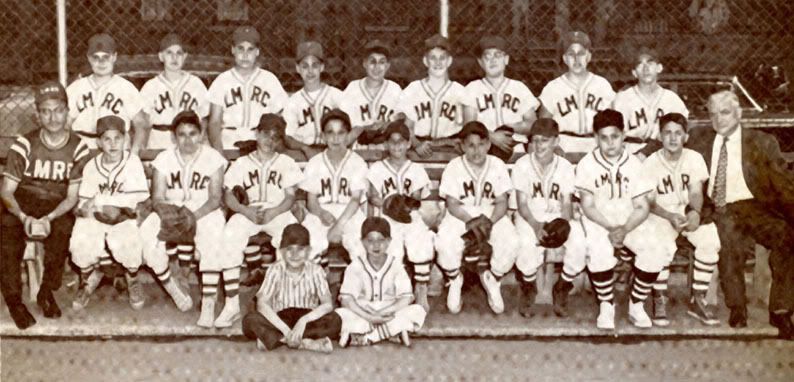
Gerald Cook was born in St. Louis, Missouri on April 30, 1916 to Catherine and James Cook. He was self educated and was never graduated from high school. As a young man, he moved to New York City and was active in organizing unions, specifically the Department Store Workers union. While on a picket line, he met his first wife, Anne Freedman. They married before he left for Spain to fight in the Abraham Lincoln Brigade. When he returned from Spain, he shipped out to fight the fascists in WWII. He served both on the European front and in the Pacific front. After the war, his first child, Catherine Anne Cook, was born inh 1947. A few years later Gerald and Anne divorced and Gerald married Joan Riddell Barlow, a journalist. They remained married until Jerry did in 1980. They had two children, Joseph Fitzgerald Cook (b. 1952) and Jezebel Cook (b. 1959). He also raised a step-son, John Barlow (b. 1946). Jerry is survived by his two daughters, his step-son and four grandchildren, Alexandra Barlow, Thomas Barlow, James Barlow and Caleb Cook.
For most of his post soldier life, Jerry was a journalist, working on various publications. He also worked for local 1199, editing their newsletter. He also worked for the Daily World. He never stopped being an activist and fought all his life for peace and justice. He died firmly believing in his Marxist principles of dialectical materialism.
From Mike's memoir, "The Anti-Warrior." Mike and his wife shared a penthouse apartment in the G building with the families of fellow Lincoln Brigade vets Jerry Cook and Irving Goff. This occurred in 1941. Soon the men would be off to fight in World War II.
Yesterday, July 14, 2012, Saturday Night Fever was shown in Prospect Park. I would have loved to have seen it as well as spot Milt Felsin's name in the credits. Milt lived in Knickerbocker for a brief time in the early 1940's before joining the OSS. I believe he lived in a 10 Monroe Street penthouse apartment.
from the archives of the Abraham Lincoln Brigade
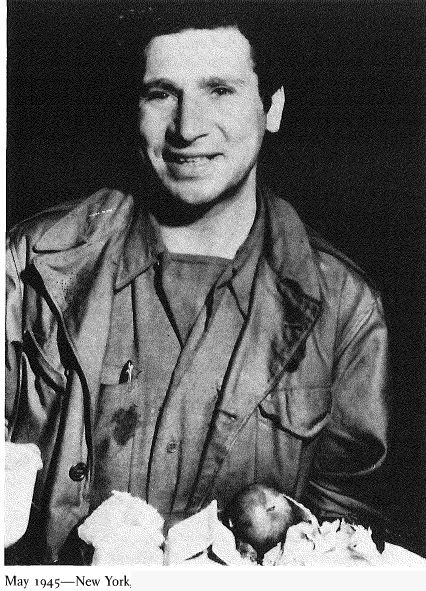
Born in New York City, Milt Felsen left the University of Iowa in his senior year to go to Spain in May of 1937. He served as a machine gunner in the Lincoln battalion and was wounded at Brunete. Upon release from the hospital, he spent the rest of the war as an ambulance driver.
In World War Two, Felsen joined the Office of Strategic Services with other Lincoln veterans. Wounded and taken prisoner in North Africa, he spent two years in prisoner of war camps in Italy and Germany. Felsen’s memoir of childhood and the war years, The Anti-Warrior, was published by the University of Iowa in 1989. It is one of the few autobiographies by Lincoln veterans. It is a great read. Milt accomplished many things in
peacetime. After the war, he worked for film-related labor unions in New York.
In 1960 he ran the East Coast office of the Directors Guild of America. He served on its board for 30 years. He was an associate producer of Saturday Night Fever, the John Travolta film that launched the disco era. His independent producing credits included The Bell Jar and The Directors, a television documentary series. Milt retired to Sarasota, Florida, where he kept in touch with film and theater. Over his busy career, Milt Felsen was staunchly loyal to the Lincolns.
He participated in reunions as well as trips to Spain, where his good humor was always appreciated. He will be sorely missed by those who had the good fortune of knowing him.
The unassuming and soft-spoken brigadista Milt Felsen passed away on April 8, 2005, in Florida. His wife, Lois Bennett, said of him, “Milt was a sweet guy and a tough guy. Life with him was so much fun.”
- Robert Coale
341 19 Communists
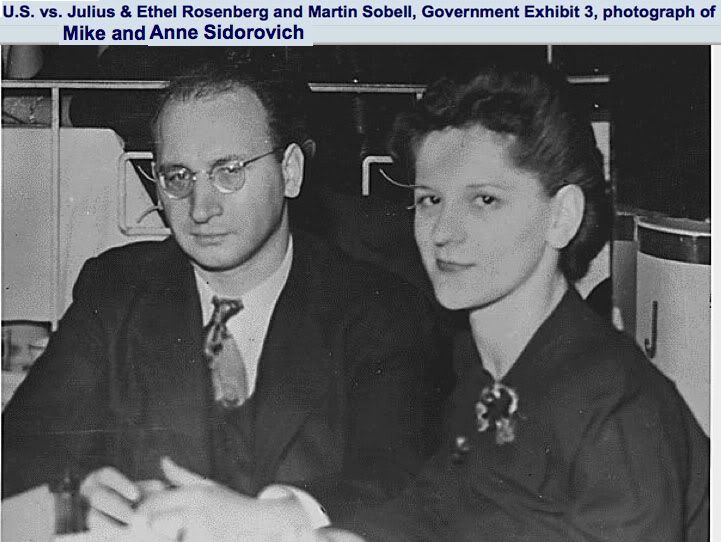
Before moving to Knickerbocker Village Michael Sidorovich lived at the above address. During the early 1950 FBI inquest on Soviet espionage there was a search for evidence implicating Michael and his wife Ann. The above is just a fraction of what was gathered. Pretty amazing that so many of the people that lived here were members of the American Labor Party. Yet in 1937 Fiorello LaGuardia garnered almost a half a million votes or 21.6% of his total from the party. In the 1930's there was no stigma associated to the party, but by 1950 it was considered too "red."About the American Labor Party:
In 1936 the American Labor Party (ALP) was formed by left-wing supporters of Franklin D. Roosevelt and the New Deal. This included Abraham Cahan, Sidney Hillman and David Dubinsky. The ALP put forward a left-wing, non-socialist, program. Its 1937 Declaration of Principles stipulated that there should be a "sufficient planned utilization of the natural economy so that coal, oil, timber, water, and other natural resources that belong to the American people... shall be protected from predatory interests." The following year, ALP member, Vito Marcantonio was elected to Congress where he represented East Harlem's 20th District.
They lived at 10 Monroe Street from October 1942 until May of 1943 in apartment GB12.
Michael attended Seward Park High and later Stuyvesant High School. After graduation he fought in Spain as a member of the Abraham Lincoln Brigade. Michael and Ann were a suspected Communist spies who were friends and, for a short time neighbors, of the Rosenbergs. They were also witnesses before the Grand Jury during the Rosenberg trial.
From an era when there were businesses that actually made something in New York and the Fourth Ward. David Diefenthaler probably walked to work from his Knickerbocker apartment.
In the 1940 census David was listed as a coffee roaster living with his wife Ruth at 36 Monroe Street. Shortly after he joined the Air Force.
More about B. Fischer and Co. and the Diefenthaler family:
Following the death of Benedickt Fischer in 1903 the firm passed under the control of William H. Fischer, son of Benedickt, and Mr. Diefenthaler. Mr. Diefenthaler is survived by a widow, two sons, Richard and David A. Diefenthaler, ...
SAN SALVADOR— The 1919-20 coffee crop in El Salvador is estimated at approximately 100000000 pounds. ... Mr. Diefenthaler is survived by a widow, two sons, Richard and David A. Diefenthaler, a flight officer with the Army Air Forces
B. FISCHER and CO. 190 Franklin Street NEW YORK
Name: David Diefenthaler
Gender: Male
Birth Date: 21 Jul 1913
Death Date: 26 Dec 1970
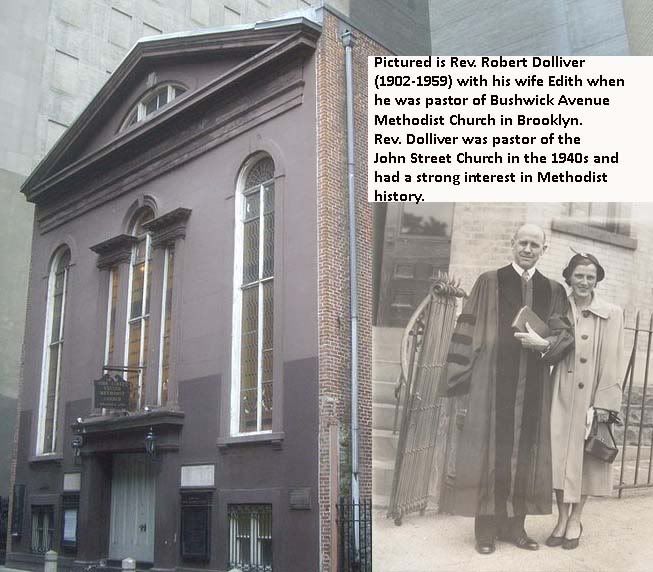
The John Street United Methodist Church located at 44 John Street in Manhattan, New York, USA was built in 1841. It is the third church located at the site. It is the home of the oldest Methodist congregation in North America, starting on October 12, 1766. It was designated a New York City Landmark in 1964. Below the sanctuary, the Wesley Chapel Museum displays many artifacts from eighteenth and nineteenth century American Methodist history. These include church record books, the Wesley Clock (a gift of John Wesley, 1769), love feast cups, class meeting circular benches, the original 1785 altar rail, the original 1767 pulpit made by Philip Embury, and Embury's signed Bible. The current pastor is the Rev. Jason P. Radmacher. The organist and choir master is Earl Wentz. Hymnist Fanny Crosby was a member of the church congregation for many years.
Then, on October 26, he wrote to his wife, in Richmond, Virginia, ”A bit of excitement – an NBC reporter phoned me last night…and told me he wanted to broadcast part of my service on this Sunday afternoon…”
While Lefkowitz would write and deliver the sermon, Max Fuchs, a First Division rifleman, was given the honor of serving as cantor. Born in Poland, Fuchs had come to America at the age of twelve. Raised on New York City’s Lower East Side, he attended yeshiva, sang in a number of choirs, and had been enthralled by some of the city’s great cantors. He could never have imagined, when he joined the army in 1942, how this background would impact his military service.
Fuchs often led services because the First Division, known as the Big Red One, did not have a Jewish chaplain. His religious knowledge and melodic voice were noticed by commanding officers and, after Omaha Beach, he was transferred to division headquarters and made an acting chaplain.
So, on October 29, 1944, Corps Chaplain Sidney Lefkowitz, Max Fuchs, NBC war correspondent James Cassidy, and 50 Jewish soldiers gathered not far from the destroyed Aachen synagogue to deliver a message of hope and renewal to the world.
“We hear the sound of artillery guns, because the front line is not far from where we are,” Cassidy warned listeners.
“How sweet upon the mountain are the feet of the messenger of good tidings!” declared Rabbi Lefkowitz. “The light of religious freedom has pierced through the darkness of Nazi persecution.”
Amidst the explosion of artillery shells, Fuchs led the Jewish GIs in the singing of Ein Keloheinu and Yigdal.
In a show of brotherhood the broadcast ended with comments by Catholic Chaplain Father Edward Waters and Protestant Chaplain Bernard Henry.
“One of the great fruits born of this war,” said Father Waters, “is religious freedom for all men.”
Protestant chaplain Bernard Henry closed the service with the hope of Jewish renewal. “I am confident that the Jews everywhere in Europe shall soon again have the opportunity to enter their houses of worship,” said Henry. “That is definitely one of the things we are fighting for and are resolved to preserve.”
The broadcast from Aachen reverberated across the U .S. Those that missed the original Sunday morning transmission were able to listen to one of a number of repeat programs.
Philip S. Bernstein, director of Jewish chaplains of CANRA, the Committee on Army and Navy Religious Activities, wrote to chaplain Lefkowitz, “The Ayn Kaylohaynu will never have the same meaning for me again. I think that I will never be able to sing it without remembering the American boys singing it from Aachen.” He added, “You have made history Sidney. I believe this with all my heart. It seems to me that in this phase of the war our chaplains have become the symbols of liberation.”
Sitting in her Brooklyn home, Naomi Groob also was moved by the broadcast. “What a beautiful voice,” she thought as she listened to Fuchs sing. Shortly after the war, while on a Shabbat walk along the East River, she met Max, the man with the beautiful voice. They married in 1946.
After the war, Fuchs became a cantor, serving at the Bayside Jewish Center for 39 years. He also maintained a second career, cutting and polishing diamonds in New York City’s Diamond district, an activity he still engages in at the age of 85.
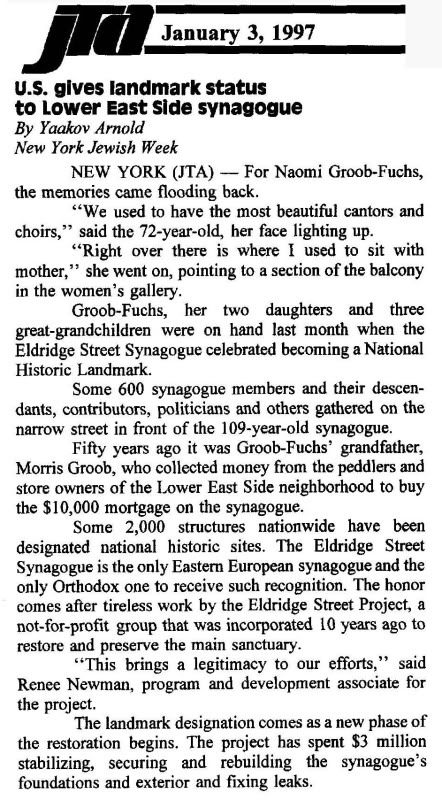
Max Fuchs, 89, had come to the day’s event with his wife, Naomi, and their children. A cantor for many decades, he recalled leading services at the Eldridge Street Synagogue in the 1940s, after returning from service in World War II. “I was the last cantor to conduct High Holiday services,” he said.
He gave his family members much credit for their part in keeping the Eldridge Street Synagogue alive even during its declining years. “My in-laws were big machers here,” he said, referring mostly to Morris Groob, a longtime congregant and leader at the synagogue.
The Weissberg's were living at 32 Monroe Street in 1940. Eric was only one. His parents were Will and Cecile.
from Eric's site
Considered by aficionados to be one of the best five-string banjo players ever, Eric Weissberg has been a major force on the folk scene and a ubiquitous prescence on the studio scene for more than four decades.
He attended The Little Red School House in Greenwich Village, where he started playing banjo and guitar at the age of seven and violin at ten. Then to the High School of Music and Art as a string bass major, continuing at the University of Wisconsin and The Juilliard School of Music. He taught himself bluegrass style banjo at the age of eleven by slowing down 78rpm records, and in 1958 he was a founding father of the New York bluegrass trio "The Greenbriar Boys". He joined the folk group "The Tarriers" in 1959, recording and touring worldwide for six years.
As a top New York studio musician Eric has done over six thousand sessions - jingles, movie tracks, and records - playing guitar, pedal steel guitar, mandolin, Dobro, and fiddle as well as banjo for such diverse artists as Bob Dylan, Barbra Streisand, John Denver, Willie Nelson, Johnny Cash, Arlo, The Talking Heads, Bruce Springsteen, Doc Watson, Judy Collins, Bette Midler, Buddy Rich, Shanana, Jim Croce, Rick Danko and many others.
In 1967 he performed the world premiere of Earl Robinson's Concerto for Five-string Banjo, with Arthur Fiedler and the Boston Pops. He had a number one single and album with "Dueling Banjos", the soundtrack from "Deliverance" which earned him two gold records and a "Grammy" award from the National Academy of Recording Arts and Sciences. He is a five-time winner of the New York N.A.R.A.S "Most Valuable Player" award and a Virtuoso award.
Lately Eric has reappeared on the live scene singing and picking music in concert, both solo and as accompanist.
Knickerbocker Village at the 2010 Conference on New York State History, June 4
click on picture above for conference schedule
All copyrights acknowledged. For research and educational purposes only.
June 1974
PS 177: June, 1959, Nancy with Mrs. Jonas
About Knickerbocker Village
I found that a recurring topic on my blog, Pseudo Intellectualism, would be my memories of the wonderful place I grew up in on the Lower East Side, Knickerbocker Village. I lived there from 1952-1964. There has also been an avalanche of new information coming in from my old friends through our group emails. All of this has refreshed our collective minds and I decided to shift my old posts (from the last two years) to this dedicated site as well as add new recollections. Hopefully other lost KVer's can arrive here and feel free to share as well. Note 1: Many posts are an outgrowth of history projects I did with kids while teaching on the LES. Note 2: As this blog has evolved it has also become a view of life in NYC during the 50's and 60's. You can contact me at davidbellel.mac.com.
Stewie Brokowsky R.I.P., photo by Murray Schefflin
Help In Understanding Various Blog Posts, The KV Mind Map: Click On Image Below
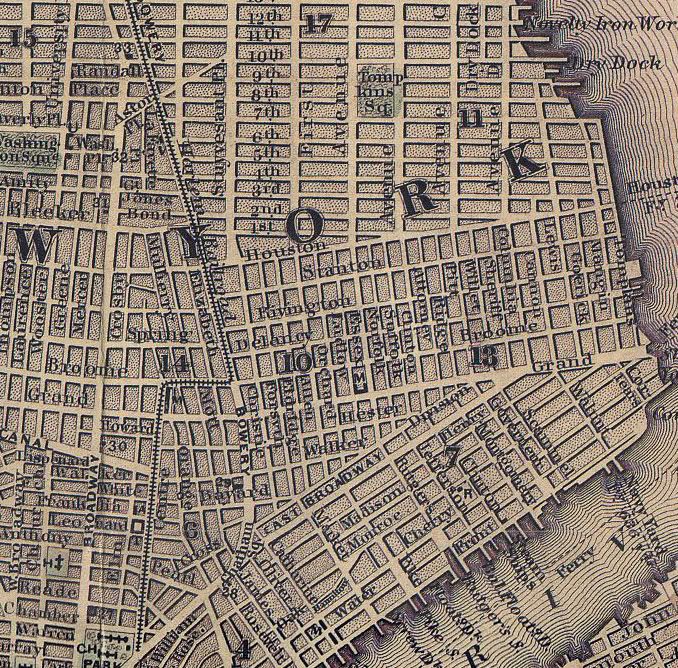
1847 LES Ward Map Section: A Geographic Tool For Locating Blog Posts
Click For A Better View
Deep Thoughts
#1. Annie Dillard talks about her fascination with science and minerals in particular. Then she goes on to details anecdotes concerning various Americans who became obsessed with the possibility of discovering valuable or interesting mineral deposits or rock formations within or close to their home environments. She speaks about men - almost all these scientific minded people are male - who discover veins of coal, copper, bauxite, and so on. She depicts the ordinariness of their fascination and the fact that it tapped into the extraordinary. Like nature had these incredible finds waiting to be unearthed all around. People who could see the worth of what was all around them or, in some cases, beneath them, excavated and found, just beneath the surface of their obsessive preoccupations, depths of riches and fascination. So in exploring the history of KV we go back into what had been the ordinary and find it layered in a criss-cross of historical significance. A transmutation of the lung block, redeemed as a bold social experiment tinged with ambitions as immodest as a revolution and as commonplace as sandwiches - ordinary though it may be but still - the most delicious sandwiches of the twentieth century. Buried beneath the surface of the KV heritage are connections to so may aspects of our culture and NYC's greatness as to be not only unfathomable but irrefutable. Do you know what I'm saying here?
Son Of Salvatore
FAQ's: Click On Image
KV Honorary Members (And Their Corresponding Sponsors)
Tim Russert-Mark
George Carlin-Allan
Paul Newman-David
Pete Seeger-Bob
John F. Kennedy Jr.-Joe
To be is to do - Plato To do is to be - Socrates Do be do be do - Frank Sinatra
Yes. I was thrown out of the Canal theater a number of Saturdays for rolling on the floor, in the aisles laughing. I think one of the movies that prompted my gaiety was "Psycho" - the shower scene. What can I tell you? I guess I wasn't tuned into the mood. At the time. Also saw many rock and roll movies at the Canal, Elvis films and the Murray the K fests. Saturday I often would go there with Joey Maldonado and his cousins. We would load up on candy by the quarter pound from that obscure bakery that was just around the corner on Madison Street, quarter block from Catherine - around the corner from the Brokowsky's fruit store, Gogol's and the pharmacy on the corner. Next to the newstand. Remember? By the bus stop. See what I'm saying? (In your mind, can you see it?) Bakery had golden and tan tile design but couldn't hold a candle to Savoia. No marble floors either.
guest memorist Howie: the first movie I ever went to was at the Tribune Theatre (near City Hall, now by the site of Pace University), a Disney cartoon 'Lady and the Tramp', also remember going there with Ronnie, David and maybe Paul, think it was '62 to see 'Safe at Home' starring Mickey Mantle and Roger Maris....I saw 'The Time Machine" with David at the Canal theatre in 1960 (academy award to George Pal - special effects), we were so taken by the notion of time travel that we proceeded to go home and build a time machine...somehow we got hold of some wood, nails, rope and wheels..after a couple of days the time machine started to take shape although it looked remarkably like a pretty decent scooter so we decided it needed a safe haven and hid it in a pit on Monroe St...one that we were able to climb...on the third day the time machine was stolen from the pit...we never saw it again...probably in the year 3000 by now..
guest memorist Neal Hellman on BLT's (the non Ref Luncheonette variety) A great B.L.T. is a complex eatable symphony. One in which all the parts maintain their individuality, yet at the same time, surrender their tasty nuances in the true spirit of gastronomic gestalt and dwell as one.This equinox I choose Sumano's Bakery Ciabatta bread. Though I was skeptical about it's naked, pale texture, I felt it would toast up well and its many crevices would add some fun places for the mayo to go.With the mayonnaise choice I have to stay with tradition and of course go with Hellmann's though for some reason it's known west of the Mississippi as “best foods”. Please do not waste my time with this hippie safflower oil concoction or some other type of healthy alternative. For when it comes to mayonnaise for my Ultimate B.L.T. there is no east or west, there is only Hellmann's…. case closed. My ingredients are now all together, but the intense work has just begun. For now without the correct timing and the correct application of all the ingredients, my ritual could easily plummet into a spiritual abyss. All ingredients must sit together (as one) at room temperature as I invoke the spirit of all the great B.L.T. makers in all the luncheonettes in the greater metropolitan area of New York. I heat my cast iron skillet (using a Teflon pan would be heresy) to a comfortable medium heat. I lay the bacon down 4 strips per sandwich and as I do the strips greet the metal with a friendly sizzle “hello”. As they are slowly cooking I cut the tomato's, neither too thin or too thick and lay them down ever so gently on a plate to await their glorious marriage. The lettuce has been carefully washed and spun with all traces of ribs removed. The mayonnaise jar is open and waiting to join this eatable canvass. Once the bacon is turned the toast swings into action. It has to be brown all the way but with no traces of crusty darkness.As the toast is finishing I remove the bacon and pat it down with a paper towel. Now it's time to assemble my edible equinox creation. Mayo on both pieces of toast, then the tomato's and I prefer the lettuce between the tomato and the bacon, for I feel it's texturally more secure that way. I don't want an immediate confluence of tomato and bacon; I like the lettuce to work as a buffer. Here's where many folks really go askew: they push the bread down so hard that the bacon is crushed. No, no a thousand times no. One must gently, ever so gently caress the concoction together. After which one will take a sharp knife and make a diagonal cut. A straight cut is what people from small towns in Nebraska and Ohio do. Those of use who are members of the B.L.T. illuminati always make a diagonal cut. The masterpiece will then be placed on a plate and then consumed in a way as to enjoy the warm and crunchy (yet still pliable) bacon, the exploding sensation of a dry farm Molino tomato, the juicy lettuce, the condiment-ing mayonnaise and ever so supportive bread. My first Ultimate B.L.T. goes to my neighbor for her birthday. With that offering I realize now that I am truly invoking the Japanese Equinox celebration of Hign-e. Yes with my ultimate B.L.T. offering I am illustrating the six perfections: perseverance, effort, meditation, wisdom, observance of precepts, and giving.
KV Journeyman
11/13/07: Even standing in the cold rain, the Baroque facades on these buildings are fantastic. Brussels has some of the best architecture in the world, all types, all styles. Standing in the middle of the main town square one is overwhelmed with the magnitude of detail and size.
11/14/07: I am currently in Brugge in NW Belgium. It appears to be a quiet town with all old and small buildings, perhaps pre-Victorian, with a network of canals similar, but without the gondolas and singing rip-off-the-tourist gondoleers. I'll learn more tomorrow as we get a tour prior to dinner.
12/5/07: Just finished a fresh grilled tilapia sandwich while sitting outside looking at the expansive white sands of Clearwater Beach and the far reaches of the Gulf of Mexico, realizing I am flying back to DC tomorrow morning into the remnants of the latest Alberta Clipper to wreak havoc on the Nation's Capitol. Enough to upset the strongest and staunchest among us.
Time Magazine: 10/15/1934
Smack in the middle of the slum-mulligan of Manhattan's lower East Side two barefaced, rectangular apartments rear their bricks twelve stories into the air. Jointly christened Knickerbocker Village, they cover four whole city blocks. Between the two units is a concrete playground, and within each will be a garden. Each of the 1,593 apartments has wooden parquet floors, electric refrigeration, tiled bathrooms, outside windows. The elevators are self-operating. Rentals range from $22.50 for 2½ rooms on the ground floor to $87.50 for a 5½-room penthouse. Average is $12.50 a room. Knickerbocker Village will cost about $9,000,000, and with the exception of Rockefeller Center is the only large structure which Manhattanites have noticed abuilding these last two years. Last week it was ready for occupancy.
Because Knickerbocker Village is also Manhattan's first experiment in government-financed, low-cost housing, RFC's Chairman Jesse H. Jones, East-Sider Alfred E. Smith, many a minor wig gathered in its banner-decked playground to mark the day. Said Al Smith: "I was tempted to swap the Empire State Building." Chairman Jones thumped the tub of slum clearance. Informed that the first of the two units was already 95% rented, while the second unit (to be opened Dec. 1) was 50% rented, he waved an expansive hand at the holiday bunting, declared: "I know of no ... safer investment for public funds than to clear about 500 acres of your slums."*
Whether or not Knickerbocker Village was a fitting inspiration for such official rejoicing was last week a red hot sociological question.
In 1929 Realtor Fred Fillmore French began buying land on the lower East Side. By swearing his 42 brokers to secrecy and using dummy corporations, he managed to get some 15 acres for $5,000,000. Then in 1931 he announced a grandiose scheme for the erection of a $50,000,000 development for junior Wall Street executives. At this point he found that he could not get credit. At the same time Fred F. French Operators, Inc. began passing its dividends on $14,000,000 of preferred stock. The project remained only a scheme with a staggering upkeep in land taxes.
When Congress authorized the RFC to make loans on slum clearance projects, Realtor French picked out the worst block in his holdings and ecstatically presented it to Mr. Jones as a worthy subject for clearance. His choice was "Lung Block," so called because of its high tuberculosis mortality rate. On it lived 650 families. In its backyards were seven jakes. On this fester Mr. French proposed to build a low-cost housing project. Mr. Jones agreed to do business, and RFC lent 85% of the required $9,000.000.
Average cost of "Lung Block" to Knickerbocker Village was high: $3,116,000, or $14 per square foot. The tax assessment was therefore reduced by two-thirds to bring the monthly room rental down to the $12.50 stipulated by the RFC. Because the average rental on "Lung Block" had been about $5 a room, Knickerbocker Village remained a low-cost housing project only in the minds of the white collar workers, who proceeded to fill it.







 Posts