Friday, April 27, 2012
Sam You Made The Pants Too Long
Pants are draggin', slowly draggin' through the street
See, I'm walking, you can hardly see my feet
I'm not finding fault at all
They're so big, I'm too small
You made my coat and vest fits the best
You made my lining good and strong
But Sam, Sam the pants.. too long
You made my pink lapel fits me so swell
Say who am to say you're wrong?
Sam, you made pants too long
I got a belt, I got suspenders
I figure, what I got lose?
What goods the belts, what goods suspenders
When the pants hang over shoes?
I get the darndest little breeze right through my BVD's
My fly is where my tie belongs
Sam, Sam, Sam,
The pants, the pants


130 Orchard Street: Beckenstein's
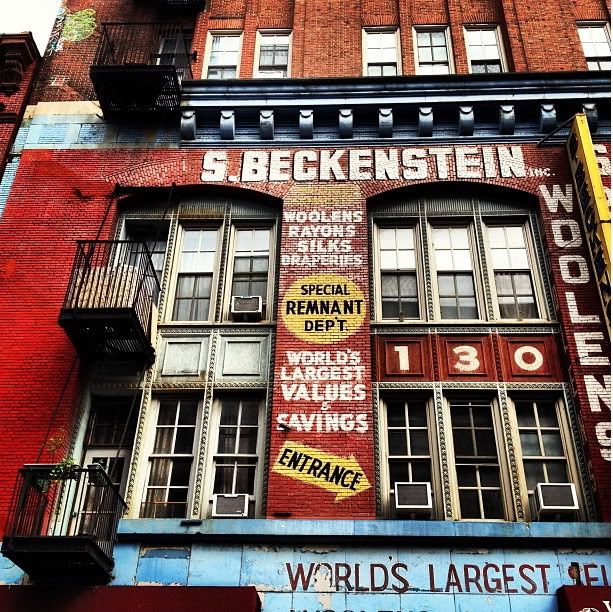
Armed with a push cart and insurmountable determination, Samuel Beckenstein laid the groundwork in 1919, on the Lower East Side's historic Orchard Street for what would ultimately develop into one of the world's most renowned fabric enterprises, Beckenstein Men's Fabric, Inc. Nearly a century and four generations later, Beckenstein's grandsons, Neal Boyarsky, President and CEO of the firm and his son Jonathan, have expanded and transformed the once modest, one room store, into an unstoppable fabric enterprise, servicing the entertainment industry, celebrities, athletes and government officials worldwide. The company's success is not only attributed to the family's unwavering commitment to the fabric industry, but it is also due to their exclusive, joint partnership with Scabel of Brussels, one of the world's most distinguished fashion leaders, who manufacture the finest and most high end fabrics. In addition to the incomparable quality and endless variety of fabric that Beckenstein Men's Fabric, Inc. offers, the company also provides their customers with unrivaled service, delivering stock fabric overnight.Supposedly the song, "Sam, You Made The Pants Too Long," was written with Sam Beckenstein in mind By some accounts it was written by Milton Berle, Sam Lewis, Victor Young, Fred Whitehouse
SAM, YOU MADE THE PANTS TOO LONG was written in 1940 by comedian Milton Berle as a parody of the tune "Lord, You Made The Night Too Long." It appealed to Barbra Streisand`s sense of humor and it became her follow-up hit to "Second Hand Rose" in 1966.

Wednesday, April 25, 2012
29 Essex Street: Haber's Stationery and Sporting Goods
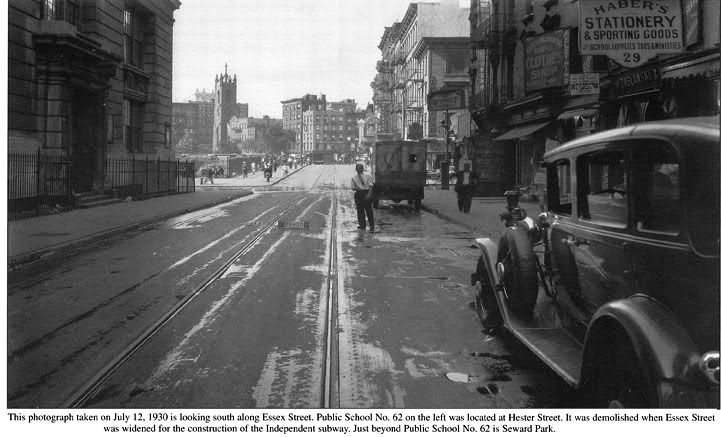
Viewable on the right side. It was a favorite destination of KVers. Supposedly, Joe Kuperstein once considered becoming an owner. about two years ago from Marsha Algranati Levine:
I lived on Essex St, over Haber's. My mom actually worked in Habers, a pretty short commute. My parents moved into the Seward coop my last year in high school, my mom's still living there. If anyone hasn't been in the old neighborhood for a while, you're in for a big shock, it's changed a lot.
341 Grand Street: Site Of Grand Street Dairy Restaurant

The photo was taken sometime in the late 1940's. The view is Grand Street looking east towards Ludlow Street. The Dairy Restaurant (although I don't know that was it's incarnation at the time) can be seen at the extreme right. My mother is in the top row on the left. My aunt is seated in the middle. For more about that restaurant, an excerpt from a 1988 nytimes article
2 Waiters and Their Producer Dine at a Source of Inspiration By RICHARD F. SHEPARD Published: November 10, 1988 ''Enter, two Jewish waiters.'' Now what kind of stage direction is that in a script for the New York Shakespeare Festival? It may have been that Joseph Papp, the founder and head of the festival, was evading an answer. But more likely, he never heard the question above the gustatory din at the Grand Dairy Restaurant, Grand Street at the corner of Ludlow Street, on the Lower East Side. Mr. Papp was accompanied by Bob Dishy and Fyvush Finkel, who nowadays are bringing an inspirational interpretation of tray chic to their central roles as Jewish waiters in Hy Kraft's ''Cafe Crown,'' a play based on the old Cafe Royal, which for decades was the center of the Yiddish theater's off-duty life on Second Avenue. The play is being produced by Mr. Papp and his festival at the Public Theater. Frank Rich, reviewing ''Cafe Crown'' in The New York Times, called it a ''feast of Jewish waiter jokes and Jewish theater jokes, heavily laced with schmaltz.'' He particularly praised the waiters - Mr. Dishy, ''his expression so dill-sour that even his tufts of hair seem exasperated,'' and Mr. Finkel, ''sure to say 'You'll love it!' to any irritating customer who alights upon one of the less palatable daily specials.'' In Other Words, an Interview The lunch on Grand Street was intended to install the professional theater people in suitable ambiance amid real Jewish waiters for the purpose of discussing how the actors achieved a credibility so overpowering in their roles as waiters that the audience might have picked up a check were it presented. Mr. Dishy and Mr. Finkel, projecting a thinly veiled contempt for their customers, evoke a world now hovering on the brink of oblivion. Wearing black jackets, black bow ties and full-length white aprons, they display tympanic virtuosity when it comes to slamming plates on the table. They intimidate diners, kibitz at card games, dish out philosophy and invariably spill half the tea from the glass. The Shakespeare Festival is meticulous about training its performers in swordplay, with an expert on hand to teach the finer points of the epee. Did Mr. Papp hire a Jewish waiter to instruct Mr. Dishy and Mr. Finkel in their roles? Did he show them how not to meet the eye of a complaining customer, how to put the thumb in the soup to indicate that it is not too hot to slurp, how to bring the potato pirogi to a table that wanted chopped liver? Did a licensed instructor teach them the shuffle that assures room temperature by the time a hot dish reaches the table? Necessary but Insufficient The answer again proved elusive. After all, every waiter who happens to be Jewish is not necessarily qualified as a Jewish waiter....some KVers' comments:
I walked by there yesterday with my wife and told her about the restaurant. Most embarrassing was cutting class and seeing your teacher there.
I remember the dairy restaurant very well from my Seward days. Used to take out a cheese danish and coffee every so often when I stayed late to edit the sports column of the Seward World. Those were the days....
Tuesday, April 24, 2012
Guss' Pickles
an excerpt from a nytimes' article on Guss'
The author is related to Marilyn Altman and Goldie Daniels, the Guss girls, who are heard above.
The author is related to Marilyn Altman and Goldie Daniels, the Guss girls, who are heard above.
I know it’s unseemly to brag about one’s illustrious family lines, but sometimes a historic turn of events invites the opportunity to name-drop. Some of my closest friends don’t even know it, but I’m related to Jewish royalty (by marriage, I should clarify, but still). My brother married into pickles — Guss’ Pickles, to be specific, the famous Lower East Side institution that announced this week that it would soon leave that neighborhood for the lower rents and enthusiastic pickle purchasers of Borough Park, Brooklyn. The New York blogs have been outdoing themselves in fits of nostalgia about this loss of lingering history on Orchard Street. But for my brother’s mother-in-law, Marilyn Altman, and her sister, Goldie Daniels — the Guss girls, as they were known back in the day, along with their late sister, Elaine — the news about the business, which they sold in 1979, came as a shock. It was also an excuse for them to come in from New Jersey, where they both live, share some old stories about their father, Isadore Guss, and, in Goldie’s case, wolf down some of the half-sours she loves so well. After greeting the current owner of the shop, Goldie, blond and petite at 71, in a gold watch and gold hoops, instinctively situated herself in back of the barrels, the vantage point from which she had sold so many pickles to long lines down Hester Street, the store’s original location. “I ate more pickles than I sold,” she said, dipping a pan — a schissel, she called it, Yiddish for pail — into a barrel. “I loooove pickles.” She took a bite and rolled her eyes. “It’s like my heritage.” Of the three daughters, only Marilyn, the baby, now 65, was deprived the privilege of working at the store. That’s what you get for dropping a yo-yo in a pickle barrel and thinking maybe no one would notice. Goldie, however, worked there until she had children. If her mother had thought a woman could run a business, Goldie would have taken it over after her father’s death in 1975. Those days holding court behind the barrels as the whole neighborhood stopped by were some of the happiest of her life. “You just talked to everyone,” she said, and it was easy to see how that worked. As she chewed her pickle, a man with his daughter contemplated the barrels, and suddenly they were all four in animated conversation about the Great Wall of China, from where the father and daughter had just returned. What did they think? Wasn’t it fabulous? When Marilyn went, she’d worn the wrong shoes, wouldn’t you know it, kept sliding backward the whole time.

A View Of Gluckstern's In 1947

Gluckstern's: 135 Delancey Street
Gluckstern's Restaurant was a Jewish or Yiddish restaurant that started in NYC in the early 1900s. This restaurant with its home cooked style meals (Romanian, Hungarian, Slavic and Corned Beef and Cabbage "Kosher" Style) was popular with a lot of the stars of the era as well as having a loyal following with the general public. I have a nice 1959 write up on the restaurant and I found mention of the restaurant in some 1960s era publications but I don't find any info after that point, so it looks like this restaurant was around over 60 years and then must have closed. I checked the 135 Delancey St Address in a current search and it seems to be a parking garage or lot.The Fabulous Kuperstein twins had their bar mitzvah at Gluckstern's
Monday, April 23, 2012
101 Orchard Street: 1934

Sadly, my father died in 1951 at age 44. He owned a small store on Orchard Street, mens' belts, ties socks etc. It was really a stand so he was mostly exposed to the elements, not good for a person with a heart condition. His name was Frank Boodman. He was born in the US but his family went back to Poland. I did locate him and his brothers Dawid (David) and Phillip on the Ellis Island web site when they were young teens who came back to the states. I found my mother, Clara, there as well. She was born here, family from Austria, but they went back to Poland. She and her brother, Morris Holzer (spelled here with a t) came back separately to the states at ages 14 & 15. Sadly, my 4 aunts and grandmother and some cousins were killed in Poland in 1943. All the more tragic because there were already here, but had left a child back there , and were poor and could not make a go of it in the U.S.
Sunday, April 22, 2012
There Used To Be A Bakery Here: Gertels
A video I put together back in 2007, just prior to Gertels' closing. It was on 53 Hester Street. Kadouri Import was at 51 Hester and a tile factory was at 55. Many of the images came from this nytimes article :
An excerpt:
No More Babka? There Goes the Neighborhood By JOSEPH BERGERAnother story about the closing from lost new york city
Gertel’s, the legendary bakery on Hester Street on the Lower East Side known for its Jewish treats like rugelach, babka and marble cake, has closed its doors. The closing is one more change in a string of changes on the historic Lower East Side, where hundreds of thousands of immigrants from Russia, Poland, Romania and Italy established their foothold in America and set up hundreds of dry goods and food shops that until recent years gave the area a characteristic pungency. But those shops are being replaced by hip boutiques and voguish restaurants, and only a few survivors, like the Russ & Daughters appetizing store and Katz’s Delicatessen, are left. Opened in 1914, Gertel’s, at 53 Hester Street near Essex Street, closed on June 22. A few days earlier, a sign had been posted, warning customers and passers-by of what some consider a culinary disaster. This writer’s father, who during his retirement worked part-time on the Lower East Side as a salesman in a dry goods store, J. S. Hosiery, would bring home challahs and cakes from Gertel’s, and they were always eagerly welcomed by his wife, grown children and their families. Gertel’s hung on even as its neighbors, like a store that sold dried fruit out of burlap bags, shut their doors. ....... On the tenement blocks nearby live Web designers, fashion photographers, makeup artists, and even some lawyers and stockbrokers who find this gritty, though gussied-up neighborhood to their liking. Some of them are grandchildren and great-grandchildren of striving sewing machine operators and hatmakers who fled the railroad flats with their airshafts and bathtubs in the kitchen for the fancy precincts of, yes, the Bronx and Brooklyn......
ny curbed has links to several stories about what replaced Gertels.
Gertels still lives as a wholesale bakery and has merged with the Delancey Brand (so-so)
Quite by chance, I found them in Harlem, while wandering the air-conditioned aisles at Fairway. They wore the Delancey brand, and I almost didn't notice the Gertel's name, printed in much smaller type. (Via email, a representative for the food market stated that Gertel's "joined forces" with Delancey Bakery, a longtime Fairway supplier, less than a year ago.)I must confess as much as I miss the great food of the lower east side I was never a big fan of Gertels.
Fairway also carried Gertel's-baked, Delancey-branded sugar bowties, seven-layer cake, marble cake, cinnamon and chocolate swirls, cinnamon babka, Russian coffee cake, mini black-and-whites, and a hamentashen assortment, but with little hesitation I gravitated toward the chocolate rugelach.
I much preferred Savoia's on Catherine Street.
Saturday, April 21, 2012
Former KVer Joel Sosinsky Interviewed About The Triangle Fire
Joel and his wife Andi co-authored a book about the fire
Joel begins speaking at around the 34 second mark.
Subscribe to:
Posts (Atom)


 Posts