Showing posts with label Evan Hunter. Show all posts
Showing posts with label Evan Hunter. Show all posts
Saturday, April 25, 2009
Sal Lombino/Evan Hunter/Ed McBain Pulp Covers 2
audio: theme music from naked city and the police story
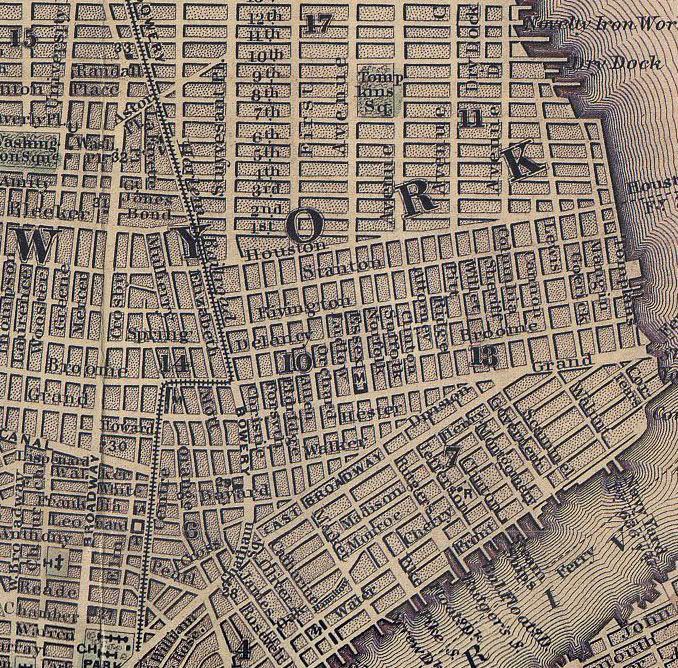
I wonder whether Sal knew another KV pulp fiction writer, Jack Karney, when he lived at Knickerbocker Village


Ed McBain's 87th Precinct
Created by Ed McBain (pseud. of Evan Hunter, né Salvatore Lombino; 1926-2005)
from thrilling detective
Long before Hill Street Blues, Homicide, and NYPD Blue, there was Ed McBain's 87th PRECINCT. The series began in 1956 with Cop Hater. Although not the first procedural, it was one of the first and the 87th Precinct has come to virtually define the genre. The books generally feature an ensemble cast and multiple plot lines. Although the books vary in quality, on the whole this is a major series, a classic of American crime fiction that has entertained, enlightened and influenced the genre for over three decades (and counting!).
The action takes place in and around New York City, and has even been called "the greatest sustained literary exploration of New York City in American literature," but, of course, the biggest joke is that throughout the entire series, New York has pretended not to be about New York at all. Instead, we're told that the action takes place is Isola. As the disclaimer in every book reads: "The city in these pages is imaginary; the people and places all fictitious. Only the police routine is based on established investigatory technique."
Yeah, right. It's New York, all right, spun ninety degrees, with only the names changed to protect the guilty. Isola isManhattan, Calm's Point is Brooklyn, Riverhead is the Bronx, Majesta is Queens and Bethtown is Staten Island.
Most folks know Ed McBain is, of course, the pseudonym of Evan Hunter. But that's also a pseudonym. He was born Salvatore Lombino in 1926. Besides McBain, he has also written under the pseudonyms Curt Cannon, Hunt Collins, Ezra Hannon, Richard Marsten, and John Abbott. Hunter's first book, The Blackboard Jungle, was published in 1954, and became the basis for the 50's film classic. As McBain, Hunter has also written a series featuring Florida attorney and P.I. wannabe Matthew Hope. In fact, Steve Carella and other members of the 87th play a pivotal part in the latest Hope novel, The Last Best Hope. He's created some memorable eyes, too, including Ben Smoke, Curt Cannon and Dudley Sledge.
In the early sixties, a TV series made its debut, featuring Robert Lansing as Det. Steve Carella and Gena Rowlands as Teddy. It also featured Norman Fell, Ron Harper and Gregory Walcott. Although well-received by critics (particularly Rowlands' performance) it didn't last long, although at least two comic books were rushed out, hoping to cash in. But they weren't quickie recycled TV episodes; in fact, they were relatively "adult" for a "good" publisher like Dell. The first was drawn by Bernie Krigstein, who is so well known for his E.C. horror work, and is truly a bizarre visual excursion. The second deals in great detail with drugs, and may be drawn by one of the artists who also did the Michael Shayne books, another short-lived series which Dell decided to take a similar approach to.
Sal Lombino/Evan Hunter/Ed McBain Pulp Covers
image source fantastic fiction
an excerpt from a January Magazine article about McBain (Hunter, Lombino..)
In Carr's The Craft of Crime: Conversations With Crime Writers (1983), McBain recalled that "I was born right here on 120th Street [in New York's Italian Harlem], between First and Second avenues, October 15, 1926, on the kitchen table. My aunt Jennie was a midwife and she delivered me and referred to me for the rest of her life as 'my baby.'" In 1944, not long before World War II ended, and just prior to his 18th birthday, the then-Salvatore Lombino joined the U.S. Navy, principally, he acknowledged, "to get out of going into the army. Anyone at the time who was drafted was being sent to Italy, to get their asses shot off," and he certainly didn't want that. Instead, he was dispatched to Hawaii, and then reassigned to Japan. It was during his navy stint that he wrote his first story, called "Chalk" ("a detective story really, a madman story -- about a guy who commits a murder, and it was sort of poetic and all that"). Though he'd once thought to become a cartoonist, "Chalk" helped convince him to pursue the life of an author, instead. After leaving the military in July 1946, he studied literature at Hunter College in New York, eventually graduating Phi Beta Kappa. He subsequently taught high school "very briefly" -- an experience he would draw upon when penning The Blackboard Jungle (1954), which he published as "Evan Hunter," a name he had legally adopted in 1952. (As his friend James Grady, a screenwriter and journalist, explains in Slate, McBain reasoned "that publishing would buy a WASP moniker more easily than the 1950s ethnic- and class-conscious marketplace would buy the books of a novelist with a name like Lombino.") That gritty tale about a young teacher whose idealism is challenged by the reality of an urban vocational school filled with troublemakers, was quickly adapted for Hollywood, the film version starring Glenn Ford and a very youthful Sidney Poitier. (Asked years later what he thought of the 1955 picture, McBain called it "a pretty good movie," though "I don't think there was a line of dialogue in the movie that came from the book.")
Curiously, despite the fact that McBain's 87th Precinct novels -- with their multiple plot lines and an ensemble cast of cops old and young, progressive and bigoted, married but mostly not -- stimulated the development of a score of memorable U.S. TV crime dramas, a 1961 NBC series called 87th Precinct, based specifically on the books and starring Robert Lansing, Norman Fell and Gena Rowlands, didn't manage to stick around past its debut year. The author had better success with movies, both for the large and small screens, several of which (including 1958's Cop Hater, 1972's Fuzz and the 1995 teleplay Ed McBain's 87th Precinct: Lightning) were adapted from 87th Precinct novels. McBain/Hunter even wrote the screenplays for some adaptations, as well as for series that had nothing to do with his books, such as Ironside and Columbo. However, he was undoubtedly best recognized as a screenwriter for having penned the script from which Alfred Hitchcock's classic 1963 suspenser, The Birds, was made.
In many ways, McBain was a pioneer. In the 1950s and 60s, his "cops resembled the real America, not the Dragnet straight arrows playing on TV sets in wood-paneled rec rooms," writes Grady, who adds that McBain "bucked the clichés of police fiction, in which cops were nearly always Irish or almost certainly white." New York Times crime-fiction critic Marilyn Stasio concurs, writing in her obituary of the novelist that he "took police fiction into a new, more realistic realm, a radical break from a form long dependent on the educated, aristocratic detective who works alone and takes his time puzzling out a case." And South Africa-born author James McClure, whose own procedurals, featuring Afrikaner Lieutenant Tromp Kramer and Zulu Sergeant Mickey Zondi (The Steam Pig, The Sunday Hangman) were clearly prompted by reading McBain's police yarns, applauded the New York writer's skill at making gold from "cop corn." McBain, he explained, "accepts things as they are; if the field that engrosses him is knee-high in clichés, so be it. In he goes, as eager and uncompromising as a child, to grasp the thistle that grows between the rows."
Who's Who In Knickerbocker Village History: Salvatore Albert Lombino, aka Evan Hunter
I recently learned from Marion Fox, a KV resident of 72 years, that Evan Hunter lived in Knickerbocker Village for a brief time after returning home from World War II.
yotube description
Evan Hunter aka Ed McBain talks about learning the techniques of mystery writing in the 1950s, pulp fiction, "The Blackboard Jungle", defining his different identities and style. The interview took place at The Mysterious Bookshop in New York, in 1984.
Evan Hunter (born Salvatore Albert Lombino October 15, 1926 July 6, 2005) was a prolific American author and screenwriter. Though he was a successful and well-known writer using the Evan Hunter name (a name he legally adopted in 1952), he was perhaps even better known as Ed McBain, a name he used for most of his crime fiction, beginning in 1956.
Evan Hunter was born and raised as Salvatore Lombino in New York City, living in East Harlem until the age of 12, at which point his family moved to the Bronx. He attended Olinville Junior High School, then Evander Childs High School, before winning an Art Students League scholarship. Later, he was admitted as an art student at Cooper Union.
Lombino served in the Navy in World War II, writing several short stories while serving aboard a destroyer in the Pacific. However, none of these stories were published until after he had established himself as an author in the 1950s.
After the war, Lombino returned to New York and studied at Hunter College, majoring in English, with minors in dramatics and education. He published a weekly column in the Hunter College newspaper as "S.A. Lombino".
While looking to start a career as a writer, Lombino took a variety of jobs, including 17 days as a teacher at Bronx Vocational High School in September 1950. This experience would later form the basis for his 1954 novel The Blackboard Jungle.
In 1951, Lombino took a job as an Executive Editor for the Scott Meredith Literary Agency, working with authors such as Arthur C. Clarke, P.G. Wodehouse, Lester del Rey, Poul Anderson, and Richard S. Prather, among others. He made his first professional short-story sale that same year, a science-fiction tale entitled "Welcome Martians", credited to S.A. Lombino.
Soon after his initial sale, Lombino sold stories under the pen names "Evan Hunter" and "Hunt Collins". The name "Evan Hunter" is generally believed to have been derived from two schools he attended, Evander Childs High School and Hunter College, although the author himself would never confirm that. (He did confirm that the name "Hunt Collins" was derived from Hunter College.)
Lombino legally changed his name to Evan Hunter in May 1952, after an editor told him that a novel he wrote would sell more copies if credited to "Evan Hunter" than it would if it were credited to "S.A. Lombino". Thereafter, he used the name Evan Hunter both personally and professionally.
As Evan Hunter, he gained fame with his 1954 novel The Blackboard Jungle, which dealt with juvenile crime and the New York City public school system. In 1955, the book was made into a movie.
During this ear, Hunter also wrote a great deal of genre fiction. He was advised by his agents that publishing too much fiction under the Hunter byline, or publishing any crime fiction as Evan Hunter, might weaken his literary reputation. As a consequence, during the 1950s Hunter used the pseudonyms Curt Cannon, Hunt Collins, and Richard Marsten for much of his crime fiction. A prolific author in several genres, Hunter also published approximately two dozen science fiction stores and four SF novels bewtween 1951 and 1956 under the names S.A. Lombino, Evan Hunter, Richard Marsten, D.A. Addams and Ted Taine.
His most famous pseudonym, Ed McBain, debuted in 1956, with the first novel in the 87th Precinct crime series. NBC ran a police drama also called 87th Precinct during the 1961–1962 season based on McBain's work.
Hunter himself publicly revealed in 1958 that he was McBain, but he continued to use that pseudonym for several decades, most notably for the 87th Precinct series, and for the Matthew Hope series of detective novels.
By about 1960, Hunter had retired the pen names of Cannon, Marsten, Collins, Addams and Taine. From this point on, crime novels were generally attributed to McBain, and other sorts of fiction to Hunter. Reprints of crime-oriented stories and novels written in the 1950s previously attributed to other psuedonyms were issued under the McBain byline. Hunter stated that the division of names allowed readers to know what to expect: McBain novels had a consistent writing style, while Hunter novels were more varied.
Under the Hunter name, novels steadily appeared throuoght the 1960s, 1970s and early 1980s, including Come Winter (1973), and Lizzie (1984). Hunter was also active as a screenwriter, penning the screenplay of the 1963 film The Birds for Alfred Hitchcock, very loosely adapted from Daphne du Maurier's short story. He was also set to adapt Winston Graham's novel Marnie for Hitchcock, but he and the director had a disagreement over a crucial scene, and Hunter was let go.
From 1958 until his death, McBain's "87th Precinct" novels appeared at a rate of approximately one or two novels a year. From 1978 to 1998, they were joined by another McBain series about lawyer Matthew Hope; books in this series appeared every year or two. For about a decade, from 1984 to 1994, Hunter published no fiction under his own name.
In 2000, a novel called Candyland appeared that was credited to both Hunter and McBain. The two-part novel opened in Hunter's psychologically-based narrative voice before switching to McBain's customary police procedural style.
Aside from McBain, Hunter used at least two other pseudonyms after 1960. The 1975 novel Doors was originally attributed to Ezra Hannon, before being reissued as a work by McBain, and the 1992 novel Scimitar was credited to John Abbott.
Hunter died of laryngeal cancer in 2005 at the age of 78 in Weston, Connecticut. He had three sons, one of whom, Richard Hunter, is considered one of the world's leading harmonica virtuosos and an expert on Internet security issues. His son Mark Hunter is a professor at INSEAD and the Institut français de Presse, and an award-winning investigative reporter and author. His eldest son, Ted, a painter, died in 2006.
Subscribe to:
Posts (Atom)


 Posts
Posts