Showing posts with label pete seeger. Show all posts
Showing posts with label pete seeger. Show all posts
Monday, July 16, 2012
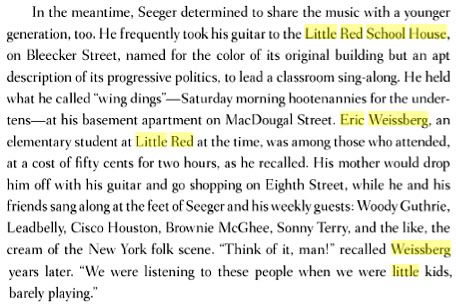
KVer Eric Weissberg and Pete Seeger


Pete Seeger: Woody Guthrie's 100th Anniversary and the lost song about the Rosenbergs
Pete Seeger, long-time Rosenberg Fund for Children Advisory Board member, performs this "lost" Woody Guthrie song about the Rosenbergs, at the RFC's 10th anniversary celebration in 2001
Celebrating Woody's 100th anniversary on American Routes
Wednesday, May 30, 2012
Who's Who In Knickerbocker Village History: Moses Asch, part 2
An excerpt from a 1978 conversation with Moses Asch from Pete Seeger's site
"Conversation with Mr. Folkways: Moe Asch" by Jim Capaldi
Moe Asch has been recording folk music longer than most of us have been alive. From the 1930’s, a time of great social and political upheaval, to the present space age, he and his microphones have captured the music and sounds of the people of the world on Asch, Disc and Folkways Records. It was his genius that recognized the value of native American folk song, and the talent of people like Woody Guthrie, Leadbelly and Pete Seeger at a time when neither the music nor the musicians playing it were considered to be worthy of any serious attention. Moe Asch has been a key figure in the folk revival, having been associated with People’s Songs Bulletin, Sing Out! and Oak Publications. But it is chiefly through his role as founder of Folkways Records that we know of him today.
Now in his seventies, Moe Asch remains a vital force in American folk music. His record company still issues dozens of new releases every year and still maintains the policy of keeping all records in print at all times. Material on the more than 1,600 discs ranges from Appalachian mountain music to love songs of Lebanon to sounds of the human body. Looking back over the accomplishments of four decades, Moe Asch’s place as perhaps the foremost oral historian of this century is well established. The discussion that follows took place in May, 1977; it reveals something of Mr. Asch’s methods, philosophy and plans for the future.
Folkscene: Was your father Sholem Asch, a famous Yiddish writer (whose most well-known work was "The Nazarene’) , an influence in your decision to devote your life to documenting the folk music of your time?
Asch: No, except that he used to go on lecture tours throughout the United States in the 1920’s; wherever he went in the old days, in small towns, they had these sheets listing past events of the place, how they began and grew; always the heading had a folk song. So I knew there were folk songs about various areas in the United States that people had documented. My main influence was the John Lomax book which came out in 1913, Cowboy Ballads. That was the first book that documented American folk songs, and I picked that up in Paris.
I’m not interested in music per se, but the literature of it, the words. The music is mostly public domain. Usually somebody, a poet or someone else, wrote about a current event, some local happening. Like tabloids, they were local things that happened that were of interest, like murders. Local people set it down; someone musically inclined put it to music and sang it. My background is literary.
Folkscene: Then why did you go into the recording business, instead of publishing?
Asch: Because I happen to be an electronic engineer and I built equipment for radio stations. They needed recordings to use on the equipment and I got involved with folk music.. .because they told a story, because they documented a thing.
Folkscene: When did you start making records?
Asch: In 1935. My first commercial issue (on the Asch label) was in 1939, "Jewish Folk Songs" by the Bagelman Sisters. I recorded Ukrainian folk songs and Jewish cantorials for the radio; it was a foreign language station.
My first recording of American folk music was Lead Belly’s play parties.
Wednesday, November 12, 2008
Pete Seeger: At 89
Down in Alabama, 1955,
Not many of us here tonight were then alive;
A young Baptist preacher led a bus boycott,
He led the way for a brand new day without firing a shot.
Don't say it can't be done
The battle's just begun
Take it from Dr. King
You too can learn to sing
So drop the gun.
Oh those must have been an exciting 13 years.
Young heroes, young heroines.
There was laughter, there were tears,
Students at lunch counters,
Even dancing in the streets.
To think it all started with sister Rosa
Refusing to give up her seat.
Song, songs, kept them going and going;
They didn't realize the millions of seeds they were sowing.
They were singing in marches, even singing in jail.
Songs gave them the courage to believe they would not fail.
We sang about Alabama 1955,
But since 9-11 we wonder will this world survive.
The world learned a lesson from Dr. King:
We can survive, we can, we will.
And so we sing -
Don't say it can't be done
The battle's just begun
Take it from Dr. King
You too can learn to sing
So drop the gun
Pete Seeger: A Special Post Veteran's Day Post
We had several Weaver records in my house. It always confused me since they were out of place with all the Perry Como and Glenn Miller, etc. My father never was never red, not even pink and as he got older he revered the likes of Bob Grant. Yet even in those later years a tv appearance by Pete or Peter, Paul and Mary would really stir him. Go know? Even the caustic David Letterman was moved when he had an elderly Pete on his show a few weeks ago.
Pete Seeger planned for the Smothers Brothers Comedy Hour in 1967 but CBS objected to the blacklisted Seeger making obvious references to the"big fool" in the White House, finally sung by Seeger on the Comedy Hour in 1968 as the finale in a medley of anti-war songs
It was back in nineteen forty-two,
I was a member of a good platoon.
We were on maneuvers in-a Loozianna,
One night by the light of the moon.
The captain told us to ford a river,
That's how it all begun.
We were -- knee deep in the Big Muddy,
But the big fool said to push on.
The Sergeant said, "Sir, are you sure,
This is the best way back to the base?"
"Sergeant, go on! I forded this river
'Bout a mile above this place.
It'll be a little soggy but just keep slogging.
We'll soon be on dry ground."
We were -- waist deep in the Big Muddy
And the big fool said to push on.
The Sergeant said, "Sir, with all this equipment
No man will be able to swim."
"Sergeant, don't be a Nervous Nellie,"
The Captain said to him.
"All we need is a little determination;
Men, follow me, I'll lead on."
We were -- neck deep in the Big Muddy
And the big fool said to push on.
All at once, the moon clouded over,
We heard a gurgling cry.
A few seconds later, the captain's helmet
Was all that floated by.
The Sergeant said, "Turn around men!
I'm in charge from now on."
And we just made it out of the Big Muddy
With the captain dead and gone.
We stripped and dived and found his body
Stuck in the old quicksand.
I guess he didn't know that the water was deeper
Than the place he'd once before been.
Another stream had joined the Big Muddy
'Bout a half mile from where we'd gone.
We were lucky to escape from the Big Muddy
When the big fool said to push on.
Well, I'm not going to point any moral;
I'll leave that for yourself
Maybe you're still walking, you're still talking
You'd like to keep your health.
But every time I read the papers
That old feeling comes on;
We're -- waist deep in the Big Muddy
And the big fool says to push on.
Waist deep in the Big Muddy
And the big fool says to push on.
Waist deep in the Big Muddy
And the big fool says to push on.
Waist deep! Neck deep! Soon even a
Tall man'll be over his head, we're
Waist deep in the Big Muddy!
And the big fool says to push on!
Subscribe to:
Posts (Atom)


 Posts
Posts