Showing posts with label dan finn. Show all posts

Tuesday, February 3, 2009

Finn Square In Tribeca


from nycparks
In 1919, the widening and extension of Varick Street created a triangular space at Varick’s intersection with West Broadway and Franklin Street. The Board of Aldermen (predecessor of the City Council) named this space for Philip Schuyler Finn, who lost his life in 1918 fighting World War I with New York’s 69th Regiment, the famous “Fighting Irish.” Nevertheless, for most inhabitants of Lower Manhattan in the early 1900s, Finn Square conjured up memories of Philip Schuyler’s father, Daniel E. Finn (1845-1910).

Woodrow Wilson And Daniel E. Finn


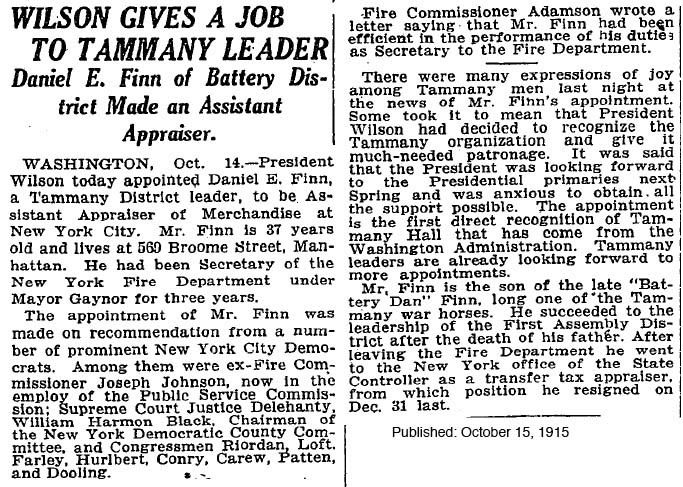
Even President Wilson had to bend to Tammany. Notice how he came "recommended." I guess he had his work in 1889 as part of his reference.

Daniel E. Finn: 1889

An example of how Tammany operated
finn-1889

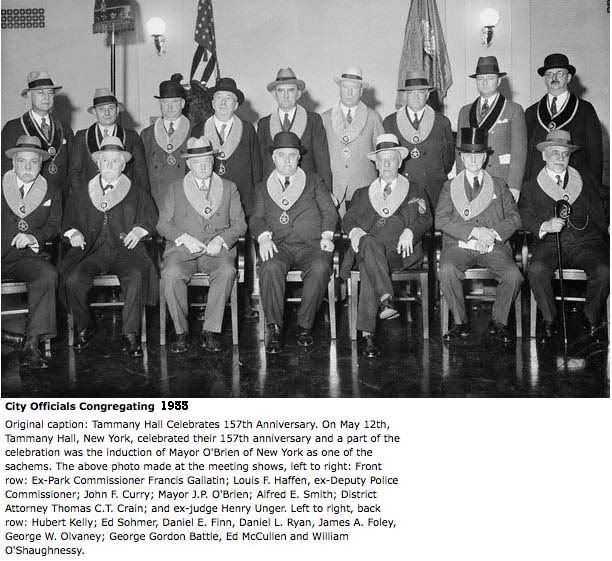
Daniel E. Finn


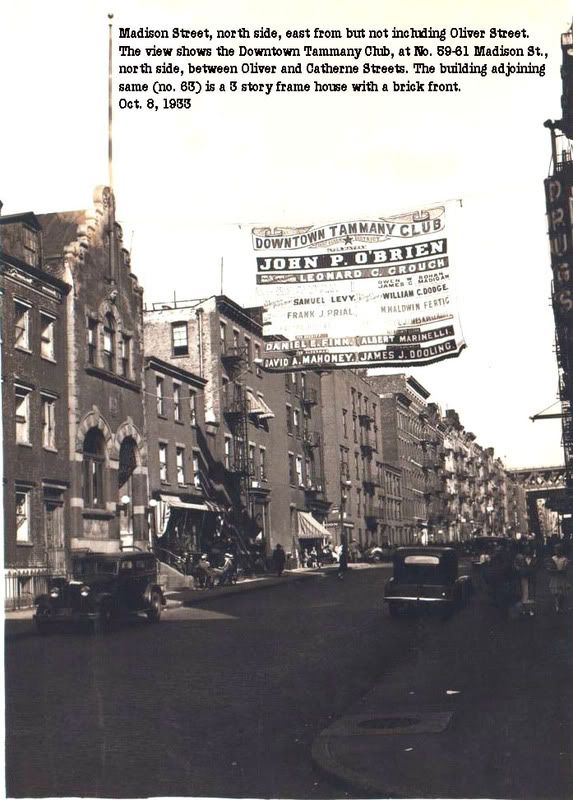
The Daniel E. Finn whose name appears on the 1933 Madison Street banner is pictured here with his crew. He's the third from the left in the top row. Finn's Tammany lineage extended back to the Tweed era in the 1800's. His father was Battery Dan Finn
“Battery Dan,” as the elder Finn was known, was a Tammany Hall politician and Democratic leader of Lower Manhattan. He won his nickname and the hearts of his constituents when he successfully opposed the construction of commercial piers along Battery Park, citing the necessity for open space in the crowded neighborhood. He became a city magistrate and police judge in 1904, dispensing advice rather than harsh sentences. Admonitions like “Don’t try to compel a girl to love you if she prefers someone else. Get another to take her place,” to two youths fighting over a girl, or “Don’t wreck or sell your body and soul for diamonds and automobiles,” to a prostitute endeared him to New Yorkers across the city. No incident caused more amusement than Finn’s encounter with three bulldogs on his way to a court session in the Bronx. Under attack, he climbed a lamppost and yelled for help. Local papers carried the story and New York loved it.
A New York Times editorial at the time of his death in 1910 praised him as “an idealist,” “a friend of the people,” and added, “He was fairly adored by thousands as leader, friend, and protector.” Crowds of mourners lined the streets as Finn’s funeral procession led to St. Peter’s Church.