Showing posts with label ralph fasanella. Show all posts
Showing posts with label ralph fasanella. Show all posts
Sunday, March 29, 2009


Ralph Fasanella 2
 a link to a slide show I had done previously involving Ralph Fasanella from pseudo-intellectualism in August of 2005
his wikipedia entry
Whether it's a strike or factory floor, former union organizer Ralph Fasanella devoted his life to painting working men and women. The man who is considered America's best self taught artist, would eventually complete hundreds of pieces of work dedicated to jobs and justice.
Ralph Fasanella was born to Joseph and Ginevra (Spagnoletti), Italian immigrants, in the Bronx, New York, on Labor Day in 1914. He was the third of six children. His father delivered ice to local homes. His mother worked in a neighborhood dress shop drilling holes into buttons, and spent her spare time as an anti-fascist activist.
Fasanella spent much of his youth delivering ice with his father from a horse-driven wagon. This experience deeply impressed him. He saw his father as representative of all working men, beaten down day after day and struggling for survival. "Fasanella later said that the compositional density of his pictures was influenced by the experience of helping his father deliver ice, which involved removing all the food from customers' refrigerators and arranging it in neatly ordered stacks."Fasanella's mother was a literate, sensitive, progressive woman. She instilled in Fasanella a strong sense of social justice and political awareness. Fasanella began accompanying his mother when she worked on anti-fascist and trade union causes. Fasanella also helped his mother publish and distribute a small Italian-language, anti-fascist newspaper to help support the family.
Joseph Fasanella abandoned his family and returned to Italy in the 1920s. This increased the influence Fasanella's mother had over young Ralph, but it also led to some behavioral problems
Fasanella served two stints in reform schools run by the Catholic Church for truancy and running away from home. He later said he was sexually abused ("used as a girl") by the priests.[2] These experiences instilled a deep dislike for authority and reinforced Fasanella's hatred for anything which broke people's spirits. Fasanella later depicted his experience in reform school in a painting titled Lineup at the Protectory 2 (1961). The melancholy image features rows of boys standing at attention, watched over by scowling, ominous-looking priests. Fasanella quit school after the sixth grade.
During the Great Depression, Fasanella worked as a textile worker in garment factories and as a truck driver. He became a member of United Electrical, Radio and Machine Workers of America (UE) Local 1227 while working as a machinist in Brooklyn. He became strongly aware of the growing economic and social injustice in the U.S., as well as the plight and powerlessness of the working class.
In late 1930s, Ralph Fasanella volunteered to fight in the Abraham Lincoln Brigade, an American paramilitary force fighting to support the Second Spanish Republic against the successful fascist rebellion led by General Francisco Franco.
After the Spanish Civil War, Fasanella returned to the United States, where he began organizing labor unions.
Fasanella joined the UE staff in 1940. He organized a Western Electric manufacturing plant in Manhattan, a Sperry Gyroscope factory, and a number of other electrical equipment and machine plants in and around New York City. One of his later paintings shows a union organizing committee meeting being held in a UE hall.
It was during a UE organizing drive in 1940 that Fasanella first began to draw.Fasanella married Matilda Weiss in 1943. The short-lived marriage ended in 1944.
In the mid-1940s, Fasanella began to suffer from intense finger pain caused by arthritis. A union co-worker suggested that he take up painting as a way to exercise his fingers and ease the pain.
In 1945, Fasanella persuaded the UE to organize painting classes for its members at a local college. He was one of the first members to sign up for classes.
Fasanella became consumed by art, and left labor union organizing to paint full-time. To pay the bills, he pumped gasoline at a service station.
Fasanella's painting focused on city life, men and women at work, union meetings, strikes, sit-ins and baseball games. He quickly developed a style which spoke to workers and the poor through the use of familiar details. Fasanella improvised a quasi-surrealist style, depicting interiors and exteriors or past and future simultaneously. He painted canvases as big as 10 feet across because he envisioned his paintings hanging in large union meeting halls.
" 'I always felt embarrassed by the whole goddamn thing,' he said, 'but I had to do it.' "
Fasanella's art was highly improvisational. He never planned out works, and rarely revised them. He said of his 1948 painting May Day, it "just came out of my belly. I never planned it. I don't know how I did it."
His first solo show was at the ACA Galleries in New York City in 1948. One of his first sales was to choreographer Jerome Robbins.
In 1950, Fasanella married Eva Lazorek, a school teacher. They had a son, Marc, and a daughter, Gina.
Fasanella's opinionated, leftist-oriented artwork caused him to be blacklisted among art dealers and galleries during the McCarthy era. His wife supported him by teaching school.
Fasanella's work, however, remained largely unknown for nearly 30 years. While he was acknowledged within labor and leftist circles, his art remained more of a popular curiosity.
A self-proclaimed folk-art dealer "discovered" Fasanella in 1972.
On October 30, 1972, Fasanella appeared on the cover of New York magazine. The cover depicted him wearing a work shirt and standing in his tiny studio. Accompanying the photo was the headline: "This man pumps gas in the Bronx for a living. He may also be the best primitive painter since Grandma Moses."
The New York magazine cover catapulted Fasanella to national fame.
Fasanella was happy with his fame, but dismissed descriptions of his work as primitive. Fasanella said it was not possible to be primitive in a post-industrial society. Critic John Berger agreed, pointing out Fasanella's left-liberal critique of urban living, "the violence of the daily necessity of the streets .. the way that the density of the working population makes itself felt."
Fasanella's art began to sell. He appeared on The Dick Cavett Show and CBS News Sunday Morning with Charles Kuralt, and his work appeared in several documentary films (including one about baseball). A large number of exhibits traveled the U.S. His work brought new respect for folk, urban and working-class art, and encouraged the emerging field of labor culture studies.
Fasanella spent three years in Massachusetts in the mid-1970s. He lived in an $18-a-week room at the YMCA while completing 18 canvases. He produced several very large paintings of New England mill towns, three of which depicted the Lawrence textile strike of 1912. He also produced a painting of Julius and Ethel Rosenberg, and violent, blood-red image of the assassination of John F. Kennedy.
In 1986, Ron Carver, a union organizer, founded a non-profit organization called Public Domain to raise money and acquire Fasanella works so that they could be displayed in public rather than private collections. Carver was inspired by Fasanella himself, who declared, "I didn't paint my paintings to hang in some rich guy's living room."[Fasanella's 5-foot by 10-foot painting, "Lawrence 1912: The Great Strike" (also titled "Bread and Roses - Lawrence, 1912") was purchased by donations from 15 labor unions and the AFL-CIO. It was loaned to the United States Congress, where it hung for years in the Rayburn Office Building in the hearing room of the House Subcommittee on Labor and Education. Following the 1994 elections, a staffer for the new Republican majority in Congress had the painting removed from the hearing room and returned to the owners.[5] The work now hangs at the Labor Museum and Learning Center in Flint, Michigan.
In 1995, Fasanella's 1950 painting, Subway Riders, was installed in the New York City subway station at Fifth Avenue and 53rd Street.
Fasanella's Family Supper is currently on permanent display in the Great Hall at Ellis Island.
By the end of his life, many of the causes Fasanella fought for no longer enjoyed public favor or had been lost. Fasanella himself lamented the decline in the relevance of his work. "It's over. What I wanted to do was to paint great big canvases about the spirit we used to have in the movement and then go around the country showing them in union halls. When I started these paintings I had no idea that when they were all finished there wouldn't be any union halls in which to show them." It quickly became apparent that much of the public fascination for Fasanella's work had relied on the political and socio-economic messages they contained rather than their artistic appeal. As those messages fell from favor, Fasanella was abandoned by many of his strongest supporters. As he told one reporter: "The other day, I called an old lefty pal at 1199 (the drug and hospital workers' union) and offered them my stuff. 'Forget it Ralph,' he said to me. 'We don't want your stuff.' "
At his death, however, he had regained a small measure of popularity again. In a press release regarding his death, John Sweeney, president of the AFL-CIO, declared Fasanella to be "a true artist of the people in the tradition of Paul Robeson and Woody Guthrie."
Critics praise Fasanella for utilizing bold images and strong colors:
His paintings—bold, colorful, loaded with detail yet unified in composition—speak powerfully of a distinct working-class identity and culture, and of the dignity of labor. They capture the past and express hope for the future.
Fasanella is also cited for being able to create deeply detailed works with highly individualized parts, yet unifying these scenes into a coherent single image. "Typically, his paintings have hundreds, if not thousands, of individually painted people and buildings. But Fasanella's people are never individuals. They're always seen en masse."
Some critics have argued that Fasanella's world is one of simplistic nostalgia for a past that never really existed. But his supporters point to the "anger, anxiety and agitation" which can be found not only in some of the subjects he depicts (strikes, sit-ins) but in the subtle details of his canvases (such as the angry marchers in his May Day). "He has done what he set out to do, paint the heroism of the working class in the organizing struggles of the thirties and the forties and the continuing struggles, the joys and sorrows and the hopes that make up the lives of workers and their families."
Who's Almost Who In Knickerbocker Village History: Ralph Fasanella
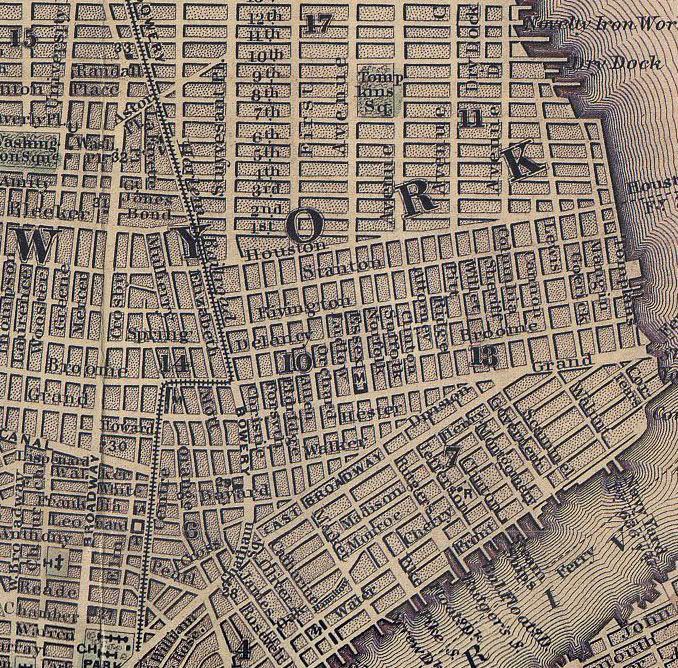
As I got absorbed in The Triangle Shirtwaist Factory Fire Memorial series I remembered the work of Sullivan Street born Ralph Fasanella and his great working people and labor themed pieces.
image source gallery felicie
audio bread and roses from labor notes
more on bread and roses and the lyrics from pseudo-intellectualism in April of 2008
below: from the daily news series' BIG TOWN BIOGRAPHY: Lives and Times of the Century's Classic New Yorker
RALPH FASANELLA NOT FOR SOME RICH GUY’S LIVING ROOM By TOM ROBBINS Daily News Staff Writer Sunday, November 14th 1999, 2:11AM
IT STARTED with a pain in his fingers, a restless, bothersome throbbing. For the longest time, Ralph Fasanella, 30-year-old former juvenile delinquent from Little Italy's mean streets, high school dropout, anti-Fascist soldier, card-carrying Red and lunchbox-toting factory worker, couldn’t figure it out. Arthritis, friends suggested. At my age? he wondered.
Then, one day while on vacation in 1944, he grabbed pencil and paper and began to draw the first thing he saw, a pair of shoes tossed in a corner.
The pain lessened. He drew some more: a cabin, a canoe. He looked at the drawings. Not bad, he noticed with surprise. He kept at it, drawing the faces of workers at the meetings he organized for the United Electrical Workers union.
A friend suggested he get brushes, paint and a canvas.
Maybe I will, he said. He'd never been in a gallery or walked into a museum. At the art supply shop, he asked, "What's a canvas?"
HE WORE OUT a brush a day. He painted what he saw on the subway and the streets, the work-worn men and women of New York, painting until he realized he was paying more attention to the faces at his union meetings than the words that were spoken.
That was when Ralph Fasanella decided he was going to become a real painter. Not one of those empty, alienated modern artists, whose work he had by now checked out. But a people's painter, a maker of big pictures celebrating the things that inspired him: strikes, baseball games, Coney Island, his immigrant family.
It didn't matter that his stuff wasn't particularly salable, that his figures were stiff and primitive, with amateur stamped all over them. He had something inside him that needed to get itself onto canvas.
Oh yes, politics was a big part of it, he said. The workers should know their proud history, of May Day, of the martyrs Sacco and Vanzetti, of sweatshops and strikes. And so he got to work.
Years later, long after even the stuffiest of critics had given him belated recognition and his paintings hung in museums and private collections and he was painting covers for The New Yorker, Ralph Fasanella still looked more factory hand than artist.
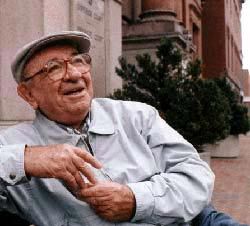
He was 5-feet-5, built like a fire hydrant. He wore big horn-rim glasses that fell over his broad nose, checked flannel shirts, dark gabardine work pants, zipper jackets and a tweed cap pulled down over his wide, bare forehead.
And not for him any reclusive artist's mystery. He could talk the paint off the wall, striking up a conversation with a stranger at a coffee shop in the morning that, if allowed, could carry well into afternoon, a gruff, obscenity-laced, nonstop tour of his thoughts on work, politics, art and, of course, his own life story.
Which went something like this:
RALPH FASANELLA was born on Labor Day, Sept. 2, 1914, the third of six children of Giuseppe and Ginevre, immigrants from Bari, a hardscrabble part of southern Italy. The family squeezed into a tiny walkup tenement on Sullivan St. Joe Fasanella sold ice from a horse-drawn wagon, lugging the big blocks upstairs with a pair of iron tongs. Ralph was supposed to help, but he always ducked out to join his friends on the street, peeking into Jimmy Kelly's saloon on the corner, pinching fruit from the stores. At age 9 he was dispatched to the New York Catholic Protectory in the East Bronx, a bleak, brick-walled reformatory for wayward kids. "Nine years old, and they beat the hell out of me," he recalled years later.
He ran away and was brought back three times. Instead of conquering him, however, the school nurtured a rebel spirit.
In 1928, broke and exhausted, Joe Fasanella gave up and went back to Italy, leaving his wife to raise the family on her earnings in a garment sweatshop. Fiercely proud Ginevre Fasanella, when she wasn't sewing buttonholes, put out an Italian-language anarchist newspaper. This time, son Ralph pitched in to help. His mother's politics, he always said, saved him from the streets.
The Depression hit, and he marched with the Unemployed Councils, then made the next step up the radical ladder, joining the Young Communist League. In 1937, he signed up to fight Franco's Fascists in Spain, sailing with the Abraham Lincoln Brigade, his mother waving goodbye at the dock.
In Spain, he was known as the tough little New York Italian guy who instructed his comrades in the finer points of beer joints and poolrooms. He survived Spain, and later did a turn in the Navy, but his chief business was still radicalism, and back home he organized hospital workers, teamsters and elevator operators right up until the day his fingers told him they wanted to paint.
His idea was to work in a machine shop and paint in his off hours. But the plan clashed with the dawn of the McCarthy era. "Every time I got a job in a factory, someone would come in and see the boss," he remembered. By his count, the FBI chased him out of nine jobs as a national security risk. He married Eva Lazorek in 1950, and her teacher's salary helped them get by until he and his brothers went partners on a garage in the Bronx. Fifteen years were passed at the Happy and Bud gas station at 163rd St. and Third Ave., pumping gas and changing oil filters. In his spare time, he painted churches, Yankee Stadium, May Day rallies.
He filled his paintings with the tiny details of everyday life, painstakingly drawing brick by brick the walls of the reformatory that had held him as a youth, the tenement windows of Italian Greenwich Village, his family grouped around the kitchen table, his mother's sewing machine in a corner, his father symbolically crucified with the ice tongs about his head, the legend "Lest We Forget" inscribed at the picture's top.
There was no market for his work. But he didn't gripe. You want to be a painter, he figured, you work two jobs.
THEN A New York magazine writer named Nicholas Pileggi got wind of him. The cover of the magazine's Oct. 30, 1972, issue ran pictures of Fasanella and his paintings under the headline: "This man pumps gas in the Bronx for a living. He may also be the best primitive painter since Grandma Moses."
Suddenly there was a swirl of cocktail parties and customers. It was a little much for a gas pump jockey. To get away from the crowd and renew his concentration, he took himself to Lawrence, Mass., site of the great 1912 "Bread and Roses" textile mills strike, a turning point in American labor history. He spent three years there, living in a local YMCA, sketching and researching, producing a huge, 5-by-10 tableau. He hung it in a local library and the residents came to see. "Jesus, look, this guy's painting our lives," said one old-timer.
It was music to Fasanella's ears. "I didn't paint my paintings to hang in some rich guy's living room," he said. "They should be seen, not hidden away."
Union activist Ron Carver agreed. In 1988, Carver launched a campaign to raise funds to place Fasanella's work in public places. With financial help from trade unions seeking to reclaim their past, "The Great Strike - Lawrence 1912" was bought and hung in the House of Representatives office building, although the Republicans subsequently evicted it. "Family Supper," the immigrant family portrait, was placed in the restored Immigration Museum on Ellis Island. In 1996, "Subway Riders" was hung - where else? - in the subway, at the IND station at Fifth Ave. and 53rd St. He was playful with kids and he spoke often at schools, passing to another generation the enthusiasm for making pictures. Himself, he painted right up to the end, which came in December 1997, from emphysema. A few weeks later, several hundred of his friends and admirers gathered at the union hall of the Local 1199 hospital workers union and celebrated the life of the little guy whose fingers told him to paint.
Subscribe to:
Posts (Atom)


 Posts
Posts