Showing posts with label jacob riis. Show all posts

Monday, April 25, 2011

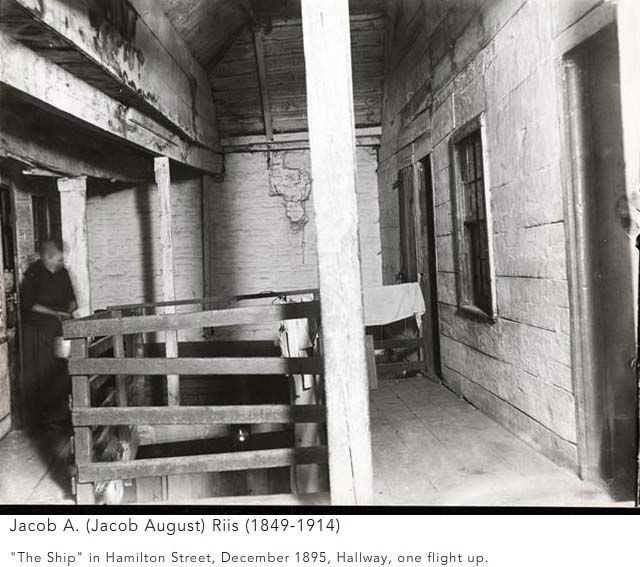
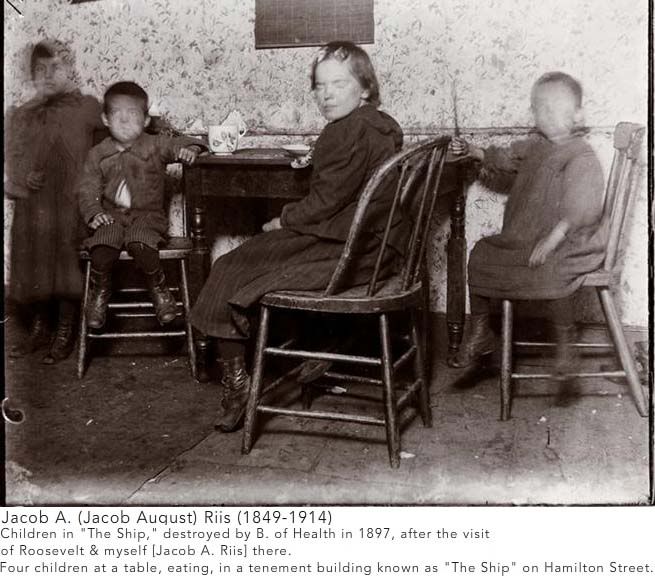
The Ship On Hamilton Street: 1890's

More proof that Hamilton Street was rough and tumble.
Also evidence of Riis' questionable views on race and ethnicity.
from How The Other Half Lives
How the Other Half Lives. 1890.
IV. The Down Town Back-Alleys
We have crossed the boundary of the Seventh Ward. Penitentiary Row, suggestive name for a block of Cherry Street tenements, is behind us. Within recent days it has become peopled wholly with Hebrews, the overflow from Jewtown adjoining, pedlars and tailors, all of them. It is odd to read this legend from other days over the door: “No pedlars allowed in this house.” These thrifty people are not only crowding into the tenements of this once exclusive district— they are buying them. The Jew runs to real estate as soon as he can save up enough for a deposit to clinch the bargain. As fast as the old houses are torn down, towering structures go up in their place, and Hebrews are found to be the builders. Here is a whole alley nicknamed after the intruder, Jews’ Alley. But abuse and ridicule are not weapons to fight the Israelite with. He pockets them quietly with the rent and bides his time. He knows from experience, both sweet and bitter, that all things come to those who wait, including the houses and lands of their Persecutors.
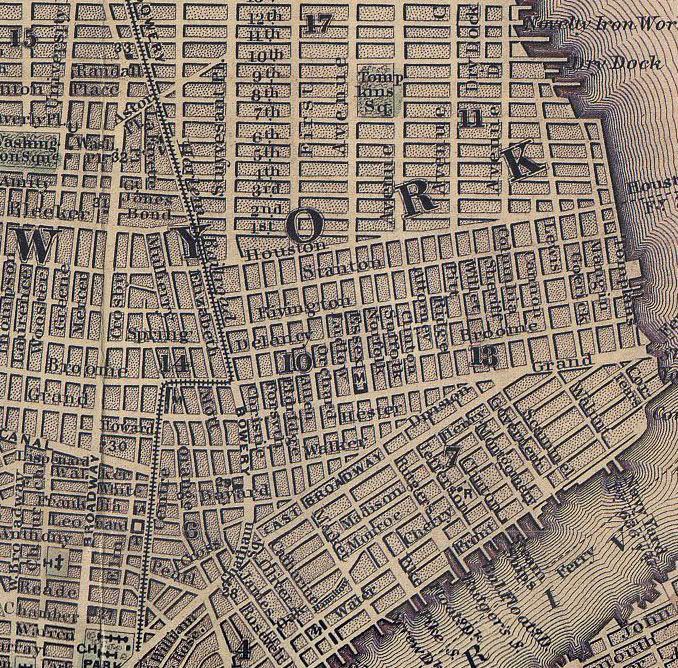
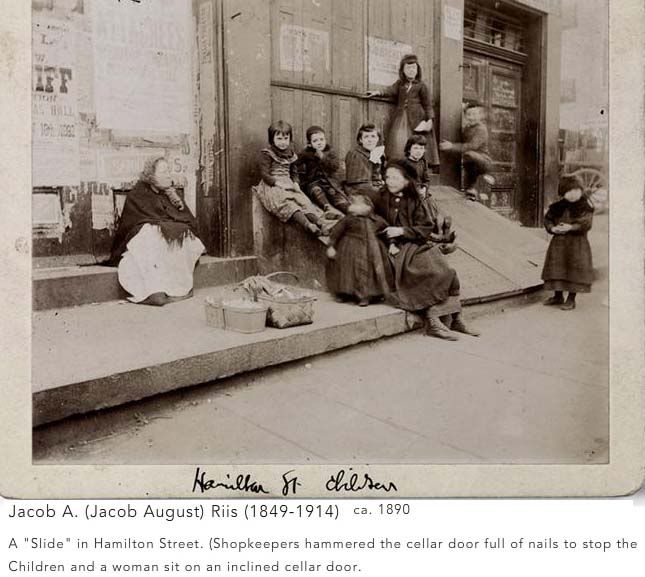
Here comes a pleasure party, as gay as any on the avenue, though the carry-all is an ash-cart. The father is the driver and he has taken his brown-legged boy for a ride. How proud and happy they both look up there on their perch! The queer old building they have halted in front of is “The Ship,” famous for fifty years as a ramshackle tenement filled with the oddest crowd. No one knows why it is called “The Ship,” though there is a tradition that once the river came clear up here to Hamilton Street, and boats were moored along-side it. More likely it is because it is as bewildering inside as a crazy old ship, with its ups and downs of ladders parading as stairs, and its unexpected pitfalls. But Hamilton Street, like Water Street, is not what it was. The missions drove from the latter the worst of its dives. A sailors’ mission has lately made its appearance in Hamilton Street, but there are no dives there, nothing worse than the ubiquitous saloon and tough tenements.
I thought the building shown here was the ship, but it was probably the Seaman's Mission that succeeded it

Sunday, January 2, 2011

Riis' Gotham Court From The Museum Of The City Of New York

Mcny Gotham Court
from the museum of the city of new york's digital collection..
I alternated many of the images with close ups of certain parts of interest. Notice the advertisement for a 1889 event at Jones Wood on page 9 of the document.It looks like it was sponsored by a Edward Lennon. That must have been a world apart from the horrors of life in the Fourth Ward at that time

Thursday, January 7, 2010

Jersey Street 2

views of Jersey Street from Jacob Riis. Riis, I believe, would often work out of the old police quarters on Centre Street, which was only a few blocks north
Pages From Riis-tenements1

Sunday, October 25, 2009

A New Look At The Other Half

Riis New Book

Daniel Czitrom co-authored a recent book which re-examines the work of Jacob Riis.
An excerpt from the nytimes review
Today one of the last Bowery flophouses leans up against the futuristic steel facade of the New Museum, and a bed at the Bowery Hotel can run $750 a night. After such gentrification, it can be difficult to conjure up the squalid New York that Jacob Riis documented in his groundbreaking 1889 work of photojournalism, “How the Other Half Lives.” Riis was well aware that the “other half” in New York City had become the other three-quarters, with 1.2 million impoverished New Yorkers living in slums, 19th-century tenements that were a public health catastrophe, rife with typhus, diarrhea, cholera and tuberculosis. Employing unsentimental storytelling, reportage, social statistics and the latest advances in flash photography, Riis shed a stark light on the horrific living conditions of New York’s vast population of poor immigrants.
In “Rediscovering Jacob Riis,” Bonnie Yochelson and Daniel Czitrom have undertaken a rigorous, scholarly re-examination of Riis’s life and work. While Czitrom, a historian at Mount Holyoke College, places Riis in the context of other 19th-century social crusaders, Yochelson, a former photo curator at the Museum of the City of New York, offers a more critical assessment; she re-evaluates Riis’s photography and questions the mythos that surrounds him.
Riis was beloved in his time. Teddy Roosevelt called him “the best American I ever knew,” and even coined the term “muckraking” to describe the fierce advocacy journalism practiced by Riis and others. But Riis was far from an infallible social reformer. In Czitrom’s estimation, he refused to acknowledge his debt to predecessors like the activist-journalist Charles Wingate and too often indulged in ethnic stereotyping. An industrious Danish immigrant, he seemed to find moral failings in nearly every other group: Polish Jews, Italians, Chinese, the Irish. Riis was also critical of interracial socializing; he said of so-called black-and-tan saloons that “there can be no greater abomination.” But Riis’s real anger was saved for the tenements themselves, whose dire conditions he called the “murder of the home.” He pursued his campaign with evangelical zeal. Riis believed that defective character led to poverty and that conscience-driven capitalism was the best solution. Although he pitied them, his reform crusade “ascribed little or no role at all to tenement dwellers themselves,” Czitrom writes. This brand of noblesse oblige perhaps anticipated the public housing failures of Riis’s 20th-century admirer Robert Moses.
But regardless of his philosophy, Riis’s photographs remain indelible. Making use of newly invented magnesium flash powder, he brought the brilliant light of a new medium to bear on a netherworld that had never been photographically recorded. He shot the down-and-out occupants of darkened Bowery basements and Chinatown opium dens, his subjects caught unawares. The dingy and cluttered rooms, lighted bright as day for a split-second exposure, are immediate and revelatory, and remain extraordinarily persuasive as evidence of the squalor Riis sought to combat.

Friday, April 10, 2009

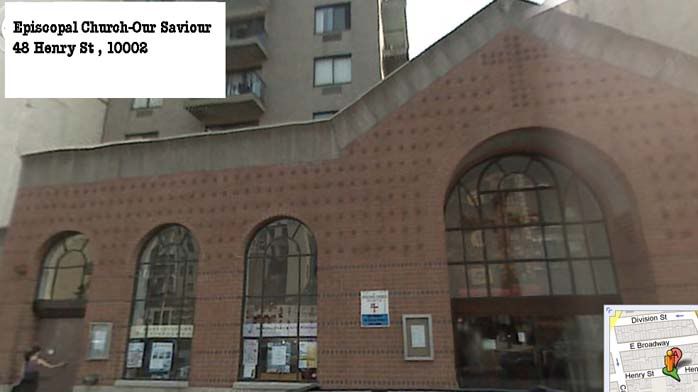
48 Henry Street 2


The web site of the church is ecoserve
Up until 1950 it housed the Jacob Riis Settlement House. From the Riis Settlement site
THE HISTORY OF JACOB A. RIIS NEIGHBORHOOD SETTLEMENT HOUSE
Jacob A. Riis was the founder of the Jacob A. Riis Neighborhood Settlement House. He was a native of Ribe, Denmark, and came to New York City in 1870. Riis's book, "How the Other Half Lives" exposed conditions previously thought not to exist in America. He used photography to bring unprecedented public awareness to pressing social problems through a relatively new medium. In 1888, he established the Jacob A. Riis Neighborhood Settlement House to meet the needs of newly arrived immigrants.
In 1888, Jacob A. Riis collaborated with the King's daughters, an organization of Episcopalian church women, to establish the organization which in 1901 was renamed as the Jacob A. Riis Neighborhood Settlement House. In it's early years, the Settlement House offered sewing classes, mothers clubs, health care, a summer camp, and a penny provident bank. In 1897, the Settlement House moved into its first home at 48 Henry St. Jacob A. Riis Neighborhood Settlement House continued to diversify activities, broadening the scope of activities to include athletics,-citizenship classes, and drama. In the 1940's and 50;s, the Settlement House began to offer programs for residents of public housing developments in Queens, Brooklyn and Manhattan. At the same time, the original Settlement House building was sold; in 1950, Jacob A. Riis Settlement House moved all of it's activities to the Queensbridge Houses in Long Island City, Queens.