Bachelor Father is an American sitcom starring John Forsythe that appeared on all three national television networks between 1957 and 1962. Bachelor Father debuted in the fall of 1957 on CBS. The series was produced by Forsythe's "Bachelor Productions" in association with MCA's Revue Studios.
Bachelor Father followed the adventures of Bentley Gregg, a wealthy bachelor attorney living in Beverly Hills who assumes the responsibility of raising his niece, Kelly (Noreen Corcoran), after her parents die in an automobile accident. Other members of the Gregg household include houseboy Peter Tong (Sammee Tong), teenage neighbor and Kelly's boyfriend, Howard Meechum (Jimmy Boyd) and Jasper, the dog. Plots centered on Bentley's adjustments to his new role as an adoptive parent, Bentley's search for the right woman to share his life, Kelly facing the usual problems of adolescence and young adulthood as she goes from high school to college, and, less often, Peter's misadventures with some financial scheme. In its final season, they storylines led to Kelly's impending marriage to Bentley's junior partner, Warren Dawson, portrayed by Aron Kinkaid. The series ended prior to the wedding. One hundred fifty-seven episodes were aired. The program never finished any of its five seasons in the top 25 in the ratings.
The series' pilot episode was originally presented on General Electric Theater (as "A New Girl in His Life") on May 26, 1957. The program was first telecast on CBS on September 15, 1957. It originally aired on Sunday evenings on alternating weeks with The Jack Benny Program opposite NBC's Sally and ABC's Maverick. The show moved to NBC on Thursday nights in June 1959 and concluded its run on the network in September 1961. The series moved on to ABC on Tuesday nights in 1961 for its final season.The last episode ran September 25, 1962. It was primarily sponsored by American Tobacco (Hit Parade, Tareyton cigarettes) throughout its original run.
After Bachelor Father, Forsythe appeared in two other sitcoms, The John Forsythe Show on NBC (1965-1966) and To Rome with Love on CBS (1969-1971), also featuring Walter Brennan as Forsythe's father-in-law. Thereafter, he starred in two highly successful drama series, Charlie's Angels and Dynasty, both on ABC.
Showing posts with label television. Show all posts
Showing posts with label television. Show all posts
Saturday, April 3, 2010
John Forsythe: Bachelor Father


Thursday Night TV In 1959
RIP John Forsythe. I don't remember watching Bachelor Father or much of anything but "You Bet Your Life" or "Untouchables" on this night
ABC: The Gale Storm Show, The Donna Reed Show, The Real McCoys, The Pat Boone Chevy Showroom, The Untouchables, Take a Good Look
CBS: Douglas Edwards with the News, To Tell the Truth, The Betty Hutton Show, Johnny Ringo, Dick Powell's Zane Grey Theater, Playhouse 90/The Big Party
NBC: Law of the Plainsman, Bat Masterson, Johnny Staccato, Bachelor Father, The Ford Show starring Tennessee Ernie Ford, You Bet Your Life, The Lawless Years.
as for John Forsythe who passed away at 92 this week:
Father: Samuel Jeremiah Freund, Mother: Blanche Materson Freund
John Lincoln Freund - better known as John Forsythe (born January 29, 1918), was an American stage, television and film actor. Forsythe starred in three television series, spanning three decades, as single playboy father Bentley Gregg in the 1950s sitcom Bachelor Father [1957–1962); as the unseen millionaire Charles Townsend on the popular 1970s crime drama Charlie's Angels (1976–1981), and as ruthless and beloved patriarch Blake Carrington on the popular 1980s soap opera Dynasty (1981–1989). He's also well-known for hosting World of Survival during the 1970s. Forsythe appeared each year to read children's fiction during the annual Christmas program near his retirement home at the rural resort community of Solvang, California, north of Los Angeles. Forsythe, the oldest of three children, was born in Penns Grove, New Jersey to a factory worker, and was raised in Brooklyn, New York where his father worked as a Wall Street businessman during the Great Depression of 1929. At only 16 years of age Forsythe graduated from Abraham Lincoln High School in Brooklyn and began attending the University of North Carolina at Chapel Hill. In 1936 at age 18, he took a job as the announcer at Ebbets Field Stadium in Brooklyn, New York, confirming a childhood love of baseball.
Monday, February 1, 2010
Friday, December 11, 2009
The Toy Parade, AKA The Leave It To Beaver Theme
I never knew this song had lyrics
("The Toy Parade" by Dave Kahn, Melvyn Leonard and Mort Greene) - Leave it to Beaver Lyrics
Hey! Here they come with a rum-tee tum they're having a toy parade.
A tin giraffe with a fife and drum is leading the kewpie parade.
A gingham cat in a soldier's hat is waving a Chinese fan,
A plastic clown in a wedding gown is dancing with Raggedy Ann.
Fee fie fiddle dee dee they're crossing the living room floor
Fee fie fiddle dee dee they're up to the dining room door.
They call a halt for a choc'late malt or cookies and lemonade
Then off they go with a ho ho ho right back to their toy brigade.
Tuesday, November 17, 2009
Fury: A Boy And His Horse
Fury, Fury
Smartest stallion anywhere
Fury, Fury
Where they need you
You're right there
Every time, I call you
I hear your call replin'
Then you gallop straight to me
With mane and tail a flyin'
from tv acres
Saturday mornings where the best time of the week when you were a kid back in the 50's. There were great shows on to watch like *Fury, Sky King, Jungle Jim, *Tugboat Annie, *Lassie, *Ramar Of The Jungle, The Lone Ranger, Roy Rogers, Cisco Kid, My Friend Flicka, Casey Jones, Adventures of Champion Hopalong Cassidy and many many more. I miss those days, and wish that programs like these could be on Television once again for the kids of today. All of these shows taught lessons on how to treat people and what was right and wrong. No one back then ever thought to talk back to his or her parents, and they treated adults with the respect they so truly deserved.
I have started this site because it seems that Fury has been lost and forgotten in time. There is not much left on the show, but what I find will be posted here. So for those who remember the show, sit back and enjoy. For those who have never heard of Fury, it will be a new experience and one I hope you will all enjoy......
Fury
Joey suffers a severe head injury while riding FURY. Episode # 17 - Season 1 - 2/04/1956 Starring: Bobby Diamond, Peter Graves, Jimmy Baird, Roger Mobley, and William Fawcett as Pete
from crazy about tv
The Fury TV show was a western action series about a widower (Jim Newton) whose wife and son had been killed by a drunk driver in an auto accident. Jim owned a ranch and adopted an orphan boy who had been wrongly accused of a minor crime. Joey developed a deep, loving relationship with a horse on the ranch named "Fury". Fury apparently felt the same way about Joey since he wouldn't let anyone but Joey ride him unless Joey said it was ok. The episode plots usually involved a person or persons who did something bad and ended out in trouble and then would be saved by Fury. There was a definite attempt to teach the kids who were watching what is and is not acceptable behavior.
Fury Cast:
Peter Graves .............. Jim Newton
Bobby Diamond ............. Joey Newton
Rodger Mobley ............. Packy Lambert
William Fawcett ........... Pete
Highland Dale ............. Fury
Fury TV Show Trivia:
Fury got his name when Pete, the ranch's foreman, said that the horse was full of "Fire and Fury". Fury had begun life as a wild horse. It had taken three years of trying before they finally caught him so the name fit pretty well!
Fury may have been the king of television shows when it comes to merchandizing! There were several comic books based on Fury. There were Fury coloring books, puzzles, trading cards, and a board game!
In addition to his outstanding movie career, Peter Graves also appeared in several other TV Series including "Mission Impossible", "Court Martial", "Whiplash", and "Where's Raymond"! He also appeared in two of television's greatest miniseries, "The Winds of War" and "War and Remembrance". Peter is also the brother of James Arness, best knowns as Marshall Matt Dillion on the TV series, "Gunsmoke". Peter even worked with his brother once on Gunsmoke by directing episode #402 of that series titled, "Which Dr.".
The horse named "Highland Dale" who played "Fury" on the show was a purebred "American Saddlebred". The Fury TV Show was not the only starring role for Highland Dale! The horse also starred in the movie, "Giant". In that movie, Highland Dale's name was "War Winds".
Fury was the first of many series that was produced for U.S. TV by "ITC Entertainment", a production company based in England.
Highland Dale somehow appeared at a wild animal park called, "Africa USA" that is located in the Santa Clarita Valley of California. Africa USA also housed the animals for the TV series, "Daktari". Anyway ... the park attendants had no idea that Highland Dale was the star of Fury! He was very sick when he arrived at the park but they got him back in good shape. They had been told that the horse's name was "King". It was strange when they discovered that "King" was extremely intelligent and could do many tricks. Finally, one day a stuntman visited the park and recognized that "King" was really "Highland Dale"! The people who worked at the park were understandably thrilled!
Bobby Diamond also had an extensive show business career including regular roles on the "The Many Loves of Dobie Gillis" and "Westinghouse Playhouse". He even appeared as a guest star on three episodes of the series, "Lassie" and played a different character each time!
After Fury went off the air, it ran in syndication until 1966 with the new name, "Brave Stallion."
Just in case you wondered what happened to Bobby Diamond, he went to law school and earned his degree in 1970. He then practiced law in Los Angeles, California.
Episodes List With Original Air Dates
The First Season
1. Joey Finds A Friend (10/15/1955)
2. Killer Stallion (10/22/1955)
3. The Horse Coper (10/29/1955)
4. Joey Goes Hunting (11/5/1955)
5. Scorched Earth (11/12/1955)
6. Joey's Dame Trouble (11/19/1955)
7. Joey And The Gypsies (11/26/1955)
8. Joey's Father (12/3/1955)
9. Joey Saves The Day (12/10/1955)
10. The 4-H Story (12/17/1955)
11. Junior Rodeo (12/24/1955)
12. Ghost Town (12/31/1955)
13. The Hobo (1/7/1956)
14. Tungsten Queen (1/14/1956)
15. Joey Sees It Through (1/21/1956)
16. Stolen Fury (1/28/1956)
17. The Choice (2/4/1956)
18. The Boy Scout Story (2/11/1956)
19. Search For Joey (2/18/1956)
20. The Miracle (2/25/1956)
21. The Test (3/3/1956)
22. Fury Runs To Win (3/10/1956)
Sunday, October 18, 2009
Life Of Riley
from the youtube description
Babs School Election- First Broadcast January 2, 1953
The very first episode of the show. Chester Riley tries to run his daughter Babs school election with disastrous results.
Hennesey
With my memory jogged about Jackie Cooper I was reminded of another favorite sit com, Hennesey. It was one I liked mostly for Abby Dalton and the great theme music and inspired me to make the video below. Jackie and Abby are still alive. Henry Kulky isn't. He played in the first sit com I remember watching, The Life Of Riley. He played Otto Schmidlap.
KV Synchronicity: The People's Choice
The loyal KV Yankee Fan Group have been burning the email lanes with updates of their teams' progress. An offshoot was an interesting story of Joe's encounter with Jackie Cooper and the chairman of the board. That led to a story about the old lime house restaurant For me it brought back memories of a tv sit-com of the KV baby boomers.
Thursday, August 20, 2009
Sunday, July 19, 2009
The Original Howdy Doody

an anonymous blog viewer came across a previous post about Howdy Doody and offered to send along an image of his original Howdy Doody button:
This is the Howdy Doody button I got in 1947 or 1948, showing Howdy’s original appearance. The original marionette was designed and owned by Frank Paris who operated the puppet on the show. After 6 months there was a contract dispute between Paris and NBC, and Paris left the show with the puppet. Smith’s lawyer said the puppet could not be replaced with a look-alike, although Smith did own the rights to the puppet’s name. The next day the show opened with Howdy’s head swathed in bandages. Bob Smith explained to the TV audience that Howdy was having his face lifted and in a few weeks the bandages would be removed. This gave Smith time to have a new puppet designed by a former Walt Disney artist. In March 1948 the bandages came off and the new Howdy was revealed to the world as an all-American boy with red hair and 48 freckles – one freckle for each state of the union. I am sure you and your Knickerbocker Village blogsters will enjoy this bit of old-time trivia that hardly anyone seems to remember.
Sunday, June 28, 2009
Victory At Sea
I watched this show all time with my father. Richard Rodgers composed the music for the series. It was his 107th birthday today.
Victory at Sea was a documentary TV series about naval warfare during World War II that was originally aired by NBC in the USA in 26 half-hour segments on Sunday afternoons, starting October 26, 1952 and ending May 3, 1953. The series, which won an Emmy in 1954 as best public affairs program, played a major role in establishing historic documentaries as a viable television genre. When it first aired, NBC thought it so important that it had no commercial breaks.
The project was conceived by Henry Salomon, who, while in the U.S. Navy during World War II, was a research assistant to historian Samuel Eliot Morison. Morison was then writing the 15-volume History of United States Naval Operations in World War II. During this period, Salomon learned of the large amounts of film that the warring navies had compiled. Salomon left the Navy in 1948 and eventually discussed his idea of a documentary series with one of his Harvard classmates, Robert Sarnoff, a rising executive at NBC television and the son of David Sarnoff, the chairman of RCA (then the owner of NBC).
NBC approved the project in 1951, with Salomon as producer and a budget of $500,000 (large for that era). His team, made up largely of newsreel veterans, scoured naval archives around the world, and received complete cooperation from the U.S. Navy, which recognized the publicity value. Salomon's team compiled 60 million feet (18,300 km) of film, which was edited to about 61,000 feet for broadcast.
After the original run, NBC syndicated it to local stations, where it proved successful financially through the mid-1960s. NBC also marketed the series overseas; by 1964, it had aired in 40 foreign markets. NBC created a feature-length motion picture condensation and made a distribution deal with United Artists; the film debuted in mid-1954; NBC aired the movie twice in the 1960s.
Salomon also signed Richard Rodgers, fresh off several hit Broadway musicals, to compose the musical score. Rodgers contributed 12 "themes"- short piano compositions a minute or two in length; these may be examined in the Rodgers Collection at the Library of Congress.[citation needed] Robert Russell Bennett did the scoring, transforming Rodgers's themes to fit a variety of moods, and composing much more original material than Rodgers, as may be observed in Bennett's inked scores, microfilmed at the Library of Congress.[citation needed] Nonetheless, Bennett received credit only for arranging the score and conducting NBC Symphony Orchestra members on the soundtrack recording sessions, and many writers still refer erroneously to "Rodgers's thirteen-hour score."[citation needed] Rodgers recorded excerpts from the music with the New York Philharmonic Orchestra for Columbia Records, but it was Bennett who made the more familiar RCA recordings with the Symphony of the Air, an orchestra created in the fall of 1954 from former NBC Symphony members, identified on the albums as the RCA Victor Symphony Orchestra.
The movements and approximate timings in the RCA Symphony performance are as follows; 1. The Song of the High Seas - 5:03 2. The Pacific Boils Over - 5:45 3. Fire on the Waters - 5:58 4. Guadalcanal March - 3:08 5. Pelelieu - 3:43 6. Theme of the Fast Carriers - 6:49 7. Hard Work and Horseplay - 3:44 8. Mare Nostrum - 4:31 9. Beneath the Southern Cross - 4:06 10.Mediterranean Mosaic - 5:03 11.Allies on the March - 5:26 12.D-Day - 5:54 13.The Sound of Victory - 6:15 14.Victory at Sea - 6:11
Tuesday, June 23, 2009
Blossom Dearie: The Surrey With The Fringe On Top
from the Jack Paar Show sometime in the 1960's
When I take you out, tonight, with me,
Honey, here's the way it's goin' to be:
You will set behind a team of snow white horses,
In the slickest gig you ever see!
Chicks and ducks and geese better scurry
When I take you out in the surrey,
When I take you out in the surrey with the fringe on top!
Watch that fringe and see how it flutters
When I drive them high steppin' strutters.
Nosey pokes'll peek thru' their shutters and their eyes will pop!
The wheels are yeller, the upholstery's brown,
The dashboard's genuine leather,
With isinglass curtains y' can roll right down,
In case there's a change in the weather.
Two bright sidelight's winkin' and blinkin',
Ain't no finer rig I'm a-thinkin'
You c'n keep your rig if you're thinkin' 'at I'd keer to swap
Fer that shiny, little surrey with the fringe on the top!
Wednesday, June 10, 2009
June Is Busting Out All Over 3
from the youtube description. From a June 2, 1956 show
The TV seasons were long back in 1956 for Gisele MacKenzie, Dorothy Collins, Russell Arms, Snooky Lanson, Raymond Scott (orch) and Ray Charles (chorus)! Running into June, here Gisele MacKenzie is seen doing a "Your Hit Parade" extra, June Is Busting Out All Over, from the musical Carousel. This little piece of video became a good representation of Gisele's musical/comedy abilities and through the years she starred in Gypsy, Hello Dolly, Unsinkable Molly Brown, Mame, Kind & I, South Pacific, Annie Get Your Gun, etc. Gisele was the all-around performer...perfect for TV and musical-comedy.
I watched this show with my parents and liked it. Looking back, "What was I thinking?"
Gisele MacKenzie may have been an all around performer-all around bland.
Wednesday, June 3, 2009
Steve Allen: 1960, Part 2
Jonathan Winters, one of the funniest and most original comedians ever. He's still with us. I thought he must have been an influence on Robin Williams and he was
Steve Allen: 1960, Part 1
Unlike that 50's music, this show certainly holds up after almost 50 years. from the museum of broadcasting certainly many of the current late night group have stolen from Steve Allen
One of the most famous ratings wars in television history began on 24 June 1956. That night NBC debuted The Steve Allen Show opposite the eighth anniversary program of what had become a television institution, The Ed Sullivan Show on CBS. The two hosts were markedly different. Sullivan was a rigorous master of ceremonies, known for enforcing strict conformity for both his guests and the members of his audience. Allen, too, served as host, but he was also innovative, funny and whimsical. Whereas Steve Allen liked to improvise and ad lib on his program, creating material and responding to guests and audience on the spot, The Ed Sullivan Show followed a strict format.
The appearances of Elvis Presley on the two programs serve to illustrate the differences between them. When Presley appeared on The Ed Sullivan Show, Sullivan instructed the camera operators to shoot the picture from the waist up only. On The Steve Allen Show, Presley appeared in a tuxedo and serenaded a bassett hound with his hit "You Ain't Nothing But a Hound Dog." Both strategies appeased nervous network censors, but each is emblematic of the show it served.
Relations between the two prominent hosts were not cordial and reached a low point in October 1956. Allen scheduled a tribute to the late actor, James Dean, for his 21 October program. When he learned that Sullivan planned his own tribute to Dean for his 14 October program, Allen charged that Sullivan had stolen his idea. Sullivan denied the charges and accused Allen of lying. Allen moved his segment to October 14 when both programs paid tribute to the late actor and showed clips from his last movie, Giant.
Much of Allen's work on The Steve Allen Show resembled previous performances on The Tonight Show, which he had hosted since 1954. He often opened the program casually, seated at the piano. He would chat with the audience, participate in skits, and introduce guests. Television critic Jack Gould considered the new program merely an expanded version of The Tonight Show and characterized it as "mostly routine stuff." Gould did concede that "more imagination could take the program far." The Steve Allen Show offered Allen a natural setting for what Gould termed his "conditioned social gift" of "creating spontaneous comedy in front of an audience in a given situation."
Allen also continued something else he had begun on The Tonight Show, discovering new talent. Andy Williams, Eydie Gorme and Steve Lawrence got their starts on The Tonight Show. And on the new show, Allen's man in the street interview segments launched the careers of comedians Bill Dana, Pat Harrington, Louis Nye, Tom Poston and Don Knotts. Dana played the timid Hispanic Jose' Jiminez, and Harrington the suave Italian golfer Guido Panzino.
Characters created by Nye, Poston and Knotts were the best known of the group. Nye portrayed the effete and cosmopolitan Gordon Hathaway whose cry "Hi Ho Steverino" became a trademark of the program. Tom Poston was the sympathetic and innocent guy who would candidly answer any question but who could never remember his name. Probably the best remembered character was the nervous Mr. Morrison portrayed by Don Knotts. Often Morrison's initials were related to his occupation. On one segment he was introduced as K.B. Morrison whose job in a munitions factory was to place the pins in hand grenades. When asked what the initials stood for, Knotts replied, "Kaa Boom!" Invariably Allen would ask Knotts if he was nervous and always got the quick one word reply, "No!!!" Allen characterized the cast as the "happiest, most relaxed professional family in television."
Allen became known for the outrageous. He conducted a geography lesson using a map of the world in the shape of a cube. He opened a program by having the camera shoot from underneath a transparent stage. Looking down at the camera Allen remarked, "what if a drunk suddenly staggered into your living room and saw this shot?"
Although Allen won some of the ratings battles with Sullivan, he ultimately lost the war. In 1959 NBC moved The Steve Allen Show to Monday nights. The following year, it went to ABC for a fourteen week run. In 1961 Allen renamed the program The Steve Allen Playhouse and took it into syndication where it ran for three years.
Monday, May 11, 2009
An Inspiration For The Coast Guard's KV Captain?
We have a KV Colonel and a couple of KV Captain's. One of them is a Captain in the Coast Guard. He finally made it back to this year's reunion. Those who remember him from an early age recall his declaration that he wanted to be an oceanographer. Who knew from being an oceanographer in 1960? Maybe this show was an inspiration? The episode is entitled The Shipwreck and it's from Season 1, Episode 30 from 1958. A guest star was Leonard Nimoy
Saturday, April 25, 2009
Naked City In Ward 11
from tv.com 90. Let Me Die Before I Wake
First aired: 2/14/1962, Writer: Abram S. Ginnes, Director: Paul Nickell
Guest star: Joanne Linville (Rosie), Jack Klugman (Joe), Louis Guss (Angie), Albert T. Viola (Phil), Paul Stevens (Nick), James Farentino, Michael Constantine (Vito)
A man escapes a hit and run attempt on his life made by his wife's lover.
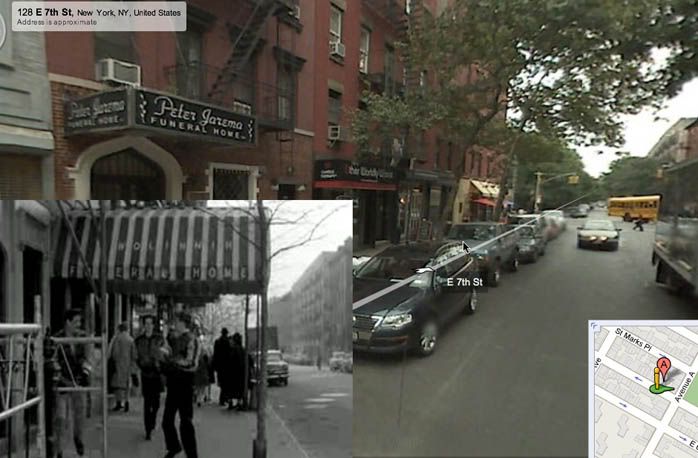
Jack Klugman is on East 7th Street and the priest is either in the front of the St Stanislaus Church or the Citylight Church. He then walks east towards Avenue A towards the Funeral Parlor. That funeral parlor is ow the Jarema Funeral Parlor
The Naked City In Ward 17
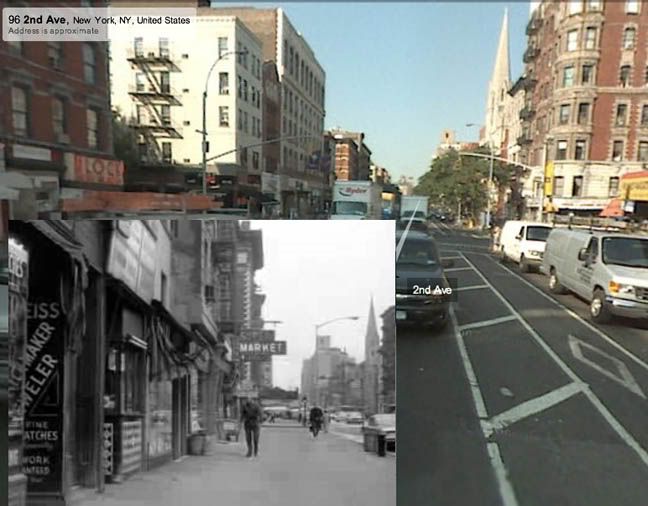
from tv.com 84. The Face of the Enemy, First aired: 1/3/1962, Writer: Peggy Shaw, Lou Shaw Director: William A. Graham, Guest star: Sorrell Booke (Hawk) , Sylvia Miles (B-girl), Kim Hunter (Edna Daggett), Eileen Fulton (Janie Daggett), Conard Fowkes (John), Jack Warden (Neil Daggett) A former Medal of Honor winner goes on a killing spree shortly after his daughter's wedding. You can see Jack Warden staggering along 2nd Avenue around 6th Street, as well as views of St. Marks' Church, Ratner's and the movie theater that would later house the Fillmore. Lawrence Dobkin is heard delivering the celebrated two-line summation that ends each show.
Naked City is a police drama series which aired from 1958 to 1963 on the ABC television network. It was inspired by the 1948 motion picture of the same name, and mimics its dramatic "semi-documentary" format..
Filmed on location in New York City, the series centers on the detectives of NYPD's 65th Precinct, but episode plots were often focused more on the criminals and victims portrayed by guest stars. Primary writer Stirling Silliphant nurtured a focus on intelligent drama with elements of comedy and pathos, leading to significant critical acclaim for the series, and leading film and television actors of the time sought out guest-starring roles. In addition to Silliphant, who went on to win an Academy Award for his script of In the Heat of the Night, writers of Naked City episodes included veteran TV writer Howard Rodman and blacklisted screenwriter Arnold Manoff, writing under the pseudonym "Joel Carpenter."
In addition, extensive location shooting made New York as much a star of the series as any of the actors. Many scenes were filmed in the south Bronx near Biograph Studios, where the series was produced, and in Greenwich Village and other neighborhoods of Manhattan. The exterior of the "65th Precinct" was the Midtown North Precinct at 306 West 54th Street between Eighth and Ninth Avenues.
Naked City first aired in 1958 as a half-hour series starring James Franciscus and John McIntire playing, respectively, Detective Jimmy Halloran and Lt. Dan Muldoon — the same characters as in the 1948 film. While critically acclaimed, the series did not garner high ratings and was canceled by ABC after its first season. One of the show's sponsors, along with production staff, successfully lobbied the network to revive the show as an hour-long series, which premiered in 1960.
The 1960 version of the series featured Paul Burke as "Detective Adam Flint", a sensitive and cerebral cop in his early thirties who does much of the legwork in the episodes. The preceding season, Burke had appeared with David Hedison in the short-lived NBC espionage drama, Five Fingers. Horace McMahon portrayed his seasoned and crusty superior, Lieutenant Mike Parker, and Harry Bellaver played his older, mellow partner, Sgt. Frank Arcaro. Both McMahon's and Bellaver's characters were also regulars in the earlier half-hour format series.
Also in 1960, Stirling Silliphant went on to create Route 66 (TV series) using the same semi-anthology format of building the stories around the guest stars rather than the regular cast.
The series was notable for featuring young New York stage actors who later became major stars. Among the future stars to appear in the series were Rip Torn, Tuesday Weld, Jack Klugman, Peter Falk, Robert Duvall, Carroll O'Connor, Jean Stapleton, George Segal, Martin Sheen, Robert Redford, Sylvia Miles, Jon Voight, Sandy Dennis, William Shatner, Christopher Walken and Dustin Hoffman. The show also featured such established performers as Kim Hunter, Eileen Heckart, Nehemiah Persoff, Betty Field, Luther Adler, Geraldine Fitzgerald, Jan Sterling, Mildred Natwick, Walter Matthau, Viveca Lindfors, Jack Warden, Eli Wallach, Burgess Meredith, Mickey Rooney and, in a rare performance on celluloid, Sanford Meisner, the noted acting teacher
Nehemiah Persoff,of course, lived in Knickerbocker Village
Tuesday, April 7, 2009
The Rifleman
I wonder whether Cliff's fascination with rifles coincided with this show's popularity. I doubt it, Cliff was already 18 when this show began. I never watched it and it wasn't because I was aware that Chuck Connors was a right winger. This site has everything you ever want to know, if you cared, about the Rifleman
The Rifleman is an American Western television program that ran on ABC, from September 30, 1958 to April 8, 1963, a production of Four Star Television
According to network publicists, the series was set in the 1880s. There are also numerous episodes where the date is given in the 1880s. A wooden plaque next to the home stated that it was rebuilt by Lucas McCain and his son Mark in August 1881.
Westerns were popular when The Rifleman premiered, and producers struggled to find gimmicks to distinguish one show from another. The Rifleman's gimmick was a modified Winchester Model 1892 rifle with a trigger mechanism allowing for rapid-fire shots. Query how he could have had a Model 1892 in the 1880's, nevertheless Connors demonstrated its rapid-fire action during the opening credits as McCain dispatched an unseen bad guy on North Fork's main street. Although the rifle may have appeared in every episode, it was not always fired, as some plots did not lend themselves to violent solutions, e.g., a cruel teacher at Mark's one-room school. There were several episodes where McCain dispatched the bad guys without the use of the rifle at all and he once threw the rifle to knock the bad guy off his horse instead of killing him because he was a friend. In one episode McCain even "spiked" the barrel of his own gun when he knew it was going to fall into the hands of the villain so that it would backfire. McCain was also well versed in the use of a six gun although he did not own one and this aspect was rarely shown.
The various episodes of The Rifleman promote fair play toward one's opponents, neighborliness, equal rights, and the need to use violence in a highly controlled manner ("A man doesn't run from a fight, Mark," McCain tells his son, "But that doesn't mean you go looking to run TO one!"). In other words, the program's villains tend to be those who cheat, who refuse to help people down on their luck, who hold bigoted attitudes, and who see violence as a first resort rather than the last option. Indeed, a curious aspect of the program is that when they meet African-Americans, the people of North Fork are truly color-blind. In "The Most Amazing Man", a black man (played by Sammy Davis, Jr.) checks into the only hotel in town; for the entire show, no one notices his race. Not only is this noteworthy for the 1880s setting, it was radical for Hollywood of the early 1960s. While the message was clear, it was neither heavy-handed nor universal. A certain amount of xenophobia drifts around North Fork, however, forcing McCain to defend the right of a Chinese immigrant to open a laundry ("The Queue") and the right of an Argentine family to buy a ranch ("The Gaucho"). This racial liberalism does not extend to villains, however. The Mexicans in "The Vaqueros" are portrayed as indolent, dangerous, and speak in the caricatured way of most Mexican outlaws in Westerns of the time.
Another fundamental value of the series is that people deserve a second chance. Marshal Micah Torrance is a recovering alcoholic. Similarly, McCain gives an ex-con a job on his ranch ("The Jailbird"). Royal Dano appeared as a former Confederate States of America soldier, given a job on the McCain ranch, who encounters the Union soldier who had cost him his arm in battle. The soldier, now a general, arranges for medical care for the wounded former foe, quoting Abraham Lincoln's orders to "Bind up the nation's wounds." (Dano also appeared as a wealthy tanner who mistakenly believes Mark is his lost son and again as a preacher with a haunting gunfighter past in an episode where Warren Oates and L. Q. Jones, as unsavory brothers, try to goad him into a gunfight and attempt to bushwhack him.)
The show was created and initially developed by a young Sam Peckinpah, who would go on to become the director of classic Western movies (The Wild Bunch, Ride the High Country, etc.). Peckinpah, who wrote and directed many of the best episodes from the first season, based many of the characters and situations on real-life scenarios from his childhood growing up on a ranch. He also used many character actors such as Warren Oates and R.G. Armstrong (the marshall in two early episodes who was killed by James Drury before Paul Fix joined the cast) who would later feature prominently in his films. His insistence on violent realism and complex characterizations, as well as his refusal to sugarcoat the lessons he felt that the Rifleman's son needed to learn about life, soon put him at odds with the show's producers at Four Star. He left the show and created another classic TV series, The Westerner, starring Brian Keith, which was short-lived.
The black-and-white program starred former athlete Chuck Connors as Lucas McCain, a widower, Union veteran of the Civil War (lieutenant in the 19th Indiana Volunteer Infantry Regiment), and a homesteader. McCain and his son Mark (singer Johnny Crawford) lived on a ranch outside the fictitious town of North Fork, New Mexico Territory.
The pilot episode was telecast on CBS on Dick Powell's Zane Grey Theater. Regulars on the program included Marshal Micah Torrance (Paul Fix) (R. G. Armstrong was the original marshal for two episodes, the first and the fourth), Sweeney the bartender (Bill Quinn), and a half-dozen other denizens of North Fork (Hope Summers, Joan Taylor, Patricia Blair, John Harmon, and Harlan Warde were regulars). Fifty-one episodes of the series were directed by Joseph H. Lewis, the director of the classic film noir Gun Crazy (1950), which accounts for some of the show's virtuoso noir lighting and dark, brooding quality. Ida Lupino directed one episode, "The Assault". Connors wrote several episodes himself. Robert Culp of CBS's Trackdown, wrote one two-part episode.
The February 17, 1959, episode of The Rifleman proved to be a spin-off for an NBC series, Law of the Plainsman starring Michael Ansara in the role of Marshal Sam Buckhart. In the story called "The Indian", Buckhart came to North Fork to look for Indians suspected in the murder of a Texas Ranger and his family.
Verse 1. HE IS NO STRANGER TO THE SETTLERS
AND THE BAD MEN KNOW HIS FAME
THEY SPEAK OF HIM IN WHISPERS
BUT THEY NEVER USE HIS NAME
Chorus: THEY CALL HIM THE RIFLEMAN,
THE STRONG, COURAGEOUS RIFLEMAN
A GREAT BIG MOUNTAIN OF A MAN.
Verse 2. HE NEVER REACHES FOR HIS RIFLE
EXCEPT WHEN HE'S ATTACKED.
HE RECKONS THERE'S A TIME TO SPEAK
AND THERE'S A TIME TO ACT.
Chorus: THEY CALL HIM THE RIFLEMAN
THE STRONG, COURAGEOUS RIFLEMAN
A GREAT BIG MOUNTAIN OF A MAN.
Verse 3. THEY KNOW THAT WHEN IT COMES TO
MARKSMANSHIP
HE'S BETTER THAN THE BEST.
STILL, SOME-ONE'S ALWAY FOOL
ENOUGH TO PUT HIM TO THE TEST.
Chorus: THEY CALL HIM THE RIFLEMAN
THE STRONG, COURAGEOUS RIFLEMAN
A GREAT BIG MOUNTAIN OF A MAN.
Verse 4. TO EVERY LAD WHO COMES TO HIM
TO LEARN THE SECRET OF HIS ART
HE TELLS THEM THERE'S NO MEDICINE
TO HEAL A COWARD'S HEART.
Chorus: THEY CALL HIM THE RIFLEMAN
THE STRONG, COURAGEOUS RIFLEMAN
A GREAT BIG MOUNTAIN OF A MAN.
Verse 5. THERE IS A MORAL TO HIS EXPLOITS
AND HE'S TAUGHT IT TO HIS SON
SPEAK SOFTLY TO YOUR ENEMY
BUT LET HIM SEE YOUR GUN!
Chorus: THEY CALL HIM THE RIFLEMAN
THE STRONG, COURAGEOUS RIFLEMAN
A GREAT BIG MOUNTAIN OF A MAN.
Subscribe to:
Posts (Atom)


 Posts
Posts