Showing posts with label cherry hill. Show all posts
Showing posts with label cherry hill. Show all posts
Sunday, January 23, 2011


Saturday, January 22, 2011
Friday, January 21, 2011
Cherry Hill Casualities In The Sinking Of The Maine
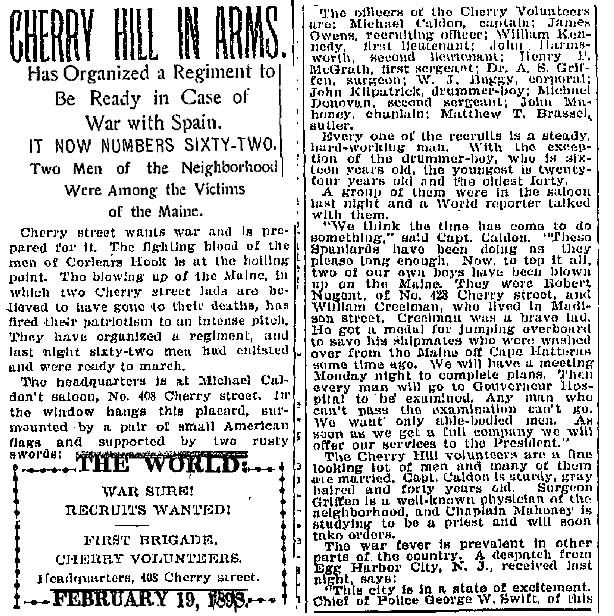
About William Creelman:
William James Creelman (August 3, 1874 – March 24, 1928) was a United States Navy sailor and a recipient of the United States military's highest decoration, the Medal of Honor. He was awarded the medal for jumping overboard during an 1897 winter storm in an unsuccessful attempt to rescue a shipmate from drowning. Creelman went on to become a commissioned officer before leaving the Navy.
Born on August 3, 1874, in Brooklyn, New York, Creelman joined the Navy from that state. By February 1897, he was serving as a landsman on the USS Maine.
On the morning of February 4, Maine set out from Hampton Roads, Virginia, for Charleston, South Carolina, as part of the six-ship "White Squadron". Later that evening a strong storm developed which lasted for several days. Early on February 6, a large wave broke over the deck of the ship and washed away two sailors, Apprentice Leonard C. Kogel and Gunner's Mate Charles Hassel. After a lifebuoy was thrown to Hassel, Creelman jumped overboard into the rough seas and swam towards Kogel, but was unable to reach the apprentice before he sank beneath the waves. He than swam to Hassel and the two men clung to the lifebuoy as they were swept out of sight of Maine. Meanwhile, the ship's sailors put out a lifeboat which was quickly disabled after its steering oar was broken by the heavy waves. As Maine maneuvered to pick up the lifeboat and its crew, two more men were washed overboard and drowned. It was three and a half hours before the seas were calm enough for Maine to locate and take aboard Creelman and Hassel, still holding onto the lifebuoy and near exhaustion.For this action, Creelman was awarded the Medal of Honor.
Creelman's official Medal of Honor citation reads:
Attached to the U.S.S. Maine, February 1897. Distinguishing himself, Creelman showed extraordinary heroism in the line of his profession during an attempt to save life at sea.
Creelman reached the commissioned officer rank of lieutenant before leaving the Navy. He died on March 24, 1928, at age 53 and was buried at Calvary Cemetery in New York City.
Monday, January 11, 2010
Sunday, January 10, 2010
27 Cherry Street: Home To Two Famous Fourth Warders
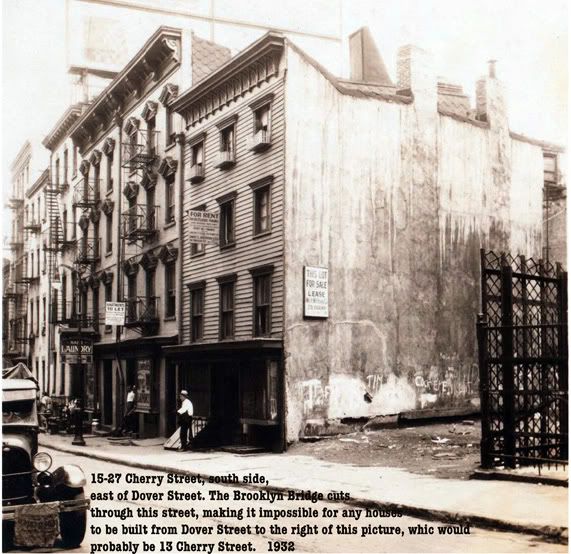
from NYPL Digital Gallery, The New York Public Library
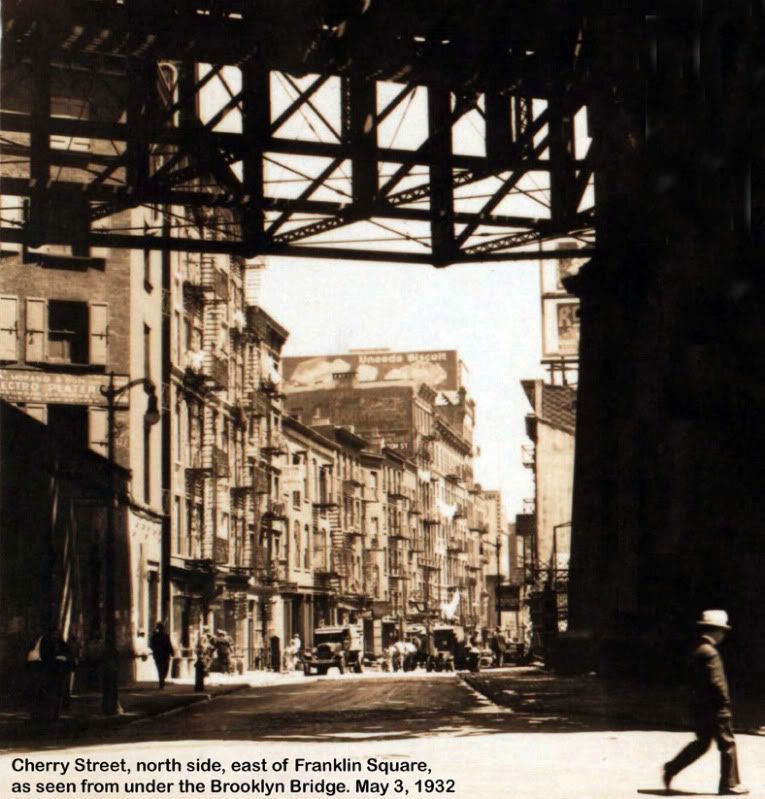
I forgot that not only did Captain Samuel Chester Reid live at 27 Cherry Street, but Cherry Hill Gang leader, Jake "Yakey" Brady, lived there too. The house probably didn't change much from the early 1800's until the ones pictured above
Thursday, July 16, 2009
Depeyster Street On The Map
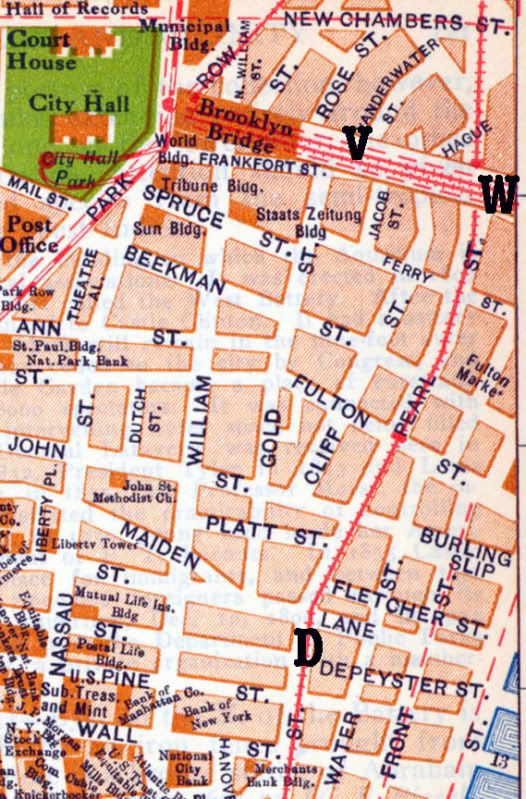
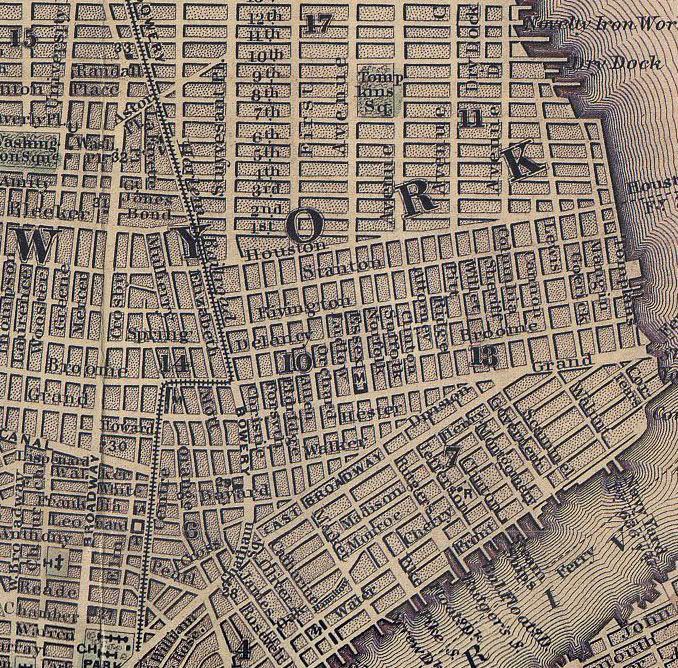
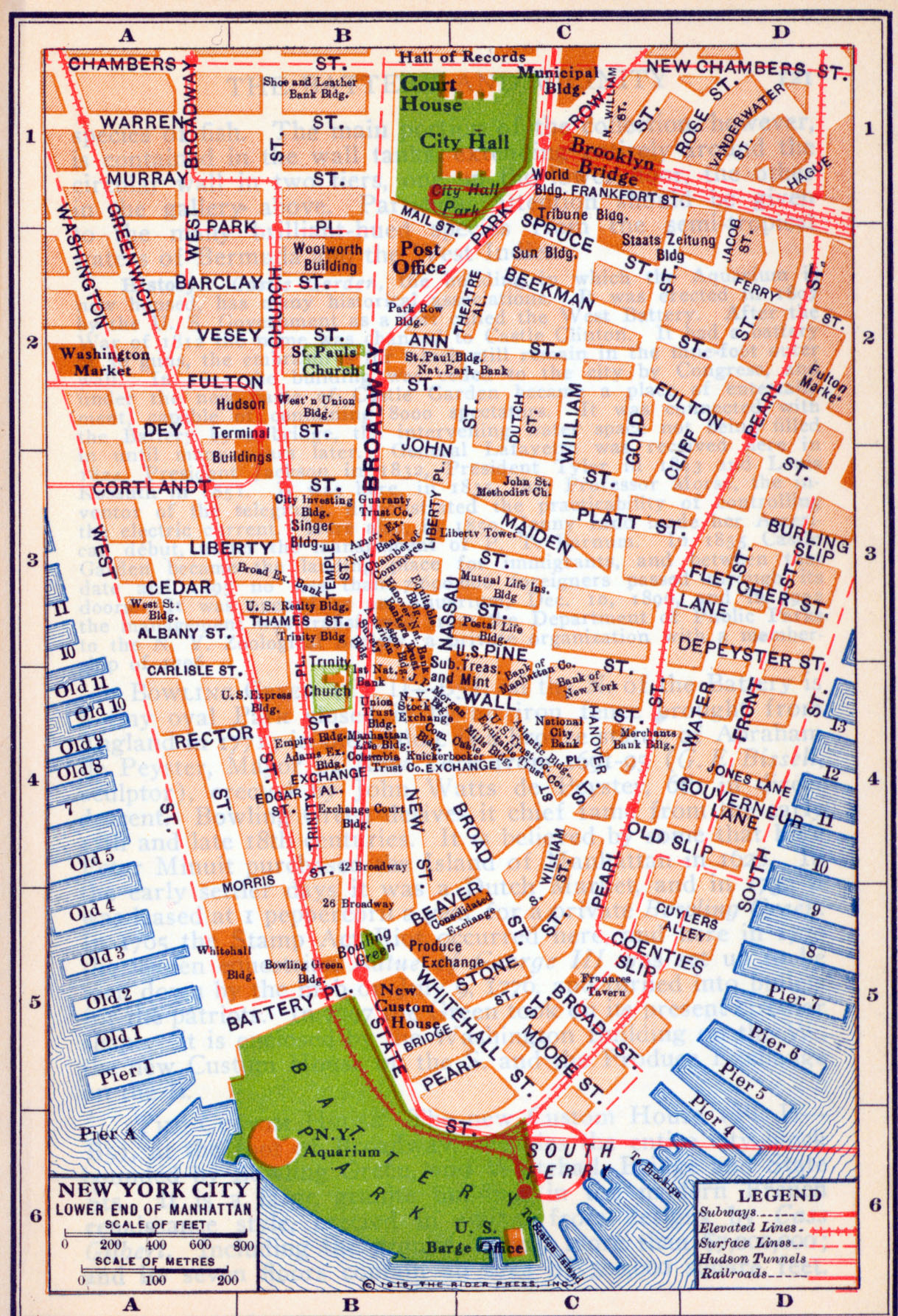
D marks the spot where Depeyster's mansion was. W is where Washington's mansion was and V is the location of Vanderwater Street. From a 1916 map from the University of Texas
Born in New Amsterdam (now known as “Manhattan”), De Peyster came from a prosperous mercantile family. In his youth he spent nine years working on the family farm in the Netherlands, before returning in 1684 to New Amsterdam. He quickly ascended the City’s political ladder, occupying almost all of the important colonial offices, including alderman, mayor, member of the king’s council, and acting governor. De Peyster amassed great wealth, and by the end of his life he is said to have been one of the city’s wealthiest merchants.
Wednesday, July 15, 2009
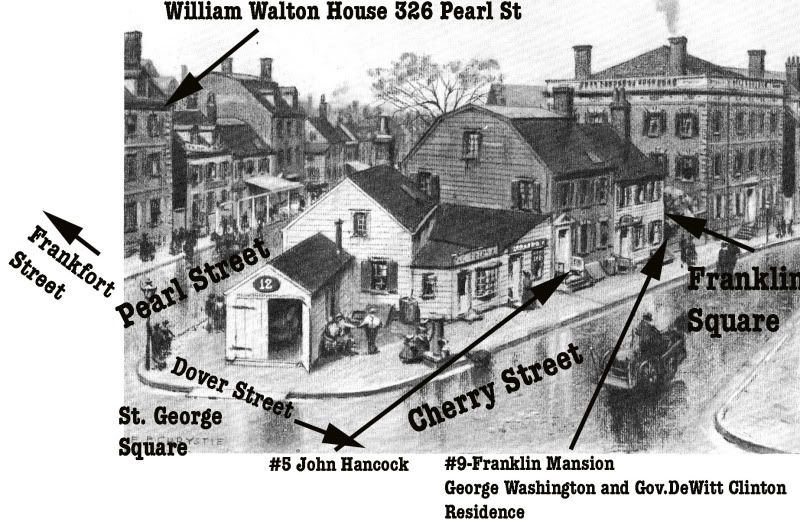
The Depeyster Mansion
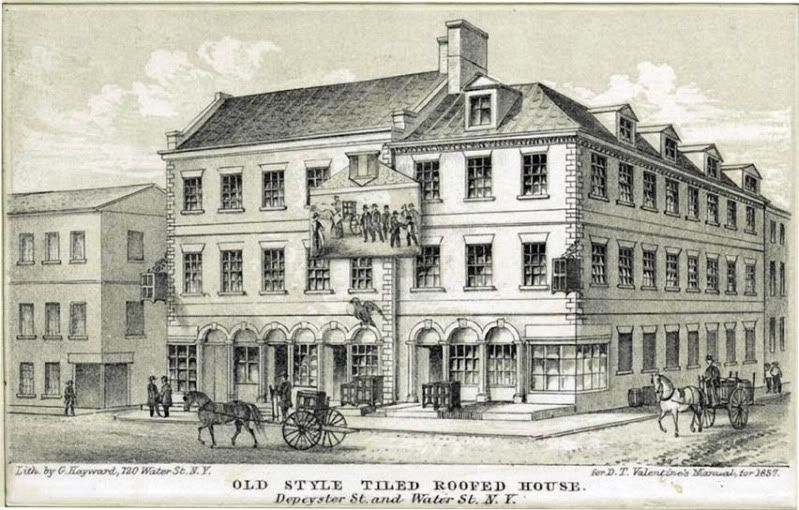
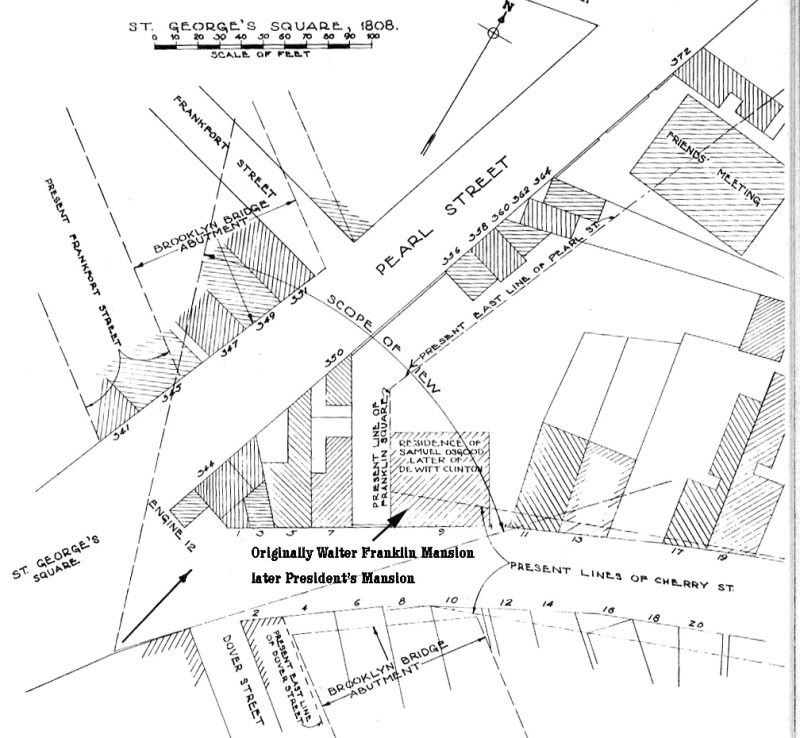
This was not too far away from the Cherry Hill section where Washington's first mansion was. Catherine Depeyster was born into the Rutgers family and I once thought Catherine Street was named after her. It wasn't. It was named after Catherine Desbrosses, daughter of Jacques Desbrosses, a 17th Century Hugueonot immigrant who had a rum distillery near the East River.
Thursday, July 2, 2009
Captain Samuel Chester Reid Of Cherry Street
reid-flag
The full article from June 30, 1918 with added images of his grave in Green-Wood Cemetery
The full article from June 30, 1918 with added images of his grave in Green-Wood Cemetery
Captain Samuel Chester Reid: Designer of Flag, War of 1812 Naval Hero And Cherry Street Resident

below from a June 30, 1918 nytimes article
from electric Scotland
Designer of Flag, War of 1812 Naval Hero
A NATION'S GRATITUDE?
Designer of Our Present Flag in Unmarked Grave for 95 Years
by C. W. Tazewell - 1967
Louisana and the Northwest Territory might now be British if Reid had not engaged them in what has been called one of the world's most decisive naval battles.
Thomas Manning, an amateur historian, knew the story of Captain Samuel Chester Reid, designer of our present flag. Manning had reason to believe that he might be buried at Green-Wood Cemetery, Brooklyn, N. Y. As cemetery supervisor he had ready access to the old, faded records. His search was rewarded with success, and he discovered the unmarked grave where the naval hero of the war of 1812 and Congressional Medal of Honor winner had remained unknown and unrecognized for almost 95
years. Further investigation verified that the Reid buried there was the naval hero. Manning obtained the support of Brooklyn Congressman Francis E. Dorn, local veteran's groups and other organizations to properly mark Reid's last resting place. The greatest difficulty was in locating the surviving descendants to receive permissions for the monument.
The Old Glory Post No. 48 of the American Legion responded by marking the grave with a flag and wreath until the erection of the monument, according to David Terada, now resident of Norfolk. Terada was then Commander of the Brooklyn Post and is now Americanism Chairman of Norfolk's American Legion Post No. 60. On October 28, 1956, the efforts of the Reid Memorial Committee met with fruition. Having been authorized by Act of Congress a granite monument and flag pole were dedicated during colorful ceremonies. Secretary of the Navy Charles S. Thomas gave the principal address and Terada laid a wreath for Kings County veterans organizations. The ceremonies were attended by two of Reid's descendants, Col. Louis Sanders, a great-grandson, and Samuel Chester Reid, 4th, a great-great-grandson.
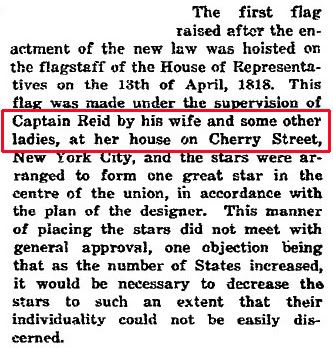
Capt. Reid designed the third version of the Stars and Stripes in 1818 at the request of a Congressional Committee headed by Peter H. Wendover, Representative from New York City. The original flag of the United States of America was created by Resolution of Congress on June 14, 1777, with thirteen stars and stripes. The second Flag Act was passed in 1794 to authorize fifteeen stars and fifteen stripes due to entry of Vermont and Kentucky into the Union. By 1818 there were twenty states and entry of others was expected soon. It was impractical to continue to add stripes as more and more states were admitted. So, Wendover's committee adopted Reid's proposal that the stripes be fixed at thirteen with one star for each state. On acceptance of the design by Congress, Mrs. Reid made the first new flag with silk provided by the government. It was flown from the Capitol dome on April 13, 1818. The twenty stars were formed in "one great luminary" as a large composite star. Notwithstanding the later establishment by President Monore of the arrangement of stars in equal rows, they were non-uniform in
many flags. As late in 1857 stars were seen in the form of large stars, as a lozenge, diamond or circle, and even as an anchor.
Samuel Chester Reid was born in 1783, son of John Reid, a Scottish lieutenant in the Royal Navy. His father was captured in an expedition against New London, Conn., in 1780, and was paroled in the custody of Judge Chester of Norwich. He married the judge's daughter, Rebecca. The son became a powder monkey in the U. S. Navy as a boy and served under Commodore Truxton as a midshipman. In the War of 1812 he was made captain of the privateer, GENERAL ARMSTRONG. His ship was pursued by a British squadron when he left New York in September, 1814. Through his skill he escaped during light winds by pumping water on the sails and by towing by rowers in the ship's boats. On the afternoon of September 26 he entered the harbor at Fayal in the Azores. A squadron of three British ships arrived soon afterwards, with 136 guns and 2,000 men. The GENERAL ARMSTRONG had seven small guns and 90 men. In the evening the British attacked with four smaller boats and were beaten off. Later, at midnight, fourteen boats with cannonades and 600 men attacked the Americans again. The British succeeded in boarding the GENERAL ARMSTRONG after heavy losses from cannon fire. In hand-to-hand combat with the courageous crew the British were repelled with many dead and wounded. Reid dueled and killed the British leader with his cutlass. Reid moved all of his guns to one side of his ship by cutting new gun ports during the night in anticipation of further attacks. With the light of dawn the 18-gun CARNATION came in and received a withering fire from the ARMSTRONG, taking so much punishment that she left the battle. As the larger British ship PLANTAGENET with 74 guns began moving in for the kill, Reid scuttled his ship.
On the next day Captain Reid was invited to tea with the surviving British officers at the British Consulate. Notwithstanding the objections of the American consul, Reid accepted, ignoring the possibility of a trap. He was cheered and welcomed by the British officers as a brave and resourceful foe. General Andrew Jackson later told Capt. Reid that "If there had been no Battle of Fayal, there would have been no Battle of New Orleans." Reid had delayed the British expedition against New Orleans for ten days allowing Jackson to arrive there earlier. Thus, Louisiana and the Northwest Territory might now be British if Reid had not engaged them in what has been called one of the world's most decisive naval battles. Capt. Reid received many honors and was a popular naval hero. The Thanks of Congress and the Medal of Honor were awarded to him along with a gold sword from the State of New York and a silver tea service from the City of New York. The sword is in the Metropolitan Museum and the tea service is in the Museum of the City of New York.
After the War of 1812 Samuel Chester Reid became harbor master for New York City. He made many innovations including a signal code for U. S. vessels and the use of the semaphore system for speedy advice on ship arrivals. He devised a method of rapid signaling by land which permitted messages to go from New York to New Orleans in two hours. Having served his country well in peace and war, Capt. Reid died in 1861 at the age of 78. He is due the gratitude of the Nation, and our recognition on Flag Day as the designer of our present flag. His grave is now a symbol of our patriotism and dedication.
Friday, June 26, 2009
The Fourth Ward In the 19th Century
Fourth Ward 2
From Professor Baldwin's comprehensive site at the University of Connecticut
From Professor Baldwin's comprehensive site at the University of Connecticut
The Fourth Ward: Life and Death in New York, 1860-1870
The tenant-house population of this city would make a city almost as large as Philadelphia, or two larger than Baltimore and Washington, or Boston and Chicago.It has been ascertained by those who have searched out the matter, that over four-fifths of the poverty and crime in the city are due to drunkenness.Were the victims of this vice -- the ruined in fortune and character -- the ill-clad, cold, hungry, sick, crushed wives and children -- the friendless widows and orphans -- the homeless and perishing young girls -- to come down from their garrets, or up from their basements and cellars, and out from their burrowing places where a ray of sunlight never enters -- where pure air is never breathed -- the sad procession would reach from the Battery to Harlem. Whose sympathy would not be moved to its depths at such a sight? yet these unfortunate creatures are here all around us, packed in their miserable abodes in a manner which surpasses belief.There are blocks not over 400 feet square that contain about twice as many people as the whole of Fifth avenue. The Fourth Ward, in which this Mission is located, contains about 50 acres (35 to 40 small blocks), yet its population would make a larger city than Utica, N.Y., or three such cities as Saratoga Springs.One tenant house in it (Gotham Court) often contains over 1,000 of these poor creatures. On one little spot near the Mission, 240 feet by 150, there are 20 tenant-house, 111 families, 5 stables, a soap and candle factory, and a tan-yard. There are less than two dwelling-houses in the ward for each rum-hole.
Gotham Court
An attempt was made in the late 1800's to provide better living conditions in this area of Cherry Hill known as Gotham Court. Formerly it was the site of the notorious Paradise Alley which was the backdrop for part of Kevin Baker's novel of that name
gotham-court-1871-1892
gotham-court-1871-1892
Subscribe to:
Posts (Atom)


 Posts
Posts